• Skip to primary navigation
  • Skip to main content
  • Skip to footer
Ann Arbor Reconstructionist Congregation

Ann Arbor Reconstructionist Congregation

  • Home
  • About
    • Overview
    • Rav Gavrielle Pescador
    • Our History
      • Photo Gallery
    • Our Values and Vision
    • LGBTQ Inclusive
    • Our Board
    • Our Sacred Objects
    • About Reconstructionist Judaism
    • Jewish Ann Arbor
  • Programs
    • Shabbat and Holidays
    • B’nei Mitzvah
    • Tikkun Olam
    • In the (Washtenaw Jewish) News
    • Health and Safety Expectations for In-Person Gatherings
    • Join our Mailing List
  • Religious School
    • About Beit Sefer
    • Teachers
    • Enrollment and Tuition
    • 2025-26 Beit Sefer Calendar
  • Blog
  • Calendar
  • Membership
    • Thinking about joining?
    • Member Area
  • Contact Us
  • Donate
You are here: Home / Blog

Blog

A letter from Anita about the Poor People’s Campaign

June 12, 2018 by Clare Kinberg

Dear AARC,

Yesterday I participated in the fifth week of rallies and actions with the Poor People’s Campaign. An effort initiated long ago by Rev. Martin Luther King, Jr., it has been re-awakened  by Rev. William Barber, who speaks of it as a national call for a moral revival.

In 30 or more states, in their Capitol cities, protests have been held each week since May 14. The next local rally will be next Monday, June 18, this time in Detroit, and then on the 25th there will be a national protest in D.C.  Each week has had a theme and a related action of civil disobedience.

You may not have heard about the Poor People’s Campaign and their acts of civil disobedience. Here is a good article about the Poor People’s Campaign, that also answers some of the questions folks are asking about the civil disobedience portion of the campaign and why people were asked to used social media to publicize and promote the demands and goals.

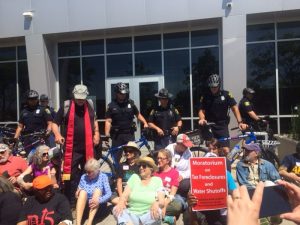
This week’s theme was fair wages and affordable housing. We were joined  in Lansing by a large group from Detroit, D15, fighting for a $15 minimum wage. The civil disobedience took place at the Michigan State Department of Housing Development, where a group called Moratorium Now had a scheduled meeting to try to reverse the decision to use millions of dollars to demolish homes in Detroit and elsewhere instead of helping people in foreclosure.

We were a diverse group racially and age wise. There was a strong clergy presence, and Rabbis Alana Alpert and Ariana Silverman were among them.

Jewish Text Study

EVERYBODY’S GOT A RIGHT TO LIVE: JOBS, INCOME,
THE RIGHT TO ORGANIZE AND HOUSING
by Rabbi Michael Rothbaum

I was trained for the civil disobedience action and volunteered to be one of those to be arrested. There is personal and legal support teams for those who volunteer for an action. The movement is well organized and spirits are kept lifted through chant and song. I am writing this to encourage anyone with the inclination and availability to participate next Monday. The Michigan chapter has a web page and a Facebook page.

The Poor People’s Campaign is worth your attention if you feel called to speak for justice in any of these areas: universal healthcare, LGBT rights, gender equality, fair wages, affordable housing, public education, free higher education, an end to racism etc.

Shalom,

Anita Rubin-Meiller

Filed Under: Posts by Members, Tikkun Olam

Belonging in America

June 4, 2018 by Clare Kinberg

By Etta Heisler

I was delighted to dive back into Jewish education at this year’s Shavuot celebration. For five years I worked at the Jewish Women’s Archive writing curricula and supporting Jewish educators as they incorporated contemporary Jewish texts and women’s voices into their work. Upon returning to my roots here in Ann Arbor (and quite literally as a program director at a nature center), I had no idea how much I was missing getting to dissect, share, and explore Jewish texts in this setting.

A quick note: this Shavuot, it was particularly meaningful for me to do some teaching as I continue to mourn the recent death of my Savta, my grandmother Dr. Diane Averbach King. My Savta was a passionate educator and respected scholar, in addition to being a doting and committed grandparent. While much of her work focused on Hebrew and Israel education, she is one of the few people I could always call to talk through ideas, struggles, or interesting new sources. I greatly appreciate the AARC community for inviting me to participate in this way–I cannot say enough how meaningful it was to connect with her memory at this time.

In my session, we explored our own experiences belonging–or not–in Jewish community before diving into four non-traditional “Jewish texts” that depict Jewish life in America: a photograph, a page from a newsletter, an excerpt of letter from a daughter to her parents, and a screen shot of a social media post. I have included the text study packet via Google Drive–feel free to use it or share it, just make sure you give credit where credit is due!

Thinking about the current political state of our country, and of the Jewish community both in the US and globally, there were several ideas that rose to the front of my mind as I looked through sources on jwa.org for this session:

  1. What is the relationship between personal identity and community identity?
  2. What makes, or who defines, a community?
  3. How does one know if one is “in” or “out” of a given community? In other words, how does one know if one belongs in a community or not?
  4. What is the relationship between inclusion (saying who is in) and exclusion (saying who is out) in creating community?

As we looked at each source, we started first with observation (I do, after all, work in science education, so we followed the scientific method). I like to use some standard questions adapted from the method of Visual Thinking Strategies: “What is going on in this source? What do we see/read that makes us say that? What information is missing or confusing?” After we explored, looked for evidence, and hypothesized, I provided some additional historical context and we asked “What more can we see or understand? What more do we want to know?”

In the end, our conversation barely got started before time was up (perhaps next year, we’ll have an all-night session?!). However, our wide-ranging discussion did leave me with a few observations that I think we might be able to use to draw some generalities around the idea of “Belonging,” our theme for the night:

  1. There are many forces that create belonging, some are experienced internally in individuals, and some are experienced externally in groups.
  2. One does not have to feel that one belongs in order for others to see them as part of a community.
  3. Search for belonging can sometimes lead to cohesion and sometimes to separation, or even bigotry.

I encourage you to take one, some, or all of these sources and explore them on your own, with friends at a Shabbat dinner or lunch, or a chevruta learning partner either face-to-face or virtually. What questions do these sources raise for you? What lessons can they teach us, or what insight can they provide about our contemporary communities? How do they help us understand our own sense of belonging–or exclusion?

Thank you again for this tremendous opportunity. Looking forward to learning more!


Filed Under: Event writeups Tagged With: community learning, Shavuot

On the ground learning

June 1, 2018 by Clare Kinberg

Jewish/Arab education and organizing in Israel and Palestine

An evening of stories in support of the bilingual storybook and curriculum Sweet Tea with Mint

Thursday, June 14, 7-9pm
Temple Beth Emeth, lower level
2309 Packard, Ann Arbor
Click here to view and save a flyer for the event
Sweet Tea with Mint

Several members of our community have made trips to Israel/Palestine recently, specifically visiting organizations of Israeli and Palestinian educators and activists who, amidst a present of terrible conflict,  are working toward a viable future for the region’s peoples. On June 14th, they will be telling stories from their trips at an event organized to raise money for a bilingual educational project.

Sweet Tea With Mint and Other Stories is the heart of a new educational curriculum that was developed by Hagar: Jewish-Arab Education for Equality in Beer Sheva. The anthology is composed of six stories focusing on Jewish, Muslim, and Christian holidays, written by distinguished children’s writers in Hebrew and Arabic. Hagar is dedicated to creating a shared space for Jewish and Arab residents of the Negev – a space based on the foundations of multiculturalism, bilingualism and equality.

The storytellers at the event include AARC members Rebecca Kanner, Alice Mishkan and Debbie Zivan. Clare Kinberg, AARC Communications Coordinator will MC.

Rebecca traveled to Israel/Palestine in May 2017, her first visit in over 30 years.  She was part of the Center for Jewish Nonviolence (CJNV) delegation of over 100 Jewish activists from around the world.  CJNV was in a coalition with 5 Palestinian, Israeli and diaspora groups that created the Sumud Freedom Camp in the West Bank village of Sarura, in South Hebron.

Alice just returned from her third year leading a study abroad to Israel and Palestine through the University of Michigan. This year, Michigan students partnered with Palestinian students at Sakhnin Teacher’s College. Students learned about the differences in educations systems for Palestinians with Israeli citizenship and Jewish Israelis. Students compared these to education systems in the United States, and learned about how education can be a tool for social change.

Debbie is just back from a family trip to Israel/Palestine for her nephew’s wedding. In addition to visiting with family (half of whom live on settlements), Debbie and family toured Hebron, the Jerusalem Hand in Hand school and stayed overnight in Neve Shalom/Wahat al Salaam. The combination of celebrating with family, seeing examples of how Arab and Jewish Israelis are prioritizing pathways to peace and a dual narrative tour that stressed the wrongs of the “other side” made for an interesting trip – a trip that created a sense of urgency to find ways to make a difference.

Hagar’s director of Director of Partnerships and Resource Development, Karen Abu Adra, will also be present to tell us more about the school and its importance to the Negev region. Karen is originally from Lancaster, Pennsylvania but has been married to a Bedouin dentist from Segev Shalom, Israel and living in Israel since 1993. They have three adult sons.  Karen taught English for 13 years in a Bedouin high school in the Bedouin city of Rahat and has been working for Hagar for a year and half.

There is a very nice connection between Hagar and the Reconstructionist movement. Hagar’s Executive Director, Sam Shube, writes:

My name is Sam Shube and I’m CEO of the Hagar Association. I served as director of Kehillat Mevakshei Derech in Jerusalem, Israel’s first Reconstructionist congregation.  Rabbi Mordechai Kaplan, z”l, was a member of Mevakshei when he lived in Israel.  The motive force for its establishment was Rabbi Jack Cohen, z”l, one of Kaplan’s leading students in Israel, a man I knew and loved.  Other Reconstructionist leaders of Mevakshei have included Jewish educator Norman Schainin.  Though I am not an ordained rabbi, my Master’s Thesis was on Kaplan and John Dewey, and I’ve always adhered to Kaplan’s views on Jewish civilization and democracy.  (I’m still a member of Mevakshei, where I occasionally read Torah and give a sermon).

I’ve lived in Israel for over 30 years (I did my undergraduate work at JTS and Columbia) and served in a variety of nonprofits. Of everything I’ve seen in this country, however, Hagar — the bilingual school in Beer Sheba — is the most familiar reflection of Kaplan’s idea of community.  Hagar’s Arab and Jewish families are intensively active on a day-to-day level, organizing field trips and fundraisers, and providing mutual assistance.   Last night at our Iftar celebration (the traditional Ramadan break-fast), Jewish and Arab families helped their children prepare gifts for hospitalized Gazan children – at the very time when Israel and the Hamas were trading rockets and artillery just a few miles to the west.   And I myself used to platform to raise funds from parents for scholarships to help needy families cover tuition fees.   Other recent community events have included discussions on the Moslem and Jewish connection with Jerusalem, and a visit to a Beer Sheba mosque.

Hagar’s community is remarkably diverse.  It includes Arabs from urban centers in northern Israel and Bedouins’ from the Negev, Jews from underserved neighborhoods in town and professors from the university.  Our community welcomes LGBT families, something not to be taken for granted in the more traditional environment of both Jewish and Arab communities in southern Israel.   In fact, the very existence of an Arab Jewish school in Beer Sheba – as opposed to more culturally liberal parts of Israel – is a miracle in and of itself.

Filed Under: Community Learning, Upcoming Activities Tagged With: Israel/Palestine

Jewish Views on Reparations

May 25, 2018 by Clare Kinberg 1 Comment

by Clare Kinberg

May 19th, Erev Shavuot, was an evening of study, cheesecake and blintzes for AARC. There were four study sessions; I hope to do a blog post on each one:

  • Jonas Higbee: “Building a Community Response to Fascism: Lessons from Richard Spencer’s Visit to MSU”
  • Clare Kinberg: “Shavuot4BlackLives: Jewish Views on Reparations”
  • Etta King Heisler: “Belonging in America:  What is Belonging and How Does it Broaden, Limit, Deepen, or Otherwise Define Our Community?”
  • Rabbi Ora Nitkin-Kaner:  “A Long and ‘Twisted’ Relationship: Us, God, and…Challah?”

First up, my session on “Jewish Views on Reparations.” My impetus for the session was “Shilumim,” the shavuot4blacklives study guide put together by Graie Barasch-Hagans, Koach Baruch Frasier and Mackenzie Zev Reynolds and distributed by Jews for Racial and Economic Justice (JFREJ).

Shilumim is the Hebrew word meaning ‘reparations;’ ‘Leshalem’ is ‘to pay’ from the same root as ‘shalem,’ to make whole. The concept of the study guide is to extend the theme of Shavuot, which Jews begin to count down to on the second night of Passover, the beginning of our liberation, and which traditionally ends with the revelation at Mt Sinai, the receiving of the Torah seven weeks later. Graie, KB and Mackenzie suggest we extend this trajectory another several weeks to end on Juneteenth (June 19) with a focus on what is needed to fulfill liberation. That is, reparations.

Shavuot4blacklives introduces the study by reminding us when the Vision For Black Lives Platform was released in 2016, many members of the Jewish community had strong reactions to the way that Israel was characterized in the document, particularly the use of the word “genocide” in connection to the Palestinian people. At the same time, “Jews of Color in our community called on all of us to remain committed to the Movement For Black Lives, to racial justice, and by extension, to Black Jews no matter what.” They offer this study guide on the reparations sections of the Platform as one way to do that.

The Israelites despoiling the Egyptians. Image from f. 13 of the ‘Golden Haggadah.” 1325–1349

Our discussion was framed using Aryeh Bernstein’s essay, “The Torah Case for Reparations,” in which he draws on many places in Torah to conclude “Jews must support reparations in principle, because we took reparations for our slave labor, we were commanded by God to do so, and we were promised these reparations in the earliest Divine plan for our liberation.” The Bernstein article, a long, worthwhile read (with lots of excellent links) is a specifically Jewish follow-up to Ta-Nehisi Coates 2014 Atlantic essay, “The Case for Reparations.”

As Bernstein’s essay based itself on Torah, Rabbi Sharon Brous’ LA Times Opinion piece, “Why Jews Should Support Reparations for Slavery,” is based on a rabbinic dispute in the Mishna:

Gittin 55a:12

§ The mishna teaches that Rabbi Yoḥanan ben Gudgeda further testified about a stolen beam that was already built into a building and said that the injured party receives the value of the beam but not the beam itself. With regard to this, the Sages taught in a baraita (Tosefta, Bava Kamma 10:5): If one robbed another of a beam and built it into a building, Beit Shammai say: He must destroy the entire building and return the beam to its owners. And Beit Hillel say: The injured party receives only the value of the beam but not the beam itself, due to an ordinance instituted for the sake of the penitent. In order to encourage repentance, the Sages were lenient and required the robber to return only the value of the beam. The mishna was taught in accordance with the opinion of Beit Hillel

I included in our discussion packet two pieces on Affirmative Action that have relevance to our current moment, a moment in which political concord among representatives of Black and Jewish communities is needed, yet is unfortunately characterized by significant discord.

One recent example of the discord: When Starbucks announced that they were closing for an afternoon (Tuesday, May 29) to do a company-wide training on racial bias, they initially included the Anti-Defamation League (ADL) as a consultant on the training. The inclusion of the ADL was immediately met with push-back from some Black activists, which, in turn, was met by dismay from many Jews who think of the ADL as an outstanding leader of anti-bias education. Contemporary Black activists cite the ADL’s frequent coordination with law enforcement and the ADL’s support for U.S. police being trained on crowd-control and counter-terrorism in Israel.

I brought into our Shavuot  discussion my own perspective which relates back to the 1970s when, to my dismay, the ADL argued against Affirmative Action programs, then among the chief policy proposals advocated by African American organizations. The ADL had determined that Affirmative Action was not good for the Jews. Our Ann Arbor community should be interested in the history revealed in this 2003 article “Jews temper views on affirmative action”:

“In the Supreme Court’s landmark 1978 decision against affirmative action in Regents of the University of California v. Bakke, Jewish groups lined up in vocal opposition to affirmative programs. In that decision, the court banned quotas but allowed racial criteria to be used in admissions decisions. This time around [2003], their positions are more muted, as well as more diverse. Only the Anti-Defamation League, one of the then-staunchest leaders of the national fight against affirmative action, has filed a brief opposing Michigan’s program.”

I included the 2017 article “Affirmative Action as Reparations” to make the link between the current arguments for reparations and the original thinking behind Affirmative Action.

Menachem Begin protesting against the Reparations from Germany Agreement in March 1952. The sign reads: “Our honor shall not be sold for money. Our blood shall not be atoned by goods. We shall wipe out the disgrace!”

Finally, I included the Yad Vashem Shoah Research Center document on “Reparations and Restitutions,” which, to the surprise of most of us at the table, begins by saying, ‘From 1953-1965, West Germany paid the State of Israel, Jewish survivors, and German refugees hundreds of millions of dollars in a symbolic attempt to make up for the crimes committed by the Nazis during the Holocaust.” The early growth if Israel’s economy was made possible by this money, yet it caused deep division among Jews.

There is a lot of information in this blog, and I hope much food for thought. The comments are open below for any who want to continue this discussion here.


Filed Under: Community Learning, Event writeups Tagged With: Human rights, Reparations, Shavuot

AARC Shavuot 2018: Belonging, Behaving, Believing

May 16, 2018 by Clare Kinberg

“In 1934 Rabbi Mordecai Kaplan, the founder of Reconstructionist Judaism, wrote his classic text Judaism As Civilization. Kaplan taught that there are three ways of identifying with a religious community: by believing, by behaving, and by belonging…And it’s true that no matter what Jews believe, and no matter how Jews behave, there is an underlying, fundamental and intrinsic interconnection that ties us together in a common history and present reality.”

–Rabbi Joe Klein

Celebrate Shavuot with a Night of Learning

Saturday May 19, 7-10 pm at the JCC

Choose from 4 study sessions taught by AARC community members

Eat cheesecake and other dairy sweets

Bring a box of grain to donate to Food Gatherers

Close the evening with Havdallah

7:00 PM:  Gather

7:15-8:15:  Jonas Higbee: “Building a Community Response to Fascism: Lessons from Richard Spencer’s Visit to MSU” (‘Behaving’)

7:15-8:15:  Clare Kinberg: “Shavuot4BlackLives: Jewish Views on Reparations” (‘Behaving’)

8:15-8:30:  Cheesecake Break

8:30-9:30:  Etta King Heisler: “Belonging in America:  What is Belonging and How Does it Broaden, Limit, Deepen, or Otherwise Define Our Community?” (‘Belonging’)

8:30-9:30:  Rabbi Ora Nitkin-Kaner:  “A Long and ‘Twisted’ Relationship: Us, God, and…Challah?” (‘Believing’)

9:30-10:00:  Havdallah

Filed Under: Community Learning Tagged With: Challah, community learning, Shavuot, Tikkun Olam

Misheberakh for the State and People of Israel: Rabbi Ascherman visits Ann Arbor

May 10, 2018 by Clare Kinberg

 By Martha Kransdorf

In the first week of May, Israeli-American human rights activist Rabbi Arik Ascherman returned to Ann Arbor on a speaking and fundraising tour. My co-pilot, Harvey Somers, and I were the anchor people for his visit here. We’d like to first of all thank AARC for their support and to thank all of the co-sponsors for the May 2 JCC Fundraising Dinner and Community Forum: Beth Israel’s Social Action Committee, Jewish Cultural Society, Pardes Hannah, & Temple Beth Emeth. In addition to Rabbi Ora, rabbis from each of the other congregations were present, and took part in the evening’s program.

Rabbi Ascherman was the head of Rabbis for Human Rights for 21 years, and last fall he founded a new organization, Torat Tzedek, Torah of Justice. At the Community Forum, he described some of the current issues that he is working on, and the list is long and quite moving. His work ranges from meeting with lawyers and interviewing people who have been threatened by settlers, to lobbying at the Knesset on behalf of poor Israelis, to helping Arab shepherds hold onto their flocks when settlers frighten them and scare them away. Torat Tzedek has also been involved helping African refugees fight the Israeli government’s efforts to deport them and helping Bedouin communities hold on to their way of life.

Rabbi Ascherman’s courage and commitment have not wavered. He won’t throw in the towel. He admits that he is somewhat less optimistic than he has been in the past, but his response is to roll up his sleeves and work harder. He urges us, similarly, to react with urgency by becoming more active.

In addition to speaking at the JCC, Rabbi Ascherman spoke at Shir Tikvah in Troy, and he led text studies at Lunch & Learn programs at TBE and at Kehillat Israel in Lansing. His visit wrapped up with an “Open House” at BIC. A busy week, by any account. We are grateful to our communities in Michigan, which contributed over $4000 to Torat Tzedek. If anyone would like more information on Rabbi Ascherman’s work or on Torat Tzedek, please feel free to get in touch with either of us.

Martha Kransdorf ,  mkransdo@umich.edu    734-663-7933

Harvey Somers,  harveysomers@gmail.com   734-780-6907

Rabbi Ascherman blogs regularly in The Times of Israel. On April 19 2018 he included this “Misheberakh — A Loving Prayer of Healing for the State and People of Israel”

The Hebrew is followed by a transliteration, and then a translation.

מי שברך קדמונינו אברהם ושרה, יצחק ורבקה, יעקב לאה ורחל, הוא יברך וירפא את החולים, מדינת ישראל ועם ישראל. הקדוש ברוך הוא ימלא רחמים עלינו להחלימנו ולרפואתנו מכל מחלה המקשה עלינו להגשים את הטוב ואת השאיפות לצדק שבליבנו – ביניהן: העיוורון לנוכחותך בכל אדם והעיוורון למציאות; החירשות לקול הדממה הדקה בתוך רעש הפחד וההפחדה, קולות הענות והמלחמה במחנה; והפקודות; האטימות לסבל של האחר/ת;  הרשימו שנשאר מכל מה שסבלנו אנו, השיכרון מכוח ומשלטון; השנאה לחושב/ת אחרת מאתנו; והאהבה היתרה לארץ ישראל ולמדינת ישראל ולעם ישראל ולכל דבר קדוש המסנוור אותנו לקדושתך ולרצונך. אנא, החזק בנו את היצר הטוב והחיות את אמונתנו בעולם מתוקן במלכותך וביכולתנו לקרבו.  שלח לנו במהרה רפואה שלמה, רפואת הנפש ורפואת הגוף, בתוך שאר החולים/ות, השתא בעגלא ובזמן קרים, ונאמר אמן.

Mi sh’beirakh kadmoneinu Avraham v’Sarah, Yitzhak v’Rivkah, Ya’akov, Leah v’Rakhek, hu yivarekh v’yirapeih et ha’kholim, Medinat Yisrael v’Am Yisrael. HaKadosh Borukh Hu yimaleh rakhamim aleinu  l’hakhlamatanu v’l’rfuatanu mi’kol makhalah ha’makshah aleinu l’hagshim et ha’tov v’et ha’sheifah la’tzedek sh’b’libeinu-beiniehen: ha’ivaraon l’nokhakhutkha b’kholadam v’ha’ivaron l’mitziut; ha’khershut l’kol ha’demamah ha’dakah b’tokh ra’ash ha’pakhad v’ha’hafkhadah, kolot ha’onot v’kolot ha’milkhamah b’makhaneh v’hapekudot;   ha’atimut l’sevel shelha’akher/et; ha’rashimu sh’nishar mi’kol mah sh’avalnu anu; ha’shikaron mi’koakh u’mi’shilton; ha’sinah l’khoshev’et akheret m’itanu; v’ha’ahavah ha’yiterah l’Eretz Yisrael v’l’Medinat Yisrael, v’l’Am Yisrael, v’lkhol d’var kadosh ha’misanveir otanu l’kedushatkhah v’l’ratzonkhah. Anah, he’khezeik banu  et ha’yetzer ha’tov v’ha’khayot et emunateinu b’olam mitukan b’malkhutkha u’v’yekholteinu l’karvo.  Shlakh lanu b’meheirah refuah shleimah, refuat ha’nefesh v’refuat ha’guf, b’tokh sh’ar he’kholim, hashta b’agalah’ u’v’zman Kariv, v’nomar amein.

May the One who blessed our ancestors Abraham and Sarah, Isaac and Rebecca, Jacob, Leah and Rachel, bless and heal the ill:  the State and People of Israel.  May the Holy One of Blessing be full of mercy and us to heal us from every illness that keeps us from fulfilling the good and the aspiration for justice that is within us – Among them: Blindness to Your Presence in every human being and blindness to reality; deafness to the Still Small Voice within the thundering fear and fearmongering, the sounds of war and singing in the camp,  and orders; hatred of those who think differently than us, disproportional love for the Land of Israel, the State of Israel, the People of Israel and every holy thing that blinds us to Your Holiness and Your Will.  Please strengthen within us our good inclination and revive our faith in the possibility of a repaired world under Your Sovereignty and our ability to bring that world closer to reality. Send us complete and speedy healing of body and soul, along with all who are ill, speedily and in our day.  And let us say, Amen.


Filed Under: Event writeups, Poems and Blessings, Posts by Members Tagged With: Human rights, Tikkun Olam

Our Measure of Grain

May 9, 2018 by Clare Kinberg

“Memorial Tablet and Omer Calendar” by Baruch Zvi Ring, 1904. Paper cut, pencil, ink and paint. Owned by the Jewish Museum in NYC. Baruch Zvi Ring (Ringiansky) came to Rochester from Vishya, Lithuania, in 1902. Please visit this artwork on the Jewish Museum website to learn more about the incredible intricacies in this work.

Our Beit Sefer, led by our Yeledim class (Bass, Ben, Ellie, Isaac, Joey, Miles, Molly, and their teacher, Shlomit) is collecting boxes of grains (pasta, cereal, rice, etc) to make a collective donation to Food Gatherers. We started collecting right after Passover and we will continue through Shavuot. By collecting donations for the Food Gatherers, the Yeledim are learning to connect the Jewish holiday cycle with a need in our community.

We are commanded by the Torah to bring, on the second day of Passover, a measure—an omer—of the first cutting of our barley harvest to the Holy Temple in Jerusalem as an offering to G‑d, and not to partake of that year’s grain crop until that offering is made. We then count 49 days, and on the 50th day, which is Shavuot, we bring the first of our wheat harvest as an offering to G‑d, and we do not use of the year’s wheat crop for Temple offerings until this is done. Hence, the 49-day count leading from Passover to Shavuot is called “the Counting of the Omer”—a reference to the omer of barley that was brought on the first day of the count.
(from “Grain, Growth and Goodness” by R. Shlomo Yaffe)

The Yeledim have set a goal of collecting as least 49 boxes of grain, one for each day of the Omer. And you can help! We will be collecting this Saturday, May 12th at the JCC during Second Saturday Shabbat morning services, and also at our congregational observance of Shavuot on Saturday May 19th.

Filed Under: Beit Sefer (Religious School), Food Tagged With: Shavuot

Nice things

April 26, 2018 by Clare Kinberg

There has been a lot of overwhelmingly bad news lately. But nice things happen all the time, too. This blog post is to connect us to a few of the nice things that happen in our congregants’ lives.

Brayan 3rd from left, Max on the right. Congrats!
Building Award
Two AARC members, Max Resnick and Brayan Zivan competed in the SkillsUSA Michigan State Leadership Conference. Max Resnick came home with the State Championship.


Award and Book

Sara Ahbel-Rappe recently received a Diversity Service Award at UM, an award which recognizes faculty who contribute to equality and diversity at the university. And her book, Socratic Ignorance and Platonic Knowledge in the Dialogues of Plato, was recently published in the SUNY Press series in Western Esoteric Traditions.

Dinner with old friends

The Carol and Matt Ullmann family had dinner with some old family friends they haven’t seen in a while. It was wonderful to spend time together.


Endorsement

At the Michigan Democratic Party’s Endorsement Convention, held on April 15 at Cobo Hall, a historic turnout of 6,700 delegates voted to endorse Samuel Bagenstos for the Michigan Supreme Court.  The turnout was fueled by a surge of over 3,000 new members of the Democratic Party.


Quoted in the Press

Andy Kirschner talks musicals in FMT News article, “Musical resurgence has Hollywood changing its tune.”

New Company
Jeff Basch started his new company, Trove Analytics. They are commercializing a technology developed at U-M that uses algorithms to analyze an existing electrocardiogram (EKG) signal to predict a patients trajectory. The algorithm informs nurses and doctors so they can prioritize patients that are most at risk of death and take action to save their lives 7 to 30 hours before the visible onset of the deterioration.


Filed Under: Simchas

Levi Kopald Bar Mitzvah drash: Sh’mini

April 26, 2018 by Clare Kinberg

Shabbat shalom. My parsha, or Torah portion, is Sh’mini, which is in the book of Leviticus. Most of Sh’mini is about dietary laws which is what you can and cannot eat in Jewish law. Some things you cannot eat are animals that do not have true hooves or do not chew their cud. Also, you may not eat birds of prey, and most insects and shellfish.

But what I think is the most interesting part of my parsha is the story of Nadav and Avihu. Two sons of Aaron, Nadav and Avihu, put fire and incense in a fire-pan, and then offered to God some sort of unholy, bad, or alien fire. And then for some reason God killed them; fire shot out and they died! Then Moses said to Aaron: “This is what God meant when God said: ‘This is how I will make myself holy – through those near to me I will show myself to be holy.’” And Aaron remained silent.

I had a lot of questions about what happened to Nadav and Avihu. Why did Nadav and Avihu make this offering in the first place? What made the fire they offered unholy? When God said “This is how I will make myself holy” – how did God killing Nadav and Avihu make God holier?

Many commentators have had similar questions about what happened. One explanation for what happened to Nadav and Avihu is that they were being punished because they were drunk.

Rashi, born in Northern France in 1040 and one of the most widely read commentators of the Torah, quotes an ancient rabbi named Rabbi Ishmael, who said: “[They died because] they had entered the sanctuary after having drunk wine. The proof is that after their death, God told Aaron and his remaining sons that they may not enter the sanctuary after having drunk wine. . . .”

Rashi offers another possible reason for why Nadav and Avihu were put to death: they were  punished because they were being disrespectful. In fact, Rashi mentions two ways that Nadav and Avihu could have been disrespectful. Rashi quotes another ancient rabbi, Rabbi Eliezer, who said: “Aaron’s sons died only because they rendered halachic decisions in the presence of Moses, their teacher.” In other words, Nadav and Avihu decided for themselves what the law meant.  They were being disrespectful to Moses, and therefore they were punished by God.

A second possibility comes from a midrash that says the Israelites were journeying through the desert with Moses and Aaron at the front, and all of Israel came after them. As they traveled along, Nadav said to Avihu, ‘Shortly, these two old men will die and we will lead the congregation.’ The way that they refer to Moses and Aaron, as old men – it could be realistic, saying that they’re going to die soon because it’s true, but it’s also very  disrespectful, and they clearly wanted power for themselves. On a deeper level, Nadav and Avihu were doubting Moses and Aaron’s abilities to teach them anymore, or to lead the nation.

So far, I’ve looked at the deaths of Nadav and Avihu as a punishment from God, either because they were drunk or because they were being disrespectful. But another, very different interpretation of what happened is that Nadav and Avihu just wanted to be close to God. What do I mean by this? Back in the book of Exodus, there’s a story of Moses, Aaron, Nadav, and Avihu going part of the way up Mt. Sinai to prostrate themselves before God. Quoting from Exodus Chapter 24, it says: “Moses and Aaron, Nadav and Avihu, and the seventy elders arose. They saw the God Of Israel and beneath God’s feet, a brickwork of sapphire … They viewed the Lord, they ate and drank.”

What’s happening here?  Nadav and Avihu went up Mount Sinai, and saw God! What was this experience like for them? It was probably incredible – and pretty unimaginable. So maybe they had such a transcendent experience that they wanted to repeat it, and that’s why they ran to bring God a fire-offering, not thinking about or even caring about what might happen to them. Or, maybe they just made a mistake based on this past experience. Maybe they assumed that because they’d gone partway up Mount Sinai in the past, with Moses, to see God, they would also be able to offer sacrifices however they wanted in the future – because they were so dear to God.

Up until now, we’ve looked at Nadav and Avihu’s actions and motivations. But what about God’s?

If we look back at Leviticus chapter 10, verse 3, it says: “Then Moses said to Aaron, “This is what God spoke, [when God said], ‘I will be sanctified through those near to Me, and before all the people I will be glorified.’”

Some commentators have suggested that this verse is related to what happened to Nadav and Avihu. What could this mean, that in killing Nadav and Avihu, God was glorified? Perhaps God wanted the people of Israel to see God again, because God had already been seen at Mount Sinai. So God demonstrated God’s glory to the Israelites by consuming Nadav and Avihu.  In other words, God wanted an audience. And I can relate to this – for example, I want people I’m close to to see me at my basketball games or baseball games–it’s understandable to want to be seen, especially when you’re good at something.

In this interpretation, God acts without caring about Nadav and Avihu. But there’s also another possible interpretation: that  God actually helped Nadav and Avihu by killing them.  In this interpretation, their death is not a punishment, but actually a reward from God–a way of being one with God, which they desperately wanted. It’s even possible that the strange fire they offered was such a wonderful, spontaneous offering that God instinctively drew them in and consumed them.

This interpretation is supported by a passage from  Torat Kohanim, which says that when Nadav and Avihu died, “Two thread-like [sparks] of fire entered their nostrils thereby destroying their souls along with all their internal organs, but leaving their external body structures intact.” It’s possible that this is proof that their being consumed by fire was a favor or blessing from God because their souls simply joined God and their bodies were left unharmed.

So. What kind of God is this? How does this relate to our lives?

The first time you hear this story, you might think Aaron’s sons died for no reason. Yet after many weeks of study and comparing the commentators’ interpretations, I think this story teaches us that there’s more than one way to be close to God. Everyone doesn’t have to have the same practices. However, the repercussions of trying to get close to God can be very dangerous.

Another possible moral of this story is that it’s hard to get close to God. It takes a lot of work, and we don’t necessarily know how to do it. There’s a lot of mystery there–not knowing what will happen. But above all, it’s important to be respectful–not just respectful to God, but also respectful to those around you, because they are extensions of God.

We don’t actually know what God is like, or what will happen when we try to get close to what is holy. This is all a mystery. However, what we’re left with is something that’s less mysterious, but almost as challenging: We know that what we can do to be close to God is to be respectful of other people.

With this in mind, Rabbi Ora asked me to come up with a new set of Ten Commandments on how to be respectful, and I’m going to teach them to you now: 

  1. Don’t say hateful things – don’t swear, don’t say hurtful things, don’t be mean, don’t insult people.
  2. Don’t talk bad about people behind their backs. In Hebrew, the phrase for this is lashon hara.
  3. Give compliments to people – truthful ones, in order to make them feel good. In order to do this, first you have to think about the person and think about their positive qualities. Like my sister Ahava – she helps with my math homework, and then I thanked her for it.
  4. Say thank you to people. Showing manners is important by thanking people, and showing gratitude and appreciation for people.
  5. Show respect to parents, teachers, principals, rabbis, adults in position of authority – to people who can teach you things. Listen to instruction. Don’t argue with someone in authority.
  6. Greet people – show people that you care that they’re there. I could do that here at services – saying hello to a new kid, a new family.
  7. Listen – honor when someone else is speaking and don’t interrupt.
  8. Always keep promises that you make.
  9. Be respectful of places – of other people’s property, and don’t litter.Take care of nature, don’t pollute.
  10. Show that you care about people through your actions – let them know you’re thinking about their feelings.

In conclusion, I have learned many things throughout this process like the many ways to respect other people and God. But I have also learned what is disrespectful. Most of the things I have learned from reading my torah portion is from Nadav and Avihu. What do you think about Nadav and Avihu? Do you think it is just as simple as God killed them because they were drunk or do you think there is some higher meaning involved such as that God did Nadav and Avihu a favor?  What do you think?

Finally, I would like to thank my mom and dad for helping me in the entire process with making sure I practiced, taking me to different appointments, my dad helping me write this speech and  my mom planning the party and helping me study my Torah portion. Also, I would like to thank my Zede Newman for helping me embrace Jewish culture and become my Jewish self. I would also like to thank my Bubbe for teaching me about Judaism and about life in general. I would also like to thank my sisters Ahava and Clara for helping me study my Torah portion and helping me throughout this entire process. I would also like to thank Scott for helping make sure I practiced and also taking me to appointments. I would also like to thank Kathy for making my invitations and decorating the baseballs for my party. I would also like to thank Deb Kraus for helping me learn my Torah portion my haftorah and how this whole service is run. I would like to thank Rabbi Ora for helping me write this speech and teaching me about my torah portion and more about Judaism. Last but not least I would like to thank this whole congregation for supporting me throughout this entire process. Shabbat shalom.

Filed Under: Divrei Torah Tagged With: Bar mitzvah

Next Year, Together

April 12, 2018 by Clare Kinberg

At Mimouna this year, we had a serious discussion after Shulchan Orekh/Dinner feast that began with Rabbi Ora making a connection to the afikoman and asking us questions about our relationships with our neighbors:

The word afikoman can be broken up into two Aramaic words, אפיקו מן, meaning “bring out sustenance.” According to the mystical text Sefer HaSichot, eating the afikoman draws down God’s infinite bounty into the framework of our material world.

In light of our many blessings, and the blessings of being in relationship, let’s answer these questions together:

  1. What relationships do we (individually and collectively) already have with local Muslim communities?
  2. In the coming year, what new relationships might be established?
  3. What could AARC’s Mimouna celebration look like next year?

We talked about ways we individually and as a Jewish congregation could grow our relationships with other vulnerable and targeted communities. As a beginning, here are some upcoming activities that were mentioned:


This Sunday, April 15, 3-7pm, Open House at the Islamic Center of Ann Arbor, sponsored by the Muslim Association of Ann Arbor.


Friday and Saturday April 20 and 21st, Temple Beth Emeth Social Action Committee is hosting Jan Harboe, author of Train to Crystal City, a book about the secret American internment camp and incarceration of U.S. citizens of German and Japanese descent during WWII.


Wednesday, April 25, the film And Then They Came for Us about the Japanese interment during WWII, at UM-Rackham Amphitheatre, 915 E. Washington St., Ann Arbor.

Sign up to be a member of the Ann Arbor Jewish Sanctuary Ann Arbor Jewish Sanctuary and Immigration Committee by going to this website, We Were Strangers, MI. 


Here is a really good article from the Detroit Jewish News, “Detainee Defenders,”  about the work to defend several hundred Iraqi who have been detained with deportation orders.

Filed Under: Community Learning, Tikkun Olam, Upcoming Activities Tagged With: immigrants, interfaith, Mimouna, refugees

  • « Go to Previous Page
  • Page 1
  • Interim pages omitted …
  • Page 44
  • Page 45
  • Page 46
  • Page 47
  • Page 48
  • Interim pages omitted …
  • Page 75
  • Go to Next Page »

Footer

Affiliated with

Copyright © 2026 Ann Arbor Reconstructionist Congregation