

by Rabbi Ora Nitkin-Kaner
It’s hard for me to resist an easy pun, so when I decided to teach a Shavuot session on challah and how this seemingly innocuous bread is rooted in a fraught relationship between the Jewish people and God, I couldn’t help myself; I named the session, “A Long and ‘Twisted’ Relationship: Us, God, and Challah.”
We began our tikkun leil session by each sharing a memory of challah from our childhoods. We then asked and attempted to answer the question: Why do we eat challah on Shabbat?
Looking through Numbers 15 (click here to access the entire source sheet/study guide), we learned that the mitzvah of challah comes from a commandment in the Torah to set aside a loaf of bread for God “as a gift.” And why 2 gift-loaves, and not just one? Because as the Israelites wandered in the desert, God “rained down bread” for them from the sky – aka manna – and on Fridays, two portions of manna fell, so that the Israelites would not have to gather food on Shabbat.
As we read through the manna story, it became clear that manna was 1. Given by God quite begrudgingly, and 2. That the Israelites mistrusted that God would continuously and consistently provide them with food. The episode of the manna quickly became a test of Israelite faith; the Israelites were ordered by Moses to gather only as much manna as they could eat each day; any manna stored for the following day would rot and become infested with maggots.
The rabbis of the Mishnaic and Talmudic eras had a field day with this enmeshed relationship as the Israelites sought safety and comfort in sustenance and God used food to teach them a lesson. The rabbis considered a variety of lenses through which to understand the relationship:
Rabbi Tarfon imagined God gently extending a hand each morning to deliver the manna like dew, and he imagined that at the same time, God collected Israelite prayers and returned with them to heaven.
Rabbi Shimon wondered why the manna didn’t simply descend once a year, and suggested alternately that 1. God wanted closeness with the Israelites, and thought that their reliance on daily deliveries of manna would reinforce the bond; 2. God wanted to reassure the hungry Israelites that they would consistently be provided for; or 3. God didn’t want to burden the Israelites by making them carry a year’s worth of manna as they trekked through the desert.
So: what are your earliest memories of biting into this sweet and complicated bread? How does challah keep you anchored to God, your ancestors, or tradition?
 Shabbat shalom! My Torah portion is Shelach. At the beginning of Shelach, all the Israelites are in the desert near Canaan when God tells Moses to send twelve spies, one from each of the twelve tribes, to go check out Canaan. Moses sends the spies to the hill country so that they can come back and tell the people what kind of land it is, and he also tells them to bring back ripe grapes to show what kinds of fruits grow in Canaan.


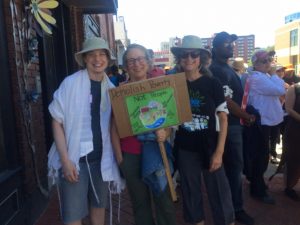 Dear AARC,
 I was trained for the civil disobedience action and volunteered to be one of those to be arrested. There is personal and legal support teams for those who volunteer for an action. The movement is well organized and spirits are kept lifted through chant and song. I am writing this to encourage anyone with the inclination and availability to participate
  I was delighted to dive back into Jewish education at this year’s


 By Martha Kransdorf

