Forest Dawn, by Idelle Hammond-Sass. Photo by Patrick Young
AARC has a new ner tamid/Eternal Light to grace our aron hakodesh, the ark that holds our Torah. Two years ago, during Yom Kippur 2016, AARC then board chair Margo Schlanger gave a talk to the congregation about our need for a ner tamid to join our other community-made sacred objects: ark, Torah table, tapestries, yad, and Torah cover. Thanks to the artistry of congregant Idelle Hammond-Sass, we were able to welcome the new ner tamid during the High Holidays.
“In considering creating a ner tamid, or Eternal Light, I wanted to visualize how to use light as an emanation, coming from an unseen source,” Idelle wrote in her artist’s statement. “Before the sun rises, the light begins to glow and illuminate the world.”
Idelle in her studio.
Like the AARC logo, most of our sacred objects include images of trees and leaves. Idelle continues, “My ideas began with leaves and branches, but as the work progressed, these became backlit bare trees flanked by fold formed panels of copper etched with branch stencils. The light offers hope, the promise of a new day and the world being born anew, and of rekindling our connection to divine presence.”
To create our ner tamid, Idelle had to take into account some technical peculiarities. As Margo wrote two years ago, “Our ark travels; it lives in our closet at the JCC, and comes out for our Torah services. So how could we have a ner tamid?” In addition, our new ner tamid has to work with our particular ark, made by Alan Haber, of cherry wood, in the dimensions given in the Torah. So the ner tamid Idelle created is very portable (with a beautiful storage case made by her husband Dale) and uses a battery powered LED light that can be on for several hours, but switched off for storage. Its dimensions and arched shape fit perfectly atop our ark.
We are very grateful to the AARC members who have helped fund this project: Margo Schlanger and Sam Bagenstos, and the Bramson and Gombert families, who contributed in celebration of their sons’ upcoming bar mitzvahs. Support for this project also comes from the Nancy Denenberg Fund, a memorial fund established in Nancy’s memory, which honors her creativity, and love of beauty.
In honor of our congregation’s new ner tamid and Rosh Hashanah being the symbolic “birthday of the world” during which we often teach the Torah’s creation story to the young people, Beit Sefer director Clare Kinberg wrote a story for the Children’s Service that connects the ner tamid with the primordial light.
Detail of Forest Dawn, photo by Patrick Young.
by Clare Kinberg
In the beginning of the beginning, there was nothing at all, there wasn’t even nothing, there was nothing before nothing. There was tohu vavohu, unformed emptiness. Except in the emptiness, there was one thing: there was the power of creation, there was the potential of creation. In this story, that is called God.
And according to the story, the very first thing that the power of creation said was “let there be light, yehi Or. And there was light, vayehi or. This was a very special light, because it was before the sun was created, and certainly before fire or electricity or batteries. It was the first light. And with the first light, everything could be seen, from one end of the universe to the other. Everything was light.
On the second day, God divided the light and separated the waters of heaven and the waters below heaven.
On the third day of creation, the waters on earth scrunched up together, and dry land appeared on earth. And the first light sparked the growth of grass, flowers and trees and fruits and vegetables. And here’s the amazing thing: In each blade of grass a little bit of the first light was hidden.
On the fourth day, the power of creation gathered the first light together and formed the sun and moon and stars, lights that could be seen and used. They are of the first light, but they are only part of the first light.
On the fifth day of creation, God created fish and birds and hid a little bit of first light in each one. And the fish and birds filled the oceans and the sky with sparks of first light.
On the sixth day of creation, God used all of the remaining first light to create millions of animals, dogs and cats and cows and deer and antelopes and monkeys and humans. Each is filled with first light, hidden within our bodies.
On the 7th day, on Shabbat, the power of creation took a rest and noticed how beautiful everything was, how each animal, plant and stone and river and ocean was its own self, yet if you looked closely you could see that bit of first light shining through.
Now all of the first light is still in us and around us, and it is called the Hidden Light, or ha ganuz.
The hidden, first light was God’s first creation, everything is made from it, and when we remember this story, we remember that we are all part of one another. This is a good thing, so there are many lights in Jewish tradition to remind us of the first light. One of these is the ner tamid, the lamp of the eternal light that we keep above the aron hakodesh, the ark where the Torah is kept. Our congregation just last night received a new ner tamid, made by an artist member of our congregation Idelle Hammond-Sass. For her, the first light in the forest reminds her of the first light of creation, and so she made a ner tamid called Forest Dawn Shachar b’yair. Look for it next time you attend an AARC Torah service.
Today makes 1660 days without access to tap drinkable water. What’s even scarier is there are places all around the country with water worse then Flint and they have no idea yet. — Mari Copeny (@LittleMissFlint) September 11, 2018
By Mark Schneyer
In her Rosh Hashanah sermon this year, Rabbi Ora urged us to “Choose Life,” and focused our attention on issues that prevent people from having access to clean water. I thought it would be useful to list some of the people and organizations mentioned in her sermon, as well as a few related ones::
Finally, Mona Hanna-Attisha, the pediatrician who stood up to advocate for the kids of Flint at a time when the state of Michigan claimed there was no problem with Flint’s water, has written a new book, What the Eyes Don’t See, telling the story of her fight and some of her own history as well. She spoke tonight in Ann Arbor, and said the title of the book refers both to the invisibility of lead in water as well as “problems we choose not to see.”
She described her inner dialogue when she was deciding to go public with the truth she was learning. “How can our water not be fine?” she said she asked herself. The government had experts testing and overseeing and enforcing the law, the water must be clean. But the evidence told her otherwise and she launched her fight.
Our family is excited to join AARC! We are a family of four: myself (Adrianne Neff), my wife Carla Grayson, and our children Noah Grayson Neff, age 18, and Sylvie Grayson Neff, age 11. We have lived in Dexter for the past 8 years and before that were Ann Arborites for many years. Carla and I celebrated our 20th wedding anniversary this summer. We were married at TBE by Rabbi Levy in 1998, and he re-married us legally when it became possible in 2015.
We live in rural Dexter Township and have a property where we keep chickens and turkeys and enjoy gardening and watching the wildlife in our woods and small pond. I am a Physician Assistant working in urgent care. I enjoy cooking, home improvement projects, boating, and working with our pets and farm animals. Carla is a lecturer in the Psychology Department at University of Michigan. She enjoys watercolors and coloring, yoga, and gardening.
Our son Noah graduated from Dexter High School in June. He will be with us for Rosh Hashanah at AARC, and then will be moving to Flagstaff, Arizona, where he will be joining the Conservation Corps and working on environmental restoration projects in national parks, forests, and our other public lands. Our daughter Sylvie is entering 6th grade in the Dexter schools. She spent 3 weeks at Camp Tavor this summer and met some other kids from AARC there. Sylvie plays lacrosse and field hockey, enjoys video games, photography, and playing with her pet cat and dog, and just started her own business selling eggs from our free-range chickens at the Webster Farmer’s Market.
Carla and I were married at TBE, Noah celebrated his Bar Mitzvah there, and the congregation was a happy home for us for many years. However, in recent years we allowed our involvement to lapse as life events moved us to become less involved with TBE and our Judaism in general. We are currently renewing our commitment to Jewish practice and community, and after much reflection, we realized that our desires, needs and values most closely align with the Reconstructionist movement, and we made the decision to join AARC. We are looking forward to being members of a smaller congregation.
Although we are new members, we already have deep ties to AARC including many dear friends and acquaintances who are members. We spent the High Holidays at AARC last year, and we loved the services and Rabbi Ora. We are eager to meet new people, make new friends, and join in the community and spiritual life of AARC.
This year, the Hebrew month of Elul begins September 1 — a nice coinciding of the secular and Jewish calendars. I think of Elul as a kind of pumping-the-brakes on the freewheeling expansiveness of summer; even though it’s usually still warm outside, Elul is a whispered reminder: Fall is coming. Slow down. Get a little quieter. And begin turning inwards.
Why? Because there is work to be done.
It’s tradition to dedicate the 29 days of Elul to reflection, study, and preparation for the coming Days of Awe. Elul challenges us to use each day to re-connect with our values and attune to the yearning of our souls.
Conceptually, the idea is noble, but acting on it is a bit more challenging. Here are a few resources to help you get started:
Is your favorite part of the High Holy Days the music? Here are 2 new niggunim we’ll be using this year – you can get a head start on learning them by clicking the links below:
AARC Yom Kippur practice is to have afternoon sessions of learning, discussion, meditation, and song between the morning service which ends about 2pm and our community Yizkor service, which begins at 4:45pm. The hour long sessions are at 2:30 to 3:30pm and 3:30 to 4:30pm.
Meditation Workshop led by Anita Rubin-Meiller
2:30-3:30pm
Yom Kippur is the ideal time to grow in our connection with ourselves. This time of guided meditation will focus on fostering gratitude and self-compassion. I will draw on Jewish resources for both. If you’d like to, bring a journal to write reflections in after each meditation. There will also be time for sharing.
Sing, Chant, Walk led by Deb Kraus
2:30-3:30pm
For the past two years on Yom Kippur afternoon, I have found myself outside with other members, singing and chanting our way through the afternoon between services. It’s been deeply meaningful to us, and a great way to pass the time. You are welcome to join us for all or part of this time. I’ll provide some song sheets but we will also have machzors nearby to aid us in our efforts. We’ll meet outside if we can and inside if we can’t.
Yoga led by Allison Stupka
A restorative session of yoga led by Allison Stupka.
My name is Bec Richman, and I am so excited to come to Ann Arbor Reconstructionist Congregation for the High Holidays as your Song Leader. I am currently living in Philadelphia, PA with my beloved partner, Josh (who is also excited to join AARC for the High Holidays).
We are both graduate students – I’m studying to become a rabbi at the Reconstructionist Rabbinical College, and Josh is getting a PhD in Urban Planning at the University of Pennsylvania. I am heading into my final year of school with an immense amount of gratitude to my teachers and my program for affording me the flexibility to pursue folklore, calligraphy, sofrut (ancient scribal arts), and mashgichut (kashrut supervision) as part of my studies. In tandem with my academic program, I have worked as a rabbinic intern for college students, as a hospital chaplain, and as congregational student rabbi. This year, I am honored to be the recipient of a grant that will allow me to build a beit midrash (house of learning) in Philadelphia.
When I’m not in school, I am often training for a triathlon, throwing pots in the ceramic studio, practicing writing Jewish sacred text on parchment, or reading quietly at a cafe. Thank G!d, my life is full and vibrant.
I am honored and excited to come to AARC for the High Holidays. This season in the Jewish calendar calls on us as individuals and as a community to tune into our relationships, behavior, and intentions. I appreciate the annual reminder of our fragility and encouragement to think with care about how to live, and I love the way the High Holiday nusach (musical theme) reflects this holy work. I have so enjoyed working with your incredible rabbi, Rabbi Ora, to plan High Holiday services, and I can’t wait to come sing with you.
Phyllis and I are approaching our 25th wedding anniversary next year. She’s a retired professor of education, having researched, taught and practiced educational psychology, student engagement and project-based learning at the UM School of Education for almost 40 years. I’m a “nominally retired” adjunct professor at the UM School of Public Health, having researched, taught and practiced public health policy, genetics policy and community engagement for 37 years. Phyllis grew up in Brooklyn (Brighton Beach), studied at Brown (then Pembroke) and received her Ph.D. at UCLA. I grew up in Detroit, attended Harvard College and Harvard Law School, and spent the next 10 years working in our Detroit-centered family business. After the business was sold I transitioned into academe when a series of voluntary positions in Detroit’s and Michigan’s health systems led to my being invited to join the UM Public Health faculty. Now that I’m reducing my university work-load, I’ve been increasingly active coordinating the Michigan advocacy activities for J Street.
My daughter Ana, from my first marriage, went to the University of California Santa Barbara and “never returned.” She’s now a public interest environmental lawyer defending the California coastal environment from the constant threats of developers. She and her husband, Tim, have given me two awesome grandchildren, Toby “the Younger” and Kaia (pictured here with Ana). Phyllis and I escape the Michigan winters by moving to Santa Barbara for several months each year.
Joining AARC marks for me the fruition of a spiritual path that included the birth of Temple Israel in the 1940s, the creation of Congregation T’Chiyah (now the Reconstructionist Congregation of Detroit) with Carl Levin and our friends in 1977, and a period of membership at Temple Beth Emeth. I’ve had a growing interest in AARC, where I have several valued friends and associates. Visiting a recent service and meeting Rabbi Ora made it clear that AARC would become a cherished spiritual home for us.
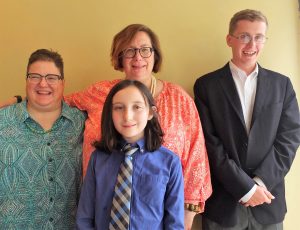
We are very excited to be new members of AARC! We are a family of four and more, living in two households and with multiple faiths, but united in our journey through life together. We are: Noah, Jennifer, Ella (age 14) and Miles (age 11). Noah is a law professor at Wayne State University and University of Michigan, Jennifer works at Zingerman’s Delicatessen, Ella is a freshman at Skyline High School, and Miles is a 6th grader at Forsythe Middle School.
Our path to AARC is the result of Miles wanting to explore his Jewish heritage. Noah grew up culturally Jewish in New York and Connecticut, made his bar mitzvah in a Reform temple, but other than that experience, didn’t really spend too much time in a temple at any point in his life. Jennifer grew up Catholic, attended church every Sunday with her family and graduated from a Catholic high school, but then as a young adult, decided church and religion wasn’t an important part of her life.
When our kids were young, we sought out a faith community to be part of and joined the First Congregational Church of Ann Arbor, where Jennifer is still an involved member. This congregation is very welcoming, inclusive of all people, whatever their story and is very much focused on serving the needs of our community. When our son Miles started asking about his Jewish background and a desire to make his bar mitzvah, we were very pleased to find AARC because it welcomed our family as we are and spoke to all our values of community, inclusivity, and service.
Miles joined the Beit Sefer last year and is looking forward to starting again this fall. We’ve joined the congregation for a few events, have appreciated how welcomed we’ve already been, and look forward to getting to know everyone more in the future.
Even the days of Selichot before Rosh HaShanah are not days of judgment – just the opposite, they are days of mercy and desire, the last set of forty days when Moshe Rabbeinu was on the mountain and the Holy One showed him favour. It is only on Rosh HaShanah that the judgment begins… Moreover, the Ten Days of Repentance are not called “days of judgment”. Just the opposite, they are days of mercy, during which Hashem avails Godself to every individual. Only Rosh HaShanah and Yom Kippur are “days of judgment”… Nodah B’Yehuda I Orach Chaim 32:3
The Jewish calendar gives us many opportunities to get ready for the new year. Reciting Psalm 27, a declaration of faith, each day of Elul is one practice. Another practice is reciting special prayers on the Saturday evening before Rosh Hashana, known as Selichot.
If Rosh Hashana feels like it’s fast approaching and you’d like to slow down and begin turning towards the new year, come to AARC’s second annual Selichot Service on Saturday September 1; we’ll celebrate Havdallah together and then learn some new tunes to carry us into the High Holiday season.
Selichot Service Saturday, September 1
8pm
each bring a candle (we’ll have extras if you forget)
Touchstone Common House
(yellow building at the front right behind the Touchstone sign)
We are so glad to be new members of AARC! We are a family of four: Myself (Gillian), my husband Alex, our 5-year-old Wesley, and our 3-year-old Wade.
We recently relocated to Chelsea from Asheville, NC. We wanted to be closer to family and soon after setting that intention, Alex found his dream job doing sustainable architecture in Ann Arbor. Before living in NC, Alex and I both did undergrad at U of M and Alex got his Masters of Architecture at U of Oregon. Before becoming a stay at home mom, I worked as a medical assistant.
As a family we enjoy gardening, canoeing, hiking, spending time with friends/family, cooking and general adventuring. Wes is starting kindergarten this year and Wade is starting preschool. Wes will also start his second year of Beit Sefer this fall.
I was delighted to find AARC last year during the high holidays. I was raised Reform but hadn’t found a synagogue I resonated with personally until now. I appreciate how the Reconstructionist tradition upholds our culture and traditions with a more humanist and naturalist tilt. I spent a lot of time in Hebrew school as a kid and it was an important part of my identity. I’m glad to be back in the fold and to share it with my own family. I’ve enjoyed everyone I’ve gotten to know over the year and look forward to years to come!