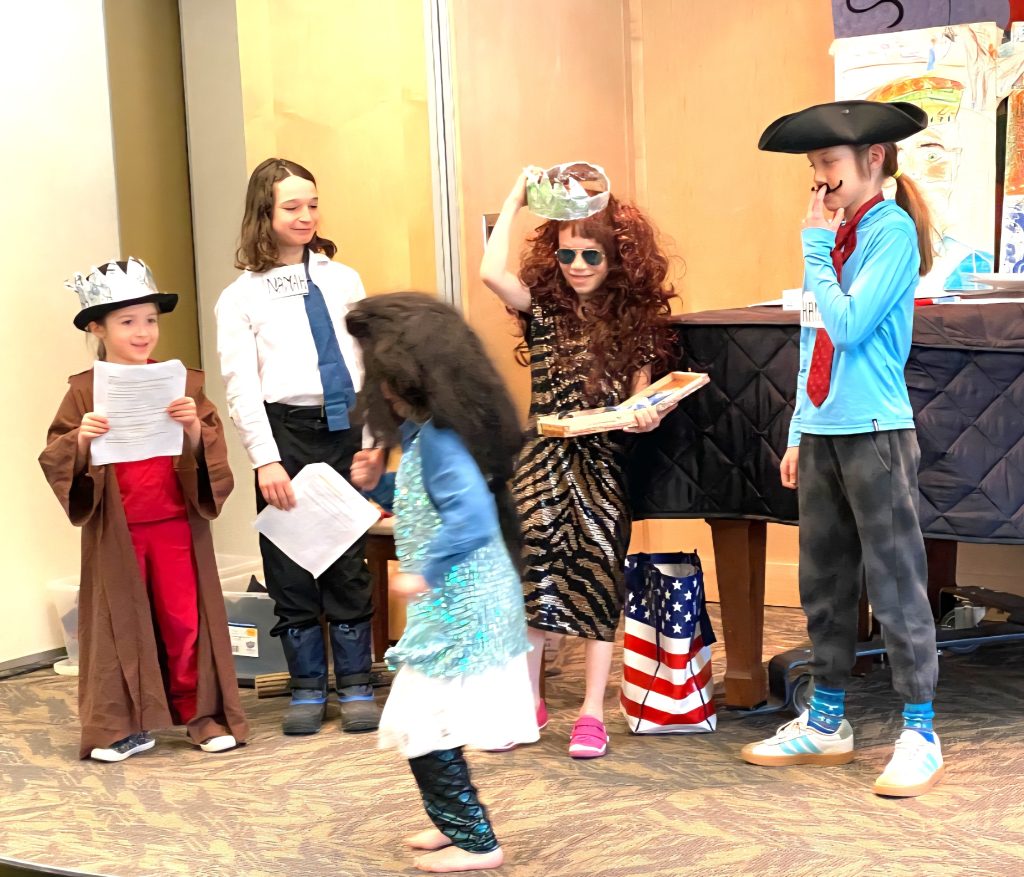
Thanks to all the organizers of the AARC’s recent Purim celebrations and to everyone who participated.
Now is a chance to savor a few photos.


Thanks to all the organizers of the AARC’s recent Purim celebrations and to everyone who participated.
Now is a chance to savor a few photos.


by Shlomit Cohen, AARC Beit Sefer Director
Judaism acknowledges the importance of our feelings: the Oy’s and the Ah! moments in our daily life, for example, by giving space and yearly practice to grief, in the month of Av, and to happiness and joy in the month of Adar.
About the month of Adar – the month of Purim – the rabbis- (חז״ל) wrote:
״משנכנס אדר מרבין בשמחה״
When Adar enters, we increase in joy.
But Jewish writings have also asked the question regarding Adar: how can we order someone to be happy, and to rejoice? Especially in difficult times?
The answer might be, specifically in challenging times like these, that we need to remind ourselves to rejoice and to be happy, as the Purim holiday teaches us:


Our Purim costumes teach us the importance of being uplifted from the sorrow and pain of life, not by withdrawing from it, but with a sense of humor. And we have a whole month to practice it yearly!
And we cannot forget the importance of Jewish humor – our shared way of dealing with reality with a laughing eye. By practicing rituals and observing the holidays, we acknowledge and turn the difficult times in our shared history into a great gathering culminating in a festive meal.
Purim specifically and the month of Adar are great reminders for us to be happy! To have faith in God’s willing, good connections and a brilliant scheme, as Mordechai and Queen Esther teach us. That’s how bad luck can turn into good fortune. “Pur” – luck – can be changed.
This year the AARC had bad luck or the misfortune of not reserving a space for our Purim celebration in advance. So instead of canceling the holiday all together, we decided to celebrate it twice, even three times!
The month of Adar is a truly happy, joyfully time of year! Happy Purim!

Above: the AARC celebrating Purim in 2024

Above: the AARC celebrating Purim in 2016
This article was written by Rav Gavrielle Pescador for the Feburary 2026 Washtenaw Jewish news.

At a time when many Jews feel fractured—by politics, by ideology, or by communal boundaries—Tu B’Shevat offers a powerful counter-narrative. Known as the “New Year of the Trees,” this holiday invites us to slow down, notice what is growing, and remember our shared roots. More than a seasonal marker, Tu B’Shevat centers values that are urgently needed right now: interdependence, renewal, gratitude, and care for the earth and for one another.
This year in Ann Arbor, Tu B’Shevat is being celebrated not by any one congregation alone, but through collaboration across the local Jewish community. On Sunday, February 1, 2026, community members of all ages will gather at the JCC from 10am to noon for a daytime Tu B’Shevat celebration that brings together multiple organizations and perspectives. There will be a variety of arts/craft/planting activities in the JCC Newman Lounge. Shlomit Cohen, the director of the Ann Arbor Reconstructionist Congregation (AARC) Beit Sefer (religious school), is part of the community-wide programming for Tu Bishvat. “One of the activities that we are excited to offer is bringing the different colors from nature and making colorful fun tie-dye with the children,” comments Shlomit.
Later that evening of February 1, at 7:00pm, a different kind of collaboration will unfold. Clergy and members from the Ann Arbor Reconstructionist and Jewish Renewal communities will come together to lead a joint Tu B’Shevat seder. Drawing on traditional ritual structures while inviting creativity, song, and reflection.
What makes this collaboration especially meaningful is Jewish Renewal and Reconstructing Judaism have a lot of affinity. Both are deeply engaged with tradition, yet embrace the opportunity to reinterpret it in light of modern life. Both emphasize ethical responsibility, spiritual depth, inclusivity, and a Judaism that speaks to the heart as well as the mind.
At the same time, their differences add texture to the collaboration. Jewish Renewal often foregrounds embodied spirituality, music, mysticism, and ecstatic prayer while Reconstructing Judaism emphasizes historical consciousness, democratic process, and thoughtful engagement with evolving Jewish civilization. When these approaches meet, and they often do, the result is not dilution, but enrichment providing multiple doorways into shared Jewish life.
Rabbi Elliot Ginsburg of Pardes Hannah, Ann Arbor’s Jewish Renewal chevre, notes “the Seder for Tu Bishvat invites us to experience an expansive understanding of the divine life-force while helping us appreciate the deep ecology of our own lives. The Seder Tu Bishvat historically draws on kabbalistic understandings of divinity as a Tree of Life with its roots in the Infinite. In this model, earthly life may be seen as leaves and fruit on the tree, energetically connected to the Source. From an ecological perspective,Tu B’Shevat, with its imagery of roots and branches, soil and fruit, reminds us that healthy ecosystems depend on diversity. So do healthy communities. When Jews gather across lines of denomination and ideology, we model a Judaism that is resilient, relational, and alive.“
In a season when public discourse so often pushes us toward division, these Tu B’Shevat gatherings invite something else: to come together, to plant seeds of connection, and to celebrate what can grow when we choose collaboration over separation. |
Rabbi Aura Ahuvia, who has strong roots in Ann Arbor’s Reconstructionist and Jewish Renewal communities, states: “I’ve felt a rising need for community with every passing month. The news, social media…it all feels oppressive and manipulative. I’ve been seeking the salve of simple connection, to be reminded that when we come together, in-person, as ourselves, we’re capable of enjoying each other’s company and even solving our problems together. Celebrating life as it reawakens within and between us feels like exactly the right thing to do right now.”

By Rabbi Gabrielle Pescador
This article appeared in the January 2026 Washtenaw Jewish News. See page 7 here: https://washtenawjewishnews.org/wp-content/uploads/2025/12/Jan-2026.pdf
This year, the Ann Arbor Reconstructionist Congregation (AARC) is delighted to have four students at the B’nei Mitzvah stage of their Jewish journey, and to have the opportunity to form a cohort — a model that allows our students to learn together, support one another, and build community as they prepare for this special milestone in their lives.

The cohort began their journey this past spring with Hebrew Boot Camp led by veteran religious school educator, Aviva Panush. In the 2025–26 fall/spring semesters, the students are continuing their studies with me, strengthening their Hebrew decoding skills, deepening their understanding of the Shabbat morning service, creating their own B’nei Mitzvah projects, and exploring what it truly means to embrace Jewish life and values on their own terms.
A major focus of the year will be learning both the structure and the thematic elements of the Shabbat morning service — gratitude, praise, deep listening, personal reflection, connecting with Torah in a deeply personal way, and committing to doing good. My hope is for the cohort to co-lead their B’nei Mitzvah service with me, not only to build skills and confidence, but to help them experience themselves as spiritual leaders within our community. This approach is especially meaningful within a Reconstructionist community, where collaborative leadership is a core value.
To engage the students creatively, I invite them to choose melodies they love. Students will also have the opportunity to play musical instruments during the service, if that brings them joy, to add extra richness to the already collaborative and uplifting energy of AARC’s prayer landscape. Jack Kessler z”l, my beloved teacher and director of ALEPH’s Cantorial Studies Program, used to say that music helps people “have fun in shul,” a pearl of wisdom that I take very seriously. When our young members experience joy in prayer and spiritual community, their post–B’nei Mitzvah engagement will hopefully become more natural and enduring.
The cohort is also learning how to craft a d’var Torah. Each student is invited to explore their Torah portion by identifying what they find meaningful, inspiring, or even challenging. In wrestling with the text — its beauty, its complexity, and its questions — students begin to discover their own values and what feels important or compelling to them. This process helps them develop a personal relationship with Torah and a thoughtful, authentic voice in interpreting tradition and finding its relevance in their daily lives.
Each student also works individually with their Torah chanting coach, Deb Kraus. Deb not only teaches trop (the cantillation patterns for Torah and Haftarah) but also guides the students in translating and interpreting their Haftarah portions into contemporary English. Our community takes great pride in our unique custom of having our students chant their own interpretive English rendition on their special day.
The goal of this cohort model is to nurture community-building not only for the students, but also for their families. The shared journey offers opportunities for families to support and deepen their relationships with one another through this rite of passage, and feel more connected to the congregation as a whole.
The cohort also enriches the wider AARC community. Younger students in the AARC Beit Sefer (religious school) with director Shlomit Cohen, witness their older peers taking on leadership roles — reading Torah, leading prayers, offering teachings — and can begin to imagine themselves in those roles. Our hope is that this visibility sparks excitement and a sense of belonging, helping younger students look forward to their own future B’nei Mitzvah journeys. And of course, it is only natural for the older generation to kvell (take pride and delight) over the accomplishments of our youth and to be encouraged by the planting of seeds for future community-building.
On a personal note, it is particularly meaningful to me to have the opportunity to be part of the process of nurturing our youth — guiding their learning, celebrating their questions and witnessing their growth. According to our tradition, this is a form of sacred communal birthing. As our sages teach, “One who teaches another’s child Torah is regarded as though they had given birth to them” (Sanhedrin 19b). I am so grateful for the privilege of getting to know the minds and hearts of these young people and of helping shepherd them to enter the next stage of their Jewish lives.
To learn more about the Ann Arbor Reconstructionist Congregation, please visit https://aarecon.org/ or email info@aarecon.org.
The AARC is delighted to welcome Shlomit Cohen as our Beit Sefer (religious school) director. Shlomit shares her background and her plans for the coming year in her own words (below).

My name is Shlomit. I am thrilled to be the director of the Ann Arbor Reconstuctionist Congregation (AARC) Beit Sefer (religious school). After teaching at the AARC Beit Sefer for five years, directing the program will be as natural as going back home. My son, Eli, had his bar mitzvah at the AARC. I am delighted to step into this position and give back to my community in the best way I can.
My vision for the Beit-Sefer is for the AARC to have a religious education program focused on supporting children in forging their unique lifelong Jewish identity. I believe that hands-on, student-centered education is the best way to shape identity while having fun.
There are so many different ways that a person can access their Judaism. As a native Israeli, archaeologist, and educator, I’m always eager to help people find opportunities to open many doors and explore the different ways of being Jewish. I grew up on a kibbutz, living Judaism as a hands-on (as well as brain- and hearts-on) daily experience. During my mandatory national service, I was in the education unit, teaching outdoor education to civilian children and adults.
I trained as an archeologist, and held positions at both the Ein Yael Living Museum and the Bible Lands Museum (in Jerusalem) as an archaeologist and the head of the education department. In these roles, I coordinated with both our professional development teams and other educational institutions to develop, plan, and implement educational programming.
Since coming to the United States twenty years ago, I’ve taught in a variety of settings, primarily focusing on Jewish religious education and Hebrew. I always seek to create cooperative education experiences that engage individuals and families both artistically and intellectually.
In 2019 I earned my masters in Jewish education from the Jewish Theological Seminary (JTS). I also completed a year-long program in Israel education at The iCenter in Chicago.
I have two children Eli (19), and Gabi (16), a dog (golden) and a white cat (retriever). I love the outdoors, gardening, cooking and entertaining. Yoga is big in my world – I have taught yoga for more than 30 years. I love arts and crafts, a good book or a movie.
This year the AARC Beit Sefer program will be based on four pillars:
My goal is to lead a supportive team with the Beit Sefer madrichim (teachers) to ensure that the kids will be happy and excited to go to school. I look forward to getting to know you and your children and having a great year together.
– Shlomit
by Emily Ohl
Since returning from Winter Break at the end of January, the Beit Sefer has jumped back into action for the second semester of the school year.
Highlights have included a Tu B’Shvat seder led by Rav Gavrielle, where students and parent guests tried a wide array of fruit and sipped on their four glasses of grape juice.
Tu B’Shvat material continued the following week as students had the opportunity to plant and take home cuttings, allowing them to connect with earth and the cycle of nature.
Currently, the Beit Sefer is preparing this year’s Purim spiel, written by Josephine Speyer and Mollie Meadow. Students will be acting out the story of Esther with a creative twist, and will have costumes and props to match. The performance will be staged on the morning of Sunday, March 16th, during Beit Sefer’s normal class time.

Hamantaschen baking in 2024
Finally, there will be a very exciting Hamantaschen baking party for Beit Sefer students and families at the home of Carol Lessure and Jon Englebert. Email Carol at clessure@gmail.com for more information.
by Emily Ohl


After weeks of preparing blessings and ritual objects, Beit Sefer students and their parents gathered this past Sunday to stage a mock Kabbalat Shabbat. Throughout the morning, students braided miniature challah loaves, placed candles in their candlesticks, and filled plastic wine goblets with grape juice.
Rav Gavrielle was gracious enough to lead alongside Head Teacher, Morah Emma Shimovich. The pair, with Emma strumming her guitar, guided families through the blessings and various Shabbat songs and prayers.
The concluding activity allowed students to spend time crafting blessings for their parents, which they then read aloud to the group. We all swayed to our familiar priestly blessing as the morning closed out, and we continued to go about our Sundays.
Many thanks to Rav Gavrielle, Morah Emma, and all of the Beit Sefer families for making our mock Shabbat a success!
by Emily Ohl

Young Jewish children sit at tables in the childcare center at the Joodsche Schouwburg in the Amsterdam Jewish quarter, 1942. Source: United States Holocaust Memorial Museum, courtesy of Hilde Jacobsthal Goldberg
Over the past week, I have processed the election results both privately and in community. I was especially grateful for our Second Saturday Shabbat Service, where I could connect with our community and be held by the sounds of our liturgy. As I parse through my feelings, my worries and fears always come back to the children in my life.
I spend my weekdays in the Duck Room at the JCC, a toddler classroom of 13 brilliant and beautiful souls. I feel so honored to be trusted with their care, to see them forming words and learning how to use their bodies. More than anything, I treasure the deep, loving, trusting connections I have built with them and their families.
When the Ducks were dropped off last Wednesday, I exchanged quiet looks of sadness, anger, and fear with their parents. A few of them said they wished they could just stay home and be with their kids. I certainly hugged them extra tight throughout the day.
Although it was a sad day for many of the adults, it was business as usual for the toddlers. Their routines and rituals are what keep their world round. I was, and am, grateful to the presence that these children require. They keep me much too busy to allow my mind to wander to matters of dread and despair.
My thoughts have also been with our class of Beit Sefer students in this time. Their relentless energy, curiosity, wit, talent, stubbornness, and playfulness give me hope and solace.
We will be staging a mock Kabbalat Shabbat this Sunday, using ritual objects made and decorated by the students, and led by Rav Gavrielle. When the future is unknowable, I hope the practice and passing down of traditions may help us feel rooted in safety and security.
Finally, I think of my niece, at almost three months old, and what the world has in store for her. There are infinite paths of fear and doubt that I could go down. Thankfully, however, there are just as many of strength and perseverance.
In grieving and in growing, as we stand on this precipice, I come back to the priestly blessing we sing at the end of services. May all of the children in our communities, both near and far, know safety, health, courage, and ease.
by Emily Ohl
Hi, My name is Emma! I’m from Skokie, Illinois and am a senior at the University of Michigan where I am majoring in Social Theory and Practice and minoring in Judaic studies. Growing up, I spent my summers in Oconomowoc, WI at Olin Sang Ruby Union Institute (URJ OSRUI) where I have been a counselor and songleader for the past four summers! This year, I am also working at The Hebrew Day School of Ann Arbor as the music teacher. I have a passion for Jewish music and love playing guitar and singing which I plan to incorporate into our classroom at Beit Sefer! I frequently lead Shabbat services on campus and have also taken Hebrew courses throughout high school and college.
I am so excited to join the AARC community because I can already feel the warmth and kindness that this community has to offer. Although I grew up in the Reform community, Reconstructionist Judaism greatly appeals to me as it allows one to make Judaism their own and gives one the opportunity to engage in practices and rituals that are meaningful to them. Additionally, as an outdoor lover, I am beyond excited to have several classes on the farm and talk about teva and Earth based Judaism. Please feel free to reach out to me if you have any questions or would like to connect: emmashim@umich.edu.