• Skip to primary navigation
  • Skip to main content
  • Skip to primary sidebar
  • Skip to footer
Ann Arbor Reconstructionist Congregation

Ann Arbor Reconstructionist Congregation

  • Home
  • About
    • Overview
    • Rav Gavrielle Pescador
    • Our History
      • Photo Gallery
    • Our Values and Vision
    • LGBTQ Inclusive
    • Our Board
    • Our Sacred Objects
    • About Reconstructionist Judaism
    • Jewish Ann Arbor
  • Programs
    • Shabbat and Holidays
    • B’nei Mitzvah
    • Tikkun Olam
    • In the (Washtenaw Jewish) News
    • Health and Safety Expectations for In-Person Gatherings
    • Join our Mailing List
  • Religious School
    • About Beit Sefer
    • Teachers
    • Enrollment and Tuition
    • 2025-26 Beit Sefer Calendar
  • Blog
  • Calendar
  • Membership
    • Thinking about joining?
    • Member Area
  • Contact Us
  • Donate

Clare Kinberg

Planting Parsley in a Leap Year!

January 7, 2016 by Clare Kinberg

parselyThe days are just beginning to lengthen, and though the cold is just settling in, the extra light signals the tree sap that spring will come. And so begins the Jewish cycle of springtime, full moon holidays: Tu b’Shevat, Purim, and Passover.

In addition to the Tu b’shevat Shabbaton on Friday and Saturday January 22/23, Rabbi Strassfeld will help our Beit Sefer students on Sunday January 24 to do some Tu b’shevat planting. Though the holiday is the “New Year of the Trees,” in our cold climate it is a custom to do some indoor planting of parsley in anticipation of Passover. I’ve done this many times and noticed that sometimes the parsley is ready to harvest by Passover, and sometimes not. I consulted with Erica Kempter of Nature and Nuture Seeds about how to better ensure our parsley seeds will grow by Passover (keep them in a warm and lighted place). But the Jewish calendar gives a very strong reason for why some years are better than others for growing indoor parsley for Passover. In each 19 year cycle there are seven leap years during which an extra month is added between the holidays of Tu b’shevat and Passover. Some years there are ~60 days between the holidays, and some years (like this year!) there are ~90 days! A good year for planting parsley on Tu b’shevat to be harvested for the Passover seder plate!

This year, the Beit Sefer students will be planting not only parsley, but arugula and lettuce, too. Here are some instructions if you want to try this at home. This is the year!
Filed Under: Beit Sefer (Religious School), Food, Upcoming Activities Tagged With: Michael Strassfeld, Passover, tu b'shevat

Shemot and Cousins

December 31, 2015 by Clare Kinberg


10523228_671018036325133_4585314863627632038_nThe book of Exodus, which we begin to read this week, is titled in Hebrew “Shemot” which means “names” in Hebrew. “These are the names of the children of Israel who went down to Egypt with Jacob…” are the parasha’s opening words. I’m down in Louisiana with my wife’s cousins, Creole and Catholic, and I’m thinking about these words and the blog post I need to write for this week. So many topics are swirling in my head. Should I write about the overflowing and moving open house at the Ann Arbor Islamic Center on December 20th? Or the upcoming AARC Tu B’Shevat seder on January 23rd? Or the non-indictment of the police murderer of Tamir Rice? I ask Cousin Betty what she thinks I should write about and, without hesitation, she says  “cousins.” Betty has long taught about the spiritual power of naming, and embracing, extended family divided by our country’s history of racism and segregation. So, I took a chance and Googled the words “shemot” and “cousins.” After all, weren’t the children of Jacob’s children cousins?

And there it was, a thoughtful and on point dvar Torah by Academy for Jewish Religion‘s teacher of philosphy Rabbi Len Levin titled “Who is a Jew?” Early on in Rabbi Levin’s Dvar on Shemot he makes the reference to cousins, “The neighboring nations [of the Israelites] of Edom, Ammon, Moab, Ishmael, Midian, and Amalek are all given places as siblings or cousins in the Abrahamic family tree. Israel is identified with the descendants of Jacob through his twelve sons. So Israel is a biological family group?” He then goes on to reflect on  Jews “by fate” of kinship and common history, and Jews “by destiny” who make the “willing decision based on faith to accept the positive teachings and values Judaism has to offer.” Shemot, he writes, tells the story of the movement from the covenant of kinship to the covenant of choice, from the “decendents of Jacob” to the “voice of Sinai.” I read his words as a teaching on inclusive and pluralistic Judaism, important lessons for today. But also commentary on our relations to all of our cousins.


Filed Under: Divrei Torah, Posts by Members Tagged With: Exodus, inclusive Judaism

Jews and Social Justice: Neither synonymous nor in conflict, but up to you

December 24, 2015 by Clare Kinberg

poverty wages are not kosherAARC visiting rabbi, Alana Alpert, is spearheading a fundraising campaign to launch Detroit Jews for Justice and is asking all of us to help. “Detroit is an incredible place full of courageous and resilient people who I feel so privileged to learn from and to struggle with,” she says in a crowdfunding video. “What happens in Detroit matters not just to the people here.  We are not just a symbol, but a microcosm. What we win or lose here has impacts across the country.”

Rabbi Alana is a gifted young rabbi, and a skilled community organizer. But, she says, “There was a time when I thought I had to choose between my Jewish identity and being a social justice activist. And then I realized that not only were they not in conflict, but they could make each other stronger.” Detroit Jews for Justice is carrying on the Jewish traditions of activism in the women’s, labor, and civil rights movements, and bringing them into this moment in history. Since 2014 DJJ has organized and participated in a long list of activities including support for #blacklivesmatter, protesting the Detroit water shutoffs, and supporting fast food workers and Wal-Mart employees in their struggle for fair wages and decent working conditions. Take a look here at what DJJ has already accomplished.

In a counterpoint to Rabbi Alana’s pre-rabbinical school feeling that she had to choose between her Jewish identify and social justice activism, one commenter on the crowdfunding video wrote, “There was a time when I thought Jews and social justice were synonymous.” There’s some food for good discussion. But, right now, Detroit Jews for Justice has picked up the baton to strengthen the tradition of Jewish involvement in social justice activism. With ten days left, the crowdfunding has raised two thirds of its goal of $18,000. You can become a Founding Supporter here.

Filed Under: Community Learning, Tikkun Olam Tagged With: Rabbi Alana, Tikkun Olam

Dina’s Cranberry Relish Recipe

December 17, 2015 by Clare Kinberg

latkes and relish

Cranberry Relish on latkes? Yes! Thank you Dina Kurz for this delicious addition to the Hanukkah Party.

Ingredients
2 whole seedless oranges, zested then peeled and separated into about 6 parts
1 teaspoon orange zest
12 oz fresh cranberries, preferably organic
3/4 cup (6 oz) sugar
(Optional) 2 tbsp Grand Marnier (or more to taste)

Put the orange slices in a small food processor or blender and make into puree. Place in a small pot with the orange zest and sugar. Bring to a boil, then simmer for 5 minutes, stirring occasionally. Then add the cranberries and cook, continuing to stir occasionally, over medium heat, for about 10 minutes. The cranberries will break and pop, and eventually look like cranberry sauce. Optionally, stir in the Grand Marnier liqueur and remove from heat. Serve hot or cold.

Filed Under: Food Tagged With: recipes

Magical Hanukkah Lights

December 16, 2015 by Clare Kinberg

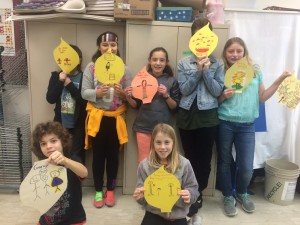
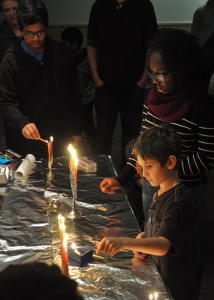
Beit Sefer G'dolim with their Hanukkah flames
G’dolim with their Hanukkah flames
Beit Sefer Yeledim with their Hanukkah flames
Yeledim with their Hanukkah flames
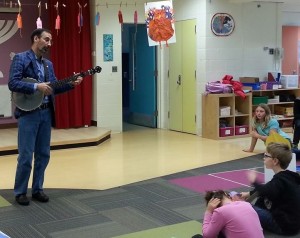
Paul with his traditional Jewish banjo teaching I Had a Little Dreidel
DSC_0804
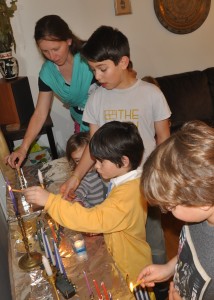
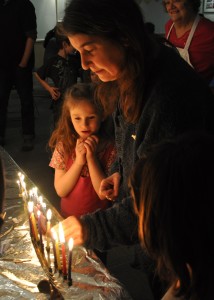
Families with Young Children Light the Lights
DSC_0818
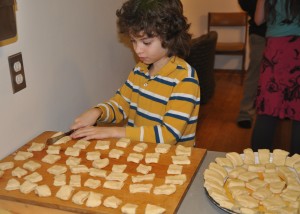
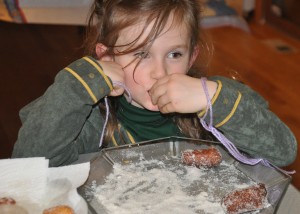
Making Sufganiyot


DSC_0819
Finishing Sufganiyot


Playing with the Gelt


DSC_0831

DSC_0832

Feeling the magic
Feeling the magic

Filed Under: Event writeups Tagged With: Hanukkah

Deep dive into Hanukkah themes

December 9, 2015 by Clare Kinberg

themes of Hanukkah imageLast year at this time, I wrote an article about the complex, often contradictory, Hanukkah themes in children’s books. I looked over about 200 children’s Hanukkah titles and made these very general observations: Many older Hanukkah books focus on the Maccabees as brave Jewish warriors. While physical and moral courage continues to be a common theme, others include a focus on faith, “not by might but by spirit alone;” religious freedom; and being Jewish in a Christian majority country, including authentic friendship between Christians and Jews.

And then there are the books, maybe the majority of them, which emphasize Hanukkah as the Jewish midwinter holiday, the light in the middle of winter, with warm family gatherings, and the generosity and thoughtfulness of present exchange. The point of many of these books seems to be to familiarize Jewish kids with the symbols of the holiday: the dreidel, the menorah, gelt, and of course, presents. Included in these is the Hanukkah around the world theme: Hanukkah in Alaska, Antarctica, the prairie and even under the sea! These books convey the message that Jews are like everyone else….just with a little twist. Others that do this are the ones that riff on familiar folktales to tell a Hanukkah story: the gingerbread man becomes the runaway latkes or the runaway dreidels; Scrooge becomes Scroogmacher; the Jewish sorcerer’s apprentice can’t stop the pan from frying latkes….you get the point. I concluded that perhaps it is the proliferation of “Hanukkah in Chelm” books that do the best job of conveying the spirit of Hanukkah for children. The wise fools/foolish wise ones are uniquely Jewish, timeless, faithful, and oh so brave in their foolishness.

This year, however, I’ve found myself looking with a much more sober eye at various versions, for adults, of the “true meaning” of Hanukkah.  As we are daily confronted with religious zealotry in its present expressions, what do we hear in the echoes of Hanukkah? As AARC member Benji Ben Baruch writes in “The Stories of Hanukkah,” the significance of the Hanukkah story was reinterpreted many times over the generations reflecting the “particular political group at a specific point in time with conflicting visions of the present and future needs of the Jewish people.” It appears to me that we are in an era of transition from the late 20th century glorification of the Maccabee’s fight for independence into a cautionary era, focusing on recognizing the dangers of zealotry and the potential devolution of power to tyranny. In a lecture by Yehuda Kurtzer titled “On Terrorism and Nationalism, Reflections on Hanukkah in Light of the 20th Anniversary of the Rabin Assassination” (part of the 5776 Rabbinic Holiday Webinar Series from the Shalom Hartman Institute), Kurtzer repeatedly refers to Matisyahu Maccabee’s actions in the core Hanukkah story as acts of “terrorist, nationalist violence” (induced by a sense of powerlessness and combined with a conviction to Divine will), pointed language in our particular time. I cannot possibly summarize this profoundly important lecture here, but if you have an hour to devote to deep Jewish learning, I highly recommend it. Other recent, and briefer, reflections on Hanukkah for our time are here by Judith Seid and here by David Wolpe.

I asked several AARC members for their own top Hanukkah themes. Responses included:

  • From darkness to light/faith in the light returning
  • Rededicating ourselves to our beliefs
  • Rekindling hope
  • Courage to be who we are
  • The right/need to fight for your religious freedom
  • Jewish perseverance
  • Inspiration to fight against tyranny
  • Strong faith/spirit as a tool to win anything
  • A great leader is like the shamash candle: serve, light others fire, and caring/watching from above.

I hope these words inspire additional reflections on the meaning of Hanukkah for each of us.


Filed Under: Community Learning, Posts by Members Tagged With: Hanukkah

Annual Meeting 2015 Opening Prayer

November 24, 2015 by Clare Kinberg

Offered by Barbara Boyk Rust

AARCAnnualMeetingNov-22-2015Dear God,

Thank you for this morning, for this time and this place to meet and share our thoughts and wishes for the well being of our sacred community.

May we receive the wisdom that we need to move ahead with ease and strength.

May we listen to each other with open hearts.

May we speak with caring and respect.

May we act in balance and alignment with our needs and our resources, with our creativity, our energy, our time, and our finances.

May we be guided to create and act in accordance with the depth of our commitment to ethical values honoring all life, in support of healing and blessing for ourselves, humanity and the earth.

Thank you so much for a community that cares, respects and opens, sharing common aims for honoring self, family, community and the world.

Amayn

Filed Under: Poems and Blessings

Human Rights Activism is a Source of Light

November 12, 2015 by Clare Kinberg

truah_logo_web_no_RHRNAFor our Shabbat morning service during Hanukkah this year, December 12, AARC will be joining hundreds of other congregations around the U.S. in a focus on human rights activism.  “T’ruah: The Rabbinic Call for Human Rights,” an organization with a long history of Jewish ethical and social justice leadership, organizes this annual Human Rights Shabbat. Rabbi Alana Alpert, rabbi at Congregation T’Chiyah in Oak Park and community organizer with Detroit Jews for Justice–and our visiting rabbi this year–is among the 1,800 rabbis who are part of the T’ruah network. She will be leading our service on December 12 and we’ve invited members of T’Chiyah to join us in Ann Arbor.

T’ruah offers organizational and intellectual support for Jewish work on issues such as ending mass incarceration, justice for farmworkers in the U.S., and standing against Islamophobia.   Rabbi Robert Dobrusin of Beth Israel Congregation in Ann Arbor is a recent past Co-chair.  At its website  are abundant excellent study, worship, and advocacy materials (including one study guide based on Margo Schlanger’s AARC d’var torah from Yom Kippur services a couple of years ago).

The roots of T’ruah as an organization go back to the early 1970s, when a cohort of Reform rabbinic students at Hebrew Union College (HUC) in Cincinnati brought their anti-Vietnam War and Civil Rights activism into their rabbinic training. Some, like Rabbi Myron Kinberg z”l (my brother), as undergraduates in the ‘60s, had trained with Clergy and Laity Concerned to do counseling with conscientious objectors. Others had been Freedom Riders, helping to register Black voters in the South. When they became rabbinic students in 1967 and 1968, they read the texts with those fresh experiences. The T’ruah website quotes one key text newly understood as a call for racial justice and human equality: “Beloved is all humankind for they were made b’tzelem Elohim (in the image of God). Doubly beloved are they, for they were told that they were made in the image of God. As it says: ‘In the image of God was humankind made.’” (Genesis 9:6) Mishnah, Pirkei Avot 3:14.

Upon ordination in 1972, one of this cohort of students, Rabbi David Forman z”l, made Aliyah. While leading the struggle for religious pluralism in Israel as director of the Israel office of the Union for Reform Judaism (1976-2003), he also founded Rabbis for Human Rights in 1988, in Israel. Another of the group of HUC students, Rabbi Bruce Cohen z”l, ordained in 1973, was sent to Israel to do peace work by his New Haven congregation in 1976 following the murder of five Israeli Arabs during protests in Nazareth, northern Israel. Rabbi Cohen co-founded, with Farhat Agbaria, the organization Interns for Peace, which for many years focused on bringing American Jewish college students to Israel to work on projects with Israeli Arabs and Jews. One such college student was Israeli’s Rabbis for Human Rights long time and current President, Rabbi Arik Ascherman, who worked with Interns for Peace in 1981-1983.

In 2002 Rabbis for Human Rights-North America was founded as a multi-denominational network of rabbis and Jewish communities to protect human rights in North America and Israel. Renamed T’ruah: The Rabbinic Call for Human Rights, in 2013, it continues to continue to call on its supporters in North America and around the world to educate and advocate for an Israel embodying our highest Jewish values.

Human rights movements gain their strength from the power of the people as a whole, the soul of a movement rather than the individual bodies who take part. As individuals we might tire, our bodies might weaken, but it is the light of our collective power – which grows brighter and brighter over time – that gives us the strength to go on. Likewise, charismatic leaders come and go, and we might think it is their light that inspires us and produces change. But they, too, are bodies, which wane and dwindle. A truly wise leader nurtures the souls of the movement, builds towards a systemic victory. He or she lets their light burn with others, rather than standing aloft as the shamash.

 – Rabbi Rachel Kahn-Troster from a Human Rights Commentary on Chanukah

Please join us on Saturday morning, December 12, as we celebrate this Human Rights Shabbat along with congregations across the country.

Filed Under: Community Learning, Divrei Torah, Tikkun Olam, Upcoming Activities Tagged With: Rabbi Alana, Tikkun Olam

Barbara Boyk Rust: Spiritual Leader and Teacher

November 11, 2015 by Clare Kinberg

BBRustBarbara Boyk Rust was one of AARC’s founding members.  Eighteen months ago, she was ordained as a spiritual teacher and leader by a Bet Din of four leaders.  Her approach to Jewish observance centers around meditation and sacred chant.  Along with member Allison Stupka, Barbara will be leading our Kabbalat Shabbat service on Friday, December 18, at 6:30. Here, Barbara shares with the community some of her thoughts about her recent ordination process:

What prompted you to undertake the process of ordination? What was the preparation like?

Before moving further into spiritual leadership I needed the review and affirmation of others whom I hold as teachers, mentors and guides.  I needed them to say either “yes” or “no” to my sense of being called to teach and lead in a spiritual context.

Early rabbinic ordination, smicha or smichut l’rabanut, involved the laying on of hands from one rabbi to the next.  Some of the meanings of smicha are to rely on, or to be authorized.  Though I am following a unique path, it did not feel appropriate to me to take further steps authorized by myself alone.  Using a template similar to the origins of Jewish rabbinic ordination I held myself accountable to those who teach me and those whom I serve for recognition, validation and affirmation of this step of my journey as a spiritual leader and teacher.

Part of what I shared with them was the story of my journey, recapped briefly here:

I have been pursuing my spiritual path consciously since my mid-teens.  For more than half my life now, individuals, families and communities have asked me to serve as creator, facilitator and leader of holiday and life cycle celebrations.  Long ago, Reb Zalman Schacter-Shalomi said something to the effect of, ‘if 200 people think you’re a rabbi, you’re a rabbi.’  While I met that criteria long ago, I decided not to complete rabbinic training through the Aleph Rabbinic Program though I was enrolled in it for some years while I completed an interdisciplinary doctorate at The University of Michigan in Higher Education and Clinical Psychology. [Read more…] about Barbara Boyk Rust: Spiritual Leader and Teacher

Filed Under: Member Profiles, Simchas

Poetry by Janet Eigner

November 4, 2015 by Clare Kinberg

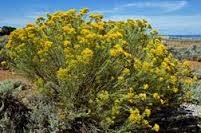
chamisaDuring a break in High Holiday services, AARC member Sally Fink brought me a copy of a stunning poem by her friend, the Sante Fe, Jewish poet, Janet Eigner. How grateful I am to be introduced to her! The poem, Sanctuary, has yet to be published so we can’t put it up on this blog yet. Below is another of her exquisite poems. And here is a wonderful review of Eigner’s second poetry collection, What Lasts is the Breath, “Reflecting on her contact with the Hopi and how it deepened her understanding of Judaism, Eigner said, ‘I do understand that ruach, (breath or spirit or wind) all can refer in Jewish belief, to God, and that the concept began simply and gained God meaning over the centuries of Jewish evolution.’”

Isaac’s Blessing
by Janet Eigner

When Isaac, a small, freckled boy
approaching seven, visits us for Family Camp,
playing pirate with his rubber sword,

sometimes he slumps in grief,
trudging along, his sacrifice and small violin
in hand, his palm over his chest,

saying, Mother is here
in my heart. Before he leaves for home,
we ask if he’d like a Jewish blessing.

Our grandson’s handsome face ignites;
he chirps a rousing, yes, for a long life.
We unfold the prayer shawl,

its Hebrew letters silvering the spring light,
hold the white tallis above his head,
recite the blessing in its ancient language

and then the English, adding, for a long life.
Isaac complains, the tallis didn’t
touch his head, so he didn’t feel the blessing.

We lower its silken ceiling
to graze his dark hair,
repeat the prayer.

Filed Under: Poems and Blessings

  • « Go to Previous Page
  • Page 1
  • Interim pages omitted …
  • Page 16
  • Page 17
  • Page 18
  • Page 19
  • Page 20
  • Interim pages omitted …
  • Page 24
  • Go to Next Page »

Primary Sidebar

Search

Join Our Mailing List

Sign up for our twice a week newsletter to get details on upcoming events and catch up on our latest news.

This field is required.

Check your inbox or spam folder to confirm your subscription.

Upcoming Events

  • All day, April 19, 2026 – Beit Sefer
  • 6:30 pm – 8:00 pm, April 24, 2026 – Fourth Friday Kabbalat Shabbat
  • All day, April 26, 2026 – Beit Sefer
  • 12:00 pm – 3:00 pm, April 26, 2026 – “Lesson of the Homeland” and the Stories We Tell: A Conversation with Anat Zeltser
  • All day, May 3, 2026 – Beit Sefer

Latest News

  • RSVP to “Lesson of the Homeland” and the Stories We Tell: A Conversation with Anat Zeltser April 16, 2026
  • Climate Action Shabbat article in the April 2026 Washtenaw Jewish News April 3, 2026
  • Reimagining Torah Study: Moving from Zoom to In Person by Rabbi Gabrielle Pescador April 1, 2026
  • Creative Spirit at the AARC Beit Sefer March 27, 2026
  • When Is a Killer Not a Murderer? by Elizabeth Brindley March 19, 2026

Footer

Affiliated with

Copyright © 2026 Ann Arbor Reconstructionist Congregation