
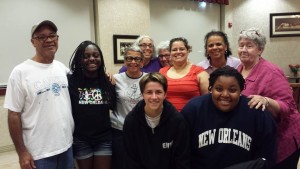
 The book of Exodus, which we begin to read this week, is titled in Hebrew “Shemot” which means “names” in Hebrew. “These are the names of the children of Israel who went down to Egypt with Jacob…” are the parasha’s opening words. I’m down in Louisiana with my wife’s cousins, Creole and Catholic, and I’m thinking about these words and the blog post I need to write for this week. So many topics are swirling in my head. Should I write about the overflowing and moving open house at the Ann Arbor Islamic Center on December 20th? Or the upcoming AARC Tu B’Shevat seder on January 23rd? Or the non-indictment of the police murderer of Tamir Rice? I ask Cousin Betty what she thinks I should write about and, without hesitation, she says “cousins.” Betty has long taught about the spiritual power of naming, and embracing, extended family divided by our country’s history of racism and segregation. So, I took a chance and Googled the words “shemot” and “cousins.” After all, weren’t the children of Jacob’s children cousins?
And there it was, a thoughtful and on point dvar Torah by Academy for Jewish Religion‘s teacher of philosphy Rabbi Len Levin titled “Who is a Jew?” Early on in Rabbi Levin’s Dvar on Shemot he makes the reference to cousins, “The neighboring nations [of the Israelites] of Edom, Ammon, Moab, Ishmael, Midian, and Amalek are all given places as siblings or cousins in the Abrahamic family tree. Israel is identified with the descendants of Jacob through his twelve sons. So Israel is a biological family group?” He then goes on to reflect on Jews “by fate” of kinship and common history, and Jews “by destiny” who make the “willing decision based on faith to accept the positive teachings and values Judaism has to offer.” Shemot, he writes, tells the story of the movement from the covenant of kinship to the covenant of choice, from the “decendents of Jacob” to the “voice of Sinai.” I read his words as a teaching on inclusive and pluralistic Judaism, important lessons for today. But also commentary on our relations to all of our cousins.

