

Enornous toda raba to Carole Caplan who really knows how to build a sukkah!


Ann Arbor Reconstructionist Congregation
Enornous toda raba to Carole Caplan who really knows how to build a sukkah!
Comments written by Julie Norris, delivered by Kevin Norris on Rosh Hashanah 2015
What makes a moment religious?
What makes an experience feel religious?
Is it a glimmer of a feeling, or a feeling that encompasses you?
What is your recipe for a religious moment?
This July 4th weekend, I was so struck when I had an experience that I expected to be a lot of nostalgic fun, but which shifted into something that felt unexpectedly, but unmistakably, religious.
We took a train to Chicago to meet up with our adult daughter, for the Grateful Dead’s 50th anniversary, fare-thee-well concert. 3 nights under the stars at Soldier’s Field with 70,000 tie-dyed faithful.
 And it happened almost immediately – the awareness that somehow this felt religious. It never struck me as religious in the early 1980s as I followed the band up and down the east coast, but now, the awareness of the rituals and culture surrounding this music led me to think about some of the similarities between the shows and services.
First, the music. Many of us are so deeply moved by music. The melodies and harmonies you recognize from decades gone by and the knowledge that these same tunes are known and appreciated by millions. The verse and refrain that feel like coming home.
There’s the rhythm of sitting and standing in unison. How do 70,000 people know, without being told, when to stand but this crowd knew. And through 3-1/2 hours, 3 nights in a row, if you closed your eyes to sink fully into the moment, suddenly a recognized chord or phrase that you hadn’t realized how much you’d missed hearing would emerge and you’d be drawn to your feet. And when you open your eyes you see that everyone else has stood too, in a collective expression of joy and appreciation.
Then there’s the text or lyrics, full of poetry and meaning, full of space for interpretation. And as I gaze at my daughter, I see that these words have now been passed on from one generation to the next.
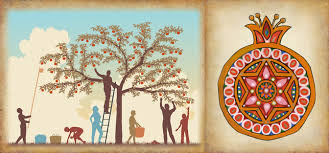 Our annual migration has begun. Once a year, in preparation for the High Holidays, AARC moves our machzorim (Holiday prayer books), our ark, Torah reading table, and many other supplies from our home at the Jewish Community Center to the Unitarian Universalists of Ann Arbor building. I wish I had a picture of Jacob Schneyer, Eli Kirschner, Brayan Zivan, Debbie Zivan, Debbie Field, Jonathan Cohn, and me measuring, sweating, lifting, and pushing the Torah reading table (and then doing it all again) before it finally slid neatly into my Honda Odyssey. But, alas, no photo, so these words will have to suffice.
Our open, ticketless High Holiday observances include opportunities for many ways to participate. In addition to the highly anticipated services led by Rabbis Michael Strassfeld and Joy Levitt, AARC members have prepared to chant Torah and lead various prayers and readings. Our teen members will be chanting haftorah and helping Rabbi Levitt lead children’s services. Everyone in the community is welcome to all observances, which in addition to Rosh Hashanah and Yom Kippur Services, include tashlich/a casting of our mistakes into the Huron River at Island Park (3:30 Sept 14), a non-traditional Yizkor where each person takes a few moments to voice their remembrances (5:30 Sept 23), and, to make the most of our heightened and open state during the afternoon of the Yom Kippur fast, a guided mediation, a workshop, and a discussion (2-5pm Sept 23). The last service of Yom Kippur, Ne’ilah/Shofar/Havdalah (7pm Sept 23) will be followed by a scrumptious break-the-fast (reservations are due September 17).
No reservations are needed for anything other than break-the-fast and childcare.
 With one week left before Rosh Hashanah, the preparatory month of Elul is waning. The 4th translation published in this blog of Psalm 27, is by Rabbi Yael Levy, director of “A Way In: Jewish Mindfulness Program” at Reconstructionist congregation Mishkan Shalom in Philadelphia. Here is a beautiful, downloadable version of the Psalm with Hebrew and Rabbi Levy’s translation. For the other translations in this series browse through our Latest News.
Psalm 27 – Meditation for Elul
To the Beloved,
The Infinite Presence is my light and expanse, who should I fear?
The Infinite Presence is the strength of my life, what shall I dread?
When forces come close
Seeming to devour me,
When narrowness threatens,
And opposition attacks,
All that is menacing stumbles and falls.
Even as an army of mistrust besieges me
My heart does not fear.
Even as thoughts and desires rise up against me
I still have trust.
One thing I ask of the Infinite,
One thing I seek,
To dwell in the Presence all the days of my life.
To awaken to the beauty of each moment
as I pass through this world.
The Infinite shelters me as I encounter difficulty and pain.
The Infinite holds me close in deep and hidden places.
And lifts me high upon a rock.
Now I can see through to what is true.
And I will offer my gifts of thanks
And I will sing and make music to the Eternal.
Please, Infinite One, Listen to my voice, hear my call.
Be gracious with me.
Answer me.
You call to my heart, “Seek my presence”
Your presence I seek.
Please don’t hide from me.
Please don’t let me turn away in anger.
I long to serve.
You are my help.
Do not let me feel abandoned. Do not let me turn away.
In You I am safe.
For my Mother and father have left me
And it is you who gathers me in.
Teach me Your ways. Guide me on the path of integrity.
There is so much to lead me astray.
Don’t let me give in to all that torments me,
the lies, the illusions, the menacing threats.
I must have faith that I can see through all of this
I can see the good, the blessings, the ways of life.
Cultivate hope in the Infinite Presence.
Let your heart be strong and filled with courage.
Cultivate hope.
Translation by Rabbi Yael Levy
Elul 5773 /2013
 During the Aug. 28 Shabbat service, visiting rabbi Alana Alpert explained her route to the rabbinate. While her first love was community organizing in service of social justice, she worried about the high rate of burnout such work entailed. Rabbinical school seemed to her a way to prepare to help those leaders most at risk for burnout. “I never expected to be a rabbi with my own congregation!” She now splits her time as a half-time rabbi for Congregation T’chiyah in Detroit and as a community organizer with Detroit Jews for Justice – and one of our visiting rabbis.
In her Dvar Torah, Rabbi Alpert examined a verse from Parsha Ki Teitzei: “When you build a new house, you shall make a guard rail for your roof…” She found this verse’s practical application in preventing potential harm to be immediately relevant to her recently purchased fixer-upper, in which she and her partner discovered rotted beams that threatened the stability of a second-floor balcony. While the installation of a roof rail or replacement beams improves physical safety, Rabbi Alpert also inferred a symbolic meaning for the rail: it acts as a limit on pride of ownership of a house – a necessary check on entitlement and privilege in the midst of poverty and homelessness.
We welcome to our congregation Rabbi Alpert and the many other newcomers who attended the service, including a large contingent of U-M Law School students. The usual outstanding potluck dinner followed the service, which this time might appropriately have been titled, “Celebration of the Tomato.”
 As always, AARC will have afternoon programming on Yom Kippur, in between the Morning and Torah service (10am-2pm) and our evening non traditional Yizkor service (5:30-6:45pm). The afternoon programming is 2-5pm; come to one part or all, as you choose. At 2, there will be an hour guided meditation–or take a break, perhaps for a walk through the beautiful grounds of the First Unitarian Universalist Congregation building. From 3-3:50pm, we will host a workshop on institutional racism and insider/outsider status by Ann Arbor activist La’Ron Williams, and at 4-4:50pm Rabbi Michael Strassfeld will lead a discussion of the Book of Jonah.
This year we are trying something new: having a respected and honored guest lead a Yom Kippur afternoon workshop that will draw us to use our open and vulnerable condition to make meaningful change. La’Ron Williams conducts workshops – with schools, business organizations, and non-profits – on the fundamentals of creating inclusive communities across a number of lines of diversity. His workshops are always informative, entertaining, and filled with opportunities for personal growth and organizational development. La’Ron is also a nationally acclaimed, award winning storyteller who, for more than twenty-five years, has toured extensively presenting highly participatory, music-spiced programs composed of a dynamic blend of original and traditional tales. He is known for his pronounced commitment to justice and peacemaking – a commitment made concrete through his involvement with the Racial and Economic Justice Task Force of the Ann Arbor based Interfaith Council for Peace and Justice, and via his work with Washtenaw Faces Race, an all-volunteer, inter-racial, interdisciplinary group that consciously and consistently works to dismantle racial hierarchy and promote racial equity in local institutions within Washtenaw County.
La’Ron describes the Yom Kippur afternoon workshop:
In the main, America’s understanding of racism remains stuck in the 1960s. Most of us only recognize it when it shows up as it did in the June shooting at the AME Church in Charleston – in overt incidents of violence, or as easily identifiable, interpersonal acts of discrimination backed by the ill will of a few individuals.
Because we think of it that way, the remedies we envision for it are part-time, incidental, and situationally applied to those we identify as its victims. In truth, 21st century racism cannot be remedied in our spare time. It lies deeply imbedded in all of our institutions; operating constantly, continuously, and “invisibly” — to perpetuate, in hundreds of ways that remain largely unmentioned, unidentified, and unexamined, a hierarchy of White advantage.
This presentation is designed to help its participants begin to recognize and understand the pervasiveness and effects of this contemporary “stealth” racism. Using a blend of storytelling, lecture and dialogue, we will focus on concept building, increasing our awareness of our personal racial identity development within an already racialized milieu, and identifying the major illusions that act to thwart our efforts to achieve inclusion.
 Then at 4 o’clock, Rabbi Strassfeld will lead a discussion of the Book of Jonah, traditionally read on Yom Kippur afternoon. What a one-two! As commentator Aviva Gottlieb Zornberg writes in The Murmuring Deep: Reflections on Biblical Unconscious, “The enigmas that enrage and sadden Jonah are not riddles to be solved. They remain; God invites Jonah to bear them, even to deepen them, and to allow new perceptions to emerge unbidden. In a word, to stand and pray.” And as Maya Bernstein comments on this: “And so we, Jonah-like, enter the synagogue as he entered the fish, and as we stand in the dark, unseeing, we call out to our Creator. We do not answer these riddles; rather, we immerse ourselves in them and let them take us over.”
 We are midway through Elul (check out the full moon at our BBQ tomorrow August 30). Below is a third translation of Psalm 27, traditionally recited each morning of Elul in preparation for the Yamim Noraim/Days of Awe. You can find the first two translations I posted here and here. (Next week I’ll post a fourth.) In her inaugural leading of Kabbalat Shabbat services last night as our visiting rabbi, Rabbi Alana mentioned the psalms/tehillim that are part of the Friday night service, which started me off thinking about how much of our liturgy is drawn from the Psalms. According to this source, “seventy-four of the hundred and fifty Psalms are incorporated bodily in the Siddur.” The Reconstructionist siddur uses many interpretive translations of the Psalms. The interpretation (can it be called a translation?) of Psalm 27 below, by Rabbi Patti Haskel, is the most colloquial I’ve found. I love it that she can translate the ponderous beseeching of the psalm into these light, easily relatable words. You can find this poem on Ritualwell.org (a wonderful resource for many things) here.
Psalm 27/Poem by Rabbi Patti Haskel
Good morning, God, happy Elul.
This day, one thing do I ask of you, God,
One thing do I seek:
To dwell in your house
All the days of my life.
… and while I dwell with you
Perhaps a few more things I might request:
Good health is at the top of my list—
For me, my family, my loved ones,
While we’re at it how about everyone, everywhere.
And perhaps food:
A healthy nosh for all who are hungry.
Quench all hunger and thirst with your love.
We do hunger for more than food and drink, so
Please quench other needs as well.
Okay, how ‘bout safety.
Safety from earthquakes, hurricanes,
Safety from one another.
Safety from all that frightens us
Safety to rest in your care.
And laughter.
Please give us much fun, silliness
to giggle at, many many smiles.
Smiles as we watch children investigate their worlds,
Smiles as we explore the lives of our elders.
God, let me behold your graciousness
Today… each day of Elul… each day
Of this year, and next, and then the next,
While I visit your temple
And immerse in your love.
Elul, a month of spiritual preparation for the Yamim Noraim/Days of Awe. Here is another interpretive translation of Psalm 27, which is traditional to recite daily during Elul. I found this translation, by Rabbi Zalman Schachter-Shalomi, on Rabbi Rachel Barenblat’s blog, the Velveteen Rabbi. You can access the original blog post here.
Psalm 27, as translated by Rabbi Zalman Schachter-Shalomi
Yah! You are my light.
You are my savior.
Whom need I dread?
Yah, with you as my strong protector who can make me panic?
When hateful bullies gang up on me, wanting to harass me, to oppress and terrorize me
They are the ones who stumble and fall.
Even if a gang surrounds me my heart is not weakened.
If a battle is joined around me my trust in You is firm.
Only one thing do I ask of You, Yah:
Just this alone do I seek, I want to be at home with you, Yah,
All the days of my life.
I want to delight in seeing You.
Seeing You when I come to visit You in Your temple.
You hide me in your sukkah on a foul day.
You conceal me unseen in Your tent.
You also raise me beyond anyone’s reach
And now, as You have held my head high despite the presence of my powerful foes
I prepare to celebrate and thrill, singing and making music to You, Yah!
Listen, Yah, to the sound of my cry
And, being kind, answer me!
My heart has said, I turn to seek you.
Your presence is what I beg for
Don’t hide Your face from me.
Don’t just put me down, You who have been my helper.
Don’t abandon me, don’t forsake me, God my support.
Though my father and my mother have left me
You, Yah, will hold me securely.
Please teach me Your way.
Teach me Your way and guide me on the straight path.
Discourage those who defame me
Because false witnesses stood up against me belching out violence.
Don’t let me become the victim of my foes.
I wouldn’t have survived
If I hadn’t hoped that I would see, yet,
Your goodness, God, fully alive on earth.
So I tell you, my friends: you too hope to Yah! Be sturdy!
And make strong your heart. And most of all, keep hoping to Yah.

Today is Rosh Hodesh Elul, tonight will be the first of day of Elul, the month before Rosh Hashanah. Last night Rabbi Strassfeld and Rabbi Levitt offered us some meaningful words about using the month of Elul to prepare for the Yamim Noaim/Days of Awe. The way I understood their messages, we ask so much of ourselves during Rosh Hashanah and Yom Kippur, facing ourselves, making teshuvah/change, we need another month to prepare ourselves.
According to one rabbi, “sometime around the year 1745 Ashkenazic Jews began to recite Psalm 27 morning and evening from Rosh Hodesh Elul until Hoshanah Rabbah.” Perhaps some of us already practice this. Perhaps others will find it comforting and meaningful. Each week in the month of Elul, I will post a different translation of Psalm 27. The Hebrew with traditional translation is here. The first translation is by Rabbi Brant Rosen and you can find the blog where he first published it here.
Psalm 27: you are my light and my hope
you are my light and my hope
why should i fear?
you are my life and my strength
so why do i tremble?
when i contemplate surrender
to my dread of the unknown,
i hold tight to you
and your strength gives me strength.
i only ask one thing of you,
just this one thing:
that i may be welcome in your house
all the days of my life,
to dwell in your innermost place
in safety beneath
the softness of your wings.
be my shelter when
i am wracked by hardship and disquiet,
offer me sanctuary and from there
i will sing hymns to the darkness
with openness and love
do you hear my song?
do you hear me when i cry
to you?
do not turn away –
i seek you endlessly,
i turn constantly toward your light.
in my darkest moments
of this i am sure:
i will never be alone,
yes, even if my father and mother
abandoned me, you will be there
to gather me up
guide me in your ways,
lead me down the paths
of wholeness and peace,
remind me that no matter
how far i may stray
there is always a road
to return.
though i don’t always see it
i will ever trust in your goodness
right here
right now
in the land of the living.
hold on to your hope
and be strong.
the time of our return
will soon arrive.
Another beautiful note from Morgan Buroker’s bat mitzvah. As part of the Birkot ha-Shachar/Dawn blessings that acknowledge the start of a new day, the wonder of life and miracle of creation, Morgan’s grandmother Tere Starr, read a poem she had written. A perfect blessing for the day.
Arpeggio
by Tere Starr
Hope is the thing with feathers.
–Emily Dickinson
I’d almost forgotten
how good anticipation feels,
but then a blackbird came
and sang to me. He ruffled
his feathers, threw his head
back and he sang. Another
blackbird joined him, and then
another. The trio of grackles
created a cacophony.
Other species joined them —
mourning doves and blue jays,
mocking birds and cardinals –
otherwise drawn to water and food,
but now each one sang along,
and somewhere in the myriad
of separate voices,
a symphony was formed.
The birds sang simple truths
of touch and hope, the joys of sharing.
Their song, a gift that’s left by ancients.
And now, with time beside us as we spiral,
the harmony resounds. Arpeggio…
Anticipation signals the essential.
If I follow, it might even lead to love.

