• Skip to primary navigation
  • Skip to main content
  • Skip to primary sidebar
  • Skip to footer
Ann Arbor Reconstructionist Congregation

Ann Arbor Reconstructionist Congregation

  • Home
  • About
    • Overview
    • Rav Gavrielle Pescador
    • Our History
      • Photo Gallery
    • Our Values and Vision
    • LGBTQ Inclusive
    • Our Board
    • Our Sacred Objects
    • About Reconstructionist Judaism
    • Jewish Ann Arbor
  • Programs
    • Shabbat and Holidays
    • B’nei Mitzvah
    • Tikkun Olam
    • In the (Washtenaw Jewish) News
    • Health and Safety Expectations for In-Person Gatherings
    • Join our Mailing List
  • Religious School
    • About Beit Sefer
    • Teachers
    • Enrollment and Tuition
    • 2025-26 Beit Sefer Calendar
  • Blog
  • Calendar
  • Membership
    • Thinking about joining?
    • Member Area
  • Contact Us
  • Donate

Clare Kinberg

Rebukes and Sacred Disagreements

March 22, 2016 by Clare Kinberg

By Carol Lessure

w-hillel-shammai-1423642404I started Sunday off with a nasty argument with Jon, my life partner, over something relatively unimportant. We were coping with daylight savings time, a mysterious rash on the face of our eldest son, while the younger one was late for religious school. I was trying to get us out the door because I planned to attend a Sunday morning text study. So I left in a huff, not feeling very kindly towards Jon. [Read more…] about Rebukes and Sacred Disagreements

Filed Under: Event writeups, Posts by Members Tagged With: Adult Learning

AARC Purim Questions and Answers

March 17, 2016 by Clare Kinberg

Our kids getting ready for Purim fun
Come welcome Shabbat and have some Purim fun

Are we reading the Megillah/Scroll of Esther? Yes! This year, the AARC will be reading the Megillah, the scroll of Esther, during the 4th Friday Shabbat service, on March 25 beginning at 6:30 pm. Rabbi Michael Strassfeld will lead us in Shabbat songs and members of the congregation and the rabbi will chant and read an abbreviated version of the Whole Megillah, primarily in English.  You won’t want to miss being part of the beautiful, creative and fun costumes of kids, members and service leaders alike.  Plus you will be thrilled by the Band’s scoring of the evening.

Will there be a Tot Shabbat beforehand like usual? Yes! There will be a Tot Shabbat from 5:45 to 6:15 preceding the service.

Will we have a potluck afterward service? Yes, but with a Purim twist! We’ll be serving Middle Eastern food, and we need you to bring salads, some little kid friendly dishes, and desserts! Nutfree, please.  Potluck at 8 pm.

Will there be a Purimshpiel? A special addition to the evening will be “All the World’s a Stage” a brief, family-friendly Purimshpiel (play) presented during the potluck dinner by the post-Bnei Mitzvah group while we munch away on home-made hamantaschen.

Speaking of Hamantaschen…. You can make them at home, or join the baking fun at the Lessure/Engelbert’s on March 19, 3-6pm. Get the full deal here and rsvp.

Should I come in costume? Yes! Not required of course, but so much fun. Need ideas? See Rachel’s blog on that!

What should I bring?  Come, one and all.  Bring a friend, a generously portioned vegetarian, nut-free, potluck dish (salad, kid-friendly main dish, or dessert), come in costume or grab a mask at the JCC, come ready to laugh and sing. Come for the service, stay for the Purimshpiel.

Should I bring the household items I have bought for the Welcome baskets? Yes! Read about it here. Sign up here.

Is this evening appropriate for young children?  This family friendly service will be fun, entertaining,  less formal, and certainly more noisy than a traditional Friday night service.  That said, it is great if parents remain mindful of their children’s participation during the service, the potluck and the Purimshpiel.  Please let me know (ckinberg@gmail.com) if your kids need childcare or pizza before the service.


Filed Under: Upcoming Activities Tagged With: Purim

Purim Costume Dos! Purim Costume Don’ts!

March 10, 2016 by Clare Kinberg

by Rachel Baron Singer
Rachel Baron Singer Punk Rock Queen Vashti

With Purim fast approaching, it’s time to start thinking about costume Dos and Don’ts! Friday March 25 Megillah/Scroll of Esther reading at the JCC is an all-family costume affair. Here are some tips to get ready for the festivities:

  • Do: Have fun mixing classic Purim characters with more modern themes and trends. Steampunk Queen Esther. Grunge Rock Mordecai. Kylo Ren Haman. The possibilities are endless!
  • Don’t: Use cultures as costumes. If a culture isn’t yours, it’s not appropriate for a costume! Native Americans, Roma, and other groups often have to endure seeing watered-down versions of their customs and traditions disrespectfully packaged into costumes; let’s not contribute to these transgressions during our celebrations.
  • Do: Get crafty! Homemade Purim costumes are simple and enjoyable to make. Superhero paper plate masks are easy to construct and homemade face paint is a snap. You would be surprised at what you can whip up with a few household items or cheap dollar store finds!
  • Don’t: Use genders as costumes. It’s totally fine to costume yourself as a character or figure whose place on the gender spectrum is different than your own, but please don’t simply dress in drag as a cheap “gender swap” gag. We want Purim to be welcoming and safe to Jews of all genders!
  • Do: Get in the Purim spirit even if costumes aren’t your thing. You can always join in the fun by simply wearing bright colors, some flashy scarves, strings of beads, or a silly hat. It’s Purim—be ridiculous!
  • Don’t: Wear blackface or any racialized makeup. Unless, of course…JUST KIDDING! NEVER EVER DO THIS!
  • Do: Have fun with whatever you choose to wear. Chag Purim Sameach!

    Debbie Field 2008
    Debbie Field begins her reign as co-chair

Filed Under: Posts by Members, Upcoming Activities Tagged With: Purim

Dish for a Cold Winter Evening

March 3, 2016 by Clare Kinberg

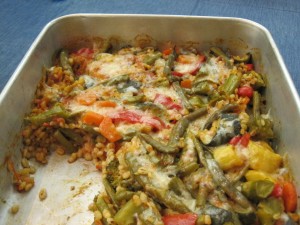
Rena's Basch's Veggie Barley Bake
Rena’s Basch’s Veggie Barley Bake
Veggie Barley Bake: A Rena Basch Recipe

Once upon a time, my friend Beth–a charming book club hostess–served this dish for dinner on a cold winter evening, and I went nuts for it.  I think of barley as a wonderful hearty and healthy grain, but it’s rarely served except as part of a beef barley soup. Barley has a rich nutlike flavor and an appealing chewy, pasta-like consistency. It’s quite versatile; you can use it as a breakfast cereal, as a substitute for rice in pilafs and risottos, in cold salads, and in hot soups and stews. Or in this casserole-like dish.

Beth said she loves serving this dish which she found in a very old, dog-eared cookbook; the kids eat it, it’s healthy with barley and lots of veggies, but it tastes like lasagna. What’s not to love about that? You can use whatever combination of veggies suits your fancy or your leftovers. You just need approximately 10 cups of chopped vegetables in all. If you have bits of different vegetables leftover in the refrigerator or freezer, this recipe is perfect for cleaning them up.

As I mentioned I went a little nuts for this dish, and have made many variations. Here are some versions:

  • The Book Club Selection: green beans and sweet potatoes (peeled and cubed, no need to pre-cook)
  • Locavorious This & That: As many of you know, I own and operate a locally grown frozen produce CSA, so I’m always trying to help folks use the frozen vegetables that come as part of their share. Some recipes call for a cup of this, or a cup of that. This recipe can use up all those leftover cups of this and that. For example: 16 oz frozen summer squash, (or ~ 4 cups fresh), ½ bag of frozen broccoli florets, ½ bag frozen green beans, a handful of red peppers and some leftover snap peas or shelled peas.
  • Another favorite: 16 oz frozen cauliflower florets (or ~ 4 cups fresh), 2 cups blanched greens such as kale or chard, and sweet potatoes (peeled and cubed) or more carrots

The Veggie Barley Bake Formula

  • 2 tbsp oil
  • 2 cloves minced garlic
  • 1 onion, chopped
  • 2 average carrots, sliced
  • 9 – 10 cups chopped frozen or fresh vegetables
  • 3/4 cup barley
  • 15 oz frozen stewed tomatoes, thawed + ½ cup water *or* 1 1/2 cups tomato broth *or* 15 oz can of diced tomatoes plus a little water
  • 1 tsp salt
  • 1 tsp. oregano
  • 2 cups shredded sharp cheddar cheese
  • Freshly ground black pepper

Preheat oven to 350 degrees.

Heat oil in large heavy skillet and sauté garlic and onion until softened, 3 -5 minutes. Add remaining vegetables and sauté, stirring a few times, for 5 minutes. If using all fresh vegetables, may want to add a little cooking time here, maybe 3 extra minutes. Add barley, tomatoes/tomato broth, and seasonings; bring to a boil, cover, and simmer for about 10 minutes.

Transfer contents of the skillet to a shallow 4 quart casserole; stir in 1 cup of the cheese. Cover and bake for 45 minutes. Veggies and barley should be tender. If not, cover and cook longer. Top casserole with remaining cup of shredded cheese if desired and return to oven uncovered for about 10 minutes.

More reasons to love barley: It’s good for you! It’s tasty! It’s full of fiber and nutrients! It can be used to make beer! Nice place to read up on barley’s health benefits is here.

Filed Under: Food Tagged With: recipes

Purim Gifts: Welcome Baskets for Refugee Families

February 25, 2016 by Clare Kinberg

welcome basketAARC Beit Sefer teacher Sharon Alvandi is a student in the UMich Jewish Communal Leadership Program, and an intern at Jewish Family Service learning to work with refugee families. Sharon has been very inspired by our AARC congregation, particularly the ways that the Beit Sefer students, parents and other community members come together to share learning and activities, investing in the character of the children. Through her work with JFS, Sharon is organizing a way for us to practice the mitzvot of Purim, giving gifts of tasty treats to one another/mishloach manot, and gifts to the poor/mattanot le-evyonim (for more about how these two mitzvot are related see this). Sharon writes:

There are many reasons to celebrate Purim and sort through a narrative that’s truly unlike any other in Jewish scripture. On Purim- the holiday of “lots”- we celebrate more than simply the idea of chance. When we listen to Esther’s story, we collectively celebrate character, resolve, and integrity. By presenting her true self–her Jewish self–to king Ahasuerus to appeal for the fate of the Jewish people of Shushan (present day Susa, Iran), Esther is a model of advocacy for herself and others. As a developing social worker, this story helps me think  about what it takes to act in a way that integrates all parts of who I am.

Purim also commemorates what it means to survive genocide or the threat of genocide. Each day when I work at JFS, I have the opportunity to observe the strength of character of the clients and the meticulous work of the case managers to serve a community of refugees in making the best choices in their first days in the U.S.   

JFS has resettled over 350 refugees since 2009.  Countries range from Iraq, Afghanistan, Somalia, Ethiopia, Iran, Syria, and Burma. JFS is set to resettle 150 individuals by October 1, 2016. AARC can help with the resettlement of families by joining with JFS  to assemble and donate Welcome Baskets for refugee families in Washtenaw County. We can do more than discuss violence that is taking place abroad. We can  welcome those in our community who have found refuge in a new place. This Purim, we can help make a space of comfort for their true selves.

Sharon has put together a list of personal care and household items the new families need upon arrival to set up their new homes. Check with this registry to see what is needed. We ask that you buy these items new and when you have, check off the registry. We will assemble the Welcome Baskets some time during the Purim Shabbaton March 25-27.

Filed Under: Beit Sefer (Religious School), Tikkun Olam, Upcoming Activities Tagged With: mitzvah, Purim

Be Happy! It’s Adar! But why?

February 17, 2016 by Clare Kinberg

FullSizeRender (3)Purim is a joyous, chaotic and raucous holiday. In this Jewish leap year, there are two months of Adar (I and II) and we celebrate Purim in Adar II. This year that will be in late March. Even in leap years, Purim is followed one month later by Passover (they both occur on the full moon).

Purim is a harbinger of spring. Like spring holidays celebrated in other cultures and religions–the Hindu celebration of Holi, Carnivale in Brazil and the Caribbean and Mardi Gras in New Orleans for examples–the elation over the departure of winter and the rebirth of the Earth is intoxicating. And Purim is clearly a holiday to be observed in the millennium, where identifying the difference between good and evil is at times totally challenging.

So MARK YOUR CALENDARS!  The AARC brings you a smorgasbord of preparatory events leading up to our Purim observance, which will culminate with Rabbi Michael Strassfeld joining us for the 4th Friday in March.  Stay tuned for RSVP details!

  • Throughout March:
    • costume and mask consultations
    • preparing Shalach Manot — the gifts of Purim
  • March 19–  Lessurbert Annual Cookie Baking (read hamantaschen) and pizza baking
  • March 25–  4th Friday Service and Potluck unveiling the beautiful, whole megillah for the whole family and dinner theater Purim Spiel. (Tot shabbat prior to the service)
  • March 26– Mincha service and learning with Rabbi Michael
This image and the one above are decorative sections from the Megillat Esther/Scroll of Esther used by AARC courtesy of Barbara Boyk Rust and Evelyn Neuhaus
This image and the one above are decorative sections from the Megillat Esther/Scroll of Esther used by AARC courtesy of Barbara Boyk Rust and Idelle Hammond-Sass

Have an idea of how to add to the fun? Contact Dina Kurz [dinakurz@gmail.com] (on behalf of the Purim Planning Committee) if you want to add an event (such as baking, costume or mask workshop, sangria making, etc.) to increase the merriment in advance of March 25.

Links to Purim last year here and here.


Filed Under: Upcoming Activities Tagged With: Purim

Rena’s February Recipe: It’s Hot and Sweet

February 3, 2016 by Clare Kinberg

side-gochujang-sesame-butternut-squash-940x560Gochujang-and-Sesame-Roasted Butternut Squash


by Rena Basch

When the latest, miraculously delicious, trendy ingredients are promoted by for-profit cooking magazines, I ususally try to ignore them. Or just smirk smugly, as in “I’m not getting sucked into searching for the impossible-to-find, often expensive, use-it-once-and-never again latest-n-greatest ingredient.” But, there are exceptions. Gochujang. I love this stuff. Gochujang is a Korean hot pepper paste; a savory, spicy, sweet, and pungent fermented Korean condiment made from red chili, glutinous rice, fermented soybeans, and salt. It’s got this sweet & spicy thing going on. If you’ve had bi bim bap at a Korean restaurant, the flavor will be familiar, as it is an ingredient in the sauce typically served with bi bim bap. It’s not that difficult to find in the Asian sections of local grocery stores or any of the Asian grocery stores around town, such as the Galleria Market on Packard in Ann Arbor, or Hua Xing Asia Market on Washtenaw in Ypsilanti. Look for it in square-shaped red tubs.Gochujang container

On to the recipe. Gochujang & sesame roasted butternut squash from bon appetit magazine. According to bon appetit, “This would work with any other winter squash—acorn and delicata don’t even have to be peeled.” However I love it with the butternut, which roasts well, and is easy to find at this time of the year, unlike delicata which does not keep as well as the hard winter squashes. These days, I’ll say this is my favorite preparation of butternut squash.  Hope you enjoy it!

Ingredients:
2 tablespoons sesame seeds
2 tablespoons vegetable oil
1 tablespoon gochujang (Korean hot pepper paste)
2 teaspoons soy sauce
1 medium butternut squash, peeled, seeded, sliced ¼” thick
Scallions, thinly sliced
Flaky sea salt

Place racks in upper and lower thirds of oven; preheat to 425°. Whisk sesame seeds, oil, gochujang, and soy sauce in a large bowl. Add squash and toss to coat. Divide squash between 2 rimmed baking sheets, arranging in a single layer. Roast, rotating sheets once, until tender and browned on some edges, 25–30 minutes. Serve topped with scallions and salt.

Here’s the link to the recipe in bon appetit

Filed Under: Food, Posts by Members Tagged With: recipes

Four Worlds of the Tu B’Shevat Seder

January 27, 2016 by Clare Kinberg

by Idelle Hammond-Sass

TreesClappingWatercolorOn Saturday evening January 23, AARC visiting rabbi Michael Strassfeld led about 60 people on a ritual journey through the mystical four worlds of the Kabbalists, exploring the different qualities of each world and our relationship to them. The Tu B’Shevat seder, modeled loosely after the Passover seder, was created by the mystics of S’fad in the 16th century, but the original holiday itself grew out of ancient tithing, and later was associated with planting trees in Israel and caring for the land.


Seder-01-23-2016

In an earlier study session, Rabbi Michael led an exploration of Jewish teachings about the environment.  The Tu B’Shevat seder is more mystical, a product of rabbinic imagination. Each mystical “world” is associated with a category of fruit, its season, an aspect of self, and an intention–and accompanied by a glass of wine. The Haggadah for the Tu B’Shevat seder, put together by Rabbi Michael and AARC co-chair Margo Schlanger, was rich with readings and illustrations that deepened our understanding. And, yes, like Passover, it is structured on fours: four worlds, four glasses of wine, four seasons.

This ancient New Year of the Trees or “Rosh Hashanah L’ilanot” was also associated with the mystical feminine aspect of God, or Shechinah. We added Miriam’s cup to our seder, and said a blessing for Miriam’s well, for without fresh water, the trees and plants cannot flourish. The cup was dedicated to the people of Flint, whose water has been polluted.

Our room was set with a U shaped arrangement of tables beautifully set with platters of fruits and seeds (carefully following the no nuts rule of the JCC) that illustrate the four worlds. The platters were piled high with figs, bananas, grapes, apple, pomegranate, pears as well as olives, dates, apricots, raspberries: Fruits with pits, hard shells and soft, dried and fresh.

Tu B'Shevat Seder Plate
Tu B’Shevat Seder Plate

The beauty of the ritual pairs a mystical sphere or world with a fruit that symbolizes it, as well as mirrors our own spiritual state. For instance in the physical realm of Assiyah (winter, white wine) we ate fruit with protective outer shells, such as banana, pomegranate, or oranges. When we peel away our protection, and can be vulnerable, we can share the sweetness inside. If you are unfamiliar with the Kabbalah, this is a sweet way to become familiar with the four worlds of Assiyah (Physical), Yetzirah (Formation), B’riyah (thought), and Atzilut (Spirit).

A delicious and plentiful dinner was organized by Rena Basch and catered by El Harissa Café. (Khallid explained our menu, featuring a Tunisian egg Tangine, Lablabi, Mama Houria, a carrot dip, with a lovely salad with figs and pomegranate seeds, and poached pears with Michigan fruit sauce.)

This event was co-sponsored by Jewish Alliance for Food Land and Justice with an impact grant through the Jewish Federation of Greater Ann Arbor. The seder helped us reach our goals of bringing together people from the wider community and celebrating the deep roots we share in the Tree of Life.  AARC was joined by Rabbi Alana Alpert and members of Congregation T’chiyah of Oak Park, fellows from Hazon Detroit, and many others from the Ann Arbor community.  Like all ARRC events, we could not have done this without volunteers, and a big thank you to all who planned and worked so hard–Margo Schlanger, Clare Kinberg, Carole Caplan and Rena Basch.

For more information on Tu B’Shevat there are many good resources on the web at Hazon.org, and Ritual Well, to name a couple.  The Jewish Alliance for Food, Land and Justice Facebook page is active–come visit!

Filed Under: Community Learning, Event writeups, Posts by Members Tagged With: food/land/justice, Michael Strassfeld, tu b'shevat

Experience POLIN

January 14, 2016 by Clare Kinberg

Cover to the POLIN catalog
Cover to the POLIN museum catalog. Polin, Hebrew for Poland, also means “Dwell here.”

“Museums can be agents of transformation that can move a whole society forward,” Barbara Kirshenblatt-Gimblett said in her opening to her January 13, 2016 lecture  at the U-M Museum of Art’s Stern Auditorium. That may sound like an audacious and grandiose statement, but after listening to Kirshenblatt-Gimblett, the chief curator of the core exhibition at the POLIN Museum of the History of Polish Jews–which literally stands on the rubble of the Warsaw Ghetto–few in the audience were doubters. Born in Toronto in 1942 to Polish immigrant parents, Kirshenblatt-Gimblett articulates a vision of recovery of 1000 years of Polish Jewish life that transports museum visitors into the world Ibrahim Ibn Yakub found on his journey in the 10th century, and through multimedia exhibits, brings them into the experience of Jewish life in Poland into the 20th century.

What makes Kirshenblatt-Gimblett and her collaborators special is their articulation of principles for the museum and their creative adherence to those principles in every aspect of the museum. When the museum opened in 2014, Kirshenblatt-Gimblett published an essay “A theater of history: 12 principles,” which begins, 

The Museum of the History of Polish Jews was created from the inside out. Before there was a museum, before there was a building, before there was a collection, there was a plan for the exhibition. The story – the thousand-year history of Polish Jews – came first. All else followed. The museum and the story it tells in the core exhibition will be an agent of transformation. Polish visitors will encounter a history of Poland, but in a way they have not experienced before. Jewish visitors will discover a history of what was once the largest Jewish community in the world and a center of the Jewish world – an estimated 70 percent of Jews today, more than 9 million people, are thought to descend from this territory. All visitors will encounter a Poland about which little is known and much misunderstood, a country that was one of the most diverse and tolerant in early modern Europe, a place where a Jewish minority was able to create a distinctive civilization while being part of the larger society.

Her essay–which in a move both simple and radical, she posted on Facebook–outlines in easily understandable language, extraordinary ideas about the presentation of  history and culture. Her lecture at U-M was this essay with slides, and information from over a year of experience with ongoing programming and over a million visitors to the museum. Leaving the lecture, many in the audience could be overheard making plans to visit POLIN.

Filed Under: Community Learning, Event writeups Tagged With: museums, Poland

A New Monthly Recipe Column by Rena Basch

January 7, 2016 by Clare Kinberg

kale salad

Massaged Kale Salad with Dried Cranberries and Feta

Want to get more kale into your (or some family members’) diet?  Here’s a technique to win over the doubters, kale-o-phobes and greens-resisters.  Sprinkle the kale with a little salt and then give it a massage.  Seriously.  Hang with me here.

I learned about “massaged kale” salad from Living Zen Organics, the café and organic food nonprofit associated with The Detroit Zen Center.  For a while Living Zen was coming to the Ann Arbor Farmers Market selling raw foods such as dried kale chips and delicious, tender kale salads.  I could not understand how the kale was so tender without being blanched or cooked first, so I asked, and learned you just need to gently massage the kale.

You found it!

The other secret to crowd-friendly kale salads is really no secret: pair the bitter green with sweet things, fresh or dried fruit and/or a sweet salad dressing.  This recipe below is one of my 3 favorite massaged kale salads (it’s so hard to choose just one), but I’m sharing this one because it’s easy, can be made with local ingredients, and I’ve seen kids actually enjoy eating it.

1 big bunch kale, Lacinato is nice, or a big box of baby kale leaves works too

1/2 teaspoon coarse kosher salt or sea salt

1/4 cup finely diced red onion

1/2 cup dried cranberries or cherries

3/4 cup small-diced apple

1/3 cup toasted sunflower seeds

1/4 cup olive oil

2 tablespoons red wine vinegar

1/2 teaspoon sugar

1/3 cup crumbled Feta cheese

If using Lacinato/dinosaur kale: wash leaves and pat it dry. Slice off the stiff stems below the leaves and continue slicing the stem away from the leaf until you have cut a thin v-shape into the kale leaf and removed the tough stem all the way up. Stack the kale leaves two or three at a time, roll them up, and slice the leaves into thin ribbons. If using curly kale, remove the stems and slice it into bite sized pieces.

Place the sliced kale in a large mixing bowl.  (If using baby kale leaves, just toss them into the bowl without de-stemming or slicing.)  Sprinkle the kale with ~ ½ t salt and massage it into the kale with your hands for two minutes.  Set a timer!  Grab big handfuls of kale, squeeze, release, toss, grab big handfuls, squeeze, release, toss, etc, you get the picture.  You’ll notice the kale start to turn a darker green and the texture of the kale will begin to soften a bit. If using baby kale, you’ll need only about 45 seconds. Sometimes if using baby kale leaves, I don’t even bother to massage it at all.

Toss in the red onions, dried fruit, apples, and sunflower seeds.  Combine everything.

In a small bowl, whisk together the oil, vinegar and sugar. Pour over the salad and toss. Sprinkle feta cheese over the top and serve.  A few grinds of black pepper over the top are nice too.

Adapted from recipe found on melskitchencafe.com blog.

Filed Under: Food, Posts by Members Tagged With: recipes

  • « Go to Previous Page
  • Page 1
  • Interim pages omitted …
  • Page 15
  • Page 16
  • Page 17
  • Page 18
  • Page 19
  • Interim pages omitted …
  • Page 24
  • Go to Next Page »

Primary Sidebar

Search

Join Our Mailing List

Sign up for our twice a week newsletter to get details on upcoming events and catch up on our latest news.

This field is required.

Check your inbox or spam folder to confirm your subscription.

Upcoming Events

  • 6:30 pm – 8:00 pm, April 24, 2026 – Fourth Friday Kabbalat Shabbat
  • All day, April 26, 2026 – Beit Sefer
  • 12:00 pm – 3:00 pm, April 26, 2026 – “Lesson of the Homeland” and the Stories We Tell: A Conversation with Anat Zeltser
  • All day, May 3, 2026 – Beit Sefer
  • All day, May 9, 2026 – Wesley Jackson B'Nei Mitzvah

Latest News

  • RSVP to “Lesson of the Homeland” and the Stories We Tell: A Conversation with Anat Zeltser April 16, 2026
  • Climate Action Shabbat article in the April 2026 Washtenaw Jewish News April 3, 2026
  • Reimagining Torah Study: Moving from Zoom to In Person by Rabbi Gabrielle Pescador April 1, 2026
  • Creative Spirit at the AARC Beit Sefer March 27, 2026
  • When Is a Killer Not a Murderer? by Elizabeth Brindley March 19, 2026

Footer

Affiliated with

Copyright © 2026 Ann Arbor Reconstructionist Congregation