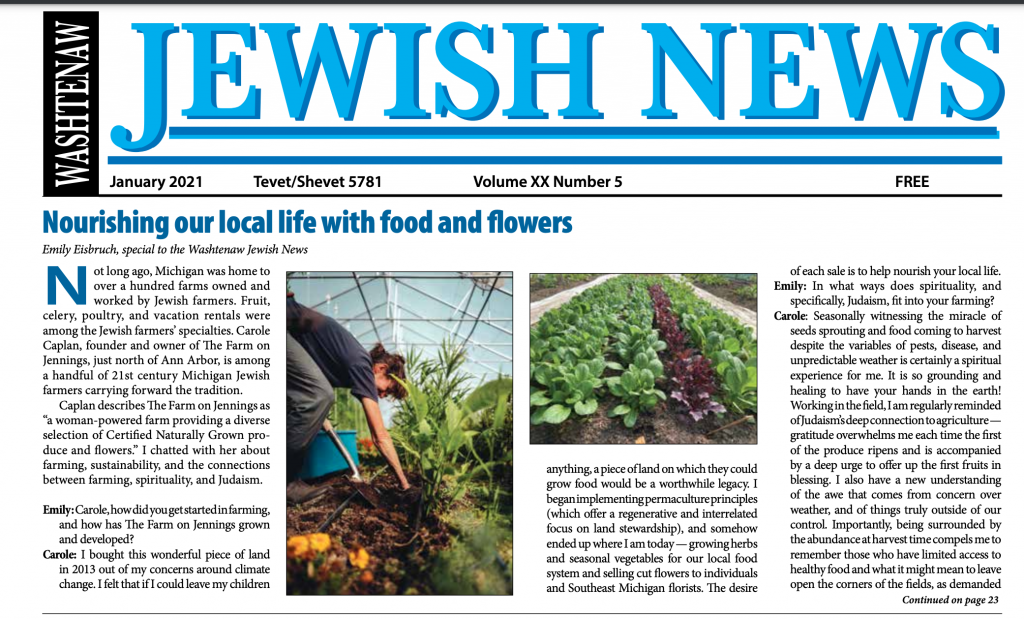
This article in the Nov. 2020 Washtenaw Jewish News highlighted creative new AARC programming during the COVID-19 pandemic.

You can click on the article to view a larger version.
– Emily Eisbruch, special to the Washtenaw Jewish News December 2020 Edition
Rabbi Ora Nitkin-Kaner
What can be better than poetic verse and vivid imagery to elevate and move our spirits? The Ann Arbor Reconstructionist Congregation (AARC) features beautiful and thought provoking poetry in its worship services, led by Rabbi Ora Nitkin-Kaner. Here’s a chat with Rabbi Ora about the role of poetry in Jewish services.
Rabbi Ora, what inspired your interest in incorporating poetry into Jewish services?
I grew up attending a Conservative shul in Toronto where Shabbat prayers were usually sung with the same melodies and there was rarely any deviation from the strict ‘keva’ (order of service). When I moved to Philadelphia in 2011 to attend the Reconstructionist Rabbinical College, I joined Fringes, a chavurah co-founded by feminist activist poet Elliott batTzedek. Fringes services feature a mix of traditional liturgy and contemporary poetry. I learned from davening (praying) with Fringes that poems can shake up our expectations of what prayer looks and feels like.
What do you see as the role of poetry in worship services?
Poems crack open our hearts when we’re feeling broken, or tired, or fearful or numb. Poems offer an ‘aha’ moment; they help us feel seen, and less alone. Good poetry reminds us that there is beauty in the world — beauty that we’ve witnessed, and beauty that others have witnessed and bring to us in a gift of words. Poetry is remedy, balm, revolution, or reminder of how interconnected we all are.
What does poetry provide that the siddur / prayerbook does not?
The siddur is full of gorgeous poetry! The psalms and the prophets are featured widely in our Shabbat siddur, and are profound and powerful poetry. But there are two real challenges to appreciating the poetry of the prayerbook: One, services are usually in Hebrew, and most North American Jews aren’t fluent Hebrew speakers. This means that a lot of the beauty of the language gets lost. And two, any poem that gets repeated again and again will lose a lot of its vividness. Bringing new poetry into services cuts through the lulling effect of repetition. Poetry—if it’s good, if it gets us and we get it—says, ‘Wake up! Pay attention!’
How does poetry compare to music/song in services?
Poetry is an invitation to awaken to what’s holy in the world and in ourselves. It’s a chance to see things in a new light, or to feel seen. For these reasons, I think of poetry as more of an individual experience — though I do love that moment when, just after our congregation finishes reading a new poem out loud, you can hear a collective murmur of ‘wow’ and ‘yes.’ Singing together is more about the collective experience, feeling the sound of many voices resonating in the room or in our bodies.
What are your favorite sources for poetry to use in services?
Poetryfoundation.org and poets.org are consistently great online sources. Lately I’ve been enjoying drawing from the book Poetry of Presence: An Anthology of Mindfulness Poems, by Phyllis Cole-Dai (editor) and Ruby R. Wilson (editor).
Who/what are some of your favorite poets and favorite poems?
Consistent favorites are Adrienne Rich, Yehuda Amichai, Ada Limon, Ross Gay, Carl Phillips, Mary Oliver, and for services in particular, Rumi and Rainer Maria Rilke.
Mary Oliver’s ‘Wild Geese’ (shown below) is an antidote to the harshness and shaming that lives in some aspects of our Jewish tradition, our world, and ourselves.
Wild Geese, by Mary Oliver
You do not have to be good.
You do not have to walk on your knees
for a hundred miles through the desert repenting.
You only have to let the soft animal of your body
love what it loves.
Tell me about despair, yours, and I will tell you mine.
Meanwhile the world goes on.
Meanwhile the sun and the clear pebbles of the rain
are moving across the landscapes,
over the prairies and the deep trees,
the mountains and the rivers.
Meanwhile the wild geese, high in the clean blue air,
are heading home again. Whoever you are, no matter how lonely,
the world offers itself to your imagination,
calls to you like the wild geese, harsh and exciting –
over and over announcing your place
in the family of things.
To learn more about the Ann Arbor Reconstructionist Congregation, and see for yourself how poetry is used to enrich the services, please visit aarecon.org, or contact Gillian Jackson at aarcgillian@gmail.com or Rabbi Ora Nitkin-Kaner at rabbi@aarecon.org.
NOTE: This article appeared in the December 2020 Washtenaw Jewish News. See page 10 here.
As most of America settled in for a night of watching poll numbers roll in, a pensive bunch of AARC members opened a night of song with ‘Stand By Me’ by Ben E. King. As the numbers trickled in, comfort was found in classic Jewish songs such as ‘Oseh Shalom’ and ‘Olam Chesed,’ as well as old favorites such as ‘Bridge over Troubled Water’ and ‘If I had a Hammer.’ Old friends and new shared thoughts, checked in about what support they might need, and found solace in community.
On the day after the election, the community was welcomed to the weekly Wednesday check-in to discuss how they are doing and what they would like from the community going forward. It is such a blessing to have a community of people invested in providing care for each other during this challenging time! Some ideas for future programming were Jewish learning groups, explorations of Judaism and social justice, interfaith work, and opportunities for personal growth and connection. If you have ideas for programming during the winter months of the pandemic, please email us!
See below for some of the music we enjoyed on Tuesday night.

There is SO much going on this month! It is heartening that our Jewish community – both local and national – is coming together for mutual support during this season. Please see the events listed below to learn more!
Sunday, November 1st. Limmud Michigan eFestival. Limmud MI will host a day of workshops with something for everyone. Some examples: “How to Be A Spiritual Badass through the Power of the Feminine Divine,” with Rabbi Tamara Kolton, “When Bigots Cite Scripture,” with Saeed Kahn and David Polsky, and “Beauty and Brutality: Art of the Holocaust,” with Jacob Kraus – and MANY more. Sign up here.
Songs for the Revolution! Tuesday, November 3rd, 8pm until we’re done! We could spend all evening on November 3rd anxiously watching the news … and/or we could sing together! Join Rabbi Ora and members as we keep one another company, schmooze, and sing our favorite (secular and Jewish) songs of hope, resistance, and revolution. If you have a song you’d like to sing or lead, please email the lyrics to Rabbi Ora by November 1, or download the lyrics in advance and be prepared to screen share.
Friday, November 6th, 5-5:30pm. Post Election/Pre-Shabbat Pause with Bend the Arc Ann Arbor (Rabbi Ora will be a speaker at this event). Regardless of the outcome (if we have one), this is a chance to gather with others to breathe, to gain strength for the work ahead, and to sing, yell, cry, and laugh. RSVP to Bend the Arc for a Zoom Link.
Sunday, November 8th, Global Day of Jewish Learning with Reconstructing Judaism. The Global Day of Jewish Learning is a project to unite Jewish communities through study of our shared texts, with a 24-hour period of live-streamed events around the world. This year’s theme is about Judaism’s vision of human dignity, the ethics of inclusivity, and the imperative to decrease marginalization. It will take place on Sunday, Nov. 8, 2020. More information can be found here.
Second Saturday Shabbat Morning Service. November 14th. Ta’Shma: Come and Learn begins at 10am; Shabbat service begins at 10:30. Meditation, prayer, discussion, community. Everyone is welcome! Zoom link will be sent out the week before the event.
Annual Membership Meeting. Sunday, November 15th, 1-2:30pm. We’ll discuss what kind of COVID-safe programming we’d like to see in Fall-Winter 2020/2021. If you have ideas for new programs or ways to innovate old ones, and how you can help, please come prepared to present your idea at the Annual Meeting.
AARC Book Club. Sunday, November 22nd, 1-2:30pm. We will discuss Michal Lemberger’s book of short stories, After Abel, and Other Stories. This book updates the midrash tradition by telling the stories of Eve and eight other women mentioned briefly in the Hebrew Bible. If you would like to join this online discussion, please email Greg Saltzman.
Friday, November 27th, 6:30pm. Fourth Friday Kabbalat Shabbat. Come connect with community, rest, recharge, rejuvenate. Everyone welcome.

Rabbi Ora asked me these questions: “What is a metaphor/image that speaks to your experience of simcha (joy), and why? And what, if anything, is Jewish/spiritual about simcha for you?”

From my personal experience, and based on the work I do with people everyday, Joy seems to emerge when we return to our natural, birthright qualities of our true Selves. I believe our natural qualities include curiosity, compassion, creativity, playfulness, and the capacity to feel joy. I believe we are all born with a light inside, connected to G-d, the universe, to life itself. That light carries and supports our freedom to express who we are. A light that allows joy to flourish, if it is allowed to shine unencumbered.
Yet life seems to carry hurtful experiences that appear to dim or almost extinguish our light, sometimes beginning in the womb. On the other hand, when children receive unconditional love, when people around them value what they bring, their uniqueness of expression and thought, children don’t need to take on beliefs like feeling they are too much or not enough. They can shine their light with joy and perhaps carry that into adulthood. Simultaneously, our culture and even our religion can impose burdens on us as well. Of course, Judaism carries many gifts, rich in tradition: learning, sacred rituals, and resilience. For me, I realize that I have taken on intergenerational burdens tied to my understanding of what it means to be Jewish. I have always felt like I have to look over my shoulder for my own safety, and perhaps I need to hide, like our ancestors did in caves.
A week or so ago, I looked inside myself and asked my system if I carried such legacy burdens. I saw myself sitting at the Passover table as a young child. I heard a voice in me say, “we must suffer” and when I asked why, it said, “in order to survive.” I looked around the 1970s table. I was with my family, no joy and little unconditional love, but there was more heaviness. The story of Passover. The gift of freedom came with a cost – the suffering we endured – slavery, witnessing plagues, death of sons, seas swallowing people, angels shushed for cheering, and we decided to never go into the promised land. To this day, my system has never allowed me to go to Israel, as if I still carry the burden of slavery in Egypt. This young part of me showed me the burdens that cover my joy during Passover, burdens I still carry today.
This inner experience happened the same day I saw Rabbi Ora’s email inviting me to give this dvar torah. The depth of the timing felt sublime. I asked myself: Where is the joy? Where is the joy of the Jewish people? Is it in Israel, where people feel they have a homeland? I cannot say. Is it in the siddur? The one I was forced to get through in Hebrew school? No. As I explored this topic more deeply within myself, I saw the contrasting Jewish experiences I have had in my life.

You see, Joy was in the siddur at Summer camp. There was a loving Jewish community in which I lived for four weeks at a time. I went to both sessions, so eight weeks of Joy. We prayed every morning in a circle, swaying together, our voices filling the Beit Am. The dancing, the discussions, the ease of being together. Joyfully singing the birkat hamazon after every meal. The machine of Society gone, our burden of suffering paused. The sadness carried in the songs we sang felt more like a beautiful sadness, one that tied us all together. Then it was time to go home again, back to Hebrew school where I wanted to say to the Rabbi, “This isn’t being Jewish! This is a fashion show. We are running through the motions. No kavanah. It’s not from the heart.” Ironically, when I studied for my bar mitzvah, which was shared by another boy, an old school rabbi showed up for me and helped me learn my torah portion. He literally slammed his fist on the desk and shouted with passion, “You have to sing loud, and slow, From Your Heart!” One of the best moments of my Jewish life – sitting across the table from this mysterious rabbi. He felt like a wizard to me. And there we were on my bar mitzvah day, the other boy racing through, I drummed up my courage and sang from my heart.
At camp, on kabbalat shabbat, we heard a story of a young boy who lived in an orthodox village. He walked into the synagogue one day, the old men davening in a murmur. The boy, not knowing the prayers, started singing what he knew, the Hebrew alphabet. He sang the alphabet with joy, no words, a nigun from the heart — and he was hushed by the men, shaming his natural love for G-d. The Rabbi stopped the service and shared what he saw: the boy was the only one truly praying.
In our Ann Arbor Reconstructionist Congregation, I see heart connection often. Rabbi Ora is a model for us. She allows her natural light to shine. Her words take us to deep understanding and compassion and she shares her heartfelt niguns with us all. One of our congregants led us in a nigun over the high holidays, her heart open and her voice connected deeply. She let her light shine.

On this day we celebrate Simchat Torah with our new friends at Congregation Agudas Achim.
The torah itself seems to hold the light that we all share inside, I feel its resonance. It’s not the words or the stories inside the torah scrolls, it’s the gestalt of it all that resonates with me. And today we roll it back to the beginning, B’reshit, when G-d sparked the first light of creation, the light that is within all of us. “G-d saw the light that it was good.” Yes, when I feel my light and the light of others, it does feel good.
Our light may be covered, like the clouds cover the sun, but it is there nonetheless. Perhaps today as we roll back to the story of creation, the beginning of what we see as life itself, we can begin to unload the burdens we gathered along the way and those given to us by our lineage. Let the clouds part even briefly, so we can go back to our natural state and feel our light and the innate birthright qualities of that light. To me this is Joy, the return to ourSelves, and that is what I wish for all of you today.
The Jews of old had light, and happiness and joy — may it be so for us! Esther 8:16
Inspired by my ancestors and the work of Richard Schwartz’s Internal Family Systems (IFS) Model and all the wonderful IFS leaders.


This year—in this unusual and uncertain year—unable to gather in community, I chose instead to pray outside.
The words and songs of the service streamed out of my phone which sat neatly tucked into my tool belt
I had been weeding as I prayed along, enjoying the morning sunshine and the cool fall air.
I think it was out somewhere between the rows of fading sunflowers and the newly planted kale that I surprisingly ran into God…or perhaps it was that God, equally as surprised, ran into me.
The familiar tunes had tugged at my heart, and suddenly—without thinking—I had sprung up and began to dance, twirling to the music with the sun on my face and laughing like a little girl.
As the laughter turned to tears—you know, as it often does when we allow ourselves to open past the veneer of the everyday—I had an undeniable sense of being connected to these growing and dying things around me, to the cycles of the seasons they follow—and to the rhythms they look to teach me about year after year.
Similarly, I felt connected to a growing and dying peoplehood, a Jewish project spanning space and centuries that was reaching out to me there in the field that very day.
For a moment I felt completely a part of, not apart from, and I felt it deep inside my bones.
As a farmer, the agricultural content of our Jewish teachings and rituals are not lost on me as I steward this small piece of land.
On Sukkot we are told to build huts to dwell in—structures consciously designed to be unstable—a roof which lets the rain in, and walls fragile enough to be blown over with the next big wind. We wave water-dependent species in all directions, and as Sukkot closes, we beat water-loving willows on the ground as we pray for rain—rain that might come at just the right time and in just the right amounts. At the same time, as farmers we are gathering in the harvest, the tactile abundance of the year which might nourish us through the cold months ahead. We buy seed and we plan for a harvest we can only trust will one day come to be.
As Jews, I think we are called to live precariously amidst the plenty precisely to remind us that despite our efforts for control, the future remains unknown. And even given that unknown, we are called to remember that this is not to be the time of our worry, but rather it is called the time of our rejoicing. The teachings seem eager to imply that joy is the fertile ground in which we can plan and plant for happiness. Happiness that might come from choices well made, and from a life well lived, but one that nonetheless, is not guaranteed.
The teachings seem eager to imply that joy is the fertile ground in which we can plan and plant for happiness.
In the bounty of the winter squash piled high in the barn awaiting market, gratitude comes easily for me and helps me access that type of joy. And with that joy, there inevitably comes hope. Farmers are incredibly hopeful people, you know. We have to be. The odds of seeds growing and plants reaching maturity against the realities of droughts, of floods, of untimely frosts and heat spells, of pests and disease…well, it’s all a practice of patiently tending what is in front of you today, despite the knowledge that disappointments and failures abound. Yet what remains certain to the farmer is that growth is possible, and that alone seems to provide the energy for one to endure, to remain adaptable, and to do the hard work that needs to be done.
If hope holds space for possibility and roots itself in joy, then perhaps joy is a fertile and abundant attitude waiting for us right outside the doors and walls we build as we attempt to keep ourselves safe. So, I invite you to join me outside. Come out to the farm sometime. Put your hands in the dirt. Soften. Connect. Find yourself to be a part of life. And listen. Joy dwells here, I am sure, and is calling out to each of us echoing our ancient texts: May we be grateful, may we be blessed, and may we merit to live many days upon the soil.

One of the qualities that makes our congregation a warm and welcoming organization is the sense of family and responsibility that we hold for one another. When someone gets involved in the workings of AARC, it becomes apparent to them that each and every member brings something valuable to the table, be it music, writing, community building, law, activism, education, technological expertise, etc. We could not be who we are without every single one of us. It is a rare honor to be a part of such an organization, one that everyone believes in and values.
In this spirit, we would like to take time to recognize the list of wonderful volunteers that helped make the High Holidays happen this year. Thank you, thank you, thank you to all of you!!


Haftorah readers: Melissa Meiller, Molly Kraus-Steinmetz, Carl Gombert, Rose Basch, Ruby Lowenstein, Tommy Cohn, Noah Resnicow, Ari Basch, Otto Nelson, Miriam Stidd, Jacob Schneyer, Eli Kirshner, Sam Ball, Jasmine Lowenstein, Brayan Zivan, Lillie Schneyer, Elliot Bramson, Zander McLane
Zoom Gabbais: Hannah Davis, Rebecca Kanner, Brenna Deichman, Debbie Gombert, Jeff Baasch, Deborah Fisch, Mark Schneller, Amy Tracy Welles
Discussion monitors: Clare Kinberg, Debbie Field, Emily Eisbruch
Tishrei Bag Committee: Laurie White, Carol Levin, Jen Hall, Evelyn Neuhaus, Clare Kinberg
Tishrei Bag Construction Crew: The Meadows Family, The Reichman Family, The Levin Family, The Dieve Family, The Jackson Family
Welcoming remarks: Deborah Fisch, Sam Bagenstos, Dave Nelson
Tech Committee: Mark Schneyer, Erica Ackerman, Stephanie Rowden, Hannah Davis
Haftarah Video: Stephanie Rowden and Andy Kirschner
Torah readers: Deborah Fisch, Evelyn Neuhaus, Tara Cohen, Deb Kraus, Molly Kraus-Steinmetz, Amie Ritchie, Rena Seltzer, Tommy Cohn, Gabrielle Pescador, Keith Kurz, Jonathan Weinberg, Avi Eisbruch, Janet Kelman, Lori Lichtman
Children’s services: Clare Kinberg, Laurie White, R. Ora
Poetry readers: Stacy Dieve, Kira Berman, Debbie Gombert, Laurie White, Evelyn Neuhaus, Vicki Goldwyn, Janet Greenhut
Singers/Musicians: Etta Heisler, Hannah Davis, Debbie Gombert, Margo Schlanger
Shofar Blower: Etta Heisler
Equipment: Dave Nelson, Stephanie Rowden, Andy Kirschner, Hannah Davis, Clare Kinberg, Gabrielle Pescador, Peter
Workshop Leaders: Anita Rubin-Meiler, Idelle Hammond-Sass, Alan Haber, Lori Lichtman, Emily Eisbruch, Deb Kraus
Community Yizkor: Claudia Kraus-Piper and Leora Druckman
Board: Deborah Fisch, Rebecca Kanner, Stacy Dieve, Rena Basch, Eric Bramson, Erica Ackerman, Carol Ullman, Sam Bagenstos,
Logistics/Planning Team: Dave Nelson, Deb Kraus, Gillian Jackson, Clare Kinberg, Deborah Fisch, Rebecca Kanner
Of course, if we accidentally omitted anyone’s name, we beg your forgiveness! The comments are open to anyone who would like to offer more gratitude to our amazing community.


Second Saturday Shabbat Morning Service. October 10th, 10-11:30am. We will celebrate a special ‘Simchat Shabbat’ (Simchat Torah/Shabbat mashup) with Congregation Agudas Achim from Attleboro, MA. We’ll begin with a Ta Shma on the value of simcha (joy) taught by Agudas Achim’s Rabbi Alex Weissman, then sing and pray together, and listen to members from both communities share their personal Torah on simcha. I hope you’ll join us for this special opportunity to expand our sense of community and open our metaphorical sukkah to these special ushpizin (guests). Email us for the Zoom link.

Siddur/Machzor Book Exchange! Sunday October 18th, 2-4pm at the JCC of Ann Arbor. We received lots of feedback that holding the High Holidays Machzorim in your hands was an important part of attending services together this year. In this spirit we have set up a time to bring back your Machzor and exchange it for a Shabbat Siddur. We will also use the occasion to collect canned goods to donate to Food Gatherers. Volunteers will be stationed in the parking lot of the JCC to receive your Machzor and sign you out a Siddur. Masks and social distancing will be in place. We look forward to seeing all of your smiling faces again! If you have any questions or will be unable to make it, please email us.

Tuesday October 27, 7-8:15 pm: Transforming Fear into Courage (Ometz Lev) with Rabbi Marc Margolius. In a time of widespread fear and anxiety for ourselves and our world, how can we cultivate an inner life which enables us to respond courageously and wisely to the needs of this moment, instead of reacting out of fear? Rabbi Marc Margolius of the Institute for Jewish Spirituality will lead a session on Jewish mindfulness practice as a practical tool to help us identify, develop, and strengthen our innate abilities to bear difficult thoughts and feelings, cultivate and access inner calm, and speak and act courageously. Zoom link will be sent out the week before the event.

Kol ha’olam kulo gesher tzar me’od; vaha’ikar lo lefached klal.
This song has been bothering me for the last thirty years.
It started when I was a kid, maybe eight years old. During Sukkot that year, we were sitting in our family sukkah, finishing up the holiday meal, when my father announced that we were going to try to make our sukkah levitate. He said this was an ancient mystical belief: that if you sang the right song enough times, with enough fervor, the sukkah would start to rise up off the ground with you in it, and you would fly.
And then my father began singing the song he thought would get us in the air: ‘Kol haolam kulo.’ Once, twice, three times, ten times, fifty. I think he was shooting for two hundred rounds that night. I don’t think we actually got there, but at some point during those endless repetitions, the song became the mystical equivalent of ‘Ninety-Nine Bottles of Beer on the Wall.’ I did not feel transported, only annoyed. And our sukkah, sadly, never flew.
In my twenties, I started thinking about the lyrics of the song, attributed to Rebbe Nachman of Braslav: ‘Kol ha’olam kulo gesher tzar me’od; vaha’ikar lo lefached klal.’ ‘The whole world is a very narrow bridge, and the most important thing is to have no fear at all.’
What? If the whole world is a very narrow bridge, the only reasonable response is to live in fear! If you see the world as a ridge between two chasms, how can you be anything other than afraid? And yet Rebbe Nachman seemed to be saying: The whole world is fearful, fear-filled, and? We should have no fear. This felt like a maddening puzzle, suggesting a type of inner transcendence as unlikely as a levitating sukkah.
A decade later, I was in rabbinical school. And I learned that the lyrics might actually have been mis-recorded. Rebbe Nachman may not have actually said, ‘lo lefached klal’ – to have no fear at all. In his book ‘Likkutei Moharan,’ he’d actually written ‘lo yitpached klal’ – that we should not make ourselves afraid.
These two possible messages from Rebbe Nachman seem to align with the two types of fear we all struggle with.
The first type is basic fear, which in Hebrew is pachad. Pachad is fear on its most primal level, fear that spurs us to meet our basic needs for food, shelter, life. Pachad is key to our survival.
The second type of fear is hitpachdut, or worry. Hitpachdut is the fear of change, fear of anticipated losses, fear that the world we anchored ourselves to is becoming unmoored. Hitpachdut is the fear that curls up our stomachs like an ouroboros, feeding on itself.
Both types of fear, pachad and hitpachdut, crop up again and again in the Torah. But they’re expressed most personally and poignantly in the Book of Psalms, which some of you studied with me during the month of Elul.
If you’ve come to services on Shabbat, you’re probably familiar with psalms that celebrate nature, or psalms that praise God. But a sizeable proportion of the Book of Psalms is actually dedicated to expressing fear. So, we have 3,000-year-old poems in which the poet writes about being terribly sick, bent double with pain and afraid of dying. And we have poems in which the psalmist worries about enemies attacking without warning. And we have descriptions of a world that once seemed ordered now turned upside down, and the prayer, “If only I had wings like a dove, I would fly off and find rest in the wilderness…refuge from the streaming wind and the storm” (Psalm 55:7-9).
We can see from the Book of Psalms that our ancestors didn’t shy away from naming their fears. They described the world as it really was. They refused to pretend. And they insisted that their fears were a proper topic of conversation with the Holy One.
The whole world is a very narrow bridge: Nearly seven months ago, we were thrust out onto a bridge we never imagined ourselves crossing.
The pachad-fears, the most basic fears of this time, are real: we’re afraid of getting sick with a virus that could kill us or leave us with a compromised immune system. We’re afraid our loved ones will get sick, will die. We’re afraid we’ll lose our jobs and not be able to access health care or feed our families. These fears are real and legitimate. And it would be suicidal, homicidal to try to model ourselves on the first meaning of ‘Kol ha’olam kulo,’ to say ‘I have no fear at all,’ and refuse to adapt. Our fears keep us wearing masks, washing our hands, refraining from gathering in large groups. Our fears protect us and others. They keep us alive.
If our basic fears help us manage threats in the present, our worries right now—hitpachdut—are about what we might lose in the future. They’re what keep us up at night, not because of physical pain, but psychic pain: Will my child make it through this pandemic without lasting trauma? What if my elderly parent dies and I can’t be there to say goodbye? What will happen if the current president refuses to leave office? When will catastrophic climate change make its way to where I live? Hitpachdut is the fear that feeds on uncertainty. It keeps us worrying and wondering and it makes our hearts clench with love. It reveals what we hold most dear.
Our whole world now is a very narrow bridge. Since we’ve got all these fears, what should we do with them?
Well, we can name and claim our fears, like our ancestors, and find connection in that act of naming—connection to the Holy One, or to one another. We can be witnessed in our fears, and mend some of the frayed edges of our lives by letting people know what we’re going through. And we can get curious about our fears, as both a useful reality check and an opportunity to explore how we engage with the world. When pachad comes up, we can ask ourselves, is this thing I’m afraid of a genuine threat to my physical safety? When hitpachdut, when worries arise, we can ask ourselves, what does this feeling reveal about who or what I care about?
There are lessons to be learned from our fears. But we would be doing ourselves and our world a profound disservice if we only stayed there.
Going back to Rebbe Nachman’s song, the song that’s been bothering me for thirty years now: The song ends with the word ‘klal,’ which has been translated as ‘at all’, but really means ‘totality’ or ‘whole.’ The song is saying, do not make fear the klal, the whole. Regardless of which type of fear we find ourselves dominated by, we cannot let it become the totality of our vision. And on this point, I think, Rebbe Nachman is right.
Pachad and hitpachdut—survival-fear and worry-fear—can both be all-consuming. Both of them, if we make them the main focus of our day-to-day lives, can be paralyzing. This is because fear narrows our vision and focuses it on boundaries. Fear confines us; and we are already so confined, in our homes, on Zoom, waiting for an uncertain future to unfold.
So where do we go from here? How do we not get stuck? You’ll hear people suggest trust as the remedy for fear, or hope, but I want to offer a different idea: that we actually need to lean into a third type of fear, yirah.
This idea is actually based on the deathbed blessing of R. Yochanan ben Zakkai, who I spoke about on Rosh HaShanah. As Yochanan lay dying, decades after he climbed out of a coffin to birth a new Judaism, his students gathered around him and asked him for a blessing. Yochanan said: ‘May it be God’s will that you fear Heaven as much as you fear flesh-and-blood’ (Berachot 28b).
Yochanan lived through destruction. He understood how overwhelming fear can be, and how, when we’re in its grip, it’s difficult to look to what’s beyond it. So Yochanan blessed his students with a fear beyond ordinary fear: yirah, fear of Heaven—or what we would call nowadays ‘awe.’
Awe may seem like an antiquated idea; maybe we associate it with hushed sounds, heavenly choirs, lofty architecture, or a God we don’t quite sense or believe in. Maybe we think of awe as a feeling that our ancestors knew, but that we, with our modern-day worries and fast-paced lives, don’t get to experience. But awe isn’t about emotion. It’s not about being moved or spiritually elevated. It’s about vision: our sense of how we fit into the world.
If we are living only in our fear, we are missing seeing the wider world. Which could mean that we are forgetting to notice beauty, connection, and goodness. That, in and of itself, would be a mistake, even a desecration of God’s creation. But more importantly, if we are living only in pachad or hitpachdut, we are profoundly limiting ourselves. We are saying: ‘I give up. I can do nothing to shape this world.’ We are confining ourselves to the dustbin of history before we’ve returned to dust.
Yochanan knew that his students needed to see beyond their ordinary fears. And so he blessed his students—as I am blessing us, this evening—with yirah.
How do we get to yirah? It starts with looking seriously at the world and ourselves, and asking the question we’ll encounter during tomorrow’s Amidah prayer: ‘where is the place of God’s glory/ayeh mekom kevodo?’ We must ask this question not just during these Yamim Noraim, these Days of Awe, but also particularly at this moment in time, when we find ourselves on a narrow bridge of history. The prayer asks, ‘where is God’s glory?’ And then it answers, as we must, too: ‘The whole world is filled with God’s glory/Meloh chol ha’aretz kevodo.’
Yirah means asking: where is God’s glory? And remembering that it fills the world, and us. Yirah means remembering that we, individually and collectively, contain holy possibilities for creation, lovingkindness, righteous anger, and offering shelter to the smallest bird. Yirah means asking ourselves seriously: Where is there room for me to act beyond the narrowness of my fear?
We are created in the image of the One who Creates, and as long as we exist in the world, we have the capacity, and the commandment, to shape it for good. It is our duty and our birthright, no matter the fire this time, no matter what the future brings, to fill the world with God’s glory. We cannot limit ourselves to only fear, only worry; we must also reach for awe of the world, our place in it, and the tasks that lie before us.
I want to close by coming back to Rebbe Nachman’s song, the song that I think, at least for now, I understand a little better.
Kol ha’olam kulo gesher tzar me’od: The whole world is a very narrow bridge. I think I’ve been looking at the bridge all wrong. If the whole world is a very narrow bridge, and I see the world in terms of space, then of course I’ll feel constrained, of course I’ll stay away from the edges, of course I’ll be afraid of the chasm I imagine on either side. But if I look at this narrow-bridged world not from a perspective of space, but a view of time, then its narrowness commands me into yirah.
Because if the bridge is narrow because our lives are finite, because we only have so many years in which to live, then Rebbe Nachman’s teaching comes to remind us that we are only here for a short time on this bridge between—depending on your theology—nothingness and nothingness, or everything and everything. And this reality should fill us with awe. And we are commanded—by the brevity of our lives, by the eternity that lives in us, by the eternity that calls to us from either side of this bridge—to live a life that is infused with awe and commanded by awe into action, simply because we are alive today. That, in itself, is an unlikely miracle.
Now what will you do with that miracle? Start by singing with me: Kol ha’olam kulo gesher tzar me’od; vaha’ikar lo lefached klal.
“The first type is basic fear, which in Hebrew is pachad. Pachad is fear on its most primal level, fear that spurs us to meet our basic needs for food, shelter, life. Pachad is key to our survival. The second type of fear is hitpachdut, or worry. Hitpachdut is the fear of change, fear of anticipated losses, fear that the world we anchored ourselves is becoming unmoored. Hitpachdut is the fear that curls up our stomachs like an ouroboros, feeding on itself.”
Which type of fear do you find yourself sitting in most often?
“If we are living only in pachad or hitpachdut, we are profoundly limiting ourselves. We are saying: ‘I give up. I can do nothing to shape this world.’ We are confining ourselves to the dustbin of history before we’ve returned to dust.”
When have you found yourself feeling that you can do something to shape our world?
“If the bridge is narrow because our lives are finite, because we only have so many years in which to live, then Rebbe Nachman’s teaching comes to remind us that we are only here for a short time on this bridge between—depending on your theology—nothingness and nothingness, or everything and everything. And this reality should fill us with awe. And we are commanded—by the brevity of our lives, by the eternity that lives in us, by the eternity that calls to us from either side of this bridge—to live a life that is infused with awe and commanded by awe into action, simply because we are alive today. That, in itself, is an unlikely miracle.”
Now what will you do with that miracle?

I want to begin with a story about a birth that happened 2,000 years ago. This isn’t the birth of a person, but the birth of a city—maybe the most important Jewish city you’ve never heard of: a place called Yavneh.
In the first century CE, the Jews in the Land of Israel were living under harsh Roman rule. In 66 CE, after years of oppression, they rose up in open revolt against the Romans. The rebellion lasted for years, so long that General Vespasian himself finally came to crush it. In the year 70 CE on the 9th of Av, he commanded his troops to destroy Jerusalem.
The Temple, which had been the heart of Jewish life for centuries, was desecrated, then set on fire. Jewish men, women, and children were killed in the streets. The scale of destruction was shocking, unprecedented. And we have stories of rabbis, who, after the destruction, could only sit in the ruins of the Temple and weep. But there was one rabbi who did more than just mourn. There was one rabbi who, even as Jerusalem was burning, dreamt up a new kind of Judaism. His name was Yochanan ben Zakkai.
Yochanan ben Zakkai recognized that Temple-based Judaism—the Judaism that connected Jews to God through priests and sacrifices—couldn’t survive the destruction of Jerusalem. So, as the city burned, Yochanan did something audacious: he got ahold a coffin. Then he lay down in it, and two other rabbis carried this coffin to the city gates, where guards were stationed. The guards wanted to stab the coffin to confirm that the person inside was actually dead, and were only convinced at the last second not to desecrate the body.
The coffin was carried into the Roman camp, and set down in front of General Vespasian. And then Yochanan stood up, and climbed out. This minor resurrection shocked the general and got his attention. Yochanan then flattered Vespasian, stroking to the general’s ego and calling him ‘emperor.’ And then Yochanan made his request: ‘Just give me Yavneh and her sages.’ And his request was granted. Jerusalem was destroyed, but Yavneh—a small town north of the city—was spared.
Before the revolt, Yavneh had been an insignificant backwater where a few rabbis studied and debated Torah. Their way of life—based around Torah learning—hadn’t really made a dent in Judaism up until that point: the Jerusalem Temple had been the focus. In Yavneh, Yochanan ben Zakkai and his fellow rabbis birthed a new kind of Judaism: the Judaism that we practice, today.
Temple Judaism had been full of warring Jewish sects, each insisting that their interpretation of Torah was the only right one. In contrast, the rabbis of Yavneh encouraged vigorous debate. This laid the groundwork for what later became the Mishnah, and then the Talmud. Rather than trying to rebuild the Temple, the rabbis of Yavneh created synagogues, and these synagogues became places of Jewish worship, and Jewish study, and Jewish community-building. In Yavneh, Judaism stopped being a centralized, sacrificial cult, and evolved into a more democratic and diverse way of life.
This was the birth of rabbinic Judaism. It was a Judaism that would spread across the Middle East to North Africa, then Asia, Europe, and eventually North America. Our Judaism, us sitting here today, is because of Yavneh. We are its inheritors.
So what? Why am I speaking with you about Yavneh today? Because we, like Yochanan, are living through a time of shatter in this country.
We saw the cracks in the veneer years ago. We saw the fault lines in 2016 and 2017, the growing fractures in 2018, 2019. And this year, and these last 6 months in particular, we are seeing chasms.
On December 31st 2016, American Sikh lawyer and activist Valarie Kaur gave a powerful speech at an AME Church in Washington, DC. She spoke about her fear that her brown son, who was just a toddler at the time, would grow up to be seen “as foreign, as suspect, as a terrorist, just as black bodies are still seen as criminal, brown bodies are still seen as illegal, trans bodies are still seen as immoral, indigenous bodies are still seen as savage, the bodies of women and girls still seen as someone else’s property.” Ms. Kaur said in 2016 that the future of this country looked dark. “But,” she went on to say, “The mother in me asks what if? What if this darkness is not the darkness of the tomb, but the darkness of the womb?”
In light of the devastation of these last 4 years, of these last 6 months, of the nearly 200,000 dead in this country alone because of a willfully incompetent administration that lets its people die in a plague, we cannot pretend this is not the darkness of the tomb as we grieve and as we rage over everyone and everything we’ve lost.
We are living through a time of shatter.
The Hebrew word for shatter is shavar. Shavar also means brokenness, destruction, calamity. It’s from the word shavar that we get the shofar call shevarim: Three cries, three articulations of grief punctuated by gasps.
Shevarim is the sound of this moment: not just the new year, but this moment, September 19th 2020 in the United States of America.
Like the shofar, we are crying out: ‘Look! Things are not ok!’
Like the shofar, we are crying out: ‘How do we get through this?’
Like the shofar, we are crying out: ‘This hurts! This hurts! This hurts.’
It feels, right now, like we are in the darkness of the tomb. It feels, lately, like death is winning, like destruction is everywhere. It feels like we are moving from crisis to crisis, barely able to catch our breath. It hurts. And there is devastation. And things are not ok.
And so I need you to remember Yochanan ben Zakkai, who, in a time when everything around him was on fire, sidled up alongside death in order to give birth to a legacy that is ours, today. I want you to remember Yochanan, who climbed into a coffin in order to birth the Judaism we needed. Our religion, us gathering here today, was midwifed by one person, 2,000 years ago, who had an audacious vision for a life that included mourning what was lost, but also imagining how different the future could be.
Like Yochanan, we are living through a time of shatter.
This shatter means that we may never regain the lives we had before. We have to grieve all that’s being lost. But grieving should also be accompanied by dreaming. Because living through a time of shatter now doesn’t mean that there is only loss ahead. It means that we also have a chance, more than ever before, to be dreaming and building towards the future that we know will be different, whether next month, next year, in five years, ten years, in the lives of our children or our grandchildren our or great-grandchildren.
Coming back to the Hebrew word for shatter, shavar. The Hebrew for crisis also comes from shavar. The word for crisis is mashber. But: mashber also means birthing stool. In our tradition, in our language, crisis, and birthing stool, are one in the same.
Every person who has ever labored to push out a baby knows that birth is messy. That birth is dangerous. That it is painful, so painful. And that it is powerful, and awe-inspiring. And we give birth again and again because ultimately, the hope of bringing new life into this world, of bringing about a new world, is worth it.
Labor is a crisis that shatters bodies and hearts. It takes all our energy, all our effort. And it is the purest moment of creation that we as humans know.
It’s no coincidence that much of the Torah we read on Rosh HaShanah retells stories of difficult births and new worlds longed for. We have Sarah, who gives birth to Isaac at age 99. And Hagar, who births Ishmael, and then saves his life with a prayer. We have Hannah, who pleads to God for a child after years of infertility, and gives birth to Samuel, who becomes a prophet. And of course, the alternate Torah reading for today is Bereshit, literally the story of the creation of our world.
Rosh HaShanah, with its stories of shatter, of breach and of birth, reminds us of all that’s possible.
Almost four years ago, Valarie Kaur suggested that this era is the darkness of the womb, and not the tomb. I think, now, we can see that it’s both. This is breaking, and birth. This is shatter; and with it, the tearing of the veil to make way for a new vision.
Rosh HaShanah is the birth day of the world, the anniversary of the moment the Holy One spoke life into existence, and named it ‘good’. Rosh HaShanah reminds us that we are God’s partners in creation. Rosh HaShanah, more than any other day, is the time to begin birthing new visions and new worlds.
I want you to remember all our ancestors, Sarah, Hagar, Hannah, Yochanan, and all those whose names we don’t know who labored after them. All our countless ancestors who dreamed and birthed and did not stop dreaming, did not stop creating, and named us as their inheritors of a tradition that reminds us, never more than today, that we are made in the image of the One who creates light out of darkness.
Trust this. Trust that this is a birth. We will need to breathe life into it. We will need to give it our patience, our fierceness, our imagination, the whole of who we are.
It will be messy. And it will be worth it.
May we, and the world we are birthing, be inscribed together in the Book of Life. And let us say, amen.
“Shevarim is the sound of this moment: not just the new year, but this moment, September 19th 2020 in the United States of America. Like the shofar, we are crying out: ‘Look! Things are not ok!’ Like the shofar, we are crying out: ‘How do we get through this?’ Like the shofar, we are crying out: ‘This hurts! This hurts! This hurts.’”
What are you crying out right now?
Whose cries are being heard, and whose voices are going unheard?
“Almost four years ago, Valarie Kaur suggested that this era is the darkness of the womb, and not the tomb. I think, now, we can see that it’s both. This is breaking, and birth. This is shatter; and with it, the tearing of the veil to make way for a new vision.”
Do you agree feel that this is a time of shatter?
What new vision are you dreaming up?