• Skip to primary navigation
  • Skip to main content
  • Skip to primary sidebar
  • Skip to footer
Ann Arbor Reconstructionist Congregation

Ann Arbor Reconstructionist Congregation

  • Home
  • About
    • Overview
    • Rav Gavrielle Pescador
    • Our History
      • Photo Gallery
    • Our Values and Vision
    • LGBTQ Inclusive
    • Our Board
    • Our Sacred Objects
    • About Reconstructionist Judaism
    • Jewish Ann Arbor
  • Programs
    • Shabbat and Holidays
    • B’nei Mitzvah
    • Tikkun Olam
    • In the (Washtenaw Jewish) News
    • Health and Safety Expectations for In-Person Gatherings
    • Join our Mailing List
  • High Holidays
  • Religious School
    • About Beit Sefer
    • Teachers
    • Enrollment and Tuition
    • 2026-27 Beit Sefer Calendar
  • Blog
  • Calendar
  • Membership
    • Thinking about joining?
    • Member Area
  • Contact Us
  • Donate

Emily Eisbruch

Exhibit Showcases AARC Creativity

September 10, 2026 by Emily Eisbruch

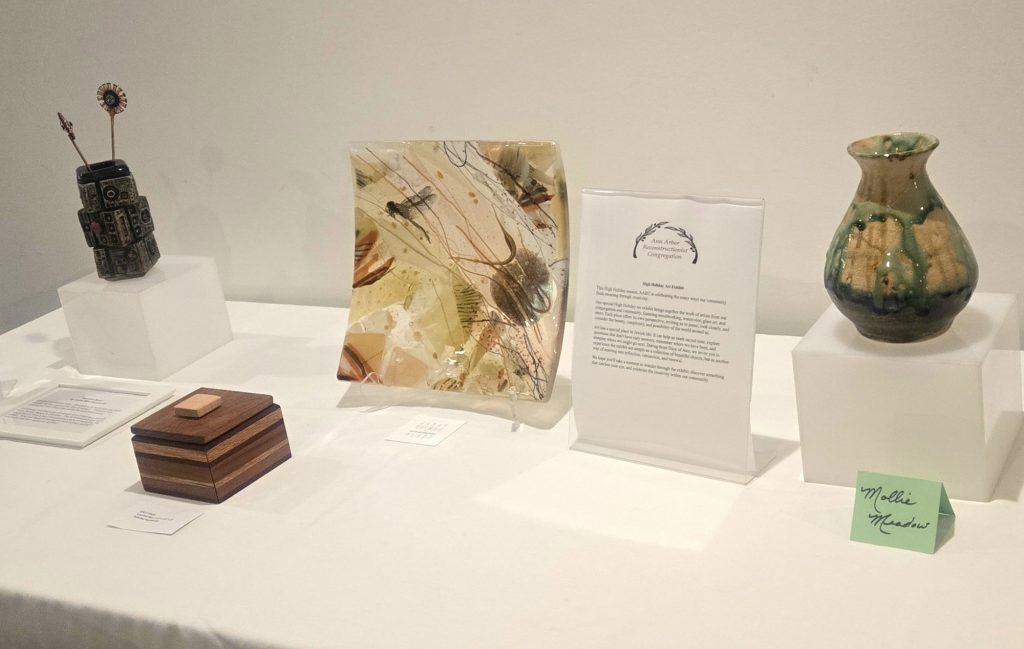
Rushing Water, by Janet Kelman


One of the pleasures of being part of the Ann Arbor Jewish community is meeting people engaged in fascinating intellectual, political, musical, and artistic endeavors. Recently, the Ann Arbor Reconstructionist Congregation (AARC) had an opportunity to showcase the artistic talents of its members in an exhibit at the First Unitarian Universalist Congregation of Ann Arbor. The range and quality of the work on display were impressive.


According to Rabbi Gabrielle Pescador, “Last year, the Ann Arbor Reconstructionist Congregation (AARC) launched AARC Creatives, giving members of our community an opportunity to share their creative work and talk about their artistic process. This year, we wanted to build on that idea by creating an exhibit. Since the First Unitarian Universalist Congregation—the home of AARC’s High Holy Day services—displays artwork throughout its building, we asked whether they might be open to exhibiting work by AARC members. They enthusiastically welcomed the idea and generously offered some of their exhibition space.”


Many wonderfully creative people in the AARC community—artists, artisans, and makers working in a wide range of media—embraced the opportunity to participate. AARC Executive Director Elizabeth Brindley served as the point person and coordinator for the exhibit.  “ It’s been wonderful to see the immense talent of our congregants, and the variety of emotions and moments captured in their pieces,” comments Elizabeth.  “The High Holidays are a time for reflection, and I think our Art Exhibit added to the depth and meaning of our High Holy Days together.“


Here are some of the featured artists and artworks:

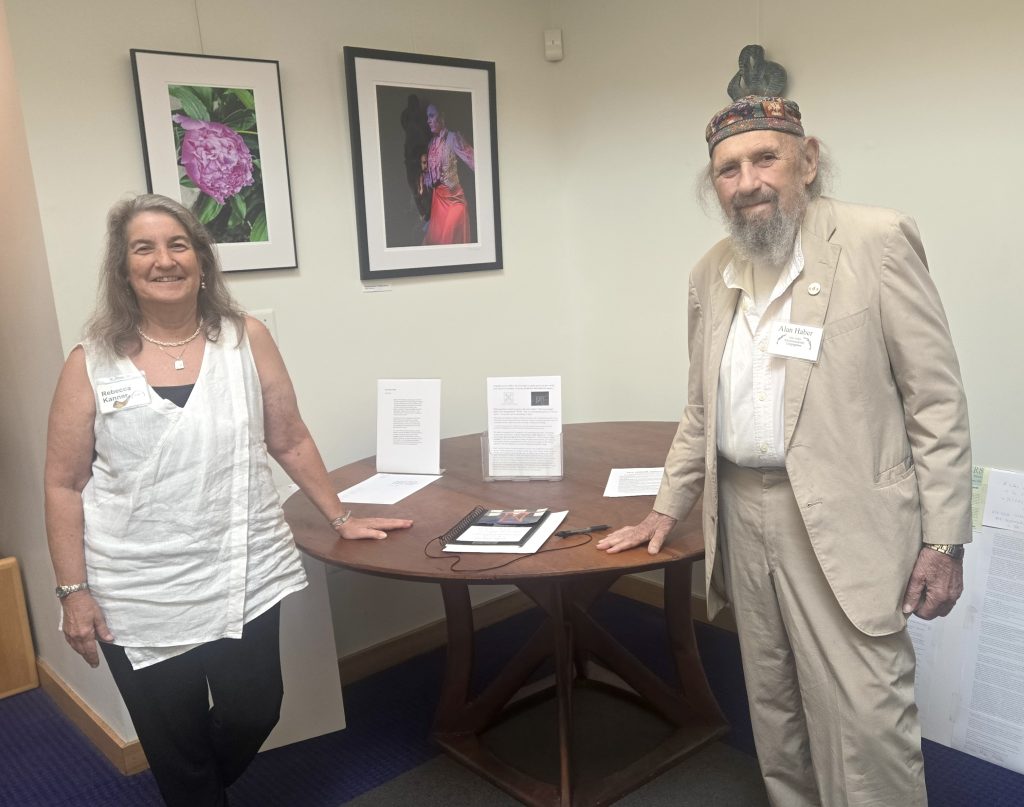
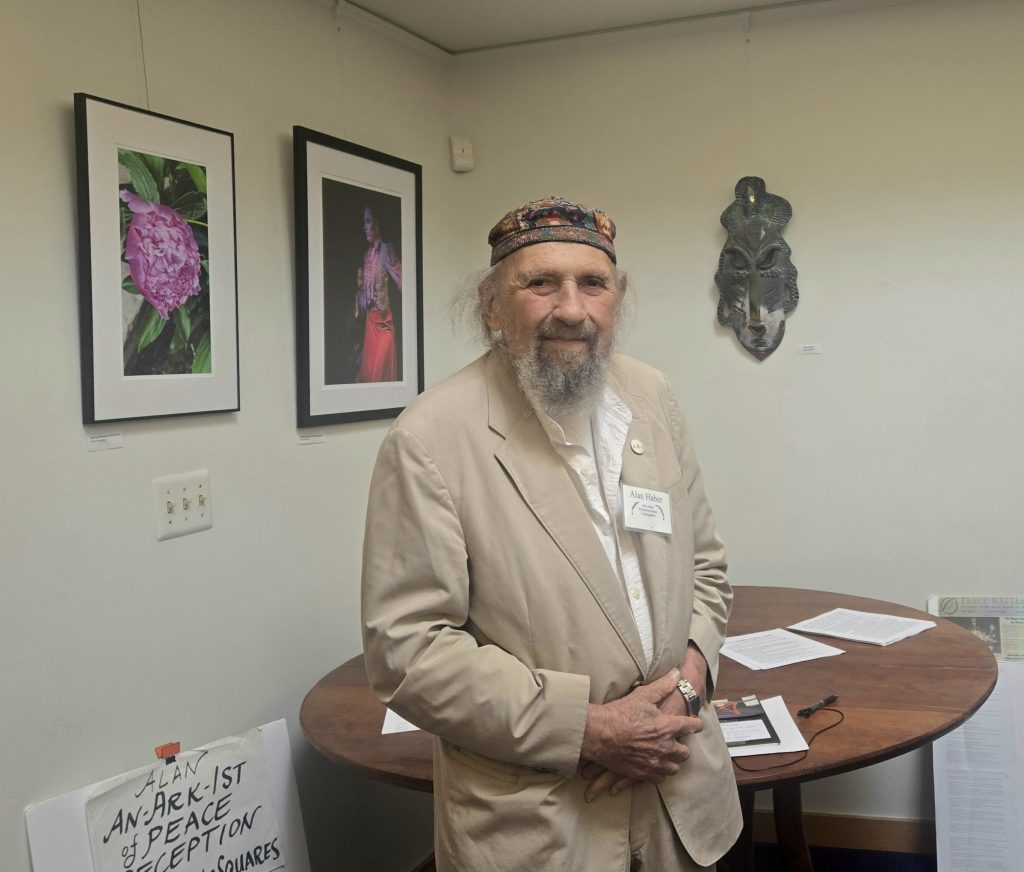
  • Alan Haber, a carpenter, exhibited a peace table that was used at The Hague Appeal for Peace in 1999 and hosted Nobel Peace Prize winners and, since then, notables of many faiths and traditions. 
  • Margot Neuhaus, a painter, sculptor, and photographer, displayed two photographs: Galapagos and Sandwater.
  • Leora Druckman, an emerging ceramic and multimedia sculptor, exhibited several examples of her work
  • Jack Edelstein displayed designs that incorporate the ancient symbol of yin and yang—also known as the Taijitu or Cosmic Dyad—an emblem of complementary polarity.
  • Janet Kelman, a glass artist, displayed a piece titled Rushing Water.
  • Paulo Neuhaus, a digital photographer,  displayed photographs of peonies in his Ann Arbor garden and a flamenco dancer in Málaga, Spain.
  • Idelle Hammond-Sass, a sculptor, jewelry maker, and painter, displayed a necklace and two watercolor paintings.
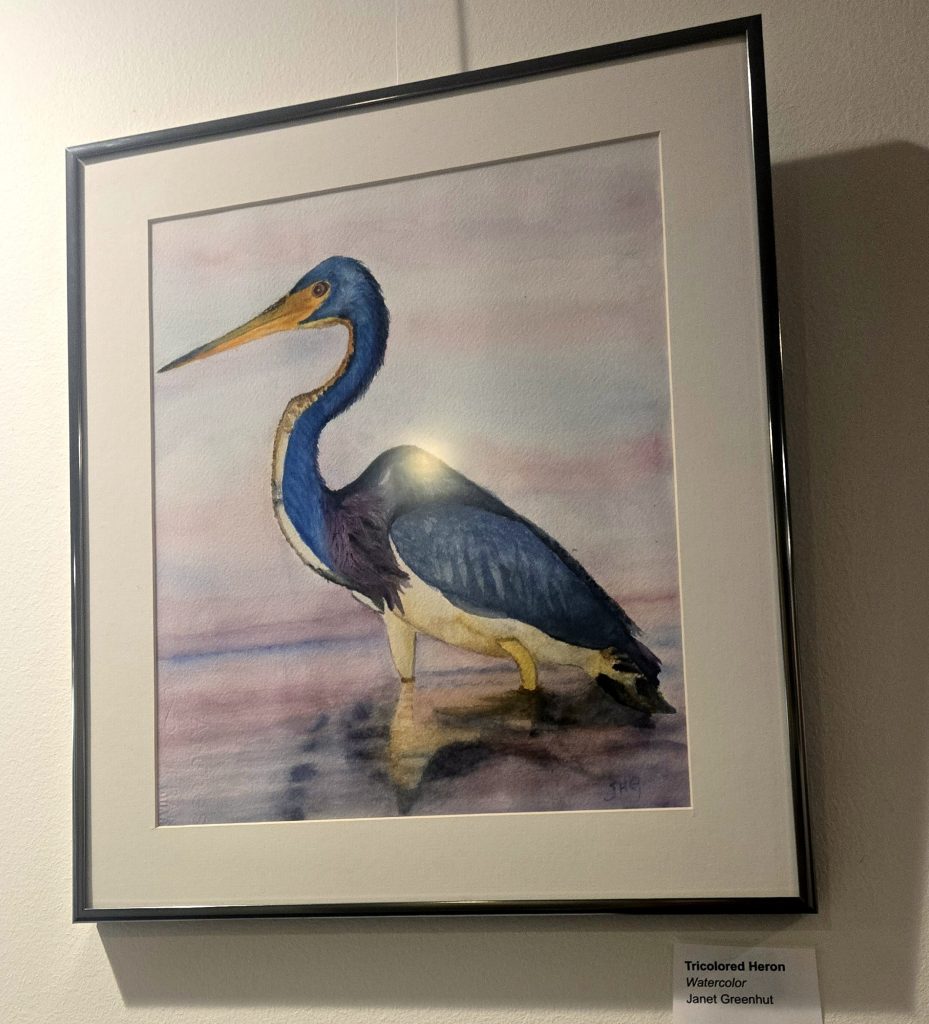
  • Janet Greenhut displayed a painting of a Tricolor Heron.
  • Mollie Meadow, a talented high school student (and our youngest participating artist),   displayed a ceramic vase she created at Interlochen Center for the Arts.
  • Sally Goldberg, a ceramic artist who is a member of the Ann Arbor Potters Guild, displayed a raku mask.
  • Dale Sass displayed a box made of select hardwoods

Love Hate, by Jack Edelstein

Painting by Idelle Hammond-Sass

Filed Under: Congregation News, Event writeups, Highlight

AARC Beit Sefer in September 2026 Washtenaw Jewish News

August 25, 2026 by Emily Eisbruch

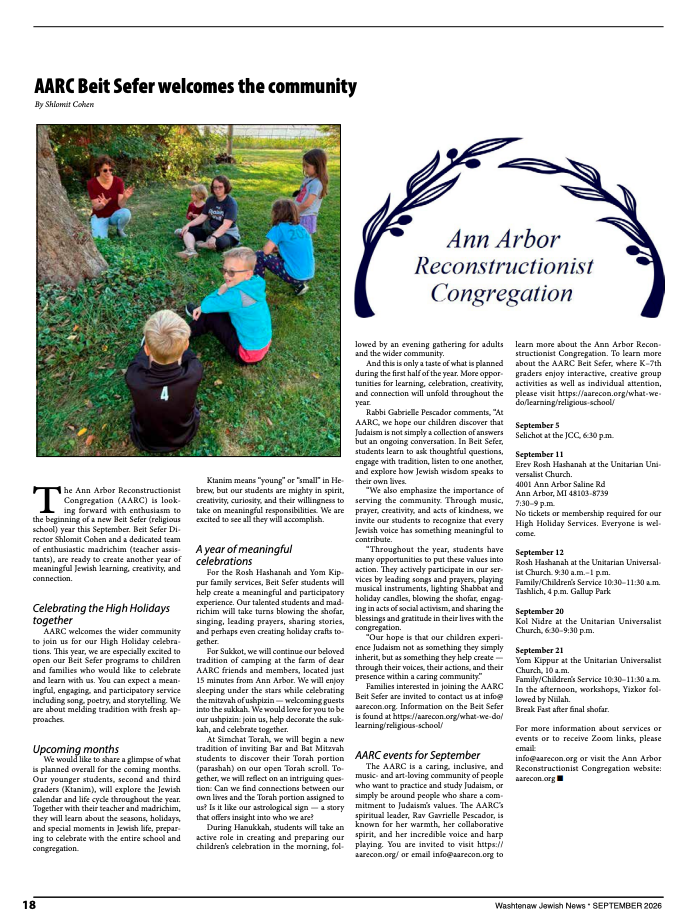
Appreciation to AARC Beit Sefer Director Shlomit Cohen for the article “AARC Welcomes the Community,” in the September 2026 Washtenaw Jewish News. The article talks about celebrating the high holidays together and upcoming meaningful celebrations. To read the article more easily, click HERE and scroll to page 18.

Filed Under: Uncategorized

AARC Board featured in the July 2026 Washtenaw Jewish News

June 28, 2026 by Emily Eisbruch

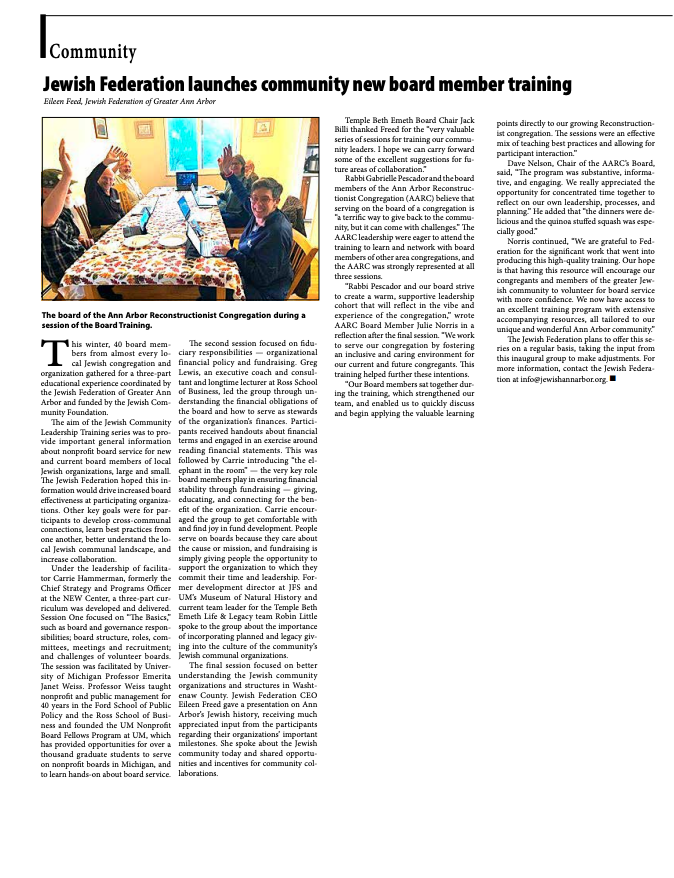
Thanks to Julie Norris who collaborated with Jewish Federation staff on this article in the July 2026 Washtenaw Jewish News. The article highlights board member training. You can read the article at THIS LINK, simply scroll to page 11.

Filed Under: Articles/Ads, Congregation News

Vegan Wine and Cheese – photos

June 6, 2026 by Emily Eisbruch

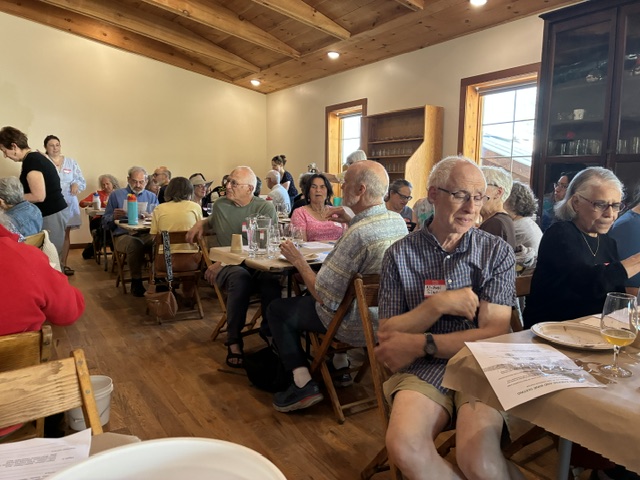
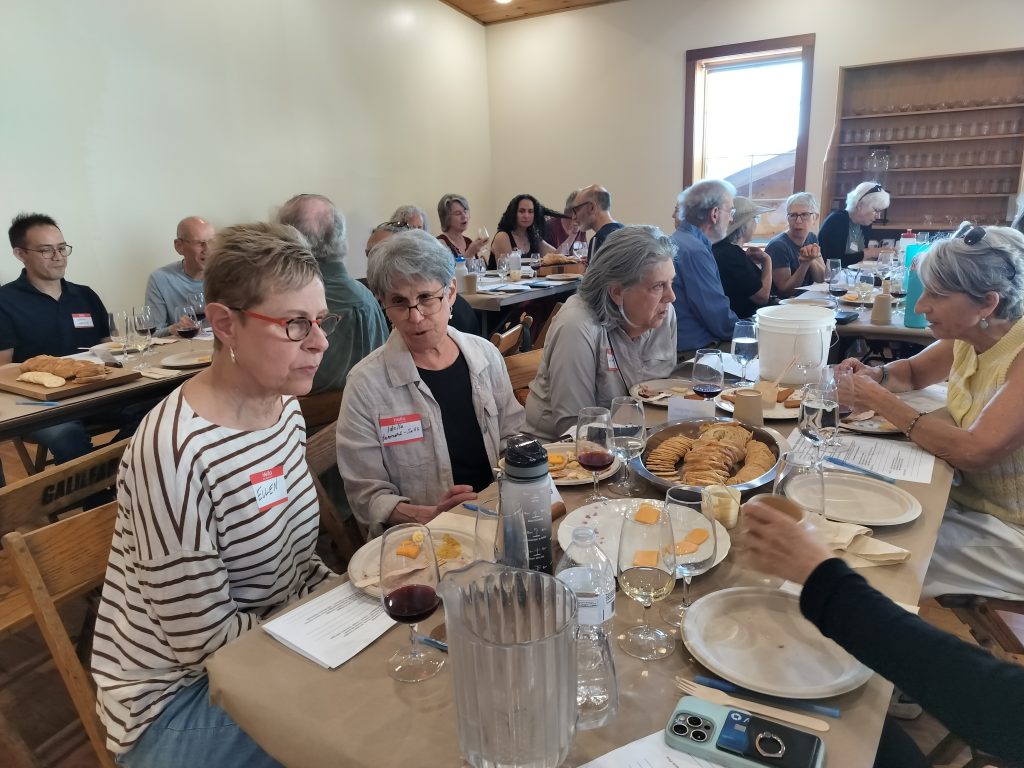
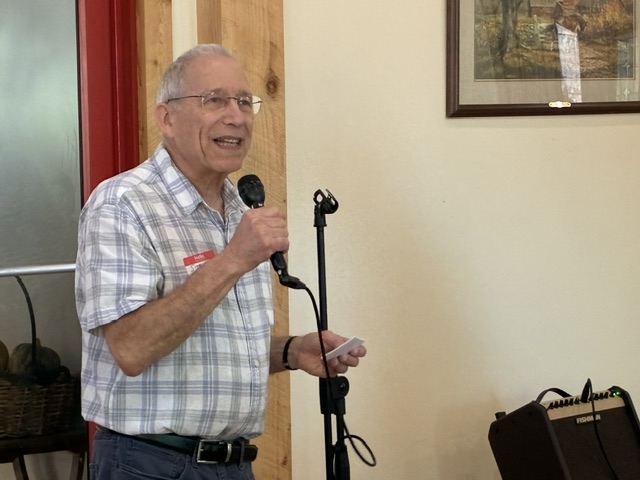
Thanks to the team who worked to make the May 2026 Vegan Wine and Cheese tasting a success. The special event — held at the Washtenaw Food Hub — highlighted the connection between our food choices and climate change. Here are a few photos for your enjoyment.

oplus_32

Filed Under: Event writeups, Food

Climate Action Shabbat article in the April 2026 Washtenaw Jewish News

April 3, 2026 by Emily Eisbruch

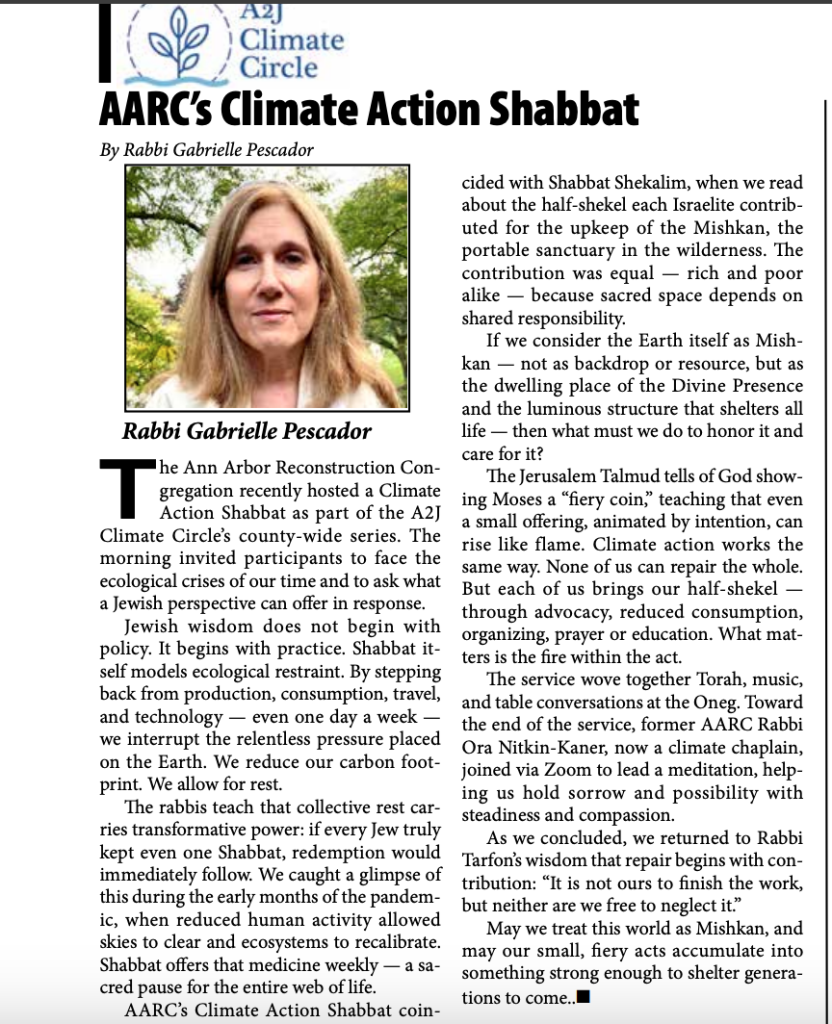
Appreciation to Rabbi Gabrielle Pescardor for this Climate Action Shabbat article in the April 2026 Washtenaw Jewish News. See page 20 HERE

Filed Under: Articles/Ads, Event writeups

Creative Spirit at the AARC Beit Sefer

March 27, 2026 by Emily Eisbruch


Thank you to Rabbi Gabrielle Pescador for this article, which appeared in the April 2026 Washtenaw Jewish News. See page 7 HERE


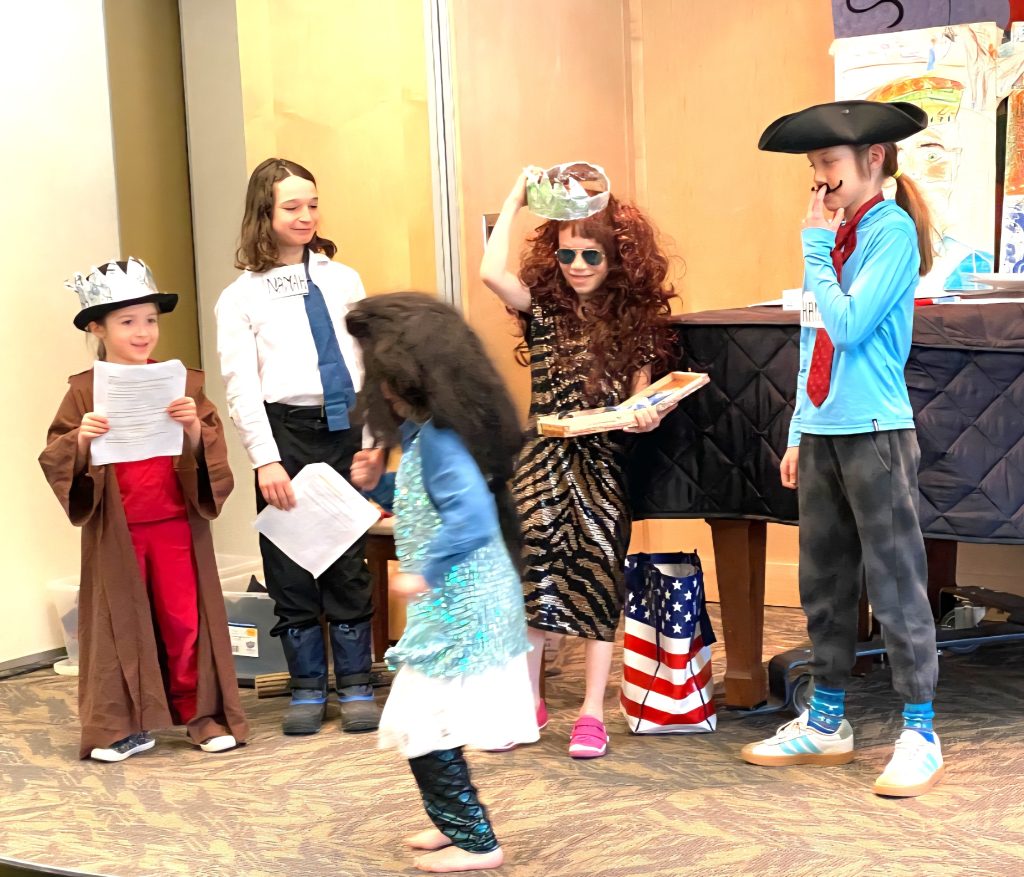
 For the past several years, the children and madrichim (teen leaders) of the Ann Arbor Reconstructionist Congregation Beit Sefer have taken on an unusual and joyful responsibility: they write their own Purim spiel.
 
Yes — the entire thing.
Not just acting it. Not just rehearsing lines written by adults. But imagining, scripting, adapting, and producing their own interpretations of the Book of Esther.
 
At first glance, it might look like a fun educational exercise. And it is. But it is also something deeper.
 
In Reconstructionist Jewish education, we don’t simply hand children inherited forms and ask them to replicate them. We invite them into the creative process of Judaism itself. We encourage them to see that Jewish tradition has always been a living, evolving conversation.
 
The Purim spiel — historically irreverent, satirical, and playful — is the perfect vehicle for this.
 
Over the past few years, our students have:

  • Set the Purim story in modern times
  • Played with contemporary political satire
  • Reimagined characters with surprising nuance
  • Written jokes only their generation could write

In doing so, they’ve learned something essential: Jewish ritual isn’t static. It is something we participate in shaping. For example, the setting for this year’s spiel started out underwater and ended up on the beach. It incorporated a running tongue-twister gag about a Shushan shoe store. It reimagined Haman’s defeat not as a hanging but as a demotion from palace advisor to shoe shiner.
 
Our madrichim, too, become co-creators. They guide, encourage, and sometimes gently redirect, and resist the urge to control. The result is not always polished, but it is authentic. It belongs to them.
 
In a time when so much of Jewish identity can feel inherited rather than chosen, giving our children authorship matters.
 
Purim itself is a holiday of reversals — hidden identities revealed, power structures flipped, laughter used as resistance. When our students write the spiel, they are not only retelling the story. They are enacting it. They experience what it feels like to speak boldly, creatively, even subversively within Jewish tradition.
 
Perhaps most importantly, they experience joy – and not as passive entertainment, but as active participation. When they stand on stage delivering lines they wrote themselves, they are not just performing Judaism. They are practicing it.

Beit Sefer director Shlomit Cohen notes:

“I’d like to pay homage to Marcy Epstein, a teacher in the U-M Comprehensive Studies Program and a past director of the AARC religious school. As director, Marcy led the families in a workshop on writing the Purim Spiel. This is a tradition that continues to be going strong and is passed on from student to student. As the current director, I wanted to honor this successful tradition, so I allowed the space for the students to write and run the show with a highly dedicated parent, David Speyer.”


In both the Friday night service and the children’s Purim Carnival, the children, dressed up and with noise makers in their hands, sang a quote from Pirkei Avot:
 “Mi Shenichnas Adar Marbin Be’Simchah” 
”משנכנס אדר מרבין בשמחה”
Translation: “When the month of Adar enters, we are joyous.” – We had a very happy Purim indeed!
 
“Learning about our traditions, interpreting them in meaningful ways, and emphasizing joy and creativity are key to the AARC Beit Sefer experience,” says Shlomit.

About the AARC

The AARC is a caring, inclusive and music- and art-loving community of people who want to practice and study Judaism, or simply be around people who share a commitment to Judaism’s values. The AARC’s spiritual leader, Rav Gavrielle Pescador, is known for her warmth, her collaborative spirit, and her incredible voice and harp playing. You are invited to visit https://aarecon.org/ or email info@aarecon.org to learn more about the Ann Arbor Reconstructionist Congregation.

To learn more about the AARC Beit Sefer, where K-7th graders enjoy interactive, creative group activities as well as individual attention, please visit https://aarecon.org/what-we-do/learning/religious-school/  

Filed Under: Articles/Ads, Beit Sefer (Religious School), Uncategorized

Purim 2026 – special photos

March 2, 2026 by Emily Eisbruch

Thanks to all the organizers of the AARC’s recent Purim celebrations and to everyone who participated.

Now is a chance to savor a few photos.

Filed Under: Beit Sefer (Religious School), Event writeups

A very fortunate three times Purim celebration!

February 20, 2026 by Emily Eisbruch

by Shlomit Cohen, AARC Beit Sefer Director

Judaism acknowledges the importance of our feelings: the Oy’s and the Ah! moments in our daily life, for example, by giving space and yearly practice to grief, in the month of Av, and to happiness and joy in the month of Adar. 

About the month of Adar – the month of Purim – the rabbis- (חז״ל) wrote:

״משנכנס אדר מרבין בשמחה״
When Adar enters, we increase in joy.

But Jewish writings have also asked the question regarding Adar: how can we order someone to be happy, and to rejoice? Especially in difficult times? 

The answer might be, specifically in challenging times like these, that we need to remind ourselves to rejoice and to be happy, as the Purim holiday teaches us:

  1. To congregate and gather as a community  – the importance of being together! (In contrast to what we all learned during pandemic about the pain of loneliness.)
  2. To make some noise when we hear the name of the wicked man – Haman.
  3. To play music as an expression of joy.
  4. To move and shake our bodies with dancing. 
  5. To be silly – by putting on costumes!
  6. To each delicious food – the sweet Hamentashen and sending the mishloach manot to friends and relatives, and the poor. Caring for the other is a joy!
  7. And even to drink – עד דלא ידע (until one does not know)

Our Purim costumes teach us the importance of being uplifted from the sorrow and pain of life, not by withdrawing from it, but with a sense of humor. And we have a whole month to practice it yearly!

And we cannot forget the importance of Jewish humor – our shared way of dealing with reality with a laughing eye. By practicing rituals and observing the holidays, we acknowledge and turn the difficult times in our shared history into a great gathering culminating in a festive meal.

Purim specifically and the month of Adar are great reminders for us to be happy! To have faith in God’s willing, good connections and a brilliant scheme, as Mordechai and Queen Esther teach us. That’s how bad luck can turn into good fortune. “Pur” – luck – can be changed. 

This year the AARC had bad luck or the misfortune of not reserving a space for our Purim celebration in advance. So instead of canceling the holiday all together, we decided to celebrate it twice, even three times!

  • First with the AARC Purim Kabbalat Shabbat – Friday night service on February 27, 6:30pm to 9:00pm
  • Second with a gathering for a Hamentashen baking party on Saturday, February 28 with a potluck at Carol Lessure and Jon Engleburt’s house, a long tradition for over ten years.
  • Third, on Sunday March 1 at Beit Sefer, the AARC religious school. 
    The kids read the megillah – in English! – make noise when the name Haman is said, and act out a purim shpiel (that took them 3 weeks of writing and preparation!). There will be song, dance, a costume parade, a questionnaire/quiz with prizes, Hamentashen… and more

The month of Adar is a truly happy, joyfully time of year! Happy Purim! 

Above: the AARC celebrating Purim in 2024

Above: the AARC celebrating Purim in 2016

Filed Under: Beit Sefer (Religious School), Upcoming Activities

Join the AARC book group with Rav Gavrielle on Sunday, March 15

February 9, 2026 by Emily Eisbruch

The Ann Arbor Reconstructionist Congregation (AARC) book group got off to a great start in 2026, reading and discussing The World We Knew, by Alice Hoffman, in January, and Hotel on the Corner of Bitter and Sweet by Jamie Ford, in February.

The AARC book group’s Sunday, March 15th meeting is eagerly anticipated as Rabbi Gavrielle Pescador will lead the discussion. The book chosen for March 15th is God Is Here: Reimagining the Divine, by Toba Spitzer. “This book was recommended by our AARC executive director Elizabeth Brindley,” explains Rav Gavrielle.

In a 2025 blog for the AARC, Elizabeth wrote:

“Mah nora hamakom hazeh! – “How awesome is this place!, Jacob exclaims this after realizing he has had a divine encounter while sleeping on the side of the road, using a rock for a pillow. He didn’t realize he was roughing it in the house of G-d, but lo! The phrase from the Torah portion, Vayetzei, first popped out at me a few years ago in Toba Spitzer’s God is Here: Reimagining the Divine. At the time I was new to working in the prison system, struggling to adjust to the environment, and trying to fill the ample amount of downtime I had as a government employee with some Jewish thought. The context Spitzer used it in, at the time, didn’t particularly speak to me, as reading the phrase a dozen times in the Torah portion apparently hadn’t, but this time the phrase stuck. What did it mean to really be here, in this place? Is any place holy if you’re present with it, or are there other conditions to this awesomeness?”

“As I’ve been reading God is Here, I find myself both personally and professionally intrigued,“ says Rav Gavrielle. “The “God-word” can be challenging for so many of us (myself included)—whether because of theology, upbringing, philosophical leanings, or simply the limits of language—and I appreciate the way Spitzer opens things up through metaphor, imagination, and lived experience. I’m excited to see where this will take our conversations.”

If you would like to read the book God is Here: Reimagining the Divine and participate in the AARC book group’s March 15th lunch and discussion, please contact Greg Saltzman at gsaltzman@albion.edu.

photo of Rav Gavrielle leading the AARC book group in January 2025

Filed Under: Books, Upcoming Activities

Tu B’Shevat as a Bridge: Growing Jewish Connection Across Communities

January 11, 2026 by Emily Eisbruch

This article was written by Rav Gavrielle Pescador for the Feburary 2026 Washtenaw Jewish news.

At a time when many Jews feel fractured—by politics, by ideology, or by communal boundaries—Tu B’Shevat offers a powerful counter-narrative. Known as the “New Year of the Trees,” this holiday invites us to slow down, notice what is growing, and remember our shared roots. More than a seasonal marker, Tu B’Shevat centers values that are urgently needed right now: interdependence, renewal, gratitude, and care for the earth and for one another.

This year in Ann Arbor, Tu B’Shevat is being celebrated not by any one congregation alone, but through collaboration across the local Jewish community. On Sunday, February 1, 2026, community members of all ages will gather at the JCC from 10am to noon for a daytime Tu B’Shevat celebration that brings together multiple organizations and perspectives.  There will be a variety of arts/craft/planting activities in the JCC Newman Lounge.  Shlomit Cohen, the director of the Ann Arbor Reconstructionist Congregation (AARC) Beit Sefer (religious school), is part of the community-wide programming for Tu Bishvat. “One of the activities that we are excited to offer is bringing the different colors from nature and making colorful fun tie-dye with the children,” comments Shlomit.

Later that evening of February 1, at 7:00pm, a different kind of collaboration will unfold. Clergy and members from the Ann Arbor Reconstructionist and Jewish Renewal communities will come together to lead a joint Tu B’Shevat seder. Drawing on traditional ritual structures while inviting creativity, song, and reflection.
What makes this collaboration especially meaningful is Jewish Renewal and Reconstructing Judaism have a lot of affinity.  Both are deeply engaged with tradition, yet embrace the opportunity to reinterpret it in light of modern life. Both emphasize ethical responsibility, spiritual depth, inclusivity, and a Judaism that speaks to the heart as well as the mind.


At the same time, their differences add texture to the collaboration. Jewish Renewal often foregrounds embodied spirituality, music, mysticism, and ecstatic prayer while Reconstructing Judaism emphasizes historical consciousness, democratic process, and thoughtful engagement with evolving Jewish civilization. When these approaches meet, and they often do, the result is not dilution, but enrichment providing multiple doorways into shared Jewish life.

Rabbi Elliot Ginsburg of Pardes Hannah, Ann Arbor’s Jewish Renewal chevre, notes “the Seder for Tu Bishvat invites us to experience an expansive understanding of the divine life-force while helping us appreciate the deep ecology of our own lives. The Seder Tu Bishvat historically draws on kabbalistic understandings of divinity as a Tree of Life with its roots in the Infinite. In this model, earthly life may be seen as leaves and fruit on the tree, energetically connected to the Source. From an ecological perspective,Tu B’Shevat, with its imagery of roots and branches, soil and fruit, reminds us that healthy ecosystems depend on diversity. So do healthy communities. When Jews gather across lines of denomination and ideology, we model a Judaism that is resilient, relational, and alive.“

In a season when public discourse so often pushes us toward division, these Tu B’Shevat gatherings invite something else: to come together, to plant seeds of connection, and to celebrate what can grow when we choose collaboration over separation.  |

Rabbi Aura Ahuvia, who has strong roots in Ann Arbor’s Reconstructionist and Jewish Renewal communities, states: “I’ve felt a rising need for community with every passing month. The news, social media…it all feels oppressive and manipulative. I’ve been seeking the salve of simple connection, to be reminded that when we come together, in-person, as ourselves, we’re capable of enjoying each other’s company and even solving our problems together. Celebrating life as it reawakens within and between us feels like exactly the right thing to do right now.”


Filed Under: Articles/Ads, Beit Sefer (Religious School), Event writeups, Rabbi's Posts

  • Page 1
  • Page 2
  • Page 3
  • Interim pages omitted …
  • Page 10
  • Go to Next Page »

Primary Sidebar

High Holidays 2026/5787

AARC’s High Holiday services are open, ticketless, and available to all, in person or online. Join us!
View the schedule and all the info

Search

Join Our Mailing List

Sign up for our twice a week newsletter to get details on upcoming events and catch up on our latest news.

This field is required.

Check your inbox or spam folder to confirm your subscription.

Upcoming Events

  • 6:30 pm – 9:30 pm, September 20, 2026 – Kol Nidre
  • 10:00 am – 10:00 pm, September 21, 2026 – Yom Kippur Services
  • 6:30 pm – 8:00 pm, September 25, 2026 – Fourth Friday Kabbalat Shabbat
  • 10:30 am – 12:00 pm, October 10, 2026 – Second Saturday Shabbat Morning Service
  • 12:00 pm – 1:30 pm, October 11, 2026 – New Perspectives, Timely Conversations: Elliot Ratzman

Latest News

  • Exhibit Showcases AARC Creativity September 10, 2026
  • D’var Torah Shelach by Elliott Levinson-Brennan September 1, 2026
  • AARC Beit Sefer in September 2026 Washtenaw Jewish News August 25, 2026
  • D’var by Wesley Jackson August 19, 2026
  • Rosh Hashanah La’Behemot Celebration August 12, 2026

Footer

Affiliated with

Copyright © 2026 Ann Arbor Reconstructionist Congregation