• Skip to primary navigation
  • Skip to main content
  • Skip to primary sidebar
  • Skip to footer
Ann Arbor Reconstructionist Congregation

Ann Arbor Reconstructionist Congregation

  • Home
  • About
    • Overview
    • Rav Gavrielle Pescador
    • Our History
      • Photo Gallery
    • Our Values and Vision
    • LGBTQ Inclusive
    • Our Board
    • Our Sacred Objects
    • About Reconstructionist Judaism
    • Jewish Ann Arbor
  • Programs
    • Shabbat and Holidays
    • B’nei Mitzvah
    • Tikkun Olam
    • In the (Washtenaw Jewish) News
    • Health and Safety Expectations for In-Person Gatherings
    • Join our Mailing List
  • Religious School
    • About Beit Sefer
    • Teachers
    • Enrollment and Tuition
    • 2025-26 Beit Sefer Calendar
  • Blog
  • Calendar
  • Membership
    • Thinking about joining?
    • Member Area
  • Contact Us
  • Donate

Posts by Members

Shabbat Shuvah Sermon: The Importance of Reset Buttons in a Year of Upheaval and a Time of Tshuvah

September 27, 2020 by Gillian Jackson

Deborah Kraus

Shabbat Shuvah is the Shabbat between Rosh Hashanah and Yom Kippur. As the name implies, it continues the holiday themes of t’shuvah, repentance and return.

Before I begin, I want to say something because as I struggled to write this drash, I couldn’t quite rid myself of the thought, “people don’t want to hear about this.  They want something really political that speaks to the moment.” 

Nonetheless, I persisted, and wrote this anyway.  Primarily because it’s what I agreed to write, but also because of my strong belief that if we don’t figure out how to help ourselves in times like this, we can’t have the energy to help others or the world.

In this week’s Brene Brown’s podcast Unlocking Us (which I highly recommend) she refers to an article by Adrian Farrow, entitled “Your Surge Capacity is Depleted; it’s Why You Feel Awful.”  It’s about how we cope (or don’t) when an acute situation, like the pandemic, becomes a chronic one.  It includes the term “resilience bank account,” which for most of us was depleted a long time ago and discusses how to get it back, most notably “to step into a more spacious mental space that allows you to do things that are constructive instead of being mired in a state of psychological self torment.”

And with that intro, here goes. 

Like many of us, I think of High Holidays as being the great time of resetting.  If we only do it once a year, this feels like the right time.  

How have we gone off our course?  

How might we even want to redefine our course?  

Is our course even possible any more?

Of course, this has been a particularly challenging year, even for those of us privileged enough to not have the rug pulled out from under us on a regular basis (I count myself among you if that is not yet clear)!  Think back to March and the frantic search for disinfectant wipes and toilet paper, when we were first confronted with the question of what is truly necessary to sustain us through what we thought was just going to be the next few days, maybe weeks.

And as days and weeks turned into months, and plans changed and were canceled, when we all started to ache for our connections and began to feel trapped in our homes, when those in our midst began to really annoy us—we did another reckoning of what was truly necessary, this time to sustain us through the few next months.

And, need I remind any of us that the problems of the world didn’t stop.  There were more black people killed with the subsequent long awaited beginning of a racial reckoning, there have been wildfires and disastrous hurricanes, there’s a recession, and of course there’s the almost complete erosion of democracy and the culture of caring in our country.  Topped off by the passing last Friday night of our hero and icon, Ruth Bader Ginsberg.

While “reset button” is not the word most people think of first in referring to 2020, (I believe that word would be…never mind; you fill in the blank), this whole year has been one long series of reset buttons as COVID has magnified every single crack in ourselves, our families, our communities, our nation and our world.

We have proven to ourselves both how adaptable we can be, as well as how inflexible we can seem when there’s even just a little extra stress, a little unexpected anything.  At some point in the last 6½ months, we have all been at our breaking points a few times.

In fact, rather than being THE resetting time, the High Holidays this year feels like a time to look around us and inside ourselves and all breathe a sigh of relief for having gotten though to this occasion.  Shehechiyanu!

Nonetheless, when Rabbi Ora asked what I’d like to do a reflection on for High Holidays this year, I suggested this concept of reset buttons.   I think of bowling alleys from my youth, impatiently pushing the button when the pins got stuck or my preferred bowling ball did not immediately return.  Or we could think about the restart mechanism on our laptops and phones: we’ve learned that the first thing to try when something freezes or malfunctions is to restart it.

For some of us this reset has meant taking inventory.  

What is truly essential to live a contented life?  

Who is essential, both to society and to us?  

and

How are we adjusting? 

What have we learned from this experience?  

And I figured since I posed the questions and have another couple of minutes, I should answer them!

First, I have a renewed sense of my privilege.  I am lucky enough to be able to work from home and that I have a home that I love.  Much as I miss my daughter, I am glad she is launched, because anyone who is in transition has had such a harder time.  I have enough money to see me through. I live, as most of us do, in a bubble that has kept us safe because others take their health seriously and have the resources to do so. And most of us have skin color deemed not threatening.  I’m absolutely not trying to minimize what this pandemic has been like for anyone with a less full backpack of privilege.  

Next, I have become even clearer on what I need to be psychologically OK and that is connections.  At least once a day, I need a quality connection, outside of my work (which is full of them; I am a psychologist and connecting is my job).  And connections have abounded.  My close friends have become closer, generally through our weekly walks, usually, but not always, on the phone.  In fact, one of my closest friends moved to NJ during this time and I venture to say that in terms of our connection, I barely noticed.

Third, there’s been a renewed commitment to my health.  Being of the age bracket deemed vulnerable, and having had some health concerns that make me more so, I doubled down.  Walking at least my 10K steps and logging my food every day has turned into a discipline that reminds me to “change the things I can” when there’s so much of this world that I need to “accept that I cannot change.”

Fourth, I have learned I can do with less.  Life is simpler.  And I’ve been relieved to have more time to myself.  There has been less FOMO; I mean we’re all missing out!  The great equalizer!

But the next one is in direct contradiction to this last one.  While I can do with less, and my history is to “adapt, adapt, adapt,” my newest realization is that I some areas, pushing for more is a radical act.  None of us know how much time we have left in the world, and as Nadine Stair’s poem says, 

“If I had my life to live over, I’d dare to make more mistakes next time. I’d relax, I would limber up. I would be sillier than I have been this trip. I would take fewer things seriously. I would take more chances. I would climb more mountains and swim more rivers. I would eat more ice cream and less beans. I would perhaps have more actual troubles, but I’d have fewer imaginary ones.

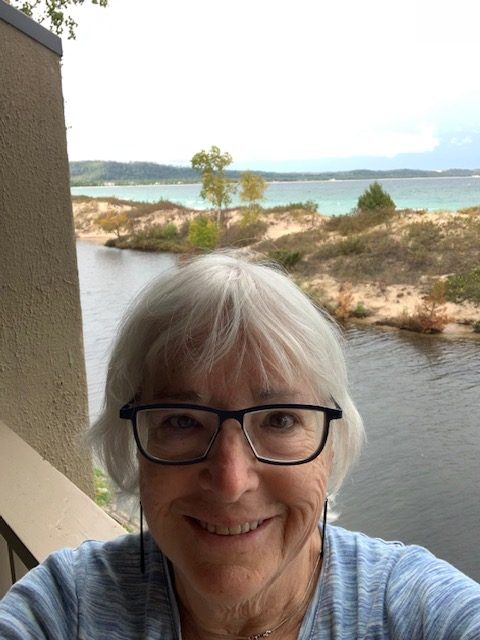
So instead of saying an automatic “no” to my wants, I’m figuring out what parts of my wants can be possible.   Which is why I’m coming to you tonight from Glen Arbor, aka “my happy place,” where I have been since second day Rosh and will be till next Wednesday.  Yup, I’m spending Yom Kippur contemplating at the lake.

This great idea wasn’t mine.  But I’m glad someone asked me why, if I hadn’t gotten enough lake on my vacation, why I couldn’t go back up, since work is portable right now.  That’s the thing: despite my persona, I just don’t think outside the box enough. 

I imagine that’s what Nadine was thinking when she wrote that poem.

Because if not now, when?

In summary, I’ve stopped saying, “I can’t wait till things get back to normal,” 

because no one knows if that will ever happen, or what the new normal will look like,

because I believe that the real test of this reset button and this time of reflection is in what we will automatically go back to by next year,

And lastly,

because I believe that if we have learned nothing in this time– if we reset automatically to how things were– that  will have been the true missed opportunity.

Questions for Discussion:

What are the things you have learned through this pandemic and which of these lessons do you want to keep or expand upon as we think about post-pandemic?

Despite all the death, financial problems and governmental heartlessness, are there ways that the pandemic has been good for the world?

Does this concept of extended time of reset resonate for you, and if so, has it changed your high holiday experience?  If so, how?

Filed Under: Posts by Members Tagged With: high-holidays-2020, posts by members

Unique Opportunity to Commemorate Tisha b’Av 5780/2020

July 20, 2020 by Gillian Jackson

By Rebecca Epstein

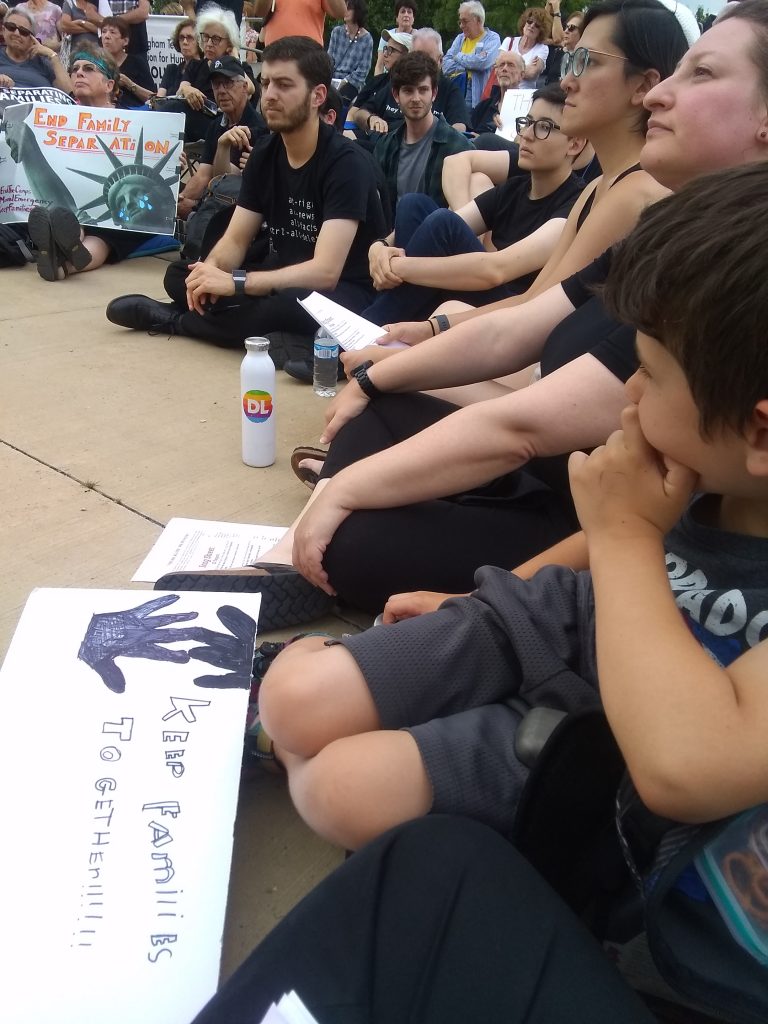
Bend the Arc Demonstration in Dearborn. Photo Credit: Rebecca Epstein

Tisha b’Av (literally the 9th of Av) is a day of collective mourning, the saddest day of the Jewish year. It marks the destruction of the First Temple in 586 BCE and the Second Temple in 70 CE, but also symbolizes other tragedies, including the Holocaust and Pograms. The day is traditionally observed by fasting and reading the Book of Lamentations. Lamentations is a collection of five poems about the destruction of the Temple. Its theology is straightforward: God inflicted this terrible punishment because Israel was sinful. According to the Babylonian Talmud, the sin was sinat inam, baseless hatred, that is, the cruelty of our speech and actions toward others. However, the rabbis taught that transgression is also the ill feelings we carry in our hearts, which damage those who hold them and destroy those they are aimed against. Today, Tisha b’Av serves as a call to name systemic racism as the source of baseless hatred in our time and to take action to eradicate its roots and results. Mourning what is lost should inspire us to build a better future.

This Tisha b’Av, Bend the Arc Jewish Action: Greater Ann Arbor invites AARC to mourn the overwhelming violence against Black people in this country and commit to working to transform the systems and institutions that uphold and perpetuate this violence. 

Join Bend the Arc for a protest that is also a religious service, with lay-led rituals and readings connecting our Jewish mourning with calls to #DefundthePolice. No knowledge of the holiday or the Jewish ritual is needed; explanations will be provided. If you have them, we encourage you to wear kippot and/or tallit. Note that a tradition of this holiday is sitting on the ground.

Time: Wednesday, July 29 10:00 – 11:00 a.m.
Location: East Ann Arbor, outdoors, exact location information available to registrants only.

*** Plan on wearing a mask and keeping 6 feet away from fellow attendees***
    
Register here

As an alternative to this in-person event, or in addition to, contact your county commissioners and city councilmembers. Ask them to defund the police and redirect those funds to social services like public health. Questions can be directed to rebeccadanaepstein@gmail.com.

Filed Under: Posts by Members Tagged With: black lives matter, tish bav

AARC To Co-Host Rabbi Arik Ascherman Lecture on “The Challenges For Torat Tzedek”

May 11, 2020 by Gillian Jackson

Co-written by Gillian Jackson and Martha Kransdorf.

On Thursday, May 14th at 1pm, Rabbi Arik Ascherman will give an online lecture about the work of the Israeli human rights organization Torah Tzedek and social justice in Israel in the context of the Coronavirus pandemic. AARC will co-host the event, along with the Jewish Community Center of Greater Ann Arbor, Beth Israel Congregation’s Social Action Committee, the Jewish Cultural Society, Pardes Hanna, and Temple Beth Emeth’s Social Action Committee.

AARC’s Martha Kransdorf has been instrumental in the organization of this event. Martha urges AARC members to sign up on the JCC’s website to reserve a spot for the lecture.

Rabbi Ascherman was scheduled to visit us in late March but like so many, had to cancel his trip. We hope to reschedule his in-person appearance at some point in the not-too-distant future. In the meantime, we are lucky to be able to hear his perspective on the current complex developments in Israel. Perhaps you have had a chance to hear and learn from Rabbi Ascherman during previous visits; perhaps this will be your first time. Whatever the case, we are certain you will find him to be an inspirational speaker, particularly in his insistence that peace and human rights are achievable.

We look forward to seeing you there!

Filed Under: Posts by Members, Upcoming Activities Tagged With: covid-19, Israel/Palestine, Rabbi Arik Ascherman, Torah Tzedek

New COVID-19 page on website with updates and resources

March 23, 2020 by Mark

By Mark Schneyer

AARC’s website now features a page on pandemic-related issues for the benefit of our community. It includes:

  • The latest updates on how we are shifting services and programming online and how you can participate;
  • Links to resources to get or give help in our community; and
  • A cumulative and continually updated list of Rabbi Ora’s links to music, meditation, chanting, and rituals, as shared in her emails.

The page can be reached from the menu throughout the site and directly at https://aarecon.org/covid-19-information-resources/. I hope you’ll check it out soon and continue to seek it out whenever you need it during this challenging time.

Filed Under: Posts by Members Tagged With: covid-19, Pandemic

Sam Ball’s Dvar Torah: Lech Lecha

December 8, 2019 by Gillian Jackson

Hello everybody! Thank you for coming to my bar mitzvah! The name of my parshah or my torah portion is Lech Lecha, which is in the book of Genesis. Lech Lecha means “Go forth,” which is what God said to Abram: “Go forth from where you call home and go to the place where I tell you.” And Abram and Sarai did. By the way, Abram and Sarai are called Abram and Sarai because they hadn’t yet gotten their second names of Abraham and Sarah from God.

First Abram and his wife Sarai went to Canaan. They then went to Egypt. When they got to Egypt, Pharaoh saw how pretty Sarai was. Sarai was taken into Pharaoh’s palace and she received lots of gifts, like cattle and camels and slaves. After some time in Egypt, Abram and Sarai left to go back to Canaan.

Ten years passed in Canaan and Sarai, who wanted to get pregnant, still couldn’t. After ten years of not being able to get pregnant, Sarai gave up in frustration. So she gave her slave named Hagar to Abram and Hagar got pregnant very quickly. Once she became pregnant, Hagar began to act like she wasn’t a slave. Hagar mocked Sarai and refused to do what she was told. As it says in my parshah, “. . . her mistress was lowered in her esteem. . . .” 

Sarai was angry after being mocked by Hagar, so Sarai treated Hagar very disrespectfully. So Hagar ran away. An angel found Hagar and told her to go back to Sarai and Abram’s house because God promised to grant her a great multitude of descendants. Hagar went back and later gave birth to Ishmael.

Why did Sarai act the way she did? I think that at first, Sarai wanted someone to blame for her not being able to get pregnant, so she experimented by giving Hagar to Abram. Maybe she thought that if Hagar wasn’t able to pregnant, then the problem would be with Abram. But since Hagar did get pregnant, maybe Sarai knew that the problem was with her. And instead of accepting this fact, she denied it and treated Hagar poorly by oppressing Hagar and returning her to her former slave status.

I also think that maybe Sarai gave Hagar to Abram because Sarai wanted to be faithful to the role God had promised her, that she would be the mother of a great nation. But when Hagar started acting less like a slave and more like Abram’s wife, Sarai became angry that her role as Abram’s partner was taken. I believe that for these reasons, it was a contest of priorities for Sarai.

So far I’ve only talked about Sarai’s feelings. But what about Abram’s?

Before Sarai returned Hagar to her slave status, she counseled with Abram, complaining about Hagar. Abram said “. . . your maid is in your hands, deal with her as you think is right.” Essentially Abram said, she is your slave; do what you will to her. I think that Abram was either feeling that the situation wasn’t his problem and he shouldn’t be the one to deal with it. Or he felt that if he interfered that he would make the situation worse.

How did Hagar feel about all of this? 

I believe that Hagar was feeling that she was being cheated. The reason for this is first Hagar was a slave and she then was raised from her status of slave to wife. Then she was put back down to slavery even while she was pregnant with Ishmael. I would feel cheated if I was raised in status and then put back down again because someone was feeling jealous. I believe that Hagar thought that she was being cheated of what she rightly deserved as the person who was pregnant with Abram’s son.

I think the reason that we have all of these stories in the Torah is so that we can learn from them the easy way and not have to learn them the hard way. The easy way is getting the lesson early and not having to experience the challenging situations for ourselves. And the reason we go deeper into the Torah’s characters in the stories is because we need to understand their opinions and motivations if we are going to understand the story itself. 

Why do we have stories in general? I have learned about the collective unconscious, which is a part of our minds that connects us to everyone else, even though we don’t know it, and causes people everywhere to invent the same stories. Humans of all history and cultures have the same basic storyline for all our myths and legends – a storyline of people seeking something they need, like Jason and the Argonauts or King Arthur and his quest to find the Holy Grail, or the Buddha searching for Enlightenment or Moses and the Exodus. We all tell similar stories because there is a link between humans. Stories teach us about being human by giving us meaning.

When I read a story, I get sucked into the world of it, and the real world around me goes away. I don’t become the characters, but I observe the characters, and I can see from their point of view, like looking through their eyes. Stories show us that we are always connected with everyone else, even when believing that we are alone. 

The Torah is full of both stories and laws. Laws give us practical guidance of what not to do, like don’t murder or steal. While those are actions that we shouldn’t do, stories help us understand how to navigate emotions and thoughts ethically.

The stories in the Torah help us learn and grow and discover how to be good people. God uses stories to teach us because if we only had strict laws, we wouldn’t be able to think for ourselves and there would be no freedom. We have a considerate and forgiving God who wants us to interpret and understand. God lets us make mistakes so we can learn from them.

This takes me back to Sarai. God didn’t interfere in her life except minimally, and allowed Sarai to make her own mistakes. Sarai wasn’t perfect, and Abram wasn’t perfect. They made mistakes and improved from them. And the stories about them impact us even today because Sarai and Abram were so human. We can relate to them because we deal with the same issues and temptations, jealousy, guilt, hatred and joy.

Stories connect us all. Maybe the collective unconscious is there because we all have a little bit of God in all of us, and the little bit of God is the connection.

In our congregation, we have a custom of asking the community a question to generate discussion towards the end of a dvar Torah. I have a couple of questions for you at this point: “Why do you think stories are important and what stories have helped you find meaning in your lives?”

I want to thank all of you for coming to my bar mitzvah. I appreciate it. Thank you especially to those who are coming out of town. I want to thank Deb for tutoring me and giving me lots of support to help make this happen. I want to thank Rabbi Ora for helping me make this speech. And most of all, I want to thank my loving, supportive parents for making this happen!

Shabbat shalom!

Filed Under: Posts by Members Tagged With: bnei mitzvah

Meet the Mitzvah Committee

December 2, 2019 by Gillian Jackson

Connection: an essential ingredient of a caring community

Written by: Anita Rubin-Meiller

“Mitzvah comes from the root word tzavta, which means connection. There are 613 mitzvot, and therefore, 613 ways to connect to G-d.”

Rabbi Zushe Greenberg

I appreciate this definition of mitzvah, which goes beyond doing a good deed or following a commandment, and adds connection as an essential ingredient. Certainly, in this past year of chairing the committee, the experience of connection is what stands out. Whatever we engage in involves connection: arranging for help to set up for the joyful celebration of a B’nai Mitzvah; accompanying someone in their grief and assisting with shiva; doing our best to find someone a ride to services and events; or gathering together for our quarterly “coffee and catch up.” Connection is not only the heart and soul of our mission, it is what makes the efforts worthwhile.

As we approach the annual congregational meeting, I want to pique your curiosity about this important committee and ask that you consider joining in our efforts. At the moment six of us pair up to take care of requests as they arise. While we have done well pitching in this year, it is apparent to us that we could use additional members, as we are not always able to be available when needed. 

The mitzvah committee is designed to assist in meeting commonly arising needs of our congregation’s members. This past year we helped with the Bar Mitzvah celebrations of Jacob Resnick, Eli Revzen, Otto Nelson, and Sam Ball. We assisted with the shiva observances in the homes of Amy Rosenberg, Deborah Fisch, and Carol Lessure. We helped organize a meal train for Alice and Ryan as they welcomed their little one. And we did our best to try to secure rides for members when there was a need. 

The committee currently consists of Rena Basch, Mike Ehmann, Idelle Hammond-Sass, Amie Ritchie, Stephanie Rowden, and me. We have enjoyed deepening the connection among us in meetings over coffee at York, with conversations about how we have felt supported or challenged in the past few months. We would love to welcome you to our next meeting on February 9th.

If you are not able to join the committee, please consider completing our survey so that we may call on you for specific tasks when the need arises. The survey can be found at https://docs.google.com/forms/d/1HNkIfCEHWaN1T-EevfbrPx8E8n7UVm9icNtVhVIoEqc/edit

Please come to our “roundtable” at the December 8th congregational meeting to learn more!

Filed Under: Posts by Members Tagged With: Ann Arbor Reconstructionist Congregation, mitzvah, mitzvah committee, Reconstructionism

Happy 5th Birthday to AARC Book Group

October 27, 2019 by Emily Eisbruch

Happy 5th birthday to the AARC book group! Launched in 2014 by Jon Sweeny and Judith Jacobs, the group offers a welcoming and cozy environment in which AARC members and friends gather for intellectually stimulating discussion, friendship, networking, and nourishment. Over the years, the reading selections have ranged from a book about Tiananmen Square (our very first meeting) to books about Israel/Palestine, Jewish history and culture, politics, spirituality, death and dying, anthropology, and more.

Carol Levin comments, “My favorite things about the book group have been getting to know everyone (as a newcomer to AARC, it’s a great gateway to the community), stimulating discussion among a variety of backgrounds and experiences, and Greg and Audrey’s fabulous hospitality.”

Speaking of hospitality, appreciation is owed to everyone who has hosted the AARC book group over the years, including a huge thank you to Greg Saltzman and Audrey Newell for being our regular book group hosts, and to Greg for serving as a terrific coordinator. We have recently switched from a Sunday morning spot to a Sunday noon start time, allowing us to welcome Beit Sefer (religious school) staff to our meetings.

Thanks to Audrey for the outstanding lunch on Sept 15, 2019, over which we discussed Michael Sfard’s The Wall and the Gate: Israel, Palestine, and the Legal Battle for Human Rights.

Favorites

Several group participants identified their favorite books from among the many we’ve read and discussed.

  • Carol Levin selected Guide For the Perplexed, by Dara Horn. “I love how Horn draws connections between the historical figures Moses Maimonides and Solomon Schechter and relates their lives, and personalities, and ethical questions to today’s world of espionage and intelligence.”
  • Greg Salztman picked as his favorite The Golem and the Jinni, by Helene Wecker. “I liked the mix of historical fiction and fantasy. The golem was a fundamentally good being, and I could enthusiastically root for her triumph as she faced various perils.”
  • Martha Kransdorf chose Setting Fires, by Kate Wenner, as her favorite book group pick. “I know the shul and the rabbi who were the inspirations for those portrayed in the book, and I certainly know the NYC neighborhood where some of the story occurred. I was also moved by the mystery behind the father of the protagonist and of the arsonist.”
  • Avi Eisbruch’s favorite book group pick is To The End of the Land, by David Grossman. Avi says “I liked the way the rich inner life and maternal struggle of the main character Ora were portrayed as well as how the intersection of private and public/national events were entwined in the story.”

February with Rabbi Ora

The book group was especially well attended the past two Februaries, when Rabbi Ora chose the readings and led the discussion.

  • February 2018: Rabbi Ora led us in discussing Understanding Antisemitism, by Jews For Racial & Economic Justice.
  • February 2019: Rabbi Ora guided our conversation about a chapter of Radical Judaism: Rethinking God & Tradition, by Rabbi Art Green.

We are delighted to announce that Rabbi Ora will again lead the book group on Sunday, February 9, 2020, book selection to be announced.

AARC Book Group discussing Radical Judaism: Rethinking God & Tradition with Rabbi Ora, February 2019.

Join us

Interested in joining the AARC book group? We’d love to have you! Simply reach out to Greg at gsaltzman@albion.edu. You are welcome to come every month or as often as you like. Our selection for Sunday, December 8, 2019 is Like Dreamers: The Story of the Israeli Paratroopers Who Reunited Jerusalem and Divided a Nation, by Yossi Klein Halevi. The book for Sunday, January 12, 2019 is The Girl from Foreign: A Memoir, by Sadia Shepard.

Happy reading!

Filed Under: Books, Event writeups, Posts by Members Tagged With: book group

What Does it Mean To Be Welcoming: Gender Inclusivity

August 19, 2019 by Gillian Jackson

This blog post is the first in a three-part series exploring what it means for a congregation to be truly welcoming. Each week we will explore a different topic: gender inclusivity, welcoming people of all (dis)abilities, and appropriate touch.

Walking into a place of worship, it’s possible to take our welcome for granted, but that has not always been the case (and continues not to be, in some communities) for LGBTQIA and genderqueer/non-binary Jews. For those of us who are not cisgender, entering new spaces can cause us to feel uncertain how we will be treated. While a community might fervently believe that it is accepting of others, newcomers might not perceive this spirit of acceptance without gestures of explicit welcome.

Since biblical times, Jews have carried on a tradition of engaging with various expressions of gender. In fact, Jewish texts contain references to six different genders.

  • Androgenos – one who has both male and female characteristics
  • Tumtum – one of uncertain or undecided gender
  • Aylonit – one who is born female and transitions to male
  • Saris – one who is born male and transitions to female
  • Male – male biology and identifying
  • Female – female biology and identifying

Because Modern English typically insists upon gendered personal pronouns, we can find ourselves searching for workarounds to accommodate cultural understandings of genders beyond “he” and “she.” Modern English usage often leads us to pause mid-sentence or mid-thought to reconsider the assumptions about gender we are about to make. Just as our Jewish ancestors developed a lexicon to include various expressions of gender, we must do the same in our language.

If we wish to be more welcoming, being mindful of pronoun preferences is a good place to start. When we introduce ourselves, we might add our own chosen pronoun; for example, “Hi, my name is Gillian, you can use she/her pronouns when referring to me.” When we introduce someone new, we might say, “Sally this is Newbie; Newbie – what pronouns do you prefer?” This signals that we are not taking our gender expressions for granted and welcome others to do the same.

AARC will be offering pronoun stickers to add to our member name tags. These little stickers will help all of us avoid any assumptions and assure a special welcome to those whose pronouns are often misused. The new stickers will be on the welcome table beginning at this Friday’s Kabbalat Shabbat service.

Jewish history is overrun with accounts of our people rendered powerless, discriminated against, and treated as second class citizens. As Jews, we have an obligation to ensure that other marginalized communities never have to face these obstacles when engaging with us. It is in this spirit that I welcome you to practice this new way of interacting with gender and incorporate it into our community when welcoming guests and visitors to our congregation.

Filed Under: Community Learning, Posts by Members, Reconstructionist Movement, Tikkun Olam Tagged With: gender, Tikkun Olam

Meet the Mitzvah Committee

July 18, 2019 by Gillian Jackson

Written by: Anita Ruben-Meiller

“Let the good in me connect to with the good in others, Until all the world is transformed through the compelling power of love” – Reb Nachman of Breslov

I am writing to you as the new(ish) coordinator of the Mitzvah Committee, having stepped into that role in January, following our annual congregational meeting. The other members of the committee are Stephanie Rowden, Mike Ehmann, Idelle Hammond-Sass, Amie Ritchie and Rena Basch.

Historically, the Mitzvah Committee has helped to coordinate assistance to meet several of the needs of our members. The requests that we receive are mostly for rides and meals. Occasionally we receive requests to help get volunteers to assist with the practicalities of organizing the space for the celebration of B’nai Mitzvot or for holding a shiva observance. Very occasionally we receive requests to offer healing chants at times of illness. The hope of the committee is to make a personal connection that allows the coordination of assistance to create ease for the member in need. Towards this end, we have divided ourselves into teams to handle certain kinds of requests. While all initial requests will come through me via email at anita1018@sbcglobal.net or text message at 734-255-2619, requests for rides will be passed on to Rena and Mike; and requests for meals will be passed on to Idelle and Stephanie.

In the past few years, members of the congregation have completed a survey letting the committee know what kind of helping tasks we might be able to call on you for. We are asking that you take a moment to update your info if your availability has changed or add your name if you are ready to volunteer now.

I know that when I was ill and had surgery some years ago, and still had kids at home to tend to, I was deeply moved by and grateful for the generous assistance that came in the form of meals delivered for us to enjoy. I know from speaking with a congregational member, Amy Rosenberg, that the help that was coordinated and delivered through members of the Mitzvah Committee made it possible for her to not only have rides to visit Marc when he was hospitalized, but also to have emotionally supportive conversations.

I hope you will both volunteer for and take advantage of the services we can provide to make life a bit easier during challenging times.

Filed Under: Posts by Members, Simchas, Tikkun Olam

Otto Nelson’s Bar Mitzvah Dvar: Chukat

July 15, 2019 by Gillian Jackson

Shabbat Shalom, everyone!
Welcome to my bar mitzvah! I hope you’ve been enjoying it so far.
My torah portion is Chukat.
It’s a bit of an inconsistent portion, because it starts with Adonai (also known as G-d) detailing a purification ritual to be used after contact with the dead, which I am focusing on, but about a third of the way in it jumps to the story of the Israelites wandering through the wilderness.
The aliyah (section of Torah) I just read is Numbers, chapter 19, verses 18 to 22.
My aliyah focuses on the details of the purification ritual.
According to the Torah, this purification ritual is required after contact with a human body, grave, or bone.
It was believed that contact of this sort makes a person spiritually or ritually unclean.
Purification involves sprinkling water containing the ashes of a Red Heifer (mentioned earlier in my Torah portion) on the unclean person, after which they must wash themselves and their clothes and remain isolated from others for a period of 7 days.
If they do not undergo this ritual they are cut off from the congregation, a punishment known as Karet. Rabbis were and are not sure exactly what this punishment entails, but some theories are premature death, death without children, or generally very bad things.
On that happy note:
You may have noticed that these laws about death and contact with the dead seem very strict, and a bit strange, which brings up the question: Why were these laws created?
I think one reason is for the sake of physical purity (I’ll talk about that later), in that it helps avoid the spread of disease. However, I think it was mainly for religious purity. I think the ritual was designed to keep the perceived sanctity of the congregation by acknowledging the dead but not allowing them to negatively impact the community.
However, I think now we should look at what other people think the purpose of this ritual is, through rabbinical commentary. A traditional addition to a D’var torah, rabbinical commentary is essentially looking back at observations on the Torah portion made by past Jewish scholars to see what they think (Like looking at the comments on a YouTube video, except generally more positive and much older).
Rabbi Joseph Bechor Shor, a rabbi who lived in France in the 13th century, speculated that the purification ritual was to assist with physically letting go of the dead, and avoiding the practice of incorporating dead bodies into physical objects and adornments, a tradition among several neighboring tribes at the time and place the Torah was written. He also held that it is a natural tendency to physically cling to loved ones who have died, and that the ritual exists to warn Jews against this tendency. However, Rabbi Samson Hirsch, a 19th century German rabbi, claimed that the meaning was more symbolic, showing the Jewish people that there is a possibility of redemption from sin, such as the sin of touching a dead body.
Additionally, allow me to note that Rabbi Yochanan (A first century rabbi who saved Judaism in a super-dramatic way that should REALLY be made into an action film), Rabbi Isaac (A student of Yochanan), and Rabbi Joshua of Sikinin (A lesser-known Talmudic rabbi), believed that the ritual is not made to be understood or have a reason behind it.
Now, the reasons I just quoted are more spiritual reasons for this ritual,
but I also want to mention possible practical or medical reasons.
A possible medical reason for the ritual was to use water to wash off bacteria from the person and their clothes, which were possibly infected from diseases carried by dead bodies, and then put the person in a quarantine for any remaining germs or effects to die off.
Strange thing is, the biblical purification ritual in my Torah portion seems in line with modern medical practices. However, this is thousands of years before modern medicine. So how could the ritual use ideas similar to those of contemporary medical science?
Personally, I think that the connection is coincidental. After all, when we do something that works, we continue to do it. And in ancient times, the health benefits of certain rituals could be seen as divine signs to continue them.
At the core of this ritual is purity. But what is purity? Physical purity? Religious purity? And what do these things mean in today’s world?
Personally, I think that the idea of purity, both religious and physical, is really mostly a social construct. Although how clean or healthy you are can affect physical purity, I think what you and others think about you is most of what’s taken into account. And the case of religious purity is even more heavily opinion-focused.
In today’s world, purity does not seem to be as common a topic, at least not obviously. However, I think that these ideas of purity still exist, just in a more cloaked form. When people make decisions based on physical health or look, I think that’s really just a different form of the idea of physical purity. And when people make decisions based on what they think of another person’s religion or culture, I think that’s just another branch of the idea of religious or ethical purity.
But now to my mitzvah project.
Because my portion is focused on purity and purifying, for my project my friend Eli (who had his Bar Mitzvah last month) and I swept up the memorial garden behind the JCC, planted new plants, added mulch, and weeded it, in a way restoring natural purity to it. Also, my Mom and I worked with a community organization known as NAP herps that monitors frog and salamander populations, which are indicators of natural vibrancy and purity. Finally, my family and I planted 150-something native butterfly bushes in my grandparent’s land in west Michigan, to restore some natural, native purity.
Anyway…
At this point, I have discussed purity in today’s world, talked about my mitzvah project, asked a rhetorical question and then answered it, given the interpretations of rabbis over the centuries, and given medical and spiritual reasons for this ancient ritual. I know at this point ya’ll are probably getting hungry for the luncheon, and I relate, so I’ll make this quick.
In our congregation, it’s customary for the Bar or Bat Mitzvah to ask a question of the congregation (Don’t worry, this one’s not rhetorical), so here’s mine. Throughout my D’var torah, I’ve explored many questions about purity. But now I have a question about purity for you to discuss, and that’s “What does purity, and for that matter impurity, mean to you?”

Thank you for sharing your thoughts. And to conclude, I would like to thank everyone who has helped me reach where I am today.
Thank you to:
-My Dad, David Erik Nelson, and my Mom, Cara Jeanne Spindler for helping and supporting me throughout my Bar Mitzvah and my life.
-My little sister Aziza, for, uhh…
Hmm…
Teaching me, and pushing me to my limit of, patience and understanding…
-Linda, Mojo, Riley, Danny, Justin, Ava, Henry, Vince, Sarah, Hannah, and anyone else who lives outside of the state and were willing to take the time and effort to come here
-My tutor, Deb, for helping me through my torah and haftarah portions.
-Rabbi Ora, for helping with my D’var torah.
-Anyone who has supported me in my life, be it a friend, family member, pet…
-And finally, everyone who came here to my bar mitzvah today! Thank you all so much!

Filed Under: Beit Sefer (Religious School), Divrei Torah, Event writeups, Posts by Members Tagged With: bnei mitzvah

  • « Go to Previous Page
  • Page 1
  • Interim pages omitted …
  • Page 3
  • Page 4
  • Page 5
  • Page 6
  • Page 7
  • Interim pages omitted …
  • Page 15
  • Go to Next Page »

Primary Sidebar

Search

Join Our Mailing List

Sign up for our twice a week newsletter to get details on upcoming events and catch up on our latest news.

This field is required.

Check your inbox or spam folder to confirm your subscription.

Upcoming Events

  • All day, June 13, 2026 – Elliott Levinson-Brennan B'Nei Mitzvah
  • 10:30 am – 12:00 pm, June 13, 2026 – Second Saturday Shabbat Morning Service
  • 12:15 pm – 1:15 pm, June 14, 2026 – AARC Book Group
  • 9:00 am – 10:00 am, June 15, 2026 – Rosh Chodesh Minyan Tammuz [ZOOM]
  • 6:30 pm – 8:00 pm, June 26, 2026 – Fourth Friday Kabbalat Shabbat

Latest News

  • WHY MIRC NEEDS OUR HELP NOW May 27, 2026
  • Time to stand up for our immigrant neighbors! by Steve Merritt May 19, 2026
  • Wine & Vegan Cheese Tasting to Draw Attention to Link Between Food and Climate by Steve Merritt May 14, 2026
  • AARC Has a New Member Area April 30, 2026
  • RSVP to “Lesson of the Homeland” and the Stories We Tell: A Conversation with Anat Zeltser April 16, 2026

Footer

Affiliated with

Copyright © 2026 Ann Arbor Reconstructionist Congregation