• Skip to primary navigation
  • Skip to main content
  • Skip to primary sidebar
  • Skip to footer
Ann Arbor Reconstructionist Congregation

Ann Arbor Reconstructionist Congregation

  • Home
  • About
    • Overview
    • Rav Gavrielle Pescador
    • Our History
      • Photo Gallery
    • Our Values and Vision
    • LGBTQ Inclusive
    • Our Board
    • Our Sacred Objects
    • About Reconstructionist Judaism
    • Jewish Ann Arbor
  • Programs
    • Shabbat and Holidays
    • B’nei Mitzvah
    • Tikkun Olam
    • In the (Washtenaw Jewish) News
    • Health and Safety Expectations for In-Person Gatherings
    • Join our Mailing List
  • Religious School
    • About Beit Sefer
    • Teachers
    • Enrollment and Tuition
    • 2025-26 Beit Sefer Calendar
  • Blog
  • Calendar
  • Membership
    • Thinking about joining?
    • Member Area
  • Contact Us
  • Donate

Gillian Jackson

AARC Featured in the Toledo Jewish News!

May 24, 2020 by Gillian Jackson

Emily Gordon is the author of a lovely piece about AARC in last month’s Toledo Jewish News. Featuring in-depth interviews with Rabbi Ora and Board Co-Chair Rebecca Kanner, the article goes to the heart of what makes our congregation special!

There are approximately 100 Reconstructionist congregations and havurot, mostly in the United States. Although there are three in Ohio, AARC is the closest to Toledo.

Might AARC’s emphasis on inclusivity extend to our neighbors to the south? Absolutely! We hope that when in-person events are able to be held once again, we will have the opportunity to welcome Ohioans who read about us in the Toledo Jewish News.

Filed Under: Uncategorized

AARC to Join Virtual Shavuot with Reconstructing Judaism’s Recon Connect

May 20, 2020 by Gillian Jackson

Thursday, May 28th, and Friday, May 29th. AARC will join Celebrating Shavuot @ Sinai, a virtual Shavuot celebration for the Reconstructionist movement. 

Rabbi Elyse Wechterman, Reconstructing Judaism, and the Reconstructionist Rabbinical Association will host a Shavuot evening program, beginning with Kabbalat Hag Song Fest and Candlelighting.

The celebration begins on Thursday, May 28, 7:30 pm Eastern Time, and continues with a Tikkun Leyl (translation: “nighttime study session”) Shavuot of teaching, learning, movement, and musical offerings through Friday morning, May 29, 7:30 am Pacific Time.

Reconstructionist communities and individuals are welcome to join the Zoom webinar or view the Facebook live stream for as much or as little as they wish. You can register here or watch on Facebook here. 

Want to get a jump on the learning? Take a look at Shavuot offerings from Reconstructing Judaism in previous years at the bottom of this page. You will find articles and, in some cases, audio presentations. Go ahead – revel in edification!

Filed Under: Upcoming Activities Tagged With: Shavuot

Miles Hall’s Dvar Torah: Emor

May 17, 2020 by Gillian Jackson

Miles Hall at his Zoom Bimah

Shabbat shalom, and hello everyone. The Torah portion that we’re reading from this week is Emor, which is in the book of Leviticus. 

Emor primarily gives laws for priests serving in the traveling tent of God in the wilderness, known as the Mishkan. Emor also tells the Israelites which people are not allowed to serve as priests, such as people with physical disabilities. The Torah portion also recounts how to observe Holy Days such as Yom Kippur, Rosh Hashanah, and Sukkot. It gives instructions on holy items for use in the Mishkan as well as animal sacrifices. Emor also is the place in the Torah where we learn that we are not allowed to say the most sacred name of God out loud, and what happens if we do. Finally, Emor teaches us about the law of an eye for an eye and a tooth for a tooth.

My aliyah, the part of the Torah that I chanted, was from the last portion of Emor, and I will be discussing one part of it in depth. In this part God is telling Moses how to respond to a man who blasphemed, meaning he pronounced the name of God in vain. It says:

And the LORD spoke to Moses, saying:
Take the blasphemer outside the camp; and let all who were within hearing lay their hands upon his head, and let the whole community stone him.
And to the Israelite people speak thus: Anyone who blasphemes his God shall bear his guilt;
if he also pronounces the name LORD, he shall be put to death. The whole community shall stone him; stranger or citizen, if he has thus pronounced the Name, he shall be put to death.
If anyone kills any human being, he shall be put to death.
If anyone maims his fellow, as he has done so shall it be done to him:
fracture for fracture, eye for eye, tooth for tooth. The injury he inflicted on another shall be inflicted on him.
You shall have one standard for stranger and citizen alike: for I the LORD am your God.
Moses spoke thus to the Israelites. And they took the blasphemer outside the camp and pelted him with stones. The Israelites did as the LORD had commanded Moses.

My aliyah presents two laws that on the surface seem to contradict each other. First, it says how if you speak the name of God in vain – that is, blaspheme – then everyone in the camp is commanded to stone you to death. It’s not just that a blasphemer is punished with death, but that everyone has to participate in his killing, like a ceremony — which to me sounds very gruesome and like overkill. 

But then, in the very next sentence, it says that if you kill a human, you shall be put to death. 

If we take both laws literally as they’re stated in the Torah and try to follow them both, then it seems like it would mean that everyone should be put to death, because everyone would have been responsible for stoning to death the person who blasphemed.

Maybe that’s too literal a reading of what’s going on here. Maybe whoever wrote this part of the Torah thought that it would be obvious that the rule of ‘a life for a life’ doesn’t apply if you’ve been commanded to carry out divine punishment. And that of course humans need to question and interpret these laws to make sense of them.

But it sometimes feels like the Torah doesn’t really set us up to interpret it non-literally, because many times the Torah teaches a law but then doesn’t give a reason for the law. 

I get frustrated that we don’t get an explanation for why a law exists. Basically, it seems like the question of ‘why do we do this’ is answered with ‘because God says so.’

As Jews, the Torah is our ‘primary source.’ It’s the basic text that we engage with. But what if it says things that we don’t agree with now?

Throughout Jewish history, many Jews have wrestled with these questions. The rabbis of the Mishnah and Talmud spent all their time questioning what God was actually wanting us to do, rather than what was written in the commandments.

Nowadays, Reconstructionism is both a denomination and an approach to Judaism that is similar to what these ancient rabbis did. Reconstructionism allows us to wrestle with our received traditions and commandments and not throw them out altogether. This allows us to still cling to the cultural, philosophical, and moral aspects of Judaism. 

Why would we want to do that? Because it allows us to stay connected to the past and to the practices of our ancestors. And it seems like it would be wrong to discard our most basic text just because we happen to not believe in all parts of it right now. It’s comforting to have what seems like the best of both worlds, in which we can hold onto ancient beliefs and still believe in our contemporary morality.

Personally, I think that you can be Jewish and believe that the Torah is a collection of myths, rather than the literal word of God. It’s okay as a Jew to think of the Torah as a bunch of stories that people wrote, and it’s okay as a Jew to not believe that we need to follow the Torah literally. It’s okay to believe that the Torah is simply an important text that generates a lot of information and questions on how our ancestors perceived God and how we see God now.

We’re now going to discuss the three discussion questions included in the program. Please unmute yourself and respond to one or more of them:

a. Why do people feel the need to make the Torah metaphorical rather than just disagreeing with it outright?

b. The version of God in my Torah portion is a God with personality and feelings. But for many contemporary Jews, we think of God as a force. What do we do if the version of God in our received religious tradition isn’t the God that we believe in today? How do we reconcile these different versions of God? 

c. In my Torah portion it says: “You shall have one standard for stranger and citizen alike: for I the LORD am your God.” Why should we treat people the same because “God is God?” Why can’t it just be for ethical or rational reasons?

I’m glad that I could share my questions with you so that you question them too. Thank you for the great discussion.

To conclude, I want to say thank you to everybody that is here today to help me celebrate and everybody that helped me get here. I want to say thank my Hebrew tutor Deb, who helped me master my aliya and haftarah. And I want to thank Rabbi Ora, who helped me understand my parsha and answered my questions. I want to thank my parents who supported me through this process, and my family who is online today to help me celebrate. And finally to my friends, community, and the congregation for supporting me on the way. Thank you! And Shabbat shalom. 

Filed Under: Divrei Torah Tagged With: Bar mitzvah

AARC To Co-Host Rabbi Arik Ascherman Lecture on “The Challenges For Torat Tzedek”

May 11, 2020 by Gillian Jackson

Co-written by Gillian Jackson and Martha Kransdorf.

On Thursday, May 14th at 1pm, Rabbi Arik Ascherman will give an online lecture about the work of the Israeli human rights organization Torah Tzedek and social justice in Israel in the context of the Coronavirus pandemic. AARC will co-host the event, along with the Jewish Community Center of Greater Ann Arbor, Beth Israel Congregation’s Social Action Committee, the Jewish Cultural Society, Pardes Hanna, and Temple Beth Emeth’s Social Action Committee.

AARC’s Martha Kransdorf has been instrumental in the organization of this event. Martha urges AARC members to sign up on the JCC’s website to reserve a spot for the lecture.

Rabbi Ascherman was scheduled to visit us in late March but like so many, had to cancel his trip. We hope to reschedule his in-person appearance at some point in the not-too-distant future. In the meantime, we are lucky to be able to hear his perspective on the current complex developments in Israel. Perhaps you have had a chance to hear and learn from Rabbi Ascherman during previous visits; perhaps this will be your first time. Whatever the case, we are certain you will find him to be an inspirational speaker, particularly in his insistence that peace and human rights are achievable.

We look forward to seeing you there!

Filed Under: Posts by Members, Upcoming Activities Tagged With: covid-19, Israel/Palestine, Rabbi Arik Ascherman, Torah Tzedek

Beit Sefer B’Aviv B’Yachad באביב ביחד Sunday Relay

May 3, 2020 by Gillian Jackson 1 Comment

This Sunday, Beit Sefer students participated in a social distancing relay, B’Aviv B’Yachad (Spring Together!), that symbolized our ancestors’ journey through the desert. Education scholar and Beit Sefer teacher Shlomit Cohen created the relay journey with the goals of involving every family, celebrating Spring, and challenging the students (and their families) – all while observing social distancing requirements!

The race began with one family traveling by foot, bicycle, car or wing (?!?) to another family’s home. In front of that home, the traveling family took a photo of themselves and sent it to the group of Beit Sefer students. The arrival of the photo acted as the “baton,” prompting the family whose home was pictured in the photo to set out for the next household. Beit Sefer families are located in a long string between Ypsilanti Township and Chelsea, but the distance from one home to the next was easily manageable. School Director Clare Kinberg separately carried a replica tablet of the Ten Commandments to each household.

Please enjoy photos from each stop below. It was a joy to watch the photos come in over the morning and see the smiling faces in our beloved community.

Does this post inspire you to join Beit Sefer for next year? If so, please check out our religious school’s website!

First stop at the Pritchards’!
Zander and Eleanor thought it was a great day for a bike ride to stop number three.
Stop number three was a surprise!
Cara made scones and then got the sillies.
The Feinbergs were prepared for us!
Lovely to see Ava and Noah, Aaron and Erika on this spring day.
Thanks to Shlomit for planning the whole thing!
After Shlomit, we got to see Marcy’s Spring flowers.
Next stop, Aaron’s house.
Miles got his picture taken and hopped on his bike.
Next stop, Sappho and Bass.
Onward to Jack and Brenna.
Time for a socially distanced group pic.
Next stop Meadows!
We made it to the edge of town – hey, Sam and Joey!
Last stop, Wes and Wade!

Filed Under: Beit Sefer (Religious School), Event writeups Tagged With: Beit Sefer, covid-19, social distancing

Community Learning Opportunities Within the AARC Tribe of Wisdom!

April 29, 2020 by Gillian Jackson

One silver lining of the COVID-19 pandemic is that the discovery of new and intimate ways to engage with each other, be it through our Mishpacha Groups, Wednesday Check Ins, Shabbat Services, or independently within the congregation.

Beginning next week, AARC will offer even more programming: free online classes taught by members generously volunteering their time and knowledge to share their skills, wisdom, and knowledge. Zoom links for classes will be sent out via email for security reasons. Look for links in the Thursday and Tuesday mailers the week before the class.

Our First Class Starts Next Week!

THURSDAY, MAY 7TH, 7-9PM. How to make Finger Fritz with Ella August. In this baking lesson, I will show you how to make a delicious cookie called Finger Fritz. The recipe comes from my husband’s grandmother who was a Viennese pastry chef. You can just watch or follow along in your own kitchen (I will provide a written recipe). If you want to follow along, be sure you have the following ingredients ready: 3 C flour, 1 package dry yeast, 1 C (two sticks) salted butter, 3 egg yolks, 1 C sour cream, 1 C almonds, pecans or hazelnuts (or a blend), 1 ¾ C powdered sugar, 2 – 2 ½  t cinnamon, 1 C semi-sweet chocolate chips. 
Note that this recipe takes two days to make, since the dough needs to sit in the refrigerator overnight. We will make the first part together and then you’ll put your dough in your refrigerator to chill overnight. I’ll have an additional chilled dough on hand and will show you the second part of the recipe.

Zoom link will be sent out to membership in our Thursday and Tuesday Mailers. If you are not subscribed but would like to attend, please email Gillian at aarcgillian@gmail.com

Beginning the week of May 11th:

Tertulia—Spanish coffee conversation with Cara Spindler. Cara will lead us in a Spanish conversation hour. Cara says all are welcome and mistakes are okay!

.

.

.

Singing Class with Etta Heisler. Join Etta to learn some great songs for group singing from a variety of activist and religious traditions. Etta will teach the songs and provide some background on them; then the group will sing together. A singing class on mute is the perfect time to learn songs if you are self-conscious about your voice! No singing experience is necessary. A playlist will be provided so you can keep singing after the class.

Later this Spring:

In the pipeline for June is The Joy of Public Speaking Via Storytelling and Improv Games with Patti Smith. Patti says, “People consistently list public speaking as their biggest fear. Getting comfortable in front of others is a great skill. Learn to do this by telling stories. I will tell a story and then deconstruct and tell you how I put it together. Then we will all work on a story intro together. {For Improv Games:} You do NOT have to be funny to do improv! Play some simple improv games and improve your confidence!”

In additional, Laurie White and Carol Lessure are hard at work preparing engaging material to share with us in the months to come!

Does this article inspire you to teach a class? Email Gillian at aarcgillian@gmail.com so that we can get you on the schedule!

Filed Under: Community Learning Tagged With: community learning

Counting the Omer During Quarantine

April 19, 2020 by Gillian Jackson

Written by: Rabbi Ora Nitkin-Kaner

There’s a tremendous amount of uncertainty in our lives right now. Many of the norms and systems we felt we could count on have shifted, changed, or been upended. To add to the stress of this unraveling, time itself has become elastic; we don’t have a clear sense of how long this new normal will last. And that’s hard.

During our most recent Community Check-In, I spoke about how the Omer–that is, the 49 days between Day 2 of Passover and Shavuot–was the precise length of the Israelites’ journey from Egypt to Mt. Sinai.

This physical journey didn’t need to take 49 days; Egypt and Mt. Sinai aren’t that far apart. But the Israelites needed those full 7 weeks to enact an internal psychological shift, moving from a free-wheeling, newly-embraced freedom and all the frantic energy that that entailed to an understanding of the importance of mutual care and commitment to an ethical, rule-bound life.

Nowadays, we count the Omer to remember this internal shift that our ancestors experienced. Implicit in counting the Omer is a reminder that growth periods are often slow and filled with a tremendous amount of uncertainty.

We know that counting the Omer takes 49 days because we know how the story of the Exodus ends. But imagine how the Israelites must have felt just after leaving Egypt– with everything in flux, thrust into a new world, and with no sense of how or when that part of their journey would end.

As we move through our own time of profound uncertainty, we have the same tools as our ancestors to keep us rooted and open: We can notice where we started. We can look around and realize who is with us on this journey. We can understand that the path is uncertain, both in journey and duration. We can notice that we keep moving forward, one step at a time. And we can remember that we will get through this, together.

***

Several of our members are taking on the spiritual practice of counting the Omer this year, and are reporting that it feels especially relevant and helpful right now. If you didn’t start counting with Day 1, not a problem – you can jump in whenever you like!

Here are some resources to help you get started:

  • Learn more about where counting the Omer comes from
  • Listen to this beautiful melody that we learned on Wednesday; it’s a kavannah before counting the Omer
  • Learn about the connection between Kabbalah and counting the Omer
  • Sign up to count the Omer with Rabbi Yael Levy: her website A Way In offers daily and weekly Omer kavannot and meditations
  • Explore this reflection from Keshet: Counting My Genders: A Neo-Kabbalistic view of the Omer
  • And finally, take a look at a new ritual inspired by the Omer: Counting the Quarantine

May we be blessed with health, safety, and growth on this journey, and blessed to notice what can truly be counted on during this time.

Rabbi Ora

Also see: Jewish Time: Counting the Omer and the 19 Year Cycle

Filed Under: Rabbi's Posts Tagged With: counting the omer, Omer

AARC Resilience Apparent in Virtual Seders!

April 12, 2020 by Gillian Jackson Leave a Comment

Jews have a long history of taking rough stones and polishing them into jewels. At one of our recent virtual check-ins, Rabbi Ora mentioned our collective tendency to manifest reliance, selected for by generations of adversity. This trait is much in evidence this Passover!

Leora Druckman’s virtual seder table

The weeks leading up to Passover were marked with not-so-subtle correlations: the scarcity of wheat, the presence of plague, etc. … But in true Reconstructionist style, we used what we had and produced seders that were gems of both levity and gratitude – and virtual ingenuity! Please enjoy these AARC members’ reflections on their seders:

“For what it’s worth, I actually quite liked it a lot. It should’ve felt cold, I suppose, but for some reason it felt extra special to see everyone do extra work to still make it happen, but also by making sure to connect with each other online against the quarantining in these times. That meant a lot for so many and was not taken for granted. It felt like it reaffirmed relationships, values, our holiday … It felt like that extra special desire to still connect and meet anyway we could, was also in our kids. This Pesach really held extra special meaning none of us could’ve ever appreciated on such a level before.”

– Mark Dieve

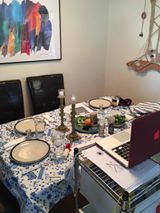
“It was nice to talk with family we don’t normally get to see this time of year. I took a pic of our table from the angle of the camera before we sat down.”

– Amie Ritchie

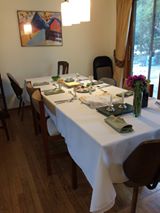
“I shared flowers (via Carole Caplan) and food with several people who usually attend our seder. Two of the three chose to attend other seders – so it was just my brother’s family and my mother sharing ours. That’s good because it took us 20 minutes to connect via Google Meet – chosen because it gave my 85 year old mother closed captions.

“Food deliveries included flowers, matzah ball soup, salads, charoset, chicken dinner ready for the oven, and all the fixings for my mother’s seder plate. She made us brisket. We did a physical distanced food exchange and visited in the sunshine with her for a bit. She was very grateful to have a seder with us.

“The computer was placed at the far end of the Seder Table.”

– Carol Lessure
Carol Lessure’s seder plate delivery package!
Carol Lessure’s seder table
Carol Lessure’s flower delivery via Carole Caplan

“The Eisbruch family enjoyed being able to join with family members and friends in time zones from Israel to California. That was a very special treat.”

– Emily Eisbruch
Deb Kraus’s cat drinking from Miriam’s cup (on cue)

So many members were able to make the most of the day and find ways to share in the depth and joy of the seder in unique and meaningful ways. How was your virtual Passover? Please share in the comments!

Filed Under: Event writeups Tagged With: covid-19, Passover, Seder

Online Jewish Resources for Shelter-in-Place

April 5, 2020 by Gillian Jackson Leave a Comment

I cannot be the only person who spends way too much time online reading headline after headline about COVID-19. It is exhausting and mentally taxing to contemplate at length something as overwhelming as a global pandemic. In an effort to steer you away from the headlines and closer to an intellectually stimulating diversion, we have compiled a list of interesting Jewish programming available online in the coming weeks. Enjoy!

For Adults:

  • Mechon Hadar has many online resources and is holding daily Mishnah groups for adults.
  • Join the Jewish Response Against COVID-19 group. The page features many links to Jewish learning and activism.
  • 929.org is hosting a daily learning activity with a new chapter of the Tanakh each day.
  • On Drisha, explore the Annual Rapoport Family Memorial Lecture Series and the Renee and Alexander Bohm Memorial Lecture Series.
  • Listen to Daf Yomi Online Podcasts, a series that inspires women to learn Talmud.
  • Take an online tour of the Jewish Museum of New York.
  • Watch a Yiddish Theater production.

For Families with Children:

  • VBS preschool has created resources, stories, videos, and a schedule to help you keep your little ones busy. This website is regularly updated with new content.
  • The Jewish Education Project Early Childhood and Family Engagement Team has created a Pinterest for families and teachers at home. This page has resources for educators and parents focusing on the coronavirus itself, as well as Jewish communal responses and Passover resources. The project is also working to collect videos of educators and rabbis reading stories as well as Jewish rituals and song sessions.
  • Mechon Hadar has many online resources and is holding daily classes for children.
  • Take an audio tour especially made for kids of the Jewish Museum of New York.
  • Watch a Yiddish Theater production.

I hope you enjoy this list of resources! A big thanks to Rabbi Ora for her tireless work to gather these resources and be a source of both peace and levity for our community.

Please share any additional resources in the comments section!

Filed Under: Community Learning Tagged With: jewish learning, quarantine

Your Virtual Seder Resource!

March 31, 2020 by Gillian Jackson

Passover is quickly approaching; the first night falls on Wednesday, April 8th. And this year, the holiday comes during an extraordinary time.

The central commandment of Passover—retelling the story of the Exodus–asks that we consider ourselves as if we, too, had journeyed from narrowness to openness and from oppression to liberation.

This year, more than any in recent memory, that narrative rings true. We are currently in a narrow place; and, for that very reason, we must take the opportunity to make this year’s holiday one of engagement, connection, and celebration.

In accordance with recent guidelines from the Reconstructionist Rabbinical Association, we urge our community to restrict in-person seders to household members AND open up our seders to connect virtually with loved ones near and far.

***

Below, you’ll find articles, classes, videos, and links to help you prepare for Passover 2020:

I want to host a seder. How do I plan for that?

Wonderful! If you’d like to try online hosting a seder this year, there are resources available to help you plan (see below).

While you’re planning your seder, please consider the holy mitzvah of welcoming others to your virtual table: Sign up here if you’re able to open your seder to members of our community.

I want to be hosted. How do I find a virtual seder to attend?

  1. Be on the lookout for an email later this week that will allow you to sign up to attend AARC members’ online seders.
  2. Sign up in advance to join Jewish Women International’s Virtual Seder on Thursday, April 9 at 8 pm EDT.
  3. Havaya (Reconstructing Judaism’s summer camp) is hosting a one-hour Virtual Family Seder on Thursday, April 9 at 7 pm EDT; sign up here to register.
  4. Join the Haggadot.com team, journalist Esther Kustanowitz, and other special guests for an everyone-welcome, fifth ‘night’ Virtual Seder on Sunday, April 12 at 2 pm EDT (join via Zoom or Facebook livestream).

How do I plan my own virtual seder?

  • Alma.com has a fantastically comprehensive guide for putting together a collaborative, meaningful seder — even when the guests are physically far away.
  • Watch the video ‘The Art of Virtually Gathering: Passover 2020.’
  • Attend a free online class this Thursday April 2 on ‘Practical Pesach Seder Ideas and Suggestions in Response to Corona’ (you’ll need to register in advance).
  • From OneTable, myriad resources for Passover 2020, including a Solo Seder Guide, Passover Recipe Guide, Passover Playlist, and links to a curated selection of haggadot.

Which haggadot should I use?

  • Reconstructing Judaism has made its classic haggadah, ‘A Night of Questions,’ available for free downloading
  • Haggadot.com allows you to create and download your own personalized haggadah, or choose from hundreds of different themed haggadot created by Jews around the world.
  • There are many fantastic haggadot available for free downloading, including Reform Judaism’s Haggadah; the Velveteen Rabbi’s Haggadah, available as both a PDF and a slideshow; the Queer Liberation Haggadah; and the 5 Legged Seder Table ‘Haggadah’, a creative workbook designed to help readers engage with the themes of the holiday.

….And consider these of-the-moment additions:

  • A supplement to the Four Questions from Repair the World
  • A Passover Prayer in the Age of Coronavirus from American Jewish Committee
  • All the classic melodies in a Passover seder available on Youtube

How do I plan a kid-friendly seder?

  • AARC member Carol Levin has generously made her delightful Haggadah Regatta into a PDF for anyone to use.
  • Check out Reform Judaism’s many family-friendly Passover resources, including crafts, coloring pages, fun quizzes, 8 great haggadot for young people, a chocolate seder (!), and model seders for kids of all ages.

How do I prepare my home for Passover?

  • Try making your own matzah at home with this delightful video from Rabbi Nathan Martin.
  • From MyJewishLearning, How to Cook for Passover During the Coronavirus Crisis, including resources, online shopping tips, and recipes
  • If you have halachic questions around cleaning for Passover, disposing of chametz, and buying kosher-for Passover products, email Rabbi Ora with your questions.

How do I spiritually prepare for Passover?

  • Attend a free online class next Monday April 6, ‘Soulful Passover Preparation’ (you’ll need to register in advance).
  • Explore some of the articles in this Passover 2020 reader from Uri Le’Tzedek.

Blessings for healthy, joyful, and connected zman cheruteinu (season of our liberation),

Rabbi Ora

Filed Under: Rabbi's Posts, Upcoming Activities Tagged With: virtual seder

  • « Go to Previous Page
  • Page 1
  • Interim pages omitted …
  • Page 17
  • Page 18
  • Page 19
  • Page 20
  • Page 21
  • Interim pages omitted …
  • Page 25
  • Go to Next Page »

Primary Sidebar

Search

Join Our Mailing List

Sign up for our twice a week newsletter to get details on upcoming events and catch up on our latest news.

This field is required.

Check your inbox or spam folder to confirm your subscription.

Upcoming Events

  • All day, April 19, 2026 – Beit Sefer
  • 6:30 pm – 8:00 pm, April 24, 2026 – Fourth Friday Kabbalat Shabbat
  • All day, April 26, 2026 – Beit Sefer
  • 12:00 pm – 3:00 pm, April 26, 2026 – “Lesson of the Homeland” and the Stories We Tell: A Conversation with Anat Zeltser
  • All day, May 3, 2026 – Beit Sefer

Latest News

  • RSVP to “Lesson of the Homeland” and the Stories We Tell: A Conversation with Anat Zeltser April 16, 2026
  • Climate Action Shabbat article in the April 2026 Washtenaw Jewish News April 3, 2026
  • Reimagining Torah Study: Moving from Zoom to In Person by Rabbi Gabrielle Pescador April 1, 2026
  • Creative Spirit at the AARC Beit Sefer March 27, 2026
  • When Is a Killer Not a Murderer? by Elizabeth Brindley March 19, 2026

Footer

Affiliated with

Copyright © 2026 Ann Arbor Reconstructionist Congregation