by Anita Rubin-Meiller
Humility/Sovereignty: Rosh Hashanah Drash, 2016
 Being asked to talk about humility in the context of recognizing God’s sovereignty returned me to my spiritual roots, Al-Anon, 1981. In the 12 steps there is a clear relationship between humility and God. Step 1, admit we are powerless. Step 3, make a decision to turn our lives and our will over to the care of God. Step 7, humbly ask God to remove our shortcomings. And isn’t that exactly what this time of year gives us the space to do? Beginning with the new moon of Elul and culminating as the gates close on Yom Kippur, we are invited to deeply know ourselves, the whole truth of ourselves, and bring that truth before the Holy One of Being, whom our prayer book calls “author of creation, teacher of truth” whose sovereign power hopefully empowers us. Humility is about being in right relationship with ourselves and thereby being in right relationship with God.
There are many ways to approach this time of searching within. Sometimes we set out determined, with a particular structure of meditating, journaling, sharing. And sometimes awareness arrives in the midst of our pain, our suffering our challenges. And that can feel like a gift or a curse.
Here’s the story: I can’t remember what happened before, but if you were peeking in on us in the moment of the outburst, it would have appeared that my husband and I were fighting over something to do with a box of crackers. Whatever it was that was really happening, the result was an emotional explosion on my part that had me leaving the house in anger at 9pm to take myself on a walk.
For a while the anger stayed and my thoughts were oriented towards “he does this, and he does that, and it will never change, etc.” Then I remembered myself. That is to say, I realized that this angry, resentful woman was not the person I wanted to be. I remembered the soothing power of self-compassion and placed a hand on my heart as I walked and gently noted my pain. And then I got curious. Why did this hurt so much?
In her newest book, Rising Strong, social work researcher and TED talk celebrity Brene Brown describes a 3-step process meant to guide us in rising from our fall, overcoming our mistakes, and facing our hurt. She gives a name to what I went through when I went for my walk after the fight with my husband: The Reckoning. Her name for the next step, The Rumble, is indicative of the wrestling that ensues when we are opened in curiosity and compassion to explore our self-justification and habitual stories and find what is really going in our mind and heart and soul.
As I settled into this calm and curious state, a wiser awareness arrived: this was about my 5 year old. Again. Often when I know that I am hurt, instead of feeling angry I am brought there: to the child needing loving attention, to the child needing to know she is lovable, to the child wanting to be held. Recognizing her presence then gave me an opportunity to soothe her and to listen more deeply to myself. I so desperately wanted to be “big” enough to go home, apologize to my husband and move on. But as I continued walking, I realized that my awareness could not yet translate into skilled words and that the best I could do was to say calmly that I didn’t have words yet, and helplessly go off to the basement couch to sleep.
One of the ways I experience humility at this time of year is recognizing that what I release into the river at Tashlich tends to repeat itself. So, as I awoke the next day I was quite aware that last year at this time I had vowed to love my husband as best as I could and for sure this meant giving up the idea that he should do what I do, want what I want, value what I value. And that introduces the other player in this tale, the self -righteous teen who pops up to protect against the hurt, the sorrow and disappointment of the 5-year-old feeling unloved. She has always been harder for me to embrace, but at least the embrace does come.
To quote Brene Brown again: “The irony is that we attempt to disown our difficult stories to appear more whole or more acceptable, but our wholeness – even our wholeheartedness- actually depends on the integration of all our experiences, including the falls” She calls her third step in the process of coming home to ourselves “The Revolution” and describes it as being able to write a new ending to your story based on the learnings from the process of The Rumble.
So I awoke to find Roger and my words.
In a letter from the Ramban to his son, quoted by Rabbi Dr. Louis Jacobs, he writes of humility: ”Let your voice be gentle and your head bowed. Let your eyes be turned earthwards and your heart heavenwards. Let every man seem superior to you in your own eyes. God alone knows the true worth of a man.”
As Roger and I took a morning walk and I tearfully shared my apology and realization, my pain and my hope for a different outcome, I could feel my whole being soften, lean in to this man that I have loved imperfectly for 30 years. And without asking, he shared his insights as well and we came to better understand the dance we have done for so long of triggering each other’s vulnerabilities and acting protectively in response. There is a saying in the Tai Chi principles: 4 ounces displaces 1,000 pounds. When I am corrected during morning practice it is often minuscule, but feels like a miracle, a small adjustment creating a significant shift.
I was sure this shift was here to stay, but “never again” are not the words of humility. Just last week I had yelled at my husband “I need you to meet me halfway” and found myself heading for the basement couch again, where I looked up the Biblical definitions of humility and found this: “the quality that lets us go more than halfway to meet the needs and demands of others.” I picked up my pillow, returned to our bedroom, and snuggled in, grateful.
Humility is knowing that no matter how hard I try I will never be perfect. It is trusting that the Holy One of Being will have a lot more patience with my repeated mistakes then I tend to have. It is finding lessons mysteriously delivered in unexpected places.
I end with the wisdom of folksinger Steve Earle from a song called “God is God”
God, in my little understanding don’t care what name I call.
Whether or not I believe doesn’t matter at all.
I receive the blessings that every day on Earth’s another chance to get it right.
Let this little light of mine shine and rage against the night.
I believe in God and God ain’t us.
 Shabbat shalom.


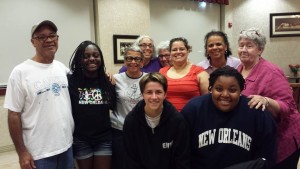 The book of Exodus, which we begin to read this week, is titled in Hebrew “Shemot” which means “names” in Hebrew. “These are the names of the children of Israel who went down to Egypt with Jacob…” are the parasha’s opening words. I’m down in Louisiana with my wife’s cousins, Creole and Catholic, and I’m thinking about these words and the blog post I need to write for this week. So many topics are swirling in my head. Should I write about the overflowing and moving open house at the Ann Arbor Islamic Center on December 20th? Or the upcoming AARC Tu B’Shevat seder on January 23rd? Or the non-indictment of the police murderer of Tamir Rice? I ask Cousin Betty what she thinks I should write about and, without hesitation, she says “cousins.” Betty has long taught about the spiritual power of naming, and embracing, extended family divided by our country’s history of racism and segregation. So, I took a chance and Googled the words “shemot” and “cousins.” After all, weren’t the children of Jacob’s children cousins?