• Skip to primary navigation
  • Skip to main content
  • Skip to footer
Ann Arbor Reconstructionist Congregation

Ann Arbor Reconstructionist Congregation

  • Home
  • About
    • Overview
    • Rav Gavrielle Pescador
    • Our History
      • Photo Gallery
    • Our Values and Vision
    • LGBTQ Inclusive
    • Our Board
    • Our Sacred Objects
    • About Reconstructionist Judaism
    • Jewish Ann Arbor
  • Programs
    • Shabbat and Holidays
    • B’nei Mitzvah
    • Tikkun Olam
    • In the (Washtenaw Jewish) News
    • Health and Safety Expectations for In-Person Gatherings
    • Join our Mailing List
  • Religious School
    • About Beit Sefer
    • Teachers
    • Enrollment and Tuition
    • 2025-26 Beit Sefer Calendar
  • Blog
  • Calendar
  • Membership
    • Thinking about joining?
    • Member Area
  • Contact Us
  • Donate
You are here: Home / Blog

Blog

Beit Sefer Open House

April 28, 2016 by Clare Kinberg

AARC Beit Sefer has had a terrific year–with fun and engaging teachers and madrichim/teenage teaching assistants, lots of parent participation, and integration into the whole congregation. Member Becky Ball, mom to Sam and Joey, has stepped up to chair the Beit Sefer committee which includes Sarah Abramowicz, Candace Bramson, Stacy Dieve, and Allison Stupka (and Clare Kinberg, ex officio in her role as Beit Sefer director).

We’re all working to showcase and grow the Beit Sefer–and that includes an Open House this Sunday (May 1) for prospective students and their parents. It’s during the normal school time–9:30 to 11:30 am.  Here’s the article in the Washtenaw Jewish News (page 8) about the Open House (thanks for writing it, Becky!).  Do you know someone who might be looking for Jewish education for their elementary age kids?  Please invite them!  You can use this letter as a template.  And don’t forget to join us at second Saturday services on May 14, 10 am, led by the G’dolim.

WJN-May-16-web-BeitSeferOpenHouse


Filed Under: Articles/Ads, Beit Sefer (Religious School), Upcoming Activities

Beautifying your Pesach Table

April 21, 2016 by Clare Kinberg

Spring Greens Saute from The Jewish Seasonal Kitchen by Amelia Saltsman

By today, you’ve probably decided what you are making for your first Passover meal tomorrow night. Patti and I will be making Stuffed Cabbage, with the recipe posted last year at this time. I’m about to go make some, and if you come to the AARC Family Seder on Sunday, you’ll get to have a taste!

But there is a long week ahead of Pesach food restrictions, and I want to share with you a stand out cookbook that could make your week more culinarily delightful: The Seasonal Jewish Kitchen: A Fresh Take on Tradition by Amelia Saltsman. With a Romanian grandmother and an Iraqi grandmother, growing up in a farming community in Israel and her extensive writings on local and fair food production, family farms, and farmers’ markets, she is an author whose interests are close to my heart. You can access some recipes and read more about her on her website and blog.

I’ve often thought about the contradiction between the limits on foods we can eat on Passover, the necessity of sticking to the dry “bread of affliction” for a full week, and our communal focus on the Passover feast, creating ever more scrumptious Pesach foods. Rabbi Yael Levy’s “Thoughts on Matzah” post from her Jewish Mindfulness site helped me come to a satisfying understanding of this.

Thoughts On Matzah

Rabbi Yael Levy | 4-20-2016

When we begin the Seder, the matzah is lechem oni—the bread of affliction.

By the middle of the seder the matzah has become the afikomen—the dessert—what we seek, what we long for.

The transformation starts as we lift up the three matzot, break the middle matzah and call, “This is the bread of affliction that our ancestors ate in the land of Egypt.  Let all who are hungry come and eat.”

As we acknowledge the suffering and brokenness that exists in us and in our world and reach out from this place to make connections, to share who we are and what we have to offer the matzah goes from being the bread of poverty to being the bread of connection, hope and faith.

Filed Under: Food, Upcoming Activities Tagged With: Passover

Dafna Eisbruch Writes from Israel

April 13, 2016 by Clare Kinberg

Me, in the back row in the pink shirt, and the friends in my kvutza, or commune. We’re all olim from Habonim Dror America and Australia, and we live in an apartment in Haifa with a beautiful view of northern Israel and the sea

Hi AARC members and friends!

I’m writing to you from Israel to share with you a bit about what I’m up to these days since my childhood in the Ann Arbor Reconstructionist Havurah. I work with an organization called Dror Israel, which is a social and educational movement established by graduates of the youth movement Habonim Dror and its Israeli counterparts. We work in all sectors of Israeli society, educating towards equality, faith in humanity, social cohesion and mutual responsibility. We see ourselves as the continuation of the kibbutz movement’s legacy–if a hundred years ago, Israel needed farmers to feed the nation and establish its borders, today Israel needs educators who can unite Ethiopians, Arabs, Russians, Mizrachim and Ashkenazim around a common vision for coexistence and shared society.  We live in communes (“urban kibbutzim”) and run many different types of educational projects.

A meeting between Arab kids I work with in the town of Kfar Manda, and Jewish kids from Afula. They made a wall painting together in Hebrew and Arabic of a quote by poet Saul Tchernichovsky: “Because I still believe in humanity and its brave spirit.”

My main job is in the youth movement, the Noar HaOved veHalomed (Working and Learning Youth). It’s the second biggest youth movement in Israel (with 85,000 participants, it ranks after the scouts and before Bnei Akiva) and is active in most cities and many kibbutzim and Arab villages in Israel, running weekly activities for kids from fourth grade and upwards. Teenagers go to leadership camps and learn to be counselors for elementary schoolers, as well as learning about issues affecting society and meeting with youth from different ethnic and socioeconomic backgrounds. The motto of the Noar HaOved veHalomed is “our home is open to every girl and boy,” and we believe that building a youth movement where everyone has a place will help us to build a society where everyone has a place.

Another project I’m involved in is a new coexistence museum exhibit on Kibbutz Eshbal, a kibbutz belonging to Dror Israel. The exhibit explores Arab and Jewish culture in the Galilee region, the everyday experience of meeting someone from the other culture in common settings like the mall or the hospital, racism and examples of racism in Israeli society, apathy and its effects, dilemmas of building a shared society (what should be together and what should remain unique and separate?) and profiles of Arabs and Jews working to build partnerships between Arab and Jewish communities in the Galilee. It’s geared toward high school groups, who discuss the challenging questions raised in the exhibit together with a guide. The goal of the exhibit is for students to critically examine the existing relationship between Jews and Arabs, and to invite them to be partners in shaping positive relations. 

High school students from Carmiel discuss the coexistence exhibit with a guide. Since its opening last month, 200 students have visited the exhibit.

A third significant project that Dror Israel runs– and that many of my friends led this year–is a yearly trip to Poland for Israeli high school students to learn about the Holocaust. Visiting Poland is a rite of passage for Israeli eleventh graders, and many students go on trips sponsored by their schools – but those trips can sometimes use the Holocaust to teach problematic nationalistic values, in the spirit of “never again to us at any cost, we must build a strong army to defeat our enemies.” The Noar HaOved veHalomed trip, in contrast, teaches students about the history of European anti-semitism, the rise of Nazism, the ghettos, extermination camps and Jewish rebellion with a focus on understanding human morality. Students learn that they always have a choice between acting to create a just society based on equality, or acting apathetically towards the inequalities in society and thus enabling human suffering. Eight hundred students from all sectors of society participated in the Noar Haoved veHalomed journey to Poland that took place this March. 

Students leading a memorial ceremony for their peers at Łopuchowo, the site of a Nazi massacre of Polish Jews

While the cost of traveling to Poland is high, the movement is committed to making the trip available to all youth including high-risk youth. To this end, there is a scholarship fund for the trip. If anyone is interested in donating, here is a link to the fund (in Hebrew).

Those who are interested and social media-savvy can check out the Noar Haoved veHalomed on Instagram.

We also run Habonim Dror’s Israel programs, MBI (a summer tour for students entering eleventh grade) and Workshop (a gap year for high school graduates)! Both programs are cool ways for Jewish kids to experience Israel in ways that speak to AARC’s humanist Jewish values. MBI students meet Israeli kids their age from the Noar HaOved veHalomed, and Workshop participants volunteer in the youth movement.

I think often of my Jewish upbringing at the AARC and love reading the blog to catch up on what’s going on with you. Sending good wishes and happy Passover from Israel,


Dafna Eisbruch

dafnation@gmail.com


Filed Under: Member Profiles, Posts by Members

Rosh Hodesh Nissan, Miriam, and tzaraat

April 6, 2016 by Clare Kinberg

lia rosen

Jews celebrate the New Year in the fall, still, Nissan is considered the first month of the year because it is the first month in which we were a free people. In midrash and legend, the first Rosh Hodesh was marked by Moses as the preparations for the Exodus began in earnest. If you didn’t begin spring cleaning on the day after Purim (some people really do this!), this week is a good time to begin to rid the house of hametz/bread and any of the things you wish to discard.

Nissan is also the month, according to legend, in which Moses’ sister Miriam, died. Chabad.org records this piece of “Jewish History” as “Miriam’s Passing (1274 BCE) Miriam, the sister of Moses, passed away at the age of 126 on the 10th of Nissan of the year 2487 from creation (1274 BCE) — 39 years after the Exodus and exactly one year before the Children of Israel entered the Holy Land.” I love the exactness of this (although the date of Nissan 10 is disputed).

This week’s parsha, Tazria, describes how to diagnose and treat a skin disease, tzaraat, which later afflicts Miriam. This connection between Rosh Hodesh Nissan, Miriam, and tzaraat is rich material for poetry and drash. Here are a few; we’ll share more on Saturday morning, hope you can make it.

Snow/Scorpions & Spiders

by Girls in Trouble

Well my mother named me bitter
Although as a child I was so kind
Hiding myself in the trees to watch over my brother
But still my name was bitter
Bitter the taste of the sea
Bitter the cries of the horses drowning behind us
If anybody had asked me
I might not have chosen to go
But everyone knows
Sometimes you don’t have a choice
So when he said You’re banished,
Seven days in the desert alone
I just started walking
I knew there was nothing to say
The scorpions and the spiders
Crawled up to me and stopped in my shade
Together in silence they watched
As the sun crossed the sky
And if your father spit in your face
Wouldn’t you want to leave that place
And if your skin should turn to snow
Wouldn’t you have to go
And if your G-d should turn from you
wouldn’t you turn too.
Still I don’t regret a minute
And I don’t regret an hour
of the week that I lived all alone
at the top of the mountain
Though no voice came down from heaven
and I never saw words written in fire
I did see the birds of prey pick all the carcasses clean
If anybody had asked me
I might not have chosen to go
But everyone knows
Sometimes you don’t have a choice
And if your father spit in your face
Wouldn’t you want to leave that place
And if your skin should turn to snow
Wouldn’t you have to go
And if your G-d should turn from you
wouldn’t you turn too.
[Suggested by Rabbi Alana]
Poem in Praise of Menstruation

by Lucille Clifton

if there is a river
more beautiful than this
bright as the blood
red edge of the moon          if
there is a river
more faithful than this
returning each month
to the same delta          if there
is a river
braver than this
coming and coming in a surge
of passion, of pain          if there is
a river
more ancient than this
daughter of eve
mother of cain and of abel          if there is in
the universe such a river          if
there is some where water
more powerful than this wild
water
pray that it flows also
through animals
beautiful and faithful and ancient
and female and brave
[suggested by Margo Schlanger]

Sent Out of the Camp

A d’var Torah for Parashat Tazria by Rabbi Danya Ruttenberg

This week’s parashah deals with a somewhat puzzling disease, called tzara’at, often translated as “leprosy.” As the Torah describes it, it’s an affliction that could appear on human skin, on clothes, or even infect houses.

It’s not clear if the affliction is truly physical, as Leviticus seems to indicate, or if it’s a physical manifestation of spiritual distress, as a number of commentators suggest. However, either way, the solution to the problem is isolation. The afflicted party is shut up for a week or more, forced to live outside the camp, away from the rest of his or her community.

On the one hand, this quarantine is traditionally understood not as a punishment, but rather a time to recover and protect others from infection. One could also imagine it as something of a retreat—a time for someone who is physically or spiritually unwell to recuperate and regain strength.

On the other, well, I can’t help but think about what it must have been like to be told that you must be cast away from loving, human connection as a result of contracting an ailment or stumbling interpersonally. What kind of impact did being sent away from the camp have on the afflicted?

Between 80,000-100,000 prisoners are in solitary confinement in the United States on any given day, many for rather minor infractions. Despite the fact that more than 15 hours in solitary confinement may begin to have an adverse impact on a prisoner’s mental health, the average sentence in solitary can run, depending on the state, anywhere from 23 months to 7.5 years, and longer for those on death row. Many argue that, in light of the significant mental harm that it causes, solitary confinement should be classified as a form of torture.

Joe Giarratano, a prisoner at Virginia’s Wallens Ridge State Prison, reflects:

Human beings are social creatures. We need psychological, intellectual, spiritual, environmental stimulation to function properly, to grow and develop. Without that stimulation we deteriorate. I do not care how strong one is mentally; solitary confinement will adversely affect you. I have literally watched grown men deteriorate before my eyes, and go mad. There were times during my… stint that I lost it and began to hallucinate and lose my grip on reality. What the public needs to realize is that eventually all of those who experience that will be released back into society, far more broken than when they went in.

Many traditional commentators attempt to cast the metzora, the one with this strange Biblical leprosy, as responsible for their own suffering—for example, citing a tendency towards malicious gossip as the reason the person needed to be exiled. But there’s another textual tradition that regards them with a softer eye.

For, the Talmud (Sanhedrin 98a-b) tells us, no less than the Messiah will be found sitting among the lepers, and will be known as “the leper scholar.” That is to say, the one who will bring healing and redemption to the world aligns her- or himself with those who have been forced into isolation. And the Sifra, the ancient midrash on Leviticus, tells us that, even in the lepers’ isolation, “the Divine Presence still abides among them.”

It’s on God to be with those who suffer. It’s on us to prevent unnecessary suffering, insofar as we are able. When we push for just and humane reforms to our contemporary prison system, we engage in the work of the Messiah.

Filed Under: Community Learning, Divrei Torah, Poems and Blessings Tagged With: community learning, Rosh Hodesh

Torah Tikkun

March 31, 2016 by Clare Kinberg

Rabbi Druin sewing the AARC torah, March 29, 2016. Photo by Stephanie Rowden

According to Rabbi Moshe Druin, of “Sofer on Site,” our Torah is between 200 and 250 years old; it has many distinctive letters that associate its scribe with the Maharal of Prague, Rabbi Judah Loew ben Bezalel. It will be challenging and fun to look for corroboration of this interesting information. Rabbi Druin speculated that this Torah came to the U.S. from Europe before WWII. Dave Nelson, who was there when Rabbi Druin opened the Torah, was particularly impressed with the age of the scroll, and with the fact that, if properly cared for, how the torah can be used indefinitely, connecting us with Jews past and future.

Rabbi Druin unfurls the whole torah to begin work. Photo by Dave Nelson
Rabbi Druin points to another distinctive embellishment to the letter pey in the AARC torah.
Rabbi Druin points to a distinctive embellishment to the letter pey in the AARC torah.

In addition to the special lettering associated with Czechoslovakia of a period 200 or so years ago, Rabbi Druin said that the varying sizes of the 52 pieces of parchment and their unusual height of almost 4 feet were also an indication of the age of the torah. More on this topic in an upcoming blog post.

Rabbi Druin points to a distinctive lamed in the AARC torah. Photo by Stephanie Rowden

Several people were able to observe and talk with Rabbi Druin as he worked. Jack Edelstein, who arranged for Rabbi Druin to do the repair, was interested to find that our Torah is much lighter than most of its size because the parchment is not coated with a certain material that torahs are typically coated with, and that the poles that the scroll is attached to are not the original ones; they are a few inches shorter than they should be, which is partially what accounts for the crinkliness of the top and especially bottom of the scroll. Evelyn Neuhaus and Mike Ehmann, Clare Kinberg, Dave Nelson, Danny Steinmetz, and Stephanie Rowden also watched as Rabbi Druin worked.  Evelyn says she felt a closer connection to the Torah after learning so much about it and having so many of its details pointed out.

Evelyn looks on as Rabbi Druin repairs the torah.
Evelyn looks on as Rabbi Druin repairs the torah. Photo by Stephanie Rowden

Now that Rabbi Druin mended and stitched all the parchments that needed it, we should be able to enjoy Hagba–the display of the Torah to the Congregation after it’s read–without stress!

Filed Under: Event writeups, Sacred Objects Tagged With: Torah

Come see a sofer at work, fixing our Torah

March 23, 2016 by Margo Schlanger

AARC’s Torah is old and much-loved. In fact, it seems to be over 200 years old. In recent years, it’s gotten a bit unstable; there are a number of tears in the scroll, and the stitching at the edges is coming unraveled.  Hagba–the display of the Torah to the Congregation, after it is read–has gotten a little too exciting.

So we’re pleased to say that Rabbi Moshe Druin, of Sofer On Site, will be visiting us on Tuesday, March 29, to fix all the stitching/tears.  He’ll work at the JCC, and you’re invited to come and watch.  Kids and adults–come by at 2:30 or 3.  Sofer on Site frequently does community events for Torah restorations.

Also, if you are able to be there for a bit and take some pictures, please let me know (email me at margo.schlanger@gmail.com).

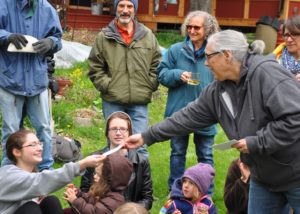
Shabbat on the farm
Shabbat on the farm

Filed Under: Community Learning, Sacred Objects, Upcoming Activities Tagged With: Torah

Friendship scroll

March 22, 2016 by Clare Kinberg

By Barbara Boyk Rust

scroll image
Come hear the Megillah read Friday March 25 at the JCC and see this beautiful scroll up close

One of the joys of friendship is sharing each other’s interests, perspectives, and experiences. For me, one of the joys of being friends with an artist is the beauty that I learn about, enjoy, and benefit from that I would not be likely to encounter otherwise. Spiritual teachings claim beauty as the perfection of love and that rings true to me.

When Idelle Hammond-Sass called me several years ago and told me about the beautiful megillah scroll she saw at the Jewish Community Center of West Bloomfield, Michigan I was so taken with her verbal description alone that I welcomed her invitation to share the cost with her for purchasing it.

The scroll is on heavy paper and every segment is adorned with colorful renderings evocative of the spirit of Purim. The artwork is a party unto itself. It was created by Israeli artist Enya Keshet, and Idelle was drawn to the designs which reminded her of Persian miniatures. She was fascinated by the embellishment, so rare in most Judaica, but allowed on a Purim scroll.

Purim has long been a special holiday for me in light of another significant friendship in my life. Many of you knew Nancy Denenberg, of blessed memory. Nancy and I together created high holiday services, Shabbat retreats, and celebrations round the entire sacred cycle. We were also involved in spiriting prayer circles for healing and life cycle transitions over the years of our friendship, from her move to Ann Arbor in the late 1980’s until her death in 2006.

Nancy had a drive to make Jewish meaning in her life relevant to the immediacy of her understanding of loving and healing and sharing in community. She had practiced yoga for many years; later moving into work with Feldenkreis Method, a technique created by an Israeli physicist. She had a strong affinity for dance and became adept at Middle Eastern beledi, belly dance, fostering for herself and others more direct contact with Middle Eastern traditions. These are a few of the many ways Nancy intentionally cultivated Jewish spiritual means to endow her life with beauty, healing, art and creativity.

photo of Nancy Dennenberg
Nancy Denenberg in beledi regalia.

On more than one Purim, Nancy donned her full regalia for belly dancing, and brought others from her troupe to the Hav celebration. Some years ago The Ann Arbor News featured a picture of her leading our costume parade.

For my part, this scroll is a remembrance of friendship, of beauty, of sharing in community. It is a way to offer the power of this artist’s rendering into the annual cycle of our congregation’s celebration of this holiday that asks us to marry the opposites: Haman and Mordechai, forces of good and forces of evil. May we each have a chance to dance our beauty and our joy with the rhythm of blessing and celebration for years to come.


Filed Under: Posts by Members, Sacred Objects, Upcoming Activities Tagged With: Purim

Rebukes and Sacred Disagreements

March 22, 2016 by Clare Kinberg

By Carol Lessure

w-hillel-shammai-1423642404I started Sunday off with a nasty argument with Jon, my life partner, over something relatively unimportant. We were coping with daylight savings time, a mysterious rash on the face of our eldest son, while the younger one was late for religious school. I was trying to get us out the door because I planned to attend a Sunday morning text study. So I left in a huff, not feeling very kindly towards Jon. [Read more…] about Rebukes and Sacred Disagreements

Filed Under: Event writeups, Posts by Members Tagged With: Adult Learning

AARC Purim Questions and Answers

March 17, 2016 by Clare Kinberg

Our kids getting ready for Purim fun
Come welcome Shabbat and have some Purim fun

Are we reading the Megillah/Scroll of Esther? Yes! This year, the AARC will be reading the Megillah, the scroll of Esther, during the 4th Friday Shabbat service, on March 25 beginning at 6:30 pm. Rabbi Michael Strassfeld will lead us in Shabbat songs and members of the congregation and the rabbi will chant and read an abbreviated version of the Whole Megillah, primarily in English.  You won’t want to miss being part of the beautiful, creative and fun costumes of kids, members and service leaders alike.  Plus you will be thrilled by the Band’s scoring of the evening.

Will there be a Tot Shabbat beforehand like usual? Yes! There will be a Tot Shabbat from 5:45 to 6:15 preceding the service.

Will we have a potluck afterward service? Yes, but with a Purim twist! We’ll be serving Middle Eastern food, and we need you to bring salads, some little kid friendly dishes, and desserts! Nutfree, please.  Potluck at 8 pm.

Will there be a Purimshpiel? A special addition to the evening will be “All the World’s a Stage” a brief, family-friendly Purimshpiel (play) presented during the potluck dinner by the post-Bnei Mitzvah group while we munch away on home-made hamantaschen.

Speaking of Hamantaschen…. You can make them at home, or join the baking fun at the Lessure/Engelbert’s on March 19, 3-6pm. Get the full deal here and rsvp.

Should I come in costume? Yes! Not required of course, but so much fun. Need ideas? See Rachel’s blog on that!

What should I bring?  Come, one and all.  Bring a friend, a generously portioned vegetarian, nut-free, potluck dish (salad, kid-friendly main dish, or dessert), come in costume or grab a mask at the JCC, come ready to laugh and sing. Come for the service, stay for the Purimshpiel.

Should I bring the household items I have bought for the Welcome baskets? Yes! Read about it here. Sign up here.

Is this evening appropriate for young children?  This family friendly service will be fun, entertaining,  less formal, and certainly more noisy than a traditional Friday night service.  That said, it is great if parents remain mindful of their children’s participation during the service, the potluck and the Purimshpiel.  Please let me know (ckinberg@gmail.com) if your kids need childcare or pizza before the service.


Filed Under: Upcoming Activities Tagged With: Purim

The Just City/Mincha/Farewell to Rabbi Michael

March 15, 2016 by Margo Schlanger

Michael Strassfeld photo
Rabbi Michael Strassfeld

March 25 to 26 is our year’s last Shabbaton with Rabbi Michael Strassfeld, who has visited us from New York and led terrific services and events.  He and we will be busy this last weekend:  Our Fourth Friday March 25 will be our community’s Purim celebration–Megillah reading, dinner theatre, shtick, etc.  More details here and here.  Please join us!


For March 26, we’ll focus on Shabbat.  At 3 pm, Rabbi Michael will lead text study on the topic of the “Just City.”

the_just_city
The Just City

He writes:  “What makes for a ‘just city’ according to Jewish tradition?  What is the overall responsibility of its citizens to those who are in need? Is there a limit to that responsibility? How do you balance legitimate self-interest with helping the poor? How do you navigate endless needs and issues of fraud? What institutions are necessary for a just city? We will look at rabbinical and biblical texts to help us explore these questions.”

And we’ll conclude with a Mincha service at 4 pm (sharp — it’s a short service), followed by seudah shlishit (shabbat snack).  Rabbi Michael, Erica Ackerman, and Debbie Zivan will read Torah.  All are welcome, at the JCC.  PLEASE RSVP, here. (We need to make minyan, and estimate food.)

Please join us for this discussion, and to say farewell to Rabbi Michael and thank him for his time with us.

Filed Under: Community Learning, Upcoming Activities

  • « Go to Previous Page
  • Page 1
  • Interim pages omitted …
  • Page 57
  • Page 58
  • Page 59
  • Page 60
  • Page 61
  • Interim pages omitted …
  • Page 75
  • Go to Next Page »

Footer

Affiliated with

Copyright © 2026 Ann Arbor Reconstructionist Congregation