This article appeared in the December 2023 Washtenaw Jewish News. See the entire issue HERE

This article appeared in the December 2023 Washtenaw Jewish News. See the entire issue HERE

We are so excited about these wonderful opportunities to spend time celebrating Chanukah together in community. We hope that you will join us! Make sure that you sign up to attend so that the hosts have adequate time to prepare for the proper number of guests. Chad Sameach everyone!!

| Home Hosted Chanukkah Potluck at Idelle and Dale’s Friday December 8th, 6:30-9:00 Latkes and Fish will be provided, please indicate what you will be bringing on the signup, instruments and music are welcome!! All ages are invited. Sign up to attend HERE. Home Hosted Chanukah Dinner for Families with Young Children Saturday, 12/9 at 4 pm Families – bring your young children ~6 and under – to a simple home based celebration with Chanukah candle lighting, a light dinner with latkes, and Havdalah for the end of Shabbat. At the home of Carol Lessure & Jon Engelbert from 4:00 – 6:00 pm to accommodate naps and early bed times. Please sign up to attend HERE and make sure to let her know about any food allergies & that you are planning to come! |
| Home Hosted Chanukkah Gelt Hunt with the Nelson Spindlers Sunday December 10th, 1pm-3pm Gelt Hunt at County Farm Park (Medford Entrance). After Gelt Hunt, hot beverages and treats at Casa Spindler Nelson. Sign up to attend HERE. |
| Home Hosted Chanukkah Bonfire and Theatrical Reading of Hershel and the Hanukkah Goblins with Etta Tuesday December 12th, 6:30-8:00 Bonfire, Candles, Mozzarella Sticks, and Dramatic Reading of Herschel and the Hanukkah Goblins. Dress warmly, bring your own hanukkiah and candles. Reading will be at 7pm. Indoor spaces will be available, requires going up one stair to get inside. Sign up to attend HERE. |
| Wednesday Evening Chanukkah Pop In with Rav Gavrielle on Zoom Wednesday December 13th, 6pm Join Rav Gavrielle on zoom on Wednesday, December 13 at 6 pm for Hanukkah candle lighting. She will also offer a teaching and lead participants in a candle meditation technique from the Zohar. All you need to bring is your menorah (with enough candles for the 7th day of Hanukkah) and your beautiful neshamah. |
| Chanukkah Party! Thursday, December 14th, 5:30-7:30pm at the JCC of Ann Arbor and on Zoom Join us for our annual Chanukah party at the JCC. We will enjoy a brief service, light candles, play dreidel, and eat Chanukkah treats (potluck style of course!) Beit Sefer will have a special presentation and much merriment will be had! More details to come, save the Date!! |

Its time to sign up to host a home-hosted Hanukkah gathering for our community! For those of you who are new to our congregation, the tradition includes visiting each other’s houses to celebrate in different ways over the 8 days of Hanukkah. Some events are hosted by families and are kid-friendly, some are events targeted towards adults, and everything in-between. It is a wonderful way to spend time together and get to know each other better. I hope that you will find time this year to participate in at least one night of Home-Hosted Hanukkah.
Here are some examples of Hanukkah events that you could host, with helpful links:
This article on “New Beginnings at the Ann Arbor Reconstructionist Congregation” appeared in the November 2023 Washtenaw Jewish News.

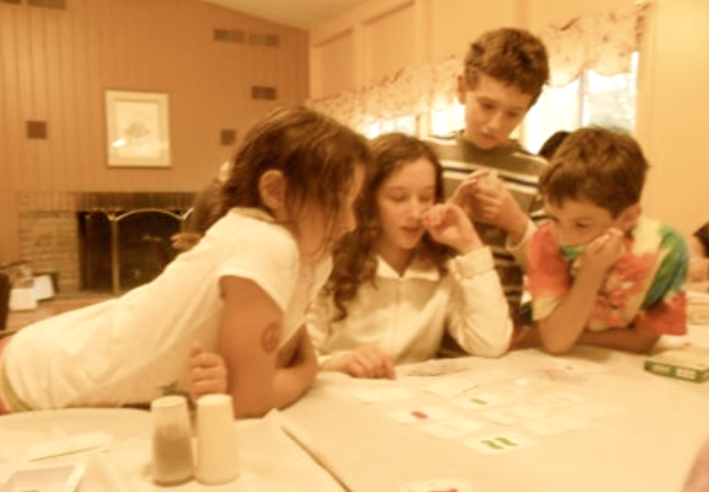
Photo of the AARC Beit Sefer at The Farm on Jennings. The shofar-blowing team was led by Rav Gavrielle, Evan Friedman (Head Teacher), and Madrichah Mollie Meadow on the ram’s horn.
(Sept 17, 2023)
.

As the crisis in Israel and Gaza deepens, below are some resources which I hope you find useful, supportive and nurturing. Please note that this post will be updated from time to time so please check back. (Last updated: January 31, 2024)

Aaron shall place his hands upon the head of the live goat and make confession for all the transgressions of the children of Israel.
Our Torah portion goes into detail about the Yom Kippur priestly practice. Aaron, the high priest, has to prepare himself and perform all the details impeccably. He risks death in order to do this. He wears special garments, has a ritual bath. He then atones for himself and his own household. Only after that can he enter the holy of holies and offer a sacrifice to atone for the Israelites and sprinkle blood on the altar seven times as an act of purification.
Our tradition tells us that in post-biblical time, in our time, prayer takes the place of the sacrifices, of korbanot, of ways of drawing near to God. We no longer have a high priest to perform sacrifices of atonement and rituals of purification on our behalf. The closest we have is the shaliach tziboor – the prayer leader. Whether that person is a rabbi, hazzan or lay leader, the shaliach tziboor is supposed to pray “on behalf” of the congregation, to lift their prayers. In fact the Shulkhan Arukh and other rabbinic writings list requirements for the shaliach tziboor; for instance that person should be pious, knowledgeable, have a pleasant voice and be well liked.
There is a lot we can learn from rabbinic discourse as well as from our Torah portion on the subject of spiritual leadership, of what it means to be a shaliach tziboor. In order to help others, like the high priest, like the shaliach tziboor, we must first make sure that we have taken care of our own souls, and our own intimate relationships before we can serve the community well. If the promise for the Jewish people is to be mamlechet kohanim – a kingdom of priests – we are all called to imitate priestly qualities but in an inclusive, more democratic way. We all have to become the shaliach tziboor.
How do we do this? We begin by doing what we are doing today – by doing teshuvah, by owning up to our errors and dysfunctional tendencies, and by taking responsibility for our part in a dispute or conflict. We are called to mend our ways and be impeccable – and I don’t mean perfect, because that’s not possible – but to be awake, present, focused, ethical and just, as we recalibrate ourselves.
To draw from our wisdom texts, we are to cultivate a pleasant voice. That does not mean that we have to be professional singers, or even sing on key; it means that our voices should communicate pleasantly, with love, compassion and respect. As for being well-liked, I don’t think that is about being popular or charismatic, but more about being a mensch, being a trustworthy and decent person, and keeping our hearts open, and doing so especially in the face of conflict, and in interacting with people we find challenging.
In one of our Elul workshops for instance we talked about finding things to appreciate in the people whom we find difficult. Doing this does not erase or bypass the challenges in our relationships, but what it does do, is help us to not turn people into unidimensional figures.
Because we are more than our errors, we are more than our flaws, more than our irritations and hang-ups. If not, teshuvah is not even worth thinking about. And like I said last week (probably more than once), teshuvah is not just a solo practice; we do teshuvah in order to love well – to have compassion for ourselves and others, and to love beyond our besties, to love beyond our community, to love beyond the personal. To love God.
Like the high priest who purifies the Israelites by sprinkling sacrificial blood seven times, we purify ourselves with gratitude, as gratitude exercises the heart; it expands the heart. And if we want to draw from the 7, gratitude practice is a 7 day a week enterprise. If we exercise gratitude on a regular basis, we are able to zoom out and see more broadly, which helps us to reframe and recontextualize our struggles, and see how much we have in common with people we may find challenging. Through gratitude we may even understand their point of view a bit better.
In taking on the responsibility of the high priest, by being part of mamlechet kohanim, a kingdom of priests, each of us contributes to the wellbeing of the community. We lead from the bimah, from where the Davening Team is situated, to my right, from where you offer readings and kavanot at the microphone also to my right, and from your seats through active participation. Frankly, we are all leading by showing up here today. We lead by supporting one another, wherever we are, however we can, inside the sanctuary and in our daily comings and goings. We do this by being awake to the truth of “what is” before us and by keeping our hearts open so that we can find a way to build bridges of connection and understanding, and by appreciating what each one of us has to offer.
G’mar chatima tova – may we all be sealed for a good and fulfilling life in the coming year.
We pray for peace. Oseh Shalom. We pray for the world to be experienced as one beating heart. How can this be achieved with all the polarities in the world? How can we make peace, how can we bring all the pieces together?
Many of us try to stay on top of the news and commentary on it, we donate and volunteer, we champion good causes, we try to be good citizens, we try to be inclusive, we try to do our part. And I don’t know about you, but I’m completely exhausted from it, from all the information, all the misinformation, emails and calls to action. My head is spinning from the noise, from the worry, from the continual shock of how far things have gone awry. Don’t get me wrong, I want to be awake to world and not stick my head in the sand. I try to stay awake and do what I can. And sometimes it seems like all I can do is pray – for strength, for inner peace to get me through it.
In the very act of praying is the acknowledgement that we need help, that we need support. We can’t do it all. In praying we slow down and surrender a bit. In doing that, we come closer to experiencing the world as one beating heart. We come closer to recognizing that we have to take care of our individual beating hearts. The call for self-care is essential, especially now – to meditate, exercise, eat properly, to take time for relationships, for quiet and slowing down, to take time for rest, to turn off our phones, step away from the computer and rest, to let the mind wander, to read poetry, to walk in nature, to pray, to find ways to let go of all the schmutz that we are carrying around.
Our tradition has special slowing down medicine – and that is shabbat. To create a shabbat practice, a day without an agenda, a day to just be, a day to be with friends and family, a day to listen attentively to the inner voice, a day to listen attentively to the voice of a dear one.
If I may, I would like to plant a seed for the new year, and that is to invite you to find shabbat buddies. To have shabbat dinner together, to take turns hosting, to tell stories and engage in real heart-to-heart conversation, as a weekly ritual. Share spiritual practices, favorite poetry.
Perhaps a shabbat afternoon walk would work for you, or a visit to your shabbat buddy’s home for afternoon tea and snacks. Maybe I shouldn’t be talking about snacks today, but I’m sure you get the idea. Turn off your devices and enjoy one another heart-to-heart. Bear witness to the soul of the other.
According to author Judith Shulevitz, shabbat allows us to escape from commerce and allow space in time, that if done in community can become a cultural asset. She stresses that shabbat is easier to do in community than as a solo practice. It’s harder if you’re the only one doing it. And I’m not talking about being halachic, but just carving out regular time to slow down even if only for a few hours. It doesn’t have to be for the whole 25 hours of shabbat; the invitation is to set aside a few sacred hours with ritual regularity. And sure, continue with your solo self-care practice. Just consider adding a spiritual mutual-care practice, a practice of restful true meeting with the other – to listen, to bear witness, to be playful, to share, to maybe study a bit of Torah together, to sing or pray together, to take pleasure in being with another. The invitation is to make time for this, to rest in the other and be refreshed.
Slowing down is what will save us in this time of chaos and uncertainty. To use a Wizard of Oz metaphor of the ruby slippers, slowing down is the power we’ve had all along, that we always have access to. It doesn’t mean that we stop doing, that we stop caring about what’s going on in the world. It means that we have what it takes to stop spinning in circles with over-thinking and worry, continually making to do lists and ticking items off that list. We have shabbat. Shabbat is our pair of ruby slippers, that helps us come home – to ourselves, to our friends and families, to the God sparks within – that helps us come home to God.
This is a season of birth and rebirth. The Torah portion for today speaks to that theme, beginning with the birth of Yitzchak, a miraculous gift from God to Sarah and Abraham in their old age. After decades of trying to conceive without success, Sarah had given up on the dream of having a child and told Abraham to sleep with her maidservant Hagar, and Yishmael was the result of that union.
In today’s Torah portion, Yishmael first appears at Yitzchak’s weaning party. When Sarah sees Yishmael, she gets so upset that she tells Abraham to kick the boy and his mother out of the household. Sarah feels threatened by the presence of Abraham’s first-born son, so she takes steps to secure her own son’s position in the family hierarchy. Abraham is not happy about Sarah’s plan, but God tells him to listen to his wife. So Abraham casts Hagar and Yishmael out with limited provisions and Yishmayel nearly dies of thirst.
There is a lot that is troubling about this Torah portion. Our forefather Abraham seems to have no moral backbone; he goes against his better judgment and follows a plan that endangers the lives of others, of his own flesh and blood. Our foremother Sarah shows signs of jealousy, hunger for power and extreme lack of compassion. And yet, we pray in their merit. We did this a half hour ago, earlier in today’s service, at the beginning of the Amidah; we recited their names in our prayers, Elohei Avraham, Elohei Sarah, “the God of Abraham, the God of Sarah.” They are supposed to be tzadikim, righteous people. They are the couple known for their open-tented hospitality. Clearly that is not the case in today’s Torah portion.
We have to face that our biblical ancestors are flawed and not just a little flawed. The truth is that we don’t have examples of perfect human beings in Torah.
Isaac seems almost invisible to us, as he is limited and does not come into his fullness due the severe trauma of coming so close to being sacrificed by his own father. Rebecca and Jacob co-conspire; they lie and manipulate to steal Esau’s birthright. Joseph is a braggart and also lies and manipulates, and his brothers are so jealous of him, that they throw him into a pit to die. Moses is short-tempered and reluctant, and at times overly protective of his position of power. David is so covetous of Uriah’s wife, that he sleeps with her, gets her pregnant and then tries to cover up his misdeeds by sending Uriah to the front lines of battle to die; and then David marries Uriah’s wife. These are just a few of the many more examples of flawed behavior in the Tanakh. Yet these same flawed figures also have moments that are worthy of praise. They are generous, loyal, brave, self-sacrificing, wise. Some have deep moments of spiritual connection. Some reflect deeply on their lives and try to make amends and do deep teshuvah. We see the teshuvah impulse in the book of Psalms which is attributed to King David.
We read the stories of our biblical ancestors over and over again, week after week, year after year, and look for lessons in their lives. You could say that their flaws make them seem more human, more relatable. That does not mean, however, that we should erase or excuse their flaws. Because they have impact.
Our flaws also have impact.
In Torah, human frailty appears hyperbolic which makes it harder to ignore. The frailties become a giant mirror that we can hold up to ourselves to ask difficult questions. Who among us has ever been jealous or shown signs of entitlement, arrogance, anger or impatience? Who among us has ever lacked compassion for another, or been blinded by our needs and desires? Who among us has fought to maintain control? Who among us has bent the truth to manipulate an outcome? And yet, even if we have erred in those directions, we are not all that. Yes we are flawed, but that’s not the whole story. We have also been generous, loyal, brave, self-sacrificing, wise. Some of us have had moments of deep spiritual connection. Some of us are here today because we are deeply committed to doing teshuvah. And at times, that can be super hard because we also know that some of our actions have had a negative impact on others. We can’t erase that. But still, while holding the truth of what we’ve done, we can also do better, because teshuvah is a journey that also has impact.
Torah teaches us that the journey of trying to create a rich meaningful life, of trying to build family and community is of key importance – of trying to find a place for God/goodness to dwell within us. All of that is the path to redemption. Like with our biblical ancestors, there are so many obstacles in the way; some are out of our control and some are not. The obstacles that are more within our control are likely more ego-based. They are the flaws that we can do something about.
In recognizing the flaws of our ancestors, we are asked to recognize the flaws in ourselves, in our communities and in our history. During the Days of Awe, we focus on what needs to be corrected and healed. And at the same time, we must give ourselves and our ancestors kavod, for journeying, for trying in the state of brokenness.
We have made mistakes and we are more than our mistakes. We are not perfect and never will be. Perfect does not exist. Perfect is static and lifeless. Trying, being awake to the moment, responding with our heart, serving with love, having the courage to recognize the truth of who we are in the moment, is the work of Teshuvah. We must commit to that journey. That is why we are here today.
Shalom everyone. It’s so good to be here to celebrate the High Holy Days together and take a deep dive into the process of teshuvah, to exame where we have missed the mark and how we can get back on track, and to acknowledge what we have done well and what we want to conDnue doing in the coming year.
Rosh Hashanah, is an opportunity to recalibrate, to renew. AFer blowing the shofar on Rosh Hashanah we recite: hayom harat olam, “today the world is born.” Through teshuvah, we birth a new world; we have a fresh start.
What kind of world do we want to create this year? What kind of inner life do we want to create? What kind of worlds do we want to co-create with others?
The truth is that we create worlds all the Dme, with our thoughts, speech and acDons. The difference is that during the High Holy Days, we try to be more conscious of that and reflect on what we need to correct and how we can make the most of what we have to offer in this world. We also are to take note that teshuvah is not just a solo acDvity as we are social beings who do not live in isolaDon. We are connected to one another and affect one another.
Full disclosure, I think about this idea of connecDon, of interconnecDon, a lot, especially when I am leading services, and so I have come up with a kavanah to help me feel the room, which I am going to share with you this evening. My kavanah is a short visualizaDon that is based on science believe it or not, on quantum foam. You may have heard of it.
At the tiny quantum level, empty space isn’t really empty. It’s actually a vibrant place, with tiny subatomic particles appearing and disappearing, in constant motion. It is a dynamic space that bears some resemblance to the effervescent behavior of the foam on the top of a freshly poured beer, with bubbles appearing and disappearing and for that reason, scientists call it “quantum foam.”
So now I will share my quantum foam meditation/kavanah with you.
Before I start a service, I look around the room and take in all the faces. Join me and take a look around and see who’s here (the familiar and unfamiliar faces, the people streaming on youtube). Now close your eyes or soften your gaze and hold all the people in the kahal in your mind’s eye and imagine dynamic beer bubbles between all of us in constant motion. We respond to the foam and it responds to us as individuals and as a group. As we move, the foam moves. As the foam changes, we change. Each of us are involved in all the subtle changes. Each of us affects the other.
Let’s breathe into that awareness.
And now for the next step. Let’s visualize the foam lighting up. Imagine light streaming through the bubbly space between us, streaming through us, lighting up all of us, weaving us together into a giant tallit of radiating light.
Breathe into that. Can you feel the person next to you? In your row? Can you feel the room?
Now take a few moments to concentrate on the breath and center yourself and bring your attention back to just you. Feel your feet on the ground and your hips on your chair, still paying attention to the breath, inhaling and exhaling, and when you are ready, open your eyes and look around the room and take in all the beautiful neshamot, all the beautiful sparks of light held together as ONE.

In times of crisis, it is very important to find connections and sources for support. Reach out to loved ones, attend to self-care, and be patient with yourselves. It’s okay to not know what to say and to have mixed feelings. It’s okay to be silent from the shock of it all. And it’s okay to pray, not for answers, but to hear your own voice. In the words of CS Lewis, “I pray because I can’t help myself. I pray because I’m helpless. I pray because the need flows out of me all the time, waking and sleeping. It doesn’t change God. It changes me.”
We have 2 opportunities to pray together in community this weekend, on Shabbat and on Sunday morning for our first Rosh Chodesh minyan. And if praying alone is better for you right now, then do that. Hitbodedut (self-isolation) is a style of prayer popularized by Rabbi Nachman of Breslov. It is a way to be in open, spontaneous, and direct communication with God that is accessible using our own words, not the words of the siddur in rabbinic Hebrew or Aramaic. Hitbodedut can be done anywhere, but Nachman recommended that it is best done in nature, as “each and every grass blade has a song which it sings, and from the grass’s song, the shepherd’s melody is created” ((Likutei Moharan 63:1:2). The hope is that being in nature allows the nervous system to settle down so that we are better able to hear those songs and be nurtured by them.
There will be a time to be critical, to analyze and make assessments. Some of us are ready and for others it is way too soon. Wherever you find yourself, be gentle and be kind, and remember to care of yourself as well as the ones you hold dear.
Saturday Morning Shabbat Service: Saturday October 14th, 10:30am-noon. Meditation, prayer, discussion, community. Everyone is welcome! Hybrid services will be in person at the JCC of Ann Arbor and online via zoom. Email aarcgillian@gmail.com or see your weekly mailers for the zoom link if you would like to attend online.
Rosh Chodesh Online Minyan: Please join Rav Gavrielle on Sunday, October 15 at 9 am for a morning service on zoom to celebrate Rosh Chodesh. She will be weaving prayer, nigunim and teachings on Rosh Chodesh practice and the special qualities of the upcoming Hebrew month of Cheshvan. Email aarcgillian@gmail.com or see your weekly mailers for the zoom link if you would like to attend.