• Skip to primary navigation
  • Skip to main content
  • Skip to primary sidebar
  • Skip to footer
Ann Arbor Reconstructionist Congregation

Ann Arbor Reconstructionist Congregation

  • Home
  • About
    • Overview
    • Rav Gavrielle Pescador
    • Our History
      • Photo Gallery
    • Our Values and Vision
    • LGBTQ Inclusive
    • Our Board
    • Our Sacred Objects
    • About Reconstructionist Judaism
    • Jewish Ann Arbor
  • Programs
    • Shabbat and Holidays
    • B’nei Mitzvah
    • Tikkun Olam
    • In the (Washtenaw Jewish) News
    • Health and Safety Expectations for In-Person Gatherings
    • Join our Mailing List
  • Religious School
    • About Beit Sefer
    • Teachers
    • Enrollment and Tuition
    • 2025-26 Beit Sefer Calendar
  • Blog
  • Calendar
  • Membership
    • Thinking about joining?
    • Member Area
  • Contact Us
  • Donate

Clare Kinberg

Refugees and Returning to Our Best Selves

October 26, 2016 by Clare Kinberg Leave a Comment

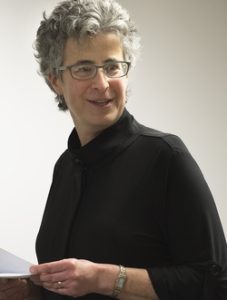
deb-fieldYom Kippur talk by Debbie Field

The Avodah service during the afternoon of Yom Kippur has its origins in an ancient temple ritual where the high priest sacrificed a bull to atone for the sins of himself, his household, and the world as a whole. In a radically reconstructed version of this service, I want to talk to you about a project of mine that engages all three levels of the Avodah: self, community, and world.

But before I describe that project, I want to reassure everyone here on two accounts. First, I am not going to talk about sins, but about atonement. And I am using the understanding of atonement that Rabbi Nathan provided in his talk on Rosh Hashanah; that is atonement as teshuvah, as a return to our best selves. Second, I have not redefined myself as high priest, and I am not speaking from an exalted position of holiness. Instead, I want to frame this talk with the line from Pirkei Avot/Sayings of the Fathers that many of you know: “It is not incumbent upon you to complete the work of creation, but neither are you at liberty to desist from it.” So, I’m speaking to you simply as somebody trying not to desist.

I’m going to start with a story. I teach at a small college a little south of here. I have a very nice colleague in the chemistry department who is originally from Syria. One day a few years ago, he stood up in the faculty meeting and asked us all to pray for his country. And everybody said, oh how sad, how sad and then we went back to our lives.

But as the news got worse and the refugee crises began to intensify, I kept thinking about his plea for our prayers. There are lots of different kinds of prayers and ways to pray; for example, when Rabbi Abraham Joshua Heschel got back from marching with Dr. Martin Luther King Jr. in Selma, he was asked if he had had time for prayer and he answered, “I was praying with my feet.” As Jews, we are obligated to help refugees: in the Torah there are 36 separate reminders that we must help the stranger because we were strangers in the land of Egypt. So, as a feet praying kind of Jew, I asked myself how I, as an individual, could pray for my colleague’s country and the people escaping from it. I also wondered how I could engage my campus community.

My first attempt was to suggest that our college house and feed a refugee family, as campuses around the country have started doing as part of a movement called Every Campus a Refuge.  I wrote a proposal that met with a curt refusal, so I redirected my energies. Eventually, the solution I came up with was to design a new course on Refugees in Modern History, which I am teaching this semester. The class includes a service learning component through a fledgling nonprofit organization called Paper Airplanes Tutoring. My students are tutoring Syrian refugees now living in various countries using Skype and Facebook. The goal is to help the Syrian young people improve their English so they can pass the language exams required for university admission. But Paper Airplanes Tutoring, and my class, also have broader goals.

According to the UN, there are 6.6 million refugees internally displaced within Syria, and over 4.8 million refugees outside of Syria, totaling over 11 million Syrian refugees. The United States has taken in just over 10,000; by contrast there are 2.7 million in Turkey. Last November after attacks in Paris, a Bloomburg News poll showed that 53% of Americans were against admitting any Syrian refugees, with an additional 11% saying they supported admitting only Christian Syrians. In the face of this huge refugee crises and our country’s opposition to helping, my aspiration is to change attitudes.

I have learned through many years of teaching that you can’t change people’s minds by railing at them. But through reading, discussing, and the investment in teaching one particular refugee, I hope that my students will see Syrian refugees as products of particular historical circumstances not of their own making, like the other refugees we have been studying in class: Jews and Palestinians, Vietnamese, Somalis, and Bosnians. More importantly, I hope my students will make individual human connections with their tutees and that the sympathy and understanding that results will ripple outward as they talk about their experiences with their friends and their parents and their communities.

I think this has started to happen. In her teaching log, one of my students described how surprised she was at how much she had in common with her student and she admitted she had assumed his culture would be alien and backward. She wrote: “We are so quick to judge others even though they are so much like ourselves; usually it is a mere difference in circumstances. I wish more people could see things this way, but I am glad that this opportunity of talking with my tutee has provided me with the human element to reevaluate my beliefs and change my current assumptions about other groups of people.”

What I’m doing is quite small. It comes out of my own desire to pray, if not with my feet, then with my syllabus, so that what I do every day can be part of repairing the world. There is so much broken in the world, but this Yom Kippur, I am trying to hang on to hope that my small, individual, pedagogical teshuvah is reaching outward to campus, community, nation, and world.

paper-airplanes-logo

Filed Under: Posts by Members, Tikkun Olam Tagged With: High Holidays, refugees, Yom Kippur

Humility/Sovereignty by Anita Rubin-Meiller

October 19, 2016 by Clare Kinberg

by Anita Rubin-Meiller
Humility/Sovereignty: Rosh Hashanah Drash, 2016

anita-rubin-muellerBeing asked to talk about humility in the context of recognizing God’s sovereignty returned me to my spiritual roots, Al-Anon, 1981. In the 12 steps there is a clear relationship between humility and God. Step 1, admit we are powerless. Step 3, make a decision to turn our lives and our will over to the care of God. Step 7, humbly ask God to remove our shortcomings. And isn’t that exactly what this time of year gives us the space to do? Beginning with the new moon of Elul and culminating as the gates close on Yom Kippur, we are invited to deeply know ourselves, the whole truth of ourselves, and bring that truth before the Holy One of Being, whom our prayer book calls “author of creation, teacher of truth” whose sovereign power hopefully empowers us. Humility is about being in right relationship with ourselves and thereby being in right relationship with God.
There are many ways to approach this time of searching within. Sometimes we set out determined, with a particular structure of meditating, journaling, sharing. And sometimes awareness arrives in the midst of our pain, our suffering our challenges. And that can feel like a gift or a curse.

Here’s the story: I can’t remember what happened before, but if you were peeking in on us in the moment of the outburst, it would have appeared that my husband and I were fighting over something to do with a box of crackers. Whatever it was that was really happening, the result was an emotional explosion on my part that had me leaving the house in anger at 9pm to take myself on a walk.

For a while the anger stayed and my thoughts were oriented towards “he does this, and he does that, and it will never change, etc.” Then I remembered myself. That is to say, I realized that this angry, resentful woman was not the person I wanted to be. I remembered the soothing power of self-compassion and placed a hand on my heart as I walked and gently noted my pain. And then I got curious.  Why did this hurt so much?

In her newest book, Rising Strong, social work researcher and TED talk celebrity Brene Brown describes a 3-step process meant to guide us in rising from our fall, overcoming our mistakes, and facing our hurt. She gives a name to what I went through when I went for my walk after the fight with my husband: The Reckoning. Her name for the next step, The Rumble, is indicative of the wrestling that ensues when we are opened in curiosity and compassion to explore our self-justification and habitual stories and find what is really going in our mind and heart and soul.

As I settled into this calm and curious state, a wiser awareness arrived: this was about my 5 year old. Again. Often when I know that I am hurt, instead of feeling angry I am brought there: to the child needing loving attention, to the child needing to know she is lovable, to the child wanting to be held. Recognizing her presence then gave me an opportunity to soothe her and to listen more deeply to myself. I so desperately wanted to be “big” enough to go home, apologize to my husband and move on. But as I continued walking, I realized that my awareness could not yet translate into skilled words and that the best I could do was to say calmly that I didn’t have words yet, and helplessly go off to the basement couch to sleep.

One of the ways I experience humility at this time of year is recognizing that what I release into the river at Tashlich tends to repeat itself. So, as I awoke the next day I was quite aware that last year at this time I had vowed to love my husband as best as I could and for sure this meant giving up the idea that he should do what I do, want what I want, value what I value.  And that introduces the other player in this tale, the self -righteous teen who pops up to protect against the hurt, the sorrow and disappointment of the 5-year-old feeling unloved. She has always been harder for me to embrace, but at least the embrace does come.

To quote Brene Brown again: “The irony is that we attempt to disown our difficult stories to appear more whole or more acceptable, but our wholeness – even our wholeheartedness- actually depends on the integration of all our experiences, including the falls” She calls her third step in the process of coming home to ourselves “The Revolution” and describes it as being able to write a new ending to your story based on the learnings from the process of  The Rumble.

So I awoke to find Roger and my words.

In a letter from the Ramban to his son, quoted by Rabbi Dr. Louis Jacobs, he writes of humility: ”Let your voice be gentle and your head bowed. Let your eyes be turned earthwards and your heart heavenwards. Let every man seem superior to you in your own eyes. God alone knows the true worth of a man.”

As Roger and I took a morning walk and I tearfully shared my apology and realization, my pain and my hope for a different outcome, I could feel my whole being soften, lean in to this man that I have loved imperfectly for 30 years. And without asking, he shared his insights as well and we came to better understand the dance we have done for so long of triggering each other’s vulnerabilities and acting protectively in response. There is a saying in the Tai Chi principles: 4 ounces displaces 1,000 pounds. When I am corrected during morning practice it is often minuscule, but feels like a miracle, a small adjustment creating a significant shift.

I was sure this shift was here to stay, but “never again” are not the words of humility. Just last week I had yelled at my husband “I need you to meet me halfway”  and found myself heading for the basement couch again, where I looked up the Biblical definitions of humility and found this: “the quality that lets us go more than halfway to meet the needs and demands of others.” I picked up my pillow, returned to our bedroom, and snuggled in, grateful.

Humility is knowing that no matter how hard I try I will never be perfect. It is trusting that the Holy One of Being will have a lot more patience with my repeated mistakes then I tend to have. It is finding lessons mysteriously delivered in unexpected places.

I end with the wisdom of folksinger Steve Earle from a song called “God is God”

God, in my little understanding don’t care what name I call.
Whether or not I believe doesn’t matter at all.
I receive the blessings that every day on Earth’s another chance to get it right.
Let this little light of mine shine and rage against the night.
I believe in God and God ain’t us.


Filed Under: Divrei Torah, Posts by Members Tagged With: High Holidays, Rosh Hashanah

Marcy’s Break-Fast Pear Plum Kugel, with Ricotta and Thoreson Farm Apples

October 18, 2016 by Clare Kinberg 3 Comments

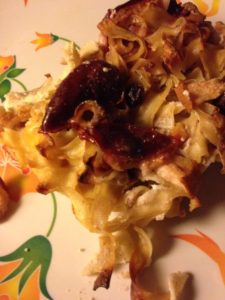
marcys-kugelby Marcy Epstein

This is a no-holds-barred, creamy sweet kugel (noodle pudding) that necessitates a good amount of improvisation. In other words, I made this up. There are two conventional kugels Ashkenazim have turned to for over a century– the sweet apple and raisin variety, and the even more common starch-salty kugel of matzah meal, potato, leek or just plain cream sort that serves as accompaniment to a main course.

Because I made this kugel toward the end of Yom Kippur, I aimed for the happy fusion between the two, the dessert you eat as an entree, something to fill a stomach after ten servings of contrition. I combined a salty, creamy starchiness with many eggs and the earthy tang of sweet and earthy fruits. I reconstructed the tradition of eating new fruit of the fall harvest, taking t’shuvah to mean the literal turning of the spoon, I prepared noodles, ricotta cheese custard, and a great combination of fruits I doubt can be exactly replicated: this year’s extra sweet fresh Italian plums, some Bartlett pears, and (learning from Nancy and Drake Meadow how to set up jars and jars of local fruit) fresh raspberries, strawberries from Tantre Farm, serviceberries gleaned from outside a hospice, and Lodi apples gathered from a wild edge of Thoreson Farm (ironically, this farm was first to cultivate cherries in Michigan, but I only had dried cherries about, and dried fruit Kugel is a whole ’nuther casserole.) As I mentioned, improvise. Look to this recipe with open invention, an invitation into the sweet coherence of a signature on baker’s parchment in life’s divine cook book. The secret of kugel is in its ingredients and coherence.

As for coherence, I had a spiritual and practical problem. Homemade noodles would have made this recipe sound that much more home grown, true to humble roots. But practically, it was already torture not to taste the kugel while fasting– to make homemade noodles would have done me in and tripped me up. (I read the al Chet while the kugel cooked.) Wide store bought egg noodles were used instead.

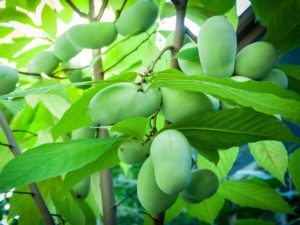
pawpaw5cropped
If you really want to stretch this recipe in another locavore way, hang out with Allison Stupka and Harry Fried, and perhaps you, too, can be enthralled to the seasonal Michigan Paw Paw and its light, complex custard– this fruit could carry the kugel on its own.

One more note: this is not the kugel of my humble roots–that is a fantastic suburban pineapple kugel that I used to make with my mother, Ruth. Among the many things I turned over with the spoon was how I missed making this kugel with her. Mind you, I did most of the making, and she would talk with me, take or make calls to people from our JCC, or tell me about her hayday of hosting Hadassah meetings with this and that. Those are the missing ingredients of my own kugel, the kavanah of turning and folding, the awkward but satisfying slops where the cream and salt hit the fruit. It is in the spirit of lost-ness and return that I dedicate this little kugel to my mother and to Karen, Debbie Zivan’s mother, whom we lost this past month. I was lucky enough to share the holy days with her, to eat kugel with her, and to feel her Jewish motherliness when I could not be with my mom. So this recipe is for them and for yours.

Ingredients:
Salt, one big pinch
Butter, salted, two pats
1/4 cup Olive oil
1 bag of wide egg noodles
1 healthy cup sour cream
1 healthy cup ricotta cheese
3 tbsp of strawberry cream cheese
3 tbsp of regular cream cheese
1/2 cup milk
6 eggs
Two pears, diced
8-10 Italian (prune) plums
One pint jar of preserved fruit: mine  was apples with raspberries and serviceberries. Apple sauce can work in a pinch.
Honey to taste.

Directions:
Preheat oven to 400 degrees. Set a couple of quarts of water with pinch of salt to boil. Add egg noodles when water is just at a boil, watch for 4-5 minutes, turn off heat and let sit. In a large mixing bowl, add cream cheese and microwave 1 minute till soft. To this, add and turn over a little milk, sour cream, a pat or two of salted butter, olive oil, eggs, vanilla, ricotta cheese, salt, and honey and cinnamon to taste. This mixture should prove to be nearly the mass of the noodles. Strain but do not rinse noodles. Add to a large casserole dish and have another smaller dish nearby in case you can make an extra for someone special. Core and chop pears. Pit and chop half the plums, leaving several halves intact. Fold cheese mixture into pan of noodles and turn. Fold canned fruit into the pan and turn. Fold chopped fruit into the pan and turn. Don’t worry about a topping for this kugel, the starch and oil in the recipe keep it from sticking (as long as you don’t over oil it), and it should have crunchy, pliant noodles on top. Bake for 40 minutes. Check to see if the custard has formed by putting in a knife and seeing it come out relatively clear of batter. Let the kugel sit a little before serving. It is best served luke warm.

Ideas for kugel are most welcome here on the AARC blog, and I can use suggestions before I expand this entry for my little Tumblr blog, New Jew Food.


Filed Under: Food, Posts by Members Tagged With: recipes, Yom Kippur

Oct 16 Beit Sefer and All Congregation Sukkah Building

October 13, 2016 by Clare Kinberg

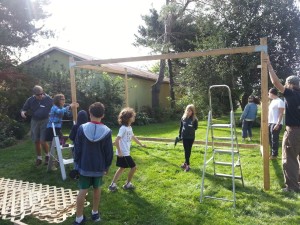
Last year, we build the sukkah on a beautiful day, hope it's as nice this year!
Last year, we built the sukkah on a beautiful day, hope it’s as nice this year!
Beit Sefer students really did the building. Come on out and help!

This coming Sunday morning, Oct 16, 2016 9:30 to 11:30 during our regular Beit Sefer/Religious School time, AARC will be building a Sukkah at Carole Caplan’s farm, 6900 Jennings Rd. The students, teachers and parents will build the sukkah just like last year, and we welcome help from all AARC members and friends. We will scour the land for s’kach (raw, unfinished vegetable matter) roof cover; we’ll make decorations; we’ll sing some songs in the finished sukkah! Please give yourself enough time to arrive by 9:30 so we can get the sukkah built in time to enjoy it. The eight day holiday of Sukkot begins at sundown on Sunday Oct 16.

Our really delightful Children’s High Holiday machzor/prayerbook closed with the Ufros aleinu prayer which is part of the evening Hashkivenu prayer.  The prayer asks God to spread over us a sukkat shalom/shelter of peace. As Rabbi Rachel Barenblatt says,

“During evening prayer there’s an extra blessing added — extra because it doesn’t appear in morning or afternoon prayer — which asks God to shelter us through the coming night. We pray ופרוש עלינו סכת שלומך, ufros aleinu sukkat shlomecha, ‘spread over us the sukkah of Your peace.’” Here’s a link to her blogpost “Shelter and Peace.”

And here’s link to the Hashkivenu prayer as sung during St. Louis’ Central Reform Congregation’s evening service. Recording features a wonderful group of CRC musicians: Rabbi Randy Fleisher, Leslie Caplan, Marty Miller, Andrew John, and Steve Friedman.

When we build a physical sukkah together, we can bring the meaning of this even closer. Enjoy, and see you Sunday.

Filed Under: Beit Sefer (Religious School), Upcoming Activities Tagged With: Sukkot

Who by water and who by [police] fire?

October 6, 2016 by Clare Kinberg

The Unetaneh Tokef prayer is unique to the Rosh Hashanah and Yom Kippur liturgy. The first line is variously translated as ‘We shall ascribe holiness to this day” and “Let us speak of the awesomeness.” The poem contains the imagery of the book of life opening on Rosh Hashanah, and being sealed on Yom Kippur. A translation of the poem can be found in this blog post by Rabbi Reuven Hammer.

For our Rosh Hashanah service this year, Deb Kraus wrote this powerful introduction to the Unetaneh Tokef.

From last high holy days to today, how many African American people have died by police fire?

For smoking an e-cigarette, like Alfredo Olango

For reaching for a gun, like Che Taylor
For just having a gun, like Michael Moore and Nicholas Robertson and Corey Jones.
Or for refusing to drop a gun, like Sahlah Ridgeway and Sylville Smith

For waiting for his son’s schoolbus to arrive, like Keith Lamont Scott.
For having his car stall out, like Terence Crutcher
For speeding, like Moses Rubin and Doll Pierre-Louis
For riding a motorcycle, like Terrence Sterling
For stealing a car, like Paul O’Neal
Or for stealing an officer’s car, like Paterson Brown, Jr.

For running away from the cops, like Dalvin Hollins and Deravis Caine Rogers and Jabril Robinson and Rodney Watts and Akiel Denkins and Calin Roquemore and Ricky Ball and Jessica Williams and Miguel Espinal and Donte Taylor and 13 year old Tyre King.
Or for approaching the cops, like Christopher Goodlow and Javario Eagle

For shooting himself in his own wheelchair, like Jeremy McDole.
For being schizophrenic, bipolar, suicidal or mentally impaired in some other way, like James Anderson and Janet Wilson and Joseph Mann and Jawari Porter and Kevin Matthews and Carlumandarlo Zaramo and Tyler Gebhard.

For trying to help a neighbor, like Bettie Jones
For faking a prescription, like Keith McLeod
For selling CDs outside a convenience store, like Alton Sterling
For damaging a traffic sign, like Peter Gaines
And for road rage, like Delrawn Small and Clarence Howard.

For “refusing to cooperate” like Cameron Glover and Gregory Frazier and Nathaniel Pickett and Darnell Wicker, who, BTW, was probably deaf…
OR For doing everything the police said, like Philando Castile
For sitting in his bedroom looking threatening, like Levonia Riggins
Or trying to protect her five year old child in her own home, like Korryn Gaines.
For looking like someone else, like Colby Friday and Donnell Thompson, Jr.
For engaging in “suspicious activity,” like Dazion Flenaugh and David Joseph, and Greg Gunn
For fighting back, like Kevin Hicks and Junior Prosper
For turning around too quickly, like Antronie Scott

For panicking, like all the people above, Blue AND Black…

Although, a sign I saw Saturday summed it up:
“We live in a world where trained cops can panic and act on impulse but untrained civilians must remain calm with a gun in their face.”

Notice race was not mentioned in that last quote. I’ll say it again:

“We live in a world where trained cops can panic and act on impulse but untrained civilians must remain calm with a gun in their face.”

I know that none of these situations are as straightforward as I have presented it.

But this year, as we pray the Unetaneh Tokef, let us really try to comprehend the myriad ways those who have pledged to serve and protect can instead cause people to die by fire, just because of the color of their skin.

–Deb Kraus

For a long reflection on Unetaneh Tokef, written by Rabbi Toba Spitzer, for Rosh Hashanah 5762 (Sept. 18, 2001), please go here.

Filed Under: Poems and Blessings

The Thing with Name Tags

September 29, 2016 by Clare Kinberg

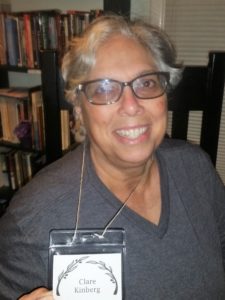
Me with my new name tag
Clare Kinberg with new name tag

One of the first tasks I was assigned as Events and Communications coordinator for AARC was to make name tags for new members, including teenagers who had would soon become bnei mitzvah and therefore full-fledged members of the congregation. And for Rosh Hashanah, I make replacement name tags for members who’ve lost theirs over the course of the year.

Now in my second year of working for AARC, I see the annual “Name Tag Check” as an important part of “taking stock,” preparing for the High Holidays. Over this past year, I’ve made four new name tags for bnei mitzvah and I’ve made five for new members….and this week I made 27 name tags for members who have lost theirs, including one for myself. Members: When you come to services for the High Holidays, be sure to pick up and put on your name tag. And put it back when you leave.

What’s with all this name tag business? Besides gently helping with our sometimes over-taxed memories for the names of people we know but just can’t pull up at the moment, name tags are an important part of reminding us of our responsibility toward welcoming others who are newer to our community. Our High Holiday services are open to all; many people come to pray with us once a year, and others who are considering joining a congregation come to check out the feel of the community. Our community is informal and pluralistic, welcoming to newcomers from a real diversity of backgrounds. If you are new to services, or attending as a non-member, I hope you will talk to people wearing AARC name tags. And members, let your name tag remind you to strike up conversations with someone you don’t already know!

I know my Name Tag Check next year will include several bnei mitzvah. I hope it will include many new members, too! (And if you lose your name tag in the middle of the year, no need to wait till High Holidays for the replacement; just let me know and I’ll make you a new one.)

Shana tova

Filed Under: Upcoming Activities Tagged With: High Holidays, Rosh Hashanah

Rena’s Fall recipe: Farmer’s Market Potato Salad

September 21, 2016 by Clare Kinberg

farmers-market-potato-saladAdapted by Rena Basch from Cooking Light magazine June 2010

Looking for a change of pace from traditional potato salad? This dish could be called “Not-Just Potato Salad.” This recipe is a flexible, vinaigrette-based powerhouse that you can load up with your favorite veggies. I particularly love it because it can be made from whatever fresh vegetables are available at the farmers market during the harvest season, or if it’s winter, sub out the ingredients like fresh corn, zucchini and green beans for frozen. During the winter-time, skip the cherry tomatoes; it’s still delicious.

For a beautiful looking salad, use a mix of red, purple, Yukon and brown-skinned potatoes. If you don’t have a variety of colorful potatoes, just use fingerlings or small red potatoes. You can serve this dish at room temperature just after it’s tossed together, or you can make it ahead, and serve chilled.

Ingredients:
1 cup fresh corn kernels, about 2 ears.  
2 pounds potatoes, scrubbed and cut into 1-inch pieces
2 ½ tablespoons olive oil, divided
2 tablespoons chopped fresh tarragon
2 tablespoons cider vinegar
2 tablespoons whole-grain Dijon mustard
½ teaspoon hot pepper sauce (such as Tabasco)
3/4 teaspoon salt
½ teaspoon freshly ground black pepper
Cooking spray
¾ cup vertically sliced red onion
¾ cup diced zucchini
 ¾ cup chopped green beans
1 cup cherry tomatoes, halved

Preheat oven to 425°.

Cut the corn off of the cobs. Place corn and chopped potatoes on a jelly-roll pan (or cookie sheet). Drizzle with 1 tablespoon oil and toss to coat. Bake at 425° for 30 minutes or until potatoes are tender.  Place roasted potato and corn in a large bowl.  Combine tarragon and next 5 ingredients (through pepper) in a small bowl, stirring with a whisk. Gradually add remaining 1 1/2 tablespoons oil, stirring constantly with a whisk. Drizzle potato mixture with dressing; toss gently to coat.

Heat a large skillet over medium heat. Coat pan with cooking spray. Add onion, green beans and zucchini to pan; cook 4 minutes or until lightly browned, stirring occasionally. Add zucchini mixture and tomatoes to potato mixture; toss gently to combine.


Filed Under: Food, Posts by Members Tagged With: recipes

D’var on Eikev by bar mitzvah Aaron Belman-Wells

September 21, 2016 by Clare Kinberg

aaron-belman-wellsShabbat  shalom.

While I was working on my maftir [concluding section of the weekly Torah portion], Deuteronomy 11:22-25, there were several points where I noticed some differences in translations of the text. These differences could be as seemingly minor as “Red” or “Reed” Sea, or as major as “Sea of the Philistines” or “Western Sea,” or even which Wilderness. Differences in translations and/or text arise because of language, misunderstanding, human error, knowledge etc. My aliyah [segment of the Torah portion], however, concerns the Promised Land. So, as you can see, knowing which sea or wilderness the text is referring to marks a boundary and is significant. Despite how minor many of these changes may seem, they still can make incredible differences in what we are to take away from that section. Looking around [i][ii] to see if this was simply an anomaly, I noticed that there were other points in the Torah where this kind of change occurred. After thinking about why this might happen, I decided that there could only be one major possibility for a change as this: there is no definite word or phrase of text that must be placed there, so people simply wrote in what they assumed to be what was meant to be there. While this often works, the example with the Red and Reed Sea shows that often times there is little to no communication or standardization  between people attempting to translate the Torah.

Differences in translation may also be due to differences in agendas and purposes. Few of us read or speak the Hebrew of the Torah, so we depend on translators. Some translators wish their translations to reflect, to the degree possible, exactly what was written. Others, recognizing that a world of 5,000 or 6,000 years ago is very foreign to modern readers, try to make the text accessible to the reader, making changes to make the events and discussion straightforward. We can see similar, if less important, differences in translations of the Bard’s Hamlet, in which there are at least 3 different versions, despite the fact that only 1 is used[iii]. Equally important, there may be differences in the translator’s view of the Torah and Judaism that influence the translation. Is a given event a recitation of a real event, or is it to be interpreted and put in some context?  All of these result in differences of words and of meaning. [Read more…] about D’var on Eikev by bar mitzvah Aaron Belman-Wells

Filed Under: Divrei Torah, Posts by Members Tagged With: Bar mitzvah

Join the 2016 AARC CROP Hunger Walk Team

September 12, 2016 by Clare Kinberg

Submitted by Cara Spindler

crop-walk-graphicOn Sunday, September 25 the Interfaith Council for Peace & Justice (ICPJ) is hosting the 42nd Annual Washtenaw/Ann Arbor CROP Hunger.  ICPJ has organized this 5k charitable walk since 1974, raising a total of $3.2 million over the decades.  Last year Washtenaw County walkers raised $48,500, with about 300 walkers participating.

CROP Hunger Walks are locally organized by businesses, schools, and communities of faith. “CROP” originally stood for the “Christian Rural Overseas Program,” a 1947 joint program between several church organizations to help with post-war poverty.  Today these community-wide local events seek to raise funds to end hunger and increase food security and food-related social justice in the U.S. and globally.  More than 1,600 walks take place across the U.S. annually.  About 25% of the proceeds go to local hunger-fighting efforts, and the walker can determine where the remaining 75% of their raised funds goes (choosing from a vetted list of global hunger agencies).

Please come and walk with us on September 25!  Call Cara Spindler ( 734-255-0939) if you want to coordinate more.  Our contingent will gather at Trinity Lutheran at 1:30 pm.  

STARTING LOCATION: Trinity Lutheran Church (1400 W Stadium Blvd., Ann Arbor, MI 48103)

DATE: Sunday, September 25, 2016, 1–4 PM

To sign up:

  1. Go to the CROP Hunger Walk website using this link
  2. Click REGISTER
  3. Fill out the form (or sign in using Facebook)
  4. When you get to “Create or Join a Team” choose “Join an existing team”
  5. Click “see list” next to the search box, and select “Ann Arbor Reconstructionist Congregation”
  6. Click the “Join Now” button.

Your friends and neighbors can donate via the website (once you log in there’s lots of tools for soliciting donations and accepting payment)—or you can bring a check/cash to drop off at the Walk.

See you on September 25!

Filed Under: Posts by Members, Tikkun Olam, Upcoming Activities Tagged With: food/land/justice, interfaith, Tikkun Olam

A “tebah” for the Huron

September 8, 2016 by Clare Kinberg

by Clare Kinberg, Beit Sefer director

Last year, on the first day of our religious school, Beit Sefer, I told a story about the word Hebrew word “tebah”תֵּבַ֣ת. When we meet again for the first session this year (10am Island Park) I want to tell the same story. I’m pretty sure at least some of the kids will remember it if I tell it again. I hope so, but it doesn’t matter.

Ann Arbor Jewish religious school
Beit Sefer Students and Teachers on the last day of class last year May 2016

It is Jewish tradition to tell the same stories over and over again. And every time a story is told, even with the same words, it is a different story, because the hearer has changed. You are not the same person you were last time you heard the story. As adults, we’ve heard many stories in the Torah dozens of times. Yet, what you hear and understand from a story, using the exact same words, is different every time you hear it.

Here is the story at I told it last year:

The stories that Jews tell from the Torah are some of our oldest stories. In fact, something like 200 generations of Jews have passed down the stories that are in the Torah. One of the oldest ones, and a story that is told by lots of different peoples, is the story of a great flood that covered the earth, and one family–Noah, his wife Nehama and their children–and the ark they built to ride on the waters of the flood and to save the plants and animals so that the earth could start over.

In Hebrew the word for Noah and Nehama’s boat is tebah. A tebah is a special boat that keeps its passengers safe. In the whole Torah there is only one other tebah:  while Noah and Nehama’s tebah was large enough to hold a pair of every animal and every plant on earth, the other tebah was so small it held only one baby passenger. In the Torah stories, about 100 generations after the great flood, the baby Moses was born and his sister, the prophet Miriam, built a small tebah, a basket more like a cradle than a huge ark, to save Moses’ life. When Moses was a grown man, so the story goes, he led the Jews out of slavery. So while one tebah played a part in saving life on earth, the small tevah played a part in saving the Jewish people.

Since one word, tebah, is used to mean such different things, a colossal ship made of gopher wood and a baby basket made of reeds, perhaps the meaning of tebah, is “life-saver.”

Or maybe it is the stories themselves that are the ark, the boat, that keeps us afloat. The stories I mean are both the stories that have been passed down generation to generation, and the stories we are creating with our own lives.

basket boat used at Ann Arbor Jewish religious school Beit Sefer
Basket-boat

Last year, on the opening day of Beit Sefer, we passed a small boat shaped basket around a big circle of parents and students. As we passed the basket, we each recited, “This basket holds our stories, pass it on.” Then, the person accepting the basket replied, “Thank you, I will learn the stories and pass them on.”

This year on opening day, we are going to make the baskets, and we are going to make a new story, all together. Beit Sefer begins at Island Park at 10am. Parents are asked to stay for a meeting, and to play a special role in writing a story and helping the students launch a tevah on the Huron River. Immediately following the launch, will be our AARC Annual Picnic. Noon to 3pm. Bring protein to grill, a side dish to share. AARC will provide drinks and paper goods.

See you there!

Filed Under: Beit Sefer (Religious School), Upcoming Activities Tagged With: huron river, Torah

  • « Go to Previous Page
  • Page 1
  • Interim pages omitted …
  • Page 12
  • Page 13
  • Page 14
  • Page 15
  • Page 16
  • Interim pages omitted …
  • Page 24
  • Go to Next Page »

Primary Sidebar

Search

Join Our Mailing List

Sign up for our twice a week newsletter to get details on upcoming events and catch up on our latest news.

This field is required.

Check your inbox or spam folder to confirm your subscription.

Upcoming Events

  • 9:00 am – 10:00 am, April 17, 2026 – Rosh Chodesh Minyan Iyar [ZOOM]
  • All day, April 19, 2026 – Beit Sefer
  • 6:30 pm – 8:00 pm, April 24, 2026 – Fourth Friday Kabbalat Shabbat
  • All day, April 26, 2026 – Beit Sefer
  • 12:00 pm – 3:00 pm, April 26, 2026 – “Lesson of the Homeland” and the Stories We Tell: A Conversation with Anat Zeltser

Latest News

  • RSVP to “Lesson of the Homeland” and the Stories We Tell: A Conversation with Anat Zeltser April 16, 2026
  • Climate Action Shabbat article in the April 2026 Washtenaw Jewish News April 3, 2026
  • Reimagining Torah Study: Moving from Zoom to In Person by Rabbi Gabrielle Pescador April 1, 2026
  • Creative Spirit at the AARC Beit Sefer March 27, 2026
  • When Is a Killer Not a Murderer? by Elizabeth Brindley March 19, 2026

Footer

Affiliated with

Copyright © 2026 Ann Arbor Reconstructionist Congregation