• Skip to primary navigation
  • Skip to main content
  • Skip to primary sidebar
  • Skip to footer
Ann Arbor Reconstructionist Congregation

Ann Arbor Reconstructionist Congregation

  • Home
  • About
    • Overview
    • Rav Gavrielle Pescador
    • Our History
      • Photo Gallery
    • Our Values and Vision
    • LGBTQ Inclusive
    • Our Board
    • Our Sacred Objects
    • About Reconstructionist Judaism
    • Jewish Ann Arbor
  • Programs
    • Shabbat and Holidays
    • B’nei Mitzvah
    • Tikkun Olam
    • In the (Washtenaw Jewish) News
    • Health and Safety Expectations for In-Person Gatherings
    • Join our Mailing List
  • Religious School
    • About Beit Sefer
    • Teachers
    • Enrollment and Tuition
    • 2025-26 Beit Sefer Calendar
  • Blog
  • Calendar
  • Membership
    • Thinking about joining?
    • Member Area
  • Contact Us
  • Donate

Clare Kinberg

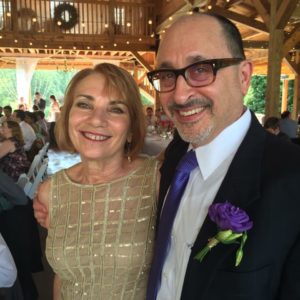
New Members Howie Brick and “D” Schwartz

January 9, 2017 by Clare Kinberg

Originally from Long Island (with accents to prove it), Howie and I attended the University of Michigan as undergrads and graduate students. We left Ann Arbor finally (or so we thought) in 1980. At that time, Howie had nearly finished his PhD in American Culture while I had completed an MA in Asian Studies.  The following years found us on the academic ramble, following Howie’s career as a historian of the 20th century USA, from New York, to Chicago, to Boston, to Eugene, OR, to St. Louis. (Yes. We share some history with Clare K.!) All the while, I was doing my thing as a writer and editor in university communications offices. Somewhere in there, we raised two children, Michael and Jessye, who are now grown and out of the house. We were shocked when Michigan came calling again in 2008, but here we are.  I am now enjoying my postwork life, while Howie gives his best to the university.
I am happy to join all the other Debras, Deborahs, Debbies, and Debs. I go by all of those names, so whatever makes you happy, makes me happy. My St. Louis rabbi just calls me “D.”
[Editor’s note: We always ask new members to introduce themselves to the community with a little blog post. Debbie (and Howie occasionally) have been showing up at services for several years, and Debbie and I always have something to talk about (explained above, Eugene! St. Louis!). If you are a new member, or even if you have been a member for a long time, but have never had a profile blog post, contact me (ckinberg@gmail.com), because I’d like to profile you!]
Filed Under: Member Profiles

Praying with My Legs: January 22

December 29, 2016 by Clare Kinberg

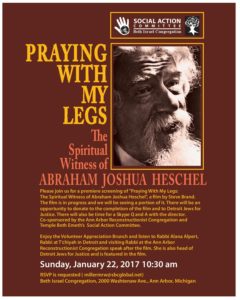
AARC is co-sponsoring the Sun, January 22, 2017, 10:30am – 12:30pm screening of the documentary-in-progress, Praying with My Legs, about Rabbi Abraham Joshua Heschel. Its filmmaker, Steve Brand, will speak via Skype and Rabbi Alana Alpert, who is in the film, will add her own remarks. The brunch and film showing is organized by the Beth Israel Congregation Social Action Committee and will honor their volunteers and include opportunities to support the completion of the film, and Detroit Jews for Justice. 

When this program was planned several months ago, the date was chosen because of its proximity to both Dr. Heschel’s yahrtzeit on the 18th of Tevet, and the national day of honor for Dr. Martin Luther King, Jr, this year, on January 16. King and Heschel were friends and colleagues who marched together at the front of the 1965 Freedom March from Selma to Montgomery. However, the planners did not anticipate that the date of the event would also coincide with the inauguration of someone who is bringing white nationalism into the White House. This film could be precisely the spiritual and political inspiration we need to face the future. Heschel was compelled by his religious beliefs to leave the confines of his study to fight for human dignity, immersing himself in the struggle for civil rights and human dignity.

The brunch at 10:30 is free, and everyone is welcome to come. To ensure that there is enough food, please RSVP to BIC Office by Tuesday, January 17th, office@bethisrael-aa.org.  More about the film here.

Filed Under: Community Learning, Tikkun Olam, Upcoming Activities

A Pledge

December 22, 2016 by Clare Kinberg

by AARC member Rose Benjamin

I am afraid to be trans today. I am afraid to leave my cocoon. I am afraid to leave Ann Arbor. I am afraid in Ann Arbor. I am afraid to walk around in a dress with my new baby. I am afraid to relax. I am looking over my shoulder. I am wondering who secretly wants to kill me, not for who I am but for what I represent, what I trigger. I am less open. I am less free. I am wondering whether to hide my transness. I am used to hiding it, maybe it wouldn’t be so bad. I am frightened for my wife, for my child. I am frightened for my gay and trans friends. I am frightened that when we are together we will be shiny targets. I am afraid that all my doubts will come back, the ones that make me feel freakish and ugly. I have not been “out” for long; should I just go back in, I wonder. I am frightened to use the women’s bathroom. I am frightened to use the men’s bathroom. I do not take my estrogen with glee anymore. I take it with dread because every dose is another step in the direction of standing out. I am afraid to be trans. I am afraid.

But I should not, cannot, will not let this defeat me. I will remember that this is about so much more than me. I will remember that millions of Muslims, Latinos, African-Americans, women, immigrants, differently abled people, progressives, radicals, socialists, bi-gendered, un-gendered, fluidly-gendered, young, elderly, Jewish, Native, people, humans are feeling just as frightened, and much more so than me. I will remember all the privilege I have regardless of being a transgender, bi-ish-sexual, Jewish, radical fop without any savings. And I will remember how many people struggled and died in obscurity just so I could wear this dress at all, just so we could rant openly, just so we could stand up for something. And I will try to feel brave, I will take heart. But not because I am very strong. I will do so because you give me hope. And so I write this to give you hope. I am scared. But I am going to wear my lipstick. I will go to Detroit and march and I will do so wearing my pins and flowers and frilly hems. Because I trust you when you say you have my back and I want you to know I have yours. Because otherwise we are lost.

I am afraid to be trans. And this will not change. I was afraid to be trans long before I accepted I was trans. Because while being trans is scary so is being honest. So is being real. So is caring. So is “being there” in any kind of actual way. So is wondering whether you belong, wondering whether the dream is just a particularly unprofitable joke we’ve all played on each other with some very profitable help from The Beatles. Life is scary. These things have to do with us, with what we say and do, with how we behave when the nighttime comes. And I want you to know something: when I read some of the remarkably powerful and empowering things you say, I am less scared and I am more heartened. Everyone is righteous and brave when things are comfortably distant. Everyone says the right things about recycling and the failing schools and how much black lives matter (and of course these things matter in the biggest ways). But now is the time when that distance shrinks, when the gap between saying and doing closes, when the comfortable space between theory and practice disappears.

And so I am making a pledge to myself and to you. I am going to keep wearing this dress. As long as you keep wearing yours, whatever form that “dress” takes. If that “dress” is your race or religion, keep wearing it. If that dress is your sexuality, nationality, artistry, humor, or hair color, keep wearing it. If that dress is your belief that people should speak up against injustice, then by all means, now is the time to layer that shit. If your dress is your laughter or longing, if it is the way you treat your co-workers and friends, if it is your relationship, the way you hold your head, the foods you like, the hours you keep, the things you collect, your makeup or lack thereof, your mental or physical health, your poverty, your character, your deepest convictions, your doubts, your love, your soul, you just keep wearing that dress. In fact, you add a scarf and hat. You add some fancy shoes you got at the overpriced vintage store. You throw on a bow. You hang some beads. You do what you have to do to wear that dress, whatever it is. And you make sure your friends wear theirs. Because this is the very occasion we’ve all been saving that dress for.

So I’m gonna keep wearing my pumps. I’m gonna keep wearing the foundation I got conned into buying by that lady at Macy’s. I’m gonna keep talking to people I don’t know, I’m gonna keep returning smiles even when there was nothing to return. I’m gonna keep wondering who needs help, gonna keep crying. I’m gonna keep my heart open even though it hurts. I’m gonna keep laughing. I’m gonna keep hoping. I’m gonna keep feeling and looking like a damn fool because no matter how much I want to give in, I just can’t be that person. And the reason I can’t is you. The things you say, the things I know you are willing to do to keep the frost from swallowing the garden reminds me that I am not alone.

I am afraid to be trans today. And I will continue to be afraid, more afraid than before. But I am also utterly resolved not to let this fear win. And after this week and month, after the initial shock and rage wear off, I will need you to keep reminding me of that resolve and I promise to remind you.
I am afraid. And I’m putting on my dress. And I’m going outside. And I’m not gonna avert my eyes.

I love you, friends,
Rose


Filed Under: Posts by Members, Tikkun Olam

Show of support for Islamic Center of Ann Arbor

December 14, 2016 by Clare Kinberg

On November 30th, 2016 the Islamic Center of Ann Arbor received an anti-Muslim hate letter, similar to letters sent to mosques all over the country, including the Islamic Center of East Lansing. The ICAA has received hate mail in the past, but this recent version includes numerous mentions of Trump: ‘There’s a new sheriff in town – President Donald Trump. He’s going to cleanse America and make it shine again. And, he’s going to start with you Muslims. He’s going to do to you Muslims what Hitler did to the jews. (sic)’”
In an expression of support to the Islamic Center of Ann Arbor/Muslim Community Association, the AARC Board sent the following statement:

The Board of the Ann Arbor Reconstructionist Congregation deplores harassment of anyone because of his or her religious beliefs or ethnicity. As Jews, we are well aware of the hostility our people have faced in many places and many eras. We were deeply troubled to learn of recent incidents in Ann Arbor targeting the Muslim community, such as a threat to burn a Muslim woman if she did not remove her hijab and a vicious letter mailed from California to many mosques, including the Islamic Center of Ann Arbor.  We are writing to express our solidarity with the Ann Arbor Muslim community and to assure you that a great many non-Muslims condemn anti-Muslim bigotry.

The secretary of the Muslim Community Association sent this note of appreciation in response.

Hello All,

Thank you for your kind words of support and solidarity. These are difficult times indeed and it is very sad to receive such a letter, but we fully understand that these people are not the norm and do not represent the greater good in this country.

Honestly, we are just very happy to receive these messages of support. Your words mean a lot to us – thank you again! We will keep your contact information and reach out to you when in need of assistance. Our strength lies in being united, and thus we are looking for ways to make connections.

Peace.

The Muslim Community Association has put up a webpage “Support from Ann Arbor Residents” that includes a sampling of the letters of support they have received.

You may also want to order and display a “One Human Family: We Support refugees and our Muslim neighbors” yard sign or banner. Distribution is a project of the Interfaith Council for Peace and Justice the Interfaith Roundtable of Washtenaw County.


Filed Under: Tikkun Olam Tagged With: interfaith

We have a new rabbi! Ora Nitkin-Kaner begins September 1, 2017

November 29, 2016 by Clare Kinberg Leave a Comment

Rabbi Ora Nitkin-Kaner

The Board of AARC is thrilled to announce that Rabbi Ora Nitkin-Kaner (RRC ’16) will begin her tenure as our congregation’s rabbi on September 1, 2017. Rabbi Ora is spending the current year in New Orleans in an intensive chaplaincy program and will be moving to Ann Arbor in the summer of 2017.

Born and raised in Toronto, Canada, Rabbi Ora began her rabbinic studies in Philadelphia at the Reconstructionist Rabbinical College in 2011. From the bio published upon her graduation in June 2016:

Ora learned Judaism at home, in Hebrew day school and at the University of Toronto, where as an undergraduate she studied Jewish folktales of demonic possession and as a graduate student she studied the intergenerational transmission of Holocaust trauma. Ora fell in love with New Orleans in 2007, and made it her home from 2008 to 2010 as she worked with exonerees and received educations in justice and power and beauty.

Ora began rabbinical school because she knew five years at RRC would help shape her into the leader she seeks to be in the world. Along the way, to her surprise and delight, she also became a Reconstructionist. While at RRC, Ora has been the grateful recipient of the Ziegelman Scholarship, John Bliss Scholarship, Wexner Graduate Fellowship, Or Hadash D’var Torah Award, Alice Stein Essay Prize and Tikkun Olam Award.

Ora’s internships at RRC have helped her grow immeasurably. As a chaplain at Monroe Village, Ora learned to hold stories; as the sabbatical and student rabbi at Congregation Kehilat Shalom, she discovered what it means to love a community; as a chaplain at Bellevue Hospital, she learned how the pastoral encounter fosters healing in patient and chaplain; and as the Bert Linder Rabbinic Intern at West End Synagogue, she found her voice.

During her first time living in New Orleans, Rabbi Ora was a fellow of the Jewish service corps organization, Avodah, where she blogged on the intersections of Judaism and social justice organizing and worked with the organization Resurrection after Exoneration which was founded by death row exoneree  John “JT” Thompson. She brought her experiences from New Orleans into her rabbinic training, concluding an MLK Day d’var in 2014 with these words:

As Jews, we have seeded the world with the idea that we are made in God’s image, that each of us, black, brown and white, Jewish or gentile, innocent or guilty, have God’s light inside of us. This teaching is the birthright that we have shared with the world. And now, it’s time to honour the corollary of that birthright – that we work for justice, even when it seems hopeless, even when crime and prison seem far away, even when the dreams of freedom of men who pace 6 foot by 9 foot cells seem far from our own, quieter dreams. I have a dream that we will put aside our complacency and recognize that we cannot drink in our freedom while communities of Americans across this country are dying of thirst.

Rabbi Ora uses her life experience as the granddaughter of Holocaust survivors to learn and teach about living with fear, loss and grief by practicing gratitude and taking action. Her dvar on Bechukotai is a beautiful contemplation on these themes.

The whole AARC community looks forward to Rabbi Ora’s leadership. Over the coming months we will be planning opportunities for meeting her in person and introducing her to our community.


Filed Under: Simchas, Upcoming Activities Tagged With: Rabbi Ora

Is memory important?

November 17, 2016 by Clare Kinberg

Zichronot/Remembrances: Is memory important? 
Rosh Hashanah 2016 Talk by Nancy Meadow
Judith Tendler , Dec 30, 1938 - July 25, 2016
Judith Tendler Dec 30, 1938 – July 25, 2016

I have loved and lost many women in my family to dementia or Alzheimer’s.

My maternal Great Aunt Sarah who, in dementia, read the same novel for ten years and loved ice cream.

My paternal grandma Alice who, in dementia, swore like a sailor and loved ice cream.

My mother, RoseAnna, who in dementia was not at peace unless she was ‘creating something’– even if it was folding the same two washcloths for hours on end. And who liked to mix her raspberry sherbet with potato chips.

My mother’s best friend, Sarah, who in dementia was tortured by interactive visions of evil people and deeds her clients suffering from trauma had shared with her over decades of a career in social work.

My mother’s sister, Aunt Judith, a beyond brilliant writer and academic who in her dementia would not stop walking even when her body could no longer do so, who corrected people’s grammar long after she could hold a conversation, who was not at peace unless she was holding a book/journal/few sheets of paper in her hands … and who loved ice cream.

I watched the disease slowly but relentlessly steal every single memory and every single piece of knowledge from their beings. Every bit they had spent a lifetime collecting. First to go was often words. Not all of them, but the beautiful, specific ones that communicated just exactly who they were, what they were thinking, how they felt, and what they wanted. As the memory pillage continued they lost the ability to sequence, connect, and feel safe in space. This is when trouble with keys, locks, codes, and doors began. Then difficulty with transitions began, small transitions like walking from tile onto carpet or through a door way, and big transitions like choosing a different route home or a new doctor. As the battle for memory marched further forward they lost names of people they loved, they knew. Every single one. From today, from yesterday, from generations before. Then the ability to care for their most basic needs, then their own name, then the ability to swallow, then to breathe.

When I was young, and I lost family members who were two generations older than me, I thought about how sad I was and how wrong it was that I could not have them in my life anymore. When I was an adult and lost my mom I thought about what mental habits I could adopt, ASAP, that might help me escape such a cruel death.

Then I lost mom’s best friend, and then Aunt Judith started to fail. Through Judith, I lost many beautiful people I fell in love with, those who lived with her while she was in an assisted living facility and then the Memory Care Ward. Then, this past July, I lost Judith – the last of her nuclear family.

Now I presume I will die from Alzheimer’s or some other dementia. I already love ice cream. The doctors object to such certainty, and perhaps it is the raw grief, but after witnessing all these strong, smart, feisty women fall who am I to think I could escape it?  

So I am here today, asking: why do we place such value on memory? Is it really so important?

When my grandmother was living with us the last six months of her life, I remember sitting on the couch with her for hours looking over family scrapbooks. I remember how happy I could make her by rattling off the names of dead friends and relatives I had never met but were in those picture books. I remember sitting at the piano with her while she played and sang a particular song from her Eastern European childhood over and over – drilling the melody and words into my childhood memory bank. My mother was caught up by the genealogy bug. She “found” over 1,500 relatives and took me on a roots tour that included visiting a shtetl in Ukraine, a street in Antwerp, and a sleepy town in Norway. My mother and grandmother clearly thought it important to remember the past.

Since my twins’ birth, I have told the story to Mollie and Isaac about how their great-great grandparents escaped from Ukraine–and who begat whom–until we get to their own birth story. I’m doing what I am supposed to do, passing along the history. But I am sure I don’t have all the facts “right,” and now there is nobody left to tell me the “real” story. I watched my mother and aunt spend decades arguing over whose version of what their parents did and thought was “correct.” I know that my sisters and I have very different ideas about people and things that happened in our common past. We each have our own versions.

So, here I am today, asking: is memory important?

Filed Under: Posts by Members Tagged With: Rosh Hashanah

D’var on Ki Tavo by bat mitzvah Jasmine Lowenstein

November 9, 2016 by Clare Kinberg

jasmine-lowensteinShabbat Shalom!

My parsha is Ki Tavo in the book of Deuteronomy. In Deuteronomy, Moses is telling the people that once they cross the Jordan River and enter the Promised Land, there will be rules and laws that they will have to follow. If they follow them, God will reward the people with blessings, but if they disobey, curses will fall upon them.

In my portion I found that there were far more curses than blessings. The blessings are only in verse 28, but the curses take up most of my portion including a 55 line aliyah and then, finally, it ends with another blessing. Maybe when the Israelites were about to enter the Promised Land they needed structure because the previous generation had come out of slavery in Egypt where they could not make their own decisions (because they weren’t free). Now they are free, but do they know how to make their own decisions?

On the journey from Egypt, they had G-d guiding them and they still made mistakes, as all human beings do. One of the times they were foolish was the incident with the Golden Calf. As you may know, Moses traveled up Mt. Sinai to receive the ten commandments. It took Moses a long time to come down from the mountain and the Israelites became scared. They thought he had died and they had lost their connection to G-d so they made a new deity, a golden calf. When Moses reached the bottom and saw the calf he was furious, so furious that he smashed the tablets on the ground!

In this example, the Israelites weren’t necessarily being foolish, they were just doing what they assumed was right based on what they saw, heard, and thought. Or didn’t think: The Israelites had always had someone leading them whether it was Moses or Pharaoh. So they had not learned how to critically think on their own.

As you can see in my parsha there are a lot of blessings and curses, but why should there be blessings and curses? I think there should be some rules, but I don’t think anyone should be cursed or die if they do something wrong. I think that everyone should get a second chance. Everyone makes mistakes; it’s just part of life. There is a difference between making a mistake and intentionally doing the wrong thing. Sometimes there are consequences for people’s actions and that is also a part of life. Even though there are consequences I don’t think that there should ever be consequences without thought to the surrounding circumstances. It’s not right or fair to that person, if someone does something by mistake and then gets punished just because there are set consequences. The world we currently live in is not fair. Punishments affect some people in worse ways than others. Different people, making the same mistake, can face different consequences because of the color of their skin, their economic class or sexual orientation, among other things. I think this is wrong.

People tend to like people just like them. In order to be fair to others, people have to be in environments where they can interact with each other and even make mistakes. The more people have an opportunity to interact with people different than them, the less they will discriminate against each other.

The LGBTQ community is an example of a community that has been discriminated against and still is. At the beginning of the AIDS epidemic, some people who didn’t know better and hadn’t been in contact with gay men thought that AIDS was a curse, inflicted on gay men, because people thought it was “bad,” “wrong,” or “disobeying to G-d” to be gay. Then when Ryan White, a boy with hemophilia, got HIV from a contaminated blood transfusion it really showed everyone that HIV wasn’t a curse or a punishment for something that people thought was “bad;” it was a disease that anyone could get. Babies were even born with it. People were wrong when they thought AIDS was a curse. Sometimes bad things happen to very good people. Long ago, the Israelites needed (or G-d thought that they needed) these blessings and curses that are in my Torah portion. Maybe in the 1980’s some people needed to think that HIV/AIDS was a curse; it might have been a coping mechanism to explain something scary.

Once people knew there was a scientific explanation, in other words, that you could get HIV/AIDS through blood transfusions, everyone realized it could happen to anyone: it doesn’t matter who you love, and it isn’t a curse. That is why for my mitzvah project I chose to raise money for Broadway Cares/Equity Fights Aids, an organization that raises money through the theater community to help support people who have HIV and AIDS. I’ll be having a Broadway sing-a-long as a fundraiser–I’ll let you all know the details when they’re set. It will be a lot of fun!!

In my parsha something else really struck me. G-d says that G-d the Eternal has not given us eyes that can see, ears that can hear, or mind to understand. The first time I read this, I thought: if the Eternal hasn’t given us eyes, ears, or a mind than how come we go to school and take tests and quizzes and manage to get some–if not all–of the questions right? If we do not have eyes that can see, then how do we read the Torah? If we did not have ears to hear, G-d would not have been able to communicate with Moses, Isaiah, Abraham, Leah, Rachel and all of the prophets. If Moses couldn’t hear G-d Moses probably wouldn’t have lead the Israelites to the land of milk and honey. Instead they probably would have ended up in the land of milk and cookies!

But later when I thought about it, I realized that wasn’t what G-d was trying to tell us. What G-d is saying is that G-d gave us sight, but didn’t give us insight; hearing but not the power to comprehend everything to its fullest potential; G-d gave us a mind but no one knows everything inside and out. I think the true message in this is that no one is perfect and people make mistakes. I am a perfectionist and learning that everyone makes mistakes and that no one is perfect has been a big part of my growth as a human being. Making mistakes, reflecting on the consequences, and being more patient with the mistakes of myself and others has helped me to become a better person and less hard on myself. In this I am learning to be a critical thinker, just like the Israelites.

In my haftarah, God is saying there is always hope and your nation Israel is going to be the center of everything. It’s kind of the opposite of my torah portion in that it’s looking at the bright side of life. My torah portion looks at the reality of life and focuses on the bad things that might happen. My feeling is that it creates a mindset that could really affect your outlook on life. We can choose to be an optimist, like Isaiah is saying, or a pessimist, like Moses is saying. Interestingly, both are channeling G-d.

My haftorah is one of the 7 leading up to the high holidays. These haftarot are known as the haftarot of consolation, and are based on balance. I think that maybe G-d was trying to balance the optimistic views to the pessimistic. I have so many people in my life who have helped me to find this balance. I would like to thank everyone who’s here for making the effort to show up and being supportive here today.

I would like to thank all of my friends, whether from school, Young Peoples Theater, or dance–you give me a place to belong. I would also like to thank all of my teachers for teaching me amazing things and making learning fun in the process. I would like to especially thank my teacher since first grade, Ms. Tucker. You are the perfect teacher for me. Thank you for helping me to become less of a perfectionist! I would like to thank Sari Mills for preparing me to start preparing for my Bat Mitzvah by teaching me Hebrew–and for being so nice in the process. Rabbi Alana–Thank you so much for doing my Bat Mitzvah even though you have another congregation and are so busy. You’re so nice and always have a smile on your face and it makes me feel confident, which is important when you are preparing for your Bat Mitzvah! Deb, thank you for always keeping your cool and being so encouraging no matter what was happening. (I think it is good that my Bat Mitzvah tutor also happens to be a therapist.) I would like to thank all of the out-of-towners who travelled from near and far to be here.

I would like to thank my human cousins and my canine one for making all of the family vacations and get-togethers all the more fun. Even though none of you are my age you still make me feel included. Thank you Alex, Eli, Lily and Joey for coming from college to my Bat Mitzvah. Thank you to all of my aunts and uncles for always being so much fun and being like my parents except with no rules!! I would like to thank my grandparents for being some of the most–if not the most-caring people I know. You guys are my role models. Pops and Grandpa–you gave me my love of math and science. And Bubbe and Nana–you gave me my love of music and art. I love you guys.

I would like to thank my Dad for always being soooo great and staying calm even when my sister, mom and I are having breakdowns. And most importantly, feeding us!! You work so hard and are the best Dad in the world. I would also like to thank my mom for helping me relax and feel so much better about myself whenever I’m stressed. And through this process of preparing for my Bat Mitzvah, especially, you have helped me remember that I’m doing great and have nothing to worry about. You’re the best mom in the world. Last but not least, I would like to thank my wonderful, amazing sister Ruby for always being wonderful and amazing and all of the other adjectives that mean that–and for being patient with me even when I can be difficult or sensitive–and still finding time to hang out with me. It’s a great thing for my best friend to be my sister. You’re the best sister in the world. I have the best family in the world. I love you guys. Thanks!!!


Filed Under: Divrei Torah, Simchas Tagged With: bat mitzvah

Commit to Confront Racism

November 3, 2016 by Clare Kinberg

Kol Nidrei Sermon by Rabbi Nathan Martin

Nathan MartinIn August 2014, an African American man, Michael Brown, was fatally shot by Officer Darren Wilson in Ferguson, Missouri. One of my students at the Reconstructionist Rabbinical College was experiencing considerable distress over the shooting. She is partnered with a person of color who is from Ferguson. At the time, I sought to respond as best as I could. I reached out to the student and together we composed an email about ways people could show up at demonstrations or to send tzedaka to the organizers of protests then happening in Ferguson. Yet, I still felt somewhat helpless and ineffective in the wake of it all.
For the last two years, we have witnessed a replay of this unfortunate type of violence again and again. Deb Kraus, in her introduction to the Unetane Tokef prayer on Rosh Hashannah, helped us to take note of the many black lives that have been cut short through police shootings.

As a liberal Jew, I grew up with a narrative of how Jews were allied with and instrumental in helping to fight for civil rights in the U.S, particularly the American south. And how we too, physically or symbolically, marched alongside our African American brothers and sisters to work for change. This remains an important part of my picture of American Jewish history of which I am proud.

And, I have come to realize that simply holding onto that picture is not enough. It’s not enough for this moment in which we find ourselves today. I have been asking myself what can I do to support our Jewish communities to be important players in the work toward eliminating institutional racism that people of color face everyday in America. Some of the hardest questions I have had to ask myself are: “what role do I play in perpetuating discrimination?” and “what can I do to make a difference?” These are difficult questions to face.

Part of my exploration has involved exploring ways in which I, as a white person, live with privilege that others don’t. I recently looked through Peggy McIntosh’s “white privilege checklist” –copies of which are in the back of the sanctuary—which asks you to note ways in which one carries privilege like, “I can go shopping alone most of the time, pretty well assured that I will not be followed or harassed,” or “I can be late to a meeting without having the lateness reflect on my race,” or “I can do well in a challenging situation without being called a credit to my race.” I could go on and list others, and encourage people to take a look at the list. But the point is that, as McIntosh notes, I as a white person carry around “an invisible package of unearned assets, which I can count on cashing in each day.”

I am aware that I have absorbed the biases and stereotypes that are the unspoken currency of American culture. I grew up in a primarily white, middle class suburb in Seattle. I went to Jewish day school. And because of this limited upbringing, I didn’t have the opportunity to experience the richness (and challenge) that comes with growing up in a more diverse community. Instead, I absorbed attitudes of distrust and fear of people who were different than me. And even today, when I read about yet another shooting of an unarmed person of color, I can see how challenging it is for me to stay engaged. I don’t want to have to face the imperfections of our country. I want to turn away rather than turn toward confronting potential bias. But now is the time to turn toward. I want to help create a country where my children, and their children, can grow up in less isolation than I did, and where we can eliminate the systematic privileging of whiteness.

And, I know that I am not alone in this struggle.

Our tradition reminds us daily to reach beyond ourselves. Our daily prayers ask us to imagine ourselves in the position of the most vulnerable in our society; they tell us that we were strangers in the land of Egypt and from our long history of experiencing anti-Jewish oppression we know what it is like to be harassed, expelled, and killed. Our tradition teaches us the radical teaching of “tzelem elohim” that we are compelled to remember that we are all created in the image of the divine, that we are all infused with divine goodness. Our tradition thus constantly calls us to spiritual transformation which is a core part of how we transform the world. One small exercise that I sometimes do, and not frequently enough, is to walk down the street and every time I see another person I say in my head “be-tzelem elohim” “in the image of God.” Spiritual practice such as this is one way to harness the wisdom of our tradition towards change.

We also get to reach for each other in this important work. For several years, I have been meeting regularly with a group of white men and women whose focus has been specifically on examining our own racism and how it limits us having the life we want to live. When we get together we listen to each other to share where it is difficult to notice our privilege, where we appreciate our efforts for combating racism, and talk about how we are doing building relationships with people of color in our lives. I also participated in a race dialogue last week as part of a training to facilitate challenging conversations where I listened to the messages that African Americans received about white people growing up. These are not easy conversations to have but they are important. And It is heartening to notice that more of these kinds of meetings and conversations are happening. What would it be like for more of us in this coming year to explore ways in which we can have frank and challenging conversations about race, whiteness, and the ways in which we have had to settle for less because of how we both experience and perpetuate institutionalized racism?

Finally, I am conscious that we are living in a moment of an important national conversation on race, a conversation that has coalesced around the Black Lives Matter movement, most recently with the issuing of the The Movement for Black Lives Platform. The platform, divided up into six categories, includes dozens of demands backed up by policy briefs, strategic plans, and links to model legislation and organizations working on those issues. It includes issues of mass incarceration and inhumane prison conditions which we will be exploring as a community tomorrow afternoon with Margo Schlanger and Ronald Simpson-Bey.

And while I do not want to downplay or diminish the hurt that many American Jews have experienced with regard to the platform’s position and wording around the Israeli-Palestinian conflict, the vast majority of the document is focused on some practical and some visionary ways that we can change American society for the better. I hope that we can hold this complexity in mind as we do the work of supporting change here at home while also voicing our hope that situations elsewhere in the world are not overly simplified or essentialized in their characterizations. We have an opportunity here to commit ourselves to standing up, in whatever way we can, for a new direction in our country. A direction where we work not only for our own welfare but for the welfare of those who face the daily indignities of personal and institutional discrimination.

Yom Kippur is an important moment in our Jewish year to not only take a close look at our individual drifting from the mark in which we set for ourselves. It is also a moment for us to take a careful look at how we as a society are fulfilling our obligations to support those who are vulnerable to discrimination. It is a time when we re-commit to act in addition to pray.

The Untene Tokef prayer which I talked about on Rosh Hashannah hints at this as well. The prayer notes that works of justice, of tzedaka, lessen the harshness of the decree. We need to enter this new year with the faith and the hope that our tzedek work, our work to right societal wrongs will lessen the harshness of the decree for ourselves and others in our country.

My challenge to all of us tonight is simple.

What is a concrete step you can envision taking in your personal and communal tzedek work that will move us towards a fairer, more just, and more loving and welcoming country for everyone? What can you see yourself doing in your own life to have the conversations about how racism has affected you? What would you need to do this year to be able to come back next high holidays and say, “yes, I made some important progress this past year. It’s not done, but I can be pleased with how I am contributing.”

There is a parable in the Talmud that seeks to answer the question of why the blessing over bread is given such high status among Jewish blessings. The parable talks of a king who has two sons, each of whom he gives an equal amount of harvested flax and wheat and is given the instruction to guard these items. One son builds a storehouse and puts the bundles of flax and wheat under lock and key. The other son takes the flax and processes it into a beautiful linen tablecloth and takes the bundles of wheat and processes them into two beautiful challot. The king rewards the son who took the time and attention to take the raw materials he provided and enhance their meaning and ritual beauty.

As a Jew one of the things I am particularly proud about is the way my people have made the righting of inequality central to our being in the world. The opportunity to do tzedek work in our world can be likened to the children of the king being asked to guard the wheat and flax. Will we take the opportunity to weave these materials into something more beautiful, to help create more equitable ways in which we can live together and share in the benefits of society? Or will we simply build walls around the status quo?

In the coming year may we all be called to harvest and transform the brokenness so that we may live into our commitment that all of us are created in the divine image.

Gut Yontiff

Filed Under: Divrei Torah, Rabbi's Posts, Tikkun Olam Tagged With: Yom Kippur

The Shofar blasts:  Waking up to something in a new way

November 3, 2016 by Clare Kinberg

a Rosh Hashanah talk by Patti Smith

patti-smithDespite a lifelong love of being the center of attention and performing, I am actually a very shy person. I am one of those unusual folk who would rather be in front of dozens or hundreds of people than talk one to one with someone. One-to-one makes me nervous. It is out of my comfort zone.

I did something this past summer that is also out of my comfort zone—I went to camp for the first time. Unlike most people raised in the same circumstances as me, I had never gone to camp. I was quite sickly as a kid and going into the woods with no air conditioning or access to doctors was not really possible. But I’ve grown up and medicine is better, and air conditioned cabins are now a thing, so I got a scholarship and off I went to a dance and arts camp in the woods.

The nerves started a few weeks before camp did. I casually mentioned to my husband that maybe I shouldn’t go. I only knew a few people by sight, and wouldn’t know most of the 120 campers and maybe I should stay home. He reminded me that I had gotten a scholarship that I had to honor.

I set off on a Sunday in August. As soon as I arrived at camp, my nerves started jangling—I didn’t know anyone and they wanted us to sit together at meals. I had to make small talk with complete strangers, most of whom were quite a bit older than me and who all seemed to know each other. I held my own but my stomach jumped all over like it always does when I have to talk to people one on one. I found a Wi-Fi signal and messaged my husband, suggesting that maybe I should come home. He replied by wishing me a happy evening. Drat!

At breakfast and lunch the next day, I felt the same uneasiness that I always have. I started to message my husband again when I heard a woman make an announcement. She was looking for people to perform at the daily gathering, the time just before lunch when campers could sing, dance, tell jokes, lead a sing-a-long, or otherwise show off their talents. I erased my message to my husband and went up to the woman.

“I’m Patti from Ann Arbor,” I said. “I do storytelling, if you could use me tomorrow.”

Her face lit up. “I’d love it! You can go first!”

The story I selected was called The Plant People, the theme of which is me being a very literal and very naïve child who literally thought that the plant people were going to come and eat us all.

So I got up there the next day and told my 5 minute story. It is very rare that I say this, but it really hit all the right notes. I normally sort of black out when I’m up there, but I was really in the moment and it went great.

And then something happened. People started talking to me, and I had something to talk to them about. The theme of naivety and childhood hit a chord with people who told me about their very literal son or their sheltered niece. By telling my story, I had empowered other people to share their stories. And in doing so, we had opened a door into a territory of common life experiences. Now we had something to talk about! And my shyness melted away.

Because I got up there and told that story, I met people who I probably wouldn’t have otherwise even met. We have all friended each other on Facebook and next year at camp, we will have lots of stories to share!

patti-smith-warrior-queenPatti will perform her storytelling on Novemeber 10th in “HERsay: An Evening of Performance Art” at Pointless Brewery & Theatre 3014 Packard St, Ann Arbor, Michigan 48108
It is already sold out, but may be a good topic to talk to Patti about next time you see her!

Filed Under: Posts by Members Tagged With: Rosh Hashanah

Teshuva: Averting the “harshness of the decree”

October 27, 2016 by Clare Kinberg

Nathan MartinErev Rosh Hashanah dvar Torah by Rabbi Nathan Martin

Shana Tova and Gut Yontif,

I first want to say what an honor and privilege it is for me to be celebrating Rosh Hashannah with you this year. When I started out my job in Ann Arbor in 2006 at the University of Michigan Hillel, I remember the feeling of having left a vibrant Reconstructionist Rabbinical College community and assuming that I would just have to settle for “less” community. And I remember the delight and surprise I felt when I started coming to the AARC.

  • There were God-wrestlers–people who thrived on challenging contemporary notions of Jewish theology trying to find their own unconventional theological path into the tradition
  • There were Jewish learners–people who simply wanted to soak up the various parts of Jewish tradition and find meaning in the voices of our ancestors
  • There were God Seekers–people who sought to integrate traditional and innovative Jewish practice to develop a meaningful Jewish path
  • There were Community Builders–I called these the “doers,” the folks who simply stepped up and made programs and community happen
  • And most of all, there was warmth and welcome. Without fanfare people stepped up and helped me and my family feel at home.

This Jewish diversity within the AARC is what makes you the strong and unique community you are. And my first blessing for the new year is that you continue to draw from these many strands to continue to build a caring and Jewishly diverse community for the future.

Rosh Hashannah is a powerful moment in our Jewish calendar cycle. We are stepping back to assess our past behavior and seeking to re-set our intentions for the coming year. We draw from the metaphor of rebirth–hayom harat ha-o’lam, today the world is born–to see if we too can renew ourselves.

Alongside the process of renewal is the time we take to recognize our own fragility. This is the essence of the “unetane tokef” prayer which we will be reciting tomorrow, a meditation on the fragility of life. The prayer confronts us with images of judgment and the uncertainty of what lies ahead. And then it takes an interesting turn with the words, “uteshuva, utefillah, utzedakah ma’avirin et roa’ hagzerah” –“teshuva, tefillah, and tzedakah avert the harshness of the decree.”

What does it mean to have the harshness of a decree averted?

teshuvah

Let’s focus tonight on the first word of this phrase: teshuva. While translated as “repentance,” the root of the word for teshvua has the meaning of “shuv” to return. I often translate “teshuva” as “returning to our best selves.” Rosh Hashannah and these ten days of repentance are a time when we try to reach for our best selves and imprint this behavior as a guide for the coming year. Often this work is done in the negative–at least liturgically. We recite litanies of mis-steps that we have done personally and as a community. But, the personal reflection moves beyond the liturgy. We each have our own personal spiritual curriculum for improvement. Here’s a personal example for you.

I have a habit of leaving my books on the dining room table–thinking that in the few free minutes I might have between dinner and bedtime I might do some reading. (Usually an overly-optimistic scenario.) When my partner Abby the other day said in a somewhat sarcastic tone “are you planning on leaving your books on the table again,” I could notice a variety of feelings come up that included: defensiveness, “Well I may read something;” guilt, “oy, she caught me;” shame, “I know I should have moved the books and I feel bad and embarrassed that I didn’t.” And, sometimes perhaps even humor, “Oy, there’s Nathan forcing his foibles onto the family.”

The smallest details of our lives can be challenging and worthy of introspection. The more we stop and look, the more we realize that we are constantly falling short of the ideal human being that we would like to be. This may be in the ways in which we take care (or don’t take care) of our bodies, in our lack of attention for those we care about, and the list goes on. But one thing I realized: when I dwell in my guilt, shame, and embarrassment on the ways I come up short of my ideals, I become both the judge and implementer of the “harsh decree” mentioned in the unetane tokef prayer. An important part of the teshuva process is also figuring out to how let go of the strong internal critique we carry that distracts us from refocusing our minds on healthier behavior and choices for the future.

The moment we are able to name and face that we are falling short–that is a moment of lessening the severity of the decree. The moment we are able to name for ourselves and others the person we would like to become–that too is a lessening of the decree. And of course, the moment we are able to translate these personal insights into repairing our important relationships with our friends and loved ones–that too is a lessening of the decree.

As I conclude my remarks tonight and we prepare to move towards the close of the service I want to invite you to think about the notion of bringing someone in close with you as you do your teshuva work this year. What would it look like to invite a teshuva hevruta, a close friend who can help you hold the best picture of yourself, into this important spiritual work? This hevruta could be someone who you could share your “teshuva list” of those who you want to reach out to and apologize to. You could even debrief how it went. This hevruta could be someone you could share your personal spiritual growth curriculum for the coming year–and you could even set up times to check in periodically how the work is going.

As my comments indicate, rather than seeing the world and ourselves being reborn anew in an instant in Rosh Hashannah, we can rather hold onto the metaphor that we are at the beginning of the year’s journey of growth and transformation and an ongoing teshuva practice. Thus, each day when we say the blessing in the daily Amida, “selach lanu avinu ki chattanu” “forgive us our Sovereign for we have strayed” we could actually have our teshuva curriculum in mind as a focusing point for our work.

May we use this time of the next day and during this week to wake ourselves up to new possibilities, define our personal curriculum, and deepen our relationships to support each other in this important work.

Wishing you blessings and sweetness–and growth–in the coming year.

Filed Under: Divrei Torah, Rabbi's Posts Tagged With: High Holidays, Rosh Hashanah

  • « Go to Previous Page
  • Page 1
  • Interim pages omitted …
  • Page 11
  • Page 12
  • Page 13
  • Page 14
  • Page 15
  • Interim pages omitted …
  • Page 24
  • Go to Next Page »

Primary Sidebar

Search

Join Our Mailing List

Sign up for our twice a week newsletter to get details on upcoming events and catch up on our latest news.

This field is required.

Check your inbox or spam folder to confirm your subscription.

Upcoming Events

  • All day, May 9, 2026 – Wesley Jackson B'Nei Mitzvah
  • 10:30 am – 12:00 pm, May 9, 2026 – Second Saturday Shabbat Morning Service
  • All day, May 10, 2026 – Beit Sefer
  • All day, May 17, 2026 – Beit Sefer
  • 9:00 am – 10:00 am, May 17, 2026 – Rosh Chodesh Minyan Sivan [ZOOM]

Latest News

  • AARC Has a New Member Area April 30, 2026
  • RSVP to “Lesson of the Homeland” and the Stories We Tell: A Conversation with Anat Zeltser April 16, 2026
  • Climate Action Shabbat article in the April 2026 Washtenaw Jewish News April 3, 2026
  • Reimagining Torah Study: Moving from Zoom to In Person by Rabbi Gabrielle Pescador April 1, 2026
  • Creative Spirit at the AARC Beit Sefer March 27, 2026

Footer

Affiliated with

Copyright © 2026 Ann Arbor Reconstructionist Congregation