• Skip to primary navigation
  • Skip to main content
  • Skip to primary sidebar
  • Skip to footer
Ann Arbor Reconstructionist Congregation

Ann Arbor Reconstructionist Congregation

  • Home
  • About
    • Overview
    • Rav Gavrielle Pescador
    • Our History
      • Photo Gallery
    • Our Values and Vision
    • LGBTQ Inclusive
    • Our Board
    • Our Sacred Objects
    • About Reconstructionist Judaism
    • Jewish Ann Arbor
  • Programs
    • Shabbat and Holidays
    • B’nei Mitzvah
    • Tikkun Olam
    • In the (Washtenaw Jewish) News
    • Health and Safety Expectations for In-Person Gatherings
    • Join our Mailing List
  • Religious School
    • About Beit Sefer
    • Teachers
    • Enrollment and Tuition
    • 2025-26 Beit Sefer Calendar
  • Blog
  • Calendar
  • Membership
    • Thinking about joining?
    • Member Area
  • Contact Us
  • Donate

Clare Kinberg

Bulletin Board Artists Needed!

July 28, 2017 by Clare Kinberg 1 Comment

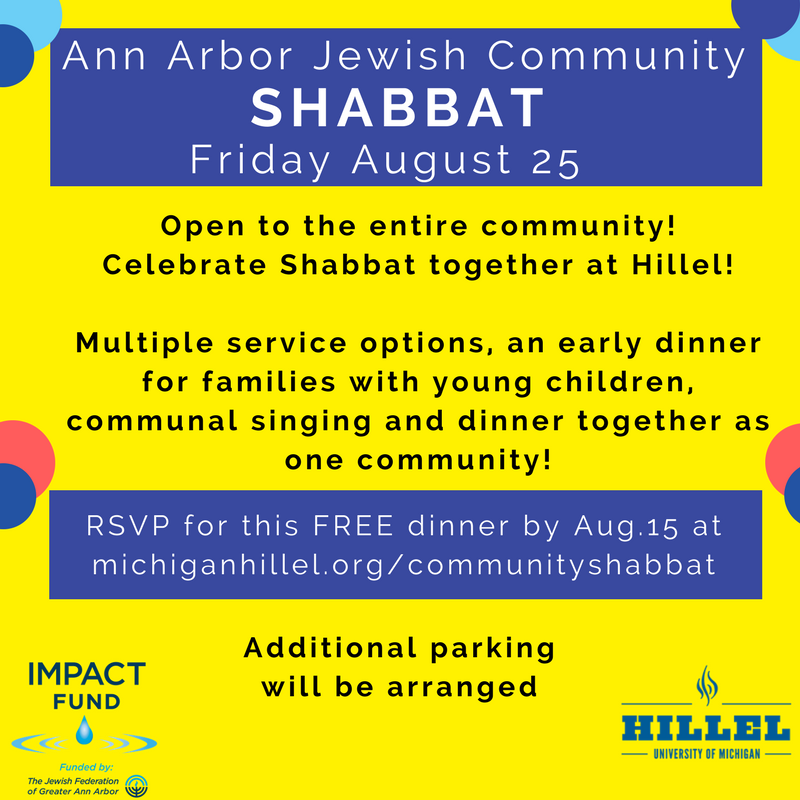
Yesterday I represented AARC at a planning meeting for the August 25th Community-Wide Shabbat at Hillel. It looks like most of the Ann Arbor congregations–Temple Beth Emeth, Beth Israel, the Orthodox Minyan, Pardes Hannah, and AARC–are coming together at Hillel to welcome Shabbat with song and have brief services and a meal. The evening will begin with activities for families with kids. The Hillel staff is arranging for extra parking. I hope many members of AARC will come out for this inaugural annual Community Wide Shabbat.

It was interesting to learn at the meeting, for the 3rd of 4th time this month, that many people who work at the JCC don’t know that the Ann Arbor Reconstructionist Community (AARC) and the Jewish Cultural Society (JCS) are different organizations. I do love JCS: “Ann Arbor’s Secular Humanistic Community,” and we do both rent space at the JCC and have Sunday morning schools for our kids. But Reconstructionist Judaism is distinctive in our approach to building community that emphasizes spiritual aspects of Judaism, commitment to evolving religious practice, and inclusivity of a wide range of relationships to God and godliness. There are some great resources on these ideas on our website.

We need more opportunities for the local Jewish community to get to know us. Which leads me to the bulletin board.
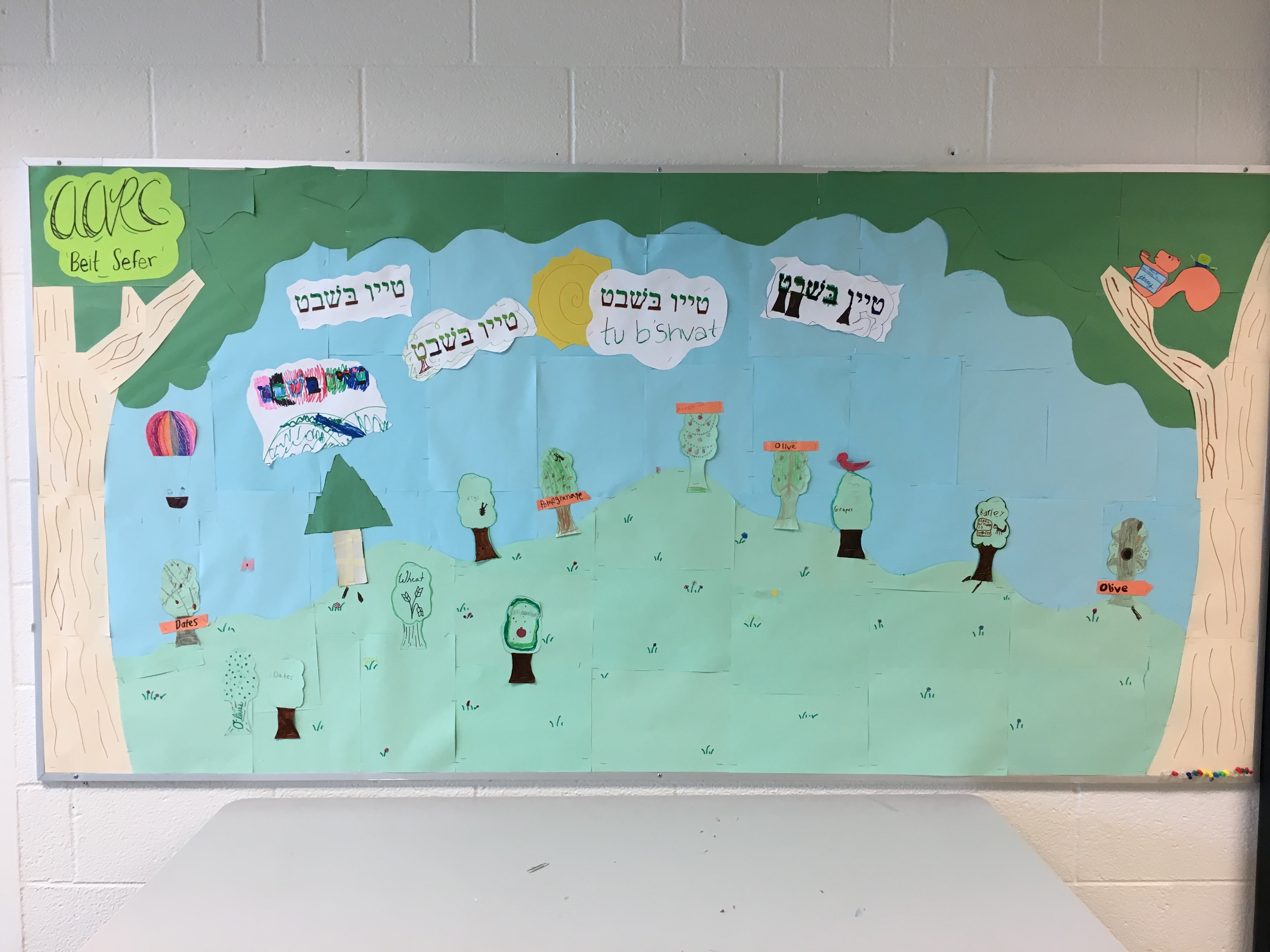
Last year, the G’dolim and K’tanim designed a Tu B’Shevat bulletin board that celebrates nature and the seven species of foods in the Torah. We are ready for a new one!

We have some prime wall space at the JCC which needs some updating. We could be using the bulletin board to put ourselves out there in eye-catching informative fashion. Do you have any ideas? Is graphic design a forte of yours? We have lots of photos of activities, our handmade and distinctive ritual objects, our members. The bulletin board could highlight our  new rabbi, the upcoming High Holidays, our dynamic school for kids. Plus thoughtful, fun people in the congregation. Can you help design some of this into a bulletin board, soon, before the end of August? Contact Clare ckinberg@gmail.com.

Filed Under: Beit Sefer (Religious School), Upcoming Activities

Solar Eclipse, Rosh Hodesh Elul, Resetting the Communal Clock

July 21, 2017 by Clare Kinberg Leave a Comment

by Clare Kinberg

Yesterday I got all excited when I realized that the upcoming total solar eclipse (August 21) coincided with Rosh Hodesh Elul, the new moon of the Jewish month in which we prepare for the High Holidays. What meaning could I derive from this momentous coincidence? Almost immediately my friend Max Jasny informed me that solar eclipses always occur on the new moon, but not every new moon. Max and I have a lot of things in common, for one, he works as an administrative assistant at Martha’s Vineyard Hebrew Center, a small congregation in a beautiful place, with a Reconstructionist rabbi. But clearly, he knows more about astronomy than I do!

Still, a total solar eclipse on Rosh Hodesh Elul has been viewed only five times in the last 250 years. It is a moment that can be grabbed to acknowledge the grandeur of the universe and the many opportunities the Jewish calendar cycle gives us to reset our personal and communal clocks.

This week I had two important meetings in planning for next year: The High Holiday Logistics Committee (Allison Stupka, me, Idelle Hammond-Sass, Mike Ehmann and Rebecca Kanner) kicked into gear with a potluck on Allison’s back porch. We planned the “big move” of all our prayer books and ritual items from the Jewish Community Center over to the UUA building which we rent for Rosh Hashana and Yom Kippur. We are so looking forward to having the services led by our new rabbi, Ora Nitkin-Kaner. As in all past years, AARC ticketless HH services are open to all and are smoothly run with lots of volunteer energy. You can view the volunteer sign up here. At least, put the dates in your calendar.

The Beit Sefer/Religious School Committee also met this week. Allison Stupka (busy girl!), me, Becky Ball and Stacy Dieve met at Becky’s home and planned two upcoming events for prospective, new and returning Beit Sefer families. We will be having a “popsicle party” on Wednesday August 30th at 6:30pm at the JCC for all returning Beit Sefer families and all families who are checking us out as a possible place for their kids to attend religious school. We’ll play on the playground (or gym if the weather is bad), share summer experiences, reacquaint the kids, and take the opportunity to show prospective families the school.

We also planned a religious school Open House at the JCC during Sukkot on Sunday Oct 8 for prospective families who may have connected with us during High Holidays and are still needing a religious school for their kids.

Coming Up in July…

  • July 28, Fourth Friday: Kabbalat Shabbat and Vegetarian Potluck at the JCC. This will be the last Fourth Friday that Rabbi Alana will lead for us at the JCC.
  • July 29, Saturday, Isabel Ahbel-Rappe’s bat mitzvah: Rabbi Aura Ahuvia will lead services.

August Notes…

  • No Second Saturday in August.
  • August 25, Instead of our regular Fourth Friday, AARC will be participating in the first Community-Wide Shabbat hosted by Hillel.

September Notes…

  • September 10: First Day of Beit Sefer, and Annual BBQ Picnic, this year at Lillie Park. More details soon.
  • Saturday September 16, Selichot
  • September 17: Apples & Honey: The Ann Arbor Jewish Community puts out the welcome wagon at the JCC and we will be doing a table.

High Holiday Dates

  • Wednesday September 20th, Erev Rosh Hashanah
  • Thursday September 21st, Rosh Hashanah
  • Friday Septtember 29th, Erev Yom Kippur
  • Saturday September 30th, Yom Kippur
  • Sunday October 1, Sukkah Building

Clare Kinberg is AARC Events and Communication Coordinator, and Director of AARC Beit Sefer/Religious School. You can reach her at ckinberg@gmail.com


Filed Under: Beit Sefer (Religious School), Upcoming Activities Tagged With: Elul, Jewish time, Rosh Hodesh

Rabbi Alana discusses faith and millennials with Ray Suarez

July 13, 2017 by Clare Kinberg

Rabbi Alana Alpert

Rabbi Alana was part of an “On Point” radio discussion among “millennial” clergy on July 6, 2017. In this discussion a rabbi, an imam, an Episcopal priest and a Catholic priest discuss why they have dedicated their lives to the clergy. Asking questions about declining numbers of people affiliating with congregations, the host Ray Suarez seemed to be motivated by concern for his own daughter, recently ordained as an Episcopal priest. Rabbi Alana did a great job in challenging the assumptions that young people are not interested in religion and getting in strong statements about creative Judaism and the spiritual pull of social justice activism. She also gave some good explanations of the work Detroit Jews for Justice is doing. Take a listen!

We have two more opportunities this summer to participate in Rabbi Alana led services. On July 28, AARC will have its regular Fourth Friday Kabbalat Shabbat and Potluck at the Jewish Community Center. And, news flash, Rabbi Alana will lead a Reconstructionist service at the Community-Wide Shabbat at Hillel on August 25th. Because August 25th is a fourth Friday, AARC is moving our regular service to Hillel on that evening. More about this will be posted soon. In the meantime, you can register for the free dinner here. There will be children’s activities, several choices for services (TBE and BIC are having their congregational services at Hillel that evening as well), in additional to a communal dinner.

Filed Under: Community Learning, Event writeups, Upcoming Activities Tagged With: Millenials, Rabbi Alana

Teaching Our Kids Jewish Prayer

July 6, 2017 by Clare Kinberg 2 Comments

RENA conference participants
When Reconstructionist Educators get together: Teaching Hebrew Prayer

I think a lot about teaching Jewish prayer to our kids. So, I was drawn to a recent thread of discussion on the Reconstructionist Educators (RENA) email list about teaching Hebrew prayer. One director started off the discussion by saying that the students in her school usually seem bored by learning Hebrew prayers, perhaps because “prayer is so disconnected from their lives.” She is thinking about replacing Hebrew prayer study with short sessions of silence, meditation, and writing. Another person shared a reference to a lesson plan on kids writing their own prayers. The long-time director at Congregation Beth-El Zedeck in Indianapolis wrote about his school’s “tefilah laboratory” where the students learn and write prayers and practice them in the sanctuary, where the environment affects their experience. Another director wrote about engaging families with young children with prayer. A theme running through the discussions is looking at the relationship between learning Hebrew and learning prayer: connected, yet separate, too.

This year our Beit Sefer will again be experimenting with different ways to engage our students in prayer. We want students to feel comfortable with Jewish and Hebrew prayer, to understand Hebrew prayer as an expressive mode of spirituality, to know that Jewish prayer has evolved over time, and that they can be involved in creating prayer.  We want to prepare them to begin getting ready for bar or bat mitzvah, if that is the path they are on, which requires familiarity with Hebrew and Hebrew prayer. And we want them to be able to access their own spirituality through Jewish prayer. I am grateful to have a place to learn what other Reconstructionist educators are thinking about these topics.

Our students learning what goes into a Mezuzah

I’d been intending to write about the RENA conference I went to back in the low key month of Cheshvan (early November)! The annual conference is for Directors of Reconstructionist religious schools, a group that at most has 100 eligible participants. There were about 15 directors at the conference.

The Jewish Community of Amherst (MA), a Reconstructionist congregation, hosted the first two days of the meeting, and for the last day we traveled about half hour away to the Springfield Jewish Community Center. We also spent an afternoon at the National Yiddish Book Center, located on the Hampshire College campus. We had sessions on developing new structures for supplementary education, project-based learning, experiential Jewish education, and other innovations..

Now that I’ve put off writing for so long, I see that long-range impact of the conference is the group’s ongoing discussions and resource sharing, made richer and more accessible now that I’ve met the correspondents. Next year’s conference is in Boulder, CO. I look forward to attending again.

Filed Under: Beit Sefer (Religious School), Event writeups

Peter Cohn’s Bar Mitzvah Dvar: B’midbar, Who is included?

June 28, 2017 by Clare Kinberg

Shabbat Shalom! Welcome to the final bar mitzvah in this generation of Cohns! Interestingly enough, we will be talking about Kohanim, our tribe, as it were, in a moment.
But first, I’d like to give you a summary of my portion. A little explanation on that: each week is associated with a portion of the Torah, and it takes one year to read the whole thing. And our tradition at AARC is for me to ask you a question, and I’ll do that later on–so pay attention.

My portion is in the first part of B’midbar, or the book of Numbers. In the portion, God orders Moses to take a census of all the Israelites. Well, not all the Israelites. But I’ll get to that later.

Moses is taking the census, and it’s kind of funny to think about him with a clipboard and pen in hand, walking from tent to tent. (Of course, that’s not quite what it was like.) Anyway, the Torah spends some time talking about the numbers of people in the different tribes and where they are camped, and then the focus moves to Aaron and his sons.

Aaron had four sons, Nadab, Abihu, Eleazar and Ithamar. Eleazar and Ithamar were still alive, but Nadab and Abihu were not. They had perished when they were not taking their ritual responsibilities seriously enough while they were at something called the “tent of meeting.” This tent of meeting, the ohel moed, is another focus of my portion. I find this appropriate, since my last name is Cohn, and the portion repeatedly brings up the Kohanim, the priests–Kohein, in Hebrew, means priest.

But let’s focus on the census Moses is taking. Here’s what I found interesting about it: the census that Moses is taking doesn’t include a lot of people. For example, the census excludes the Levites. The census excludes women. The census excludes men under 20. Put it all together, and you’ve left out more than half of the Israelites.

You are taking a census of all the Israelites, except you’re not; you’re picking and choosing who gets to count in the census. It’s kind of ironic that, after being treated so horribly for so long when they were in Egypt, because of their identity, some of the Israelites were now marginalizing some people within their own midst.

But hold on to that thought–and now zoom ahead a few thousand years. See, excluding people is a pretty common theme in history, and that includes the history of this country. Think about Philadelphia, in 1776, during the writing of the Declaration of Independence. Famously, it says that “all men are created equal.” It doesn’t say anything about women. And just a few years later, those same Founding Fathers wrote the U.S. constitution, which–just as famously–included the three fifths compromise, in which a slave counted as three fifths of a person. This is literally deciding who counts and who doesn’t.

My own family history touches on the way groups have been excluded in more recent times. For example, my grandmother Mimi is Irish; genealogically, I am one fourth Irish. I learned that when Irish immigrants first arrived in the U.S. in the mid 1850’s, they were the first huge wave of immigrants to ever come en masse. The U.S. wasn’t ready for it. They reacted badly and considered the Irish as the new “lowest rung” in society. In fact, at a time when being “white” meant being accepted, the Irish were considered non-white–which is pretty funny if you just look at my complexion — do you know how much sunscreen my relatives and I go through?

The same thing happened to my Jewish ancestors; when they first arrived, they faced discrimination and exclusion. And of course they came here in so many cases because they were fleeing persecution from abroad as well. Sometimes, being from a marginalized group makes you more aware of others facing similar problems. Many Jews were involved in efforts to fight discrimination and I’ve heard the story many times about how my great grandmother, Nana, was pushed in a baby carriage during suffrage marches. And my grandmother helped to integrate the New Orleans schools. But one of the things that struck me as interesting was that German Jews who immigrated to the United States around the same time as the Irish considered the later arriving Russian Jews as not Jewish — much less white. They settled in different places, had different trades and formed different branches of Judaism.

And actually after the Irish settled here, sometimes they acted in ways that marginalized other people–if not other Irish, than other groups of new Americans.

So when we talk about who counts and who doesn’t, sometimes the people who don’t count will turn around and exclude other groups–or even people within their own midst. It’s a little like that census Moses took thousands of years ago that excluded half of the Israelites. It makes you wonder, why anybody ever gets excluded in the first place. Or to be more direct, what really makes one person count less than another.

Think about another example from American history–relatively recent American history. When segregation was legal in the United States, there was a so-called “one drop rule.” It said that if any of your ancestors were African American, so were you. In other words, if one of your grandparents were African American, but the other three weren’t, you still were considered African American. That makes no sense!

The funny thing is, scientifically speaking, humanity originated from one place: Africa. In that sense, all of us have at least a little African blood in us. The whole idea of race, as we know it, is something that humanity constructed as a way to sort and categorize people. Of course, many people take great pride in their ethnic or racial backgrounds, and there’s nothing wrong with acknowledging diversity. But all too frequently, we have defined groups in order to treat some worse than others. And all too frequently, even those of us in historically marginalized groups have not paid enough attention to others facing the same kind of treatment.

What groups would you like to recognize that haven’t been mentioned today or historically?

As it happens, I had a lot of chance to think about that with my mitzvah project. For those of you who aren’t familiar, part of the bar mitzvah process is picking a mitzvah, or act of goodness, to perform–and it has be from a list of 613 mitzvot to choose from, which are found in the Old Testament.

The mitzvah I chose was “To love the stranger.” When I chose this before November, I had no idea how important it would become,which is to say, I had no idea how the political environment would change. I didn’t know that we would be in a country where so many people had reason to be nervous they didn’t count anymore.

Today, I feel, it is more important than ever to “love the stranger.” On January 21, I participated in a women’s’ march in Ann Arbor, and I attended a protest of the immigration ban at the Detroit airport. This is the poster I carried, by the way. It says…

My family and I donated to the rebuilding effort for the Ypsilanti Mosque when it burned down in March. And in December, I went with my mom to her church’s feast day of service to make baskets of cleaning supplies and other necessities for Syrian refugee families. For the main part of my mitzvah project, I sort of replicated that with a twist; it was boxes geared towards kids, containing books, art supplies and welcome notes. My brother Tommy drove me to Jewish Family Services (the same organization my mom’s church coordinated with) to drop them off.

This is the idea of “loving the stranger,” caring about what happens to people you don’t know as fellow people and citizens of the world.

You’ll also find this theme in my haftarah–although you’ll have to read between the lines a little bit. It’s the famous story about King Solomon and the two women who claim to be the mother of the same baby. Solomon has asked God for wisdom and this is the first instance of how he uses that wisdom.

(This is not the traditional portion assigned to my Torah portion, but the one that is assigned, which is about the prophet Hosea’s wife, has more mature content than I was comfortable with. So I followed the lead of a fellow congregation member, Jacob Schneyer. He chose this portion five years ago at his bar mitzvah to go with the parsha because he was talking about how the Levites were excluded from the count, and raised the general question about what does God want, which, as you will hear, is the question that Solomon wants to know: give me the wisdom to know what you want. And wisdom in general.)

At this time in our history, as we are still as a nation grappling with issues of inclusion and exclusion, we really need to think wisely about how and why we make those distinctions. We need to bring our wisdom to the table and realize or insist that no one should be excluded because everyone has been excluded at some point. And that’s always looked ridiculous afterwards or retrospectively.

We all want to be on the right side of history. And we need wisdom for that.


Filed Under: Divrei Torah, Posts by Members Tagged With: Bar mitzvah

Eytz Chayim: An Introduction to our Torah Table Tapestry

June 14, 2017 by Clare Kinberg

by Marcy Epstein
Torah Table Tapestry, photo by Nancy Meadow

It almost feels like an age ago when our congregation was a havurah, a thing of steady roots and fresh growth in every direction. Trees are a primary metaphor for us, one that is so powerful–from the Ten Sephirot, to the Cedars of Lebanon, back to the Tree of Knowledge and the mishnaic tree from under which the earth for Adam and Eve was formed. Since we are a branch of Reconstructionist Judaism and a species of Jewish life here in Ann Arbor, the secondary metaphors for us of growth and maturity, stability and change, tradition and the necessity for new ground, all make perfect sense.

Our bodies take the form of trees, while our Torah is spoken of as scroll (the spiral extrusion of a tree’s rings, as exegesis) and as a Tree of Life,  and Eytz Chayim. Trees grow among each other, as we have. Some of us are wiser for the proximity, others have felt the bittersweet tension of sharing the sun. Some of us are saplings, and we live within this tree as to create trees of life of our own, through our children, our work for justice, or our creativity. And while we relate to trees, we are also not trees. We are the recipients of trees. We breath off them, eat of them, draw sap, even wipe our bottoms and create some of our most holy texts from them. They seem within human domain, but they far exceed it. Thus Eytz Chayim.

A close up of the wall hanging we use as a backdrop on special events.

Over the 14 years that I have been active with the AARC, I have noticed the obvious, intentional expression of our community through wood. Wood is an expression of our living Torah, however we came to define that. During the gelilah (dressing the Torah), I noticed the swirls of tree and flame on our homemade Torah cover, made by several bat mitzvah and their families. Our Torah ark, so elegantly built by Alan Haber, was made from our city’s trees, no metal, as though to say that our Torah is among its own kind, among trees. I saw at high holidays the beauteous  backdrop, a wall hanging of leaves and boughs made by a Canadian artist and bestowed to us by another group of families with quickly-growing children. With Allison Stupka, I edited our Grapevine newsletter, which displayed our insignia of arching vine and laurel. Our Ann Arbor congregation has more than its fair share of artists, tzaddikim, and tree huggers. And trees.

Our traveling Torah is dressed and ready to roll.

Six years ago, in a conversation between Debbie Zivan and me on my front porch, we momentarily saw the cycle of growth in our community. It was as though we could sense the rings of growth brought to the Hav. Our community was on a long and arduous path, a liturgical and rabbinical journey, its life-cycle in motion with the Mitzvah Corp, our Beit Sefer, and our holidays together. We brought to the Board our feelings that while we may not own a building, though we are happily mishkanic (spiritually portable), we still needed more beautiful artistry. Our Reconstructionist community deserves the sort of beauty and artistry that went into the first tabernacle, the one priests carried long ago to contain the Torah, from which other rings of growth emanated: the Kohanim as caregivers and priests, the sanctuary and bima that came after, the gates of new cities, Holy Temples that were built, destroyed, and recreated throughout the Jewish world.  Or, at least, that was the lofty thinking that ran through my head and now tampers with my memory of the beginning of our tapestry. More to the point, we wanted a handsome, adjustable table for Shabbat, simchot, and holidays, and we saw this table paired with a beautiful tapestry created in the tradition of the mishkan.

The mishkan of Exodus was wood long before it received the parchment scrolls (also wood, also itself), a wonderful idea of living humbly and reflectively.  Jacob and his sons planted acacia trees in Egypt with plans to bear the wood as it seasoned, specifically as construction material for the ark. And as Exodus says, the artistic scion Bezalel and the humble, careful Ohaliab coordinated among diverse tribes and artisans; woodcarvers, metalworkers, weavers and sewers, enamelists, and craftspeople donated their best work so that the mishkan would fit the Biblical prescription. We became numerous like this, almost mystically as fast: Alan gave continuity to a Torah table, and Jack Edelstein committed some of his finest walnut and cherry (Ann Arbor) wood. Dale Sass, Debbie, and others joined them in designing the function of our fine table, slipping more tree matter (our congregants’ prayers) into its joints and grooves.

Meanwhile, a group of us also came together to create the tapestry to hang in front of the table, also metal workers and weavers, quilters and knitters, beaders and embroiderers, found object artists: Nancy Meadow, Idelle Hammond-Sass, Chava Israel, Janet Greenhut, Leora Druckman, Allison Stupka, and myself.  Friends from our artist circles joined us, too, to help boost production and morale: Elena DeLoof, Rabbi Michal, Michal Samuel, and Claudia Kraus-Piper.

We were very different people with various mediums, personalities, styles, skills, and rhythm through which to see a tapestry for the Torah table, so we took much longer than we ever expected to complete the tapestry. This could have been the Tower of Babel story rather than Eytz Chayim or Exodus. For four years, our group grew and regrouped, and our tapestry moved from dining table to studio to dining table, over 100 Sundays. Not by design, we were all women, and we came to the project for so many reasons: for mysticism and sacred creation; for a reconstruction of avodah and mitzvah; for grief over our dead mothers and their ways of mending, connecting, and creating; for the companionship of grown ups and for sharing our techniques with children; for communal art; for the Torah and its new table; for the b’nai mitzah we imagined reading from the bima; and for posterity. We were making something we hoped would last for centuries.  Our Torah itself comes from Chicago and a long way before. While we worked away at the Torah Table Tapestry, our first rabbi was hired, the Torah was purchased from its long lease, its longevity assured by careful repair. We wanted the same for its cloth.

The tapestry itself is layered with this history and a hope for our congregation’s long and happy life. When I describe how the Tapestry formed and what it means, it may sound contrived, like a thank-you list.  But I assure you that it was the opposite: we avoided contrivance. We never said no to daring ideas and nudged each other out of our comfort zones. It took a month or two just to get our ideas out on paper. We imagined a few things before we saw the tree, a whole tree. Idelle and Chava were entrusted to draw and assemble the design of this tree based on so many parameters and wishes that it was a miracle that we could exhibit it for community feedback at Rosh Hashanah four years ago.

It also feels like a miracle that we were able to recreate Idelle and Chava’s vision. We decided on a great tree that would be seen all at once, roots, trunk, branches, leaves, and cherry fruit, laid out in a large circle that contained four seasons, four states of the tree above and at ground. This would be a Michigan cherry tree in the endless cycle of its splendor (right now, my backyard cherry tree is heavy with ripening, imperfect spheres). Our easiest challenge was accepting our mistakes and allowing the layers of the design to form both from design and from intuition. Our hardest challenge was to find love rather than criticism for our work or the work  of others, and then also the long tasks of presentation and colorization.

Torah Table Tapestry, in progress, about two years from finished.

One thing that was so important to us as Reconstructionist artists was that the material be largely donated, that it would come from our community. One of our group donated yards of her finest blue raw silk for the base of the picture, and another donated heavy red damask for the exterior and back. AARC’s community responded to our call for meaningful materials with more richness than we could ever have expected. Here are just some samples of the cloth that became our tree: someone’s wedding gown and dress shirt, someone’s birth shirt, someone’s bounty of silk ties, someone’s skirts from her days of Orthodoxy; a hippie shirt; a slip and someone’s cape; someone’s elderly mother’s dress, someone’s young son’s pajamas, someone’s entire sample box. We also received with awe the materials of two AARC members who have passed away, Lisa Gayle’s Guatemalan scarf and Nancy Denenberg’s colorful shawl (these line the sheath for the tapestry). There were dozens of stories behind these cloths, and our group found ways to include every single one, even the fuzzy pajamas.

From these we established the first layers of the tapestry, a range of blue and gray silks from darker to lighter to represent day and night, all sorts of weather. We sorted a mountain of cloth into seasons. We learned and unlearned as we went. We disciplined ourselves to learn each other’s crafts. Chava shared her techniques for application and beading for the sparkle of snow and flowers, for the cherries. Janet taught us to embroider leaves as they grew and fell, snow, the difficult horizon and mountains. Over the years, we needed to redesign and reflect, with Idelle sharing how things could be seen. Nancy and I often experimented with stitching and blending the outer layers, meeting nearly every Sunday. Leora reminded us of the wonderful kavanah going into the tapestry, as months suddenly past between viewings, like her own found objects.

Layers went on, layers came off. The horizon shifted. Leaves changed color, the ground (like humanity to the divine) mirroring the time and decor of the tree’s canopy. The tapestry seemed to become beautiful right before our eyes, and then there were times when the work seemed endless, fruitless. We took pictures of cherry trees and talked about how they are unique among trees. We sneaked in a squirrel, a pair of birds, a bit of spilt wine, and dandelions. We learned to stop questioning ourselves and just give this freely. Our children went to school, went away, came back from college, and parents and siblings passed away. We changed jobs, fell very ill, cared for our sick, came on and off the Board, lived through Art Fair, watched Torah being read for the first time on its new table, wondered and plugged away. We met under my Sukkah two years ago just to figure out the tapestry’s endgame. The tapestry had required so much of our energies, and we were so grateful for Claudia’s infusion of skill and verve in our last months. Julia Piper spent over two hours untangling our floss. Mollie Meadow pored over the tree for missing stitches. Cherries joined the seven species to embellish all four corners. We hired a local tailor to put on the tapestry’s backing, make the bag of memorial cloths.

All this time, Chava beaded the lettering in Hebrew calligraphy in the silvery ornateness recalled by the original mishkan. I think this was a labor of love, perfection, and responsibility for her, reminiscent of Bazalel and Ohaliab. The saying that goes around our Torah tapestry (for we dedicated it to our congregational use last Rosh Hashanah) means in English, referring to the living Torah, from the Mishna 7b (3:18): “It is a tree of life for those who take hold of it, and those who support it are fortunate.” We attached each word separately, creating the arc above and below the tree. There is another truth from Mishna on the Tree of Life which I felt true over the more than four years we worked the tapestry. We had finished just in time for Rose Basch’s bat mitzvah, and we marked our first year as the AARC. The teaching is this: ‘For length of days, years of life, and peace will they [the Torah’s teachings] increase for you’ (3:2).”

Yad by Idelle Hammond-Sass, with wood box by Dale Sass.

The Torah Table Tapestry and AARC’s artistic tradition continues to grow. Our group is resting for the year (after Shmita), but soon we hope to share the tapestry and the story of its creation with other congregations, perhaps even to have it displayed among other Judaica and fiber art shows. For our repaired Torah, Idelle and Dale have created a beautiful yad of wood and metal to mark our place as we chant. Idelle is also starting on a beautiful piece of wrought metal to turn into our eternal light. And just as the artists of the Temple turned from the Tabernacle to the next growth, we are thinking about what needs to be made next. Likely it comes from the earth, maybe from the increase of trees, and their beauty. Even if you haven’t made anything before, join us. It takes everyone to see the Mishkan on its path, and Eytz Chayim is for us all.

Filed Under: Posts by Members, Sacred Objects

Degrees Conferred!

June 7, 2017 by Clare Kinberg

This spring, several AARC families are celebrating  graduations from institutions of higher learning.  The graduates are a diverse and fascinating group! Mazel tov to the graduates and families on these milestones.

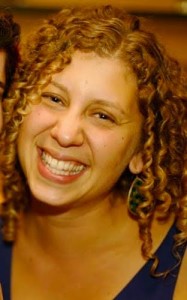
Molly Kraus-Steinmetz and her proud mom, Deb Kraus

Molly Kraus-Steinmetz graduated from Grinnell College with a major in Sociology. After spending the summer at home working with the Interfaith Committee for Peace and Justice (ICPJ), in August she will start a year-long fellowship with Avodah Service Corps in Chicago. Avodah is a Jewish leadership and social justice training organization. Molly will be an organizer with Jane Addams Senior Caucus, working on housing issues.
Molly is fundraising $1500 to support Avodah. You can donate at this link and read more about her plans.

“The forces that we’re all up against—civil and human rights violations, abuses of power, destruction of the earth, exploitation, and discrimination—are massive, and the way to fight them isn’t to stand alone. It’s through collective action. Through filling the offices of people in power with determined protesters. Through listening to people, truly hearing their fears and struggles, and helping them find a way to express them as part of a powerful chorus of voices. Through organizing. And now that I’ve finished my sociology degree, Avodah has brought me the opportunity to do all of those things at Jane Addams Senior Caucus.”

Daniel Saltzman

Gregory Saltzman and Audrey Newell had a double simcha with two of their sons graduating this year.

Daniel Saltzman graduated in May from West Point and was commissioned as a  second lieutenant in the U.S. Army.  After four months of training in Missouri as a chemical officer, he will be stationed in South Korea.  Before going to West Point, Daniel served as an Army medic in Afghanistan.

Jonathan Saltzman graduated in May from Swarthmore College.  He will begin work in July as an investment analyst for the William Penn Foundation, a charitable foundation in Philadelphia.  Jonathan will be part of a team of six who oversee the outside investment companies that manage the Foundation’s  $2.4 billion endowment.

Jonathan Saltzman


Sarah Kurz

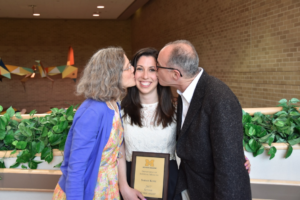
Sarah Kurz, Dina and Keith Kurz’ daughter, graduated with distinction from the University of Michigan School of Medicine.  She will be returning to her undergraduate alma mater, the University of Pennsylvania in Philadelphia, to complete a residency in Internal Medicine.  Her parents will miss the proximity they had with her during her medical school years and are so proud of her many accomplishments, honors and awards.


Filed Under: Simchas

AARC 2017 High School Grads

June 2, 2017 by Clare Kinberg

AARC has a big crop of high school graduates this year. Tracking them down for updates on their lives, and pictures, was not an easy task. But with their parents’ help I was able to get vitals for each. Mazel tov to the graduates and to their families!

Livia Belman-Wells will be graduating from Huron High School. This summer she is taking her first trip to Israel, and in the fall she will be attending Brown University in Providence, RI.
Tommy Cohn is graduating from Skyline High School. He is heading to UM College of Engineering.
Ruby Lowenstein is graduating from Community High School and will be following her heart to Bennington College in Vermont.
Noah Resnicow is graduating from Pioneer High School. He is heading to University of Wisconsin-Madison to study journalism.
Shani Samuel is graduating from Pioneer High School. Next year she’ll be going on Habonim Dror’s gap year program, and the year after that she’ll be attending the University of Michigan.
Jacob Schneyer is graduating from Skyline High School. Next year Jacob will be going to Grinnell College in Iowa.

Filed Under: Simchas

Isaac Asimov’s Book of Ruth

May 18, 2017 by Clare Kinberg

I’ve written about Shavuot several times over the past few years. In 2015, I wrote on the culmination of the counting of the Omer and the concept of “our lives as torah.” Last year, when Loving Day and Shavuot fell at the same time, I reflected on Jews and interracial marriage. In that blog, I recounted reasons I’d found that we read The Book of Ruth on Shavuot, “…the story takes place during the seasonal harvest that the holiday marks; Ruth’s acceptance of the Israelite faith is analogous to the Jewish people’s acceptance of Torah; and because of the legend that King David, a descendant of Ruth, died on Shavuot.”
Last week my friend Abbie Egherman told me about the 1972 Isaac Asimov book, The Story of Ruth. Abbie is on a search for books that will inspire us, as Jews, to become more deeply and actively involved in refugee support and resettlement. According to Asimov’s memoir, his retelling of Ruth’s story is a long essay treating the book “as a plea for tolerance against the cruelty of the scribe Ezra, who forced the Jews to ‘put away’ their foreign wives.” Asimov’s essay places the story in context of the culture of the time it was written, but his purpose, as explained in his memoir, was to reflect on the potential of any people to become persecutors when in positions of power. In particular, he wanted Jews to look at our own history, situations in which we have been in power as well as eras when we have not.

There will be plenty of time to discuss Asimov’s reflection, as well as other retellings of the Book of Ruth at our congregation’s Shavuot gathering.


AARC Shavuot in Stages

May 30, 2017

Everyone Welcome

RSVP Here 

Location: Marcy Epstein’s home, 1307 Henry St.:

6:30pm Holiday blessing, Parsha Study, and Spring Soup

7:30 Community celebration with flower strands and wreaths and Ice cream treats

8:30 “Many Books of Ruth” Real storytelling, with wine and cheese tasting

Also:

May 31st 6:30-7:30 Yiskor/Memorial Serivce at the JCC

contact for Marcy: dr_marcy@hotmail.com

Filed Under: Books, Community Learning, Tikkun Olam, Upcoming Activities Tagged With: Ruth, Shavuot

Second Saturday May 13 with Beit Sefer/Religious School Students

May 4, 2017 by Clare Kinberg

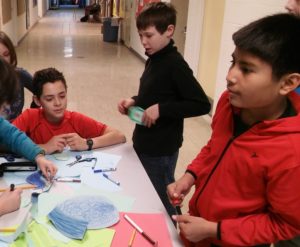
Some of the G’dolim working on our bulletin board.

Our G’dolim students, their teachers and madricha will be leading Second Saturday Shabbat morning service on May 13th. For many liberal American Jews, the Kabbalat/Welcoming Shabbat service on Friday evening is a well-attended social event of the week. The more sparsely attended (except for Bnei Mitzvah) Saturday morning service, when traditionally שחרית/Shacharit/Morning prayers and blessings are combined with reading from the Torah, is a more prayerful, relaxing time conducive to contemplation and learning. Perhaps a hard thing for pre-teenagers to lead for the congregation. But you may be surprised by how thoughtful they can be.

The students have learned the structure of the Shabbat morning service—still a mystery to many adults. They have a beginning familiarity with the prayers and melodies our congregation uses, and they have prepared a discussion on the Torah portion, Emor, which is packed with possibilities. We hope many of you will come pray and learn with us on May 13.

Second Saturday Shabbat Morning Service

May 13, 2017, 10am-noon

Jewish Community Center of Ann Arbor, 2935 Birch Hollow Dr. 48108.

Filed Under: Beit Sefer (Religious School), Upcoming Activities

  • « Go to Previous Page
  • Page 1
  • Interim pages omitted …
  • Page 8
  • Page 9
  • Page 10
  • Page 11
  • Page 12
  • Interim pages omitted …
  • Page 24
  • Go to Next Page »

Primary Sidebar

Search

Join Our Mailing List

Sign up for our twice a week newsletter to get details on upcoming events and catch up on our latest news.

This field is required.

Check your inbox or spam folder to confirm your subscription.

Upcoming Events

  • 9:00 am – 10:00 am, April 17, 2026 – Rosh Chodesh Minyan Iyar [ZOOM]
  • All day, April 19, 2026 – Beit Sefer
  • 6:30 pm – 8:00 pm, April 24, 2026 – Fourth Friday Kabbalat Shabbat
  • All day, April 26, 2026 – Beit Sefer
  • 12:00 pm – 3:00 pm, April 26, 2026 – “Lesson of the Homeland” and the Stories We Tell: A Conversation with Anat Zeltser
  • All day, May 3, 2026 – Beit Sefer

Latest News

  • RSVP to “Lesson of the Homeland” and the Stories We Tell: A Conversation with Anat Zeltser April 16, 2026
  • Climate Action Shabbat article in the April 2026 Washtenaw Jewish News April 3, 2026
  • Reimagining Torah Study: Moving from Zoom to In Person by Rabbi Gabrielle Pescador April 1, 2026
  • Creative Spirit at the AARC Beit Sefer March 27, 2026
  • When Is a Killer Not a Murderer? by Elizabeth Brindley March 19, 2026

Footer

Affiliated with

Copyright © 2026 Ann Arbor Reconstructionist Congregation