
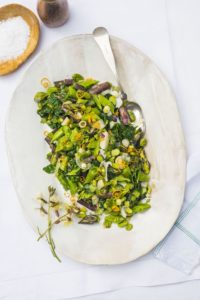
By today, you’ve probably decided what you are making for your first Passover meal tomorrow night. Patti and I will be making Stuffed Cabbage, with the recipe posted last year at this time. I’m about to go make some, and if you come to the AARC Family Seder on Sunday, you’ll get to have a taste!
But there is a long week ahead of Pesach food restrictions, and I want to share with you a stand out cookbook that could make your week more culinarily delightful: The Seasonal Jewish Kitchen: A Fresh Take on Tradition by Amelia Saltsman. With a Romanian grandmother and an Iraqi grandmother, growing up in a farming community in Israel and her extensive writings on local and fair food production, family farms, and farmers’ markets, she is an author whose interests are close to my heart. You can access some recipes and read more about her on her website and blog.
I’ve often thought about the contradiction between the limits on foods we can eat on Passover, the necessity of sticking to the dry “bread of affliction” for a full week, and our communal focus on the Passover feast, creating ever more scrumptious Pesach foods. Rabbi Yael Levy’s “Thoughts on Matzah” post from her Jewish Mindfulness site helped me come to a satisfying understanding of this.
Thoughts On Matzah
Rabbi Yael Levy | 4-20-2016
When we begin the Seder, the matzah is lechem oni—the bread of affliction.
By the middle of the seder the matzah has become the afikomen—the dessert—what we seek, what we long for.
The transformation starts as we lift up the three matzot, break the middle matzah and call, “This is the bread of affliction that our ancestors ate in the land of Egypt. Let all who are hungry come and eat.”
As we acknowledge the suffering and brokenness that exists in us and in our world and reach out from this place to make connections, to share who we are and what we have to offer the matzah goes from being the bread of poverty to being the bread of connection, hope and faith.






 AARC Beit Sefer teacher Sharon Alvandi is a student in the UMich Jewish Communal Leadership Program, and an intern at Jewish Family Service learning to work with refugee families. Sharon has been very inspired by our AARC congregation, particularly the ways that the Beit Sefer students, parents and other community members come together to share learning and activities, investing in the character of the children. Through her work with JFS, Sharon is organizing a way for us to practice the mitzvot of Purim, giving gifts of tasty treats to one another/mishloach manot, and gifts to the poor/mattanot le-evyonim (for more about how these two mitzvot are related
  Purim is a joyous, chaotic and raucous holiday. In this Jewish leap year, there are two months of Adar (I and II) and we celebrate Purim in Adar II. This year that will be in late March. Even in leap years, Purim is followed one month later by Passover (they both occur on the full moon).
 The days are just beginning to lengthen, and though the cold is just settling in, the extra light signals the tree sap that spring will come. And so begins the Jewish cycle of springtime, full moon holidays: Tu b’Shevat, Purim, and Passover.
