• Skip to primary navigation
  • Skip to main content
  • Skip to primary sidebar
  • Skip to footer
Ann Arbor Reconstructionist Congregation

Ann Arbor Reconstructionist Congregation

  • Home
  • About
    • Overview
    • Rav Gavrielle Pescador
    • Our History
      • Photo Gallery
    • Our Values and Vision
    • LGBTQ Inclusive
    • Our Board
    • Our Sacred Objects
    • About Reconstructionist Judaism
    • Jewish Ann Arbor
  • Programs
    • Shabbat and Holidays
    • B’nei Mitzvah
    • Tikkun Olam
    • In the (Washtenaw Jewish) News
    • Health and Safety Expectations for In-Person Gatherings
    • Join our Mailing List
  • Religious School
    • About Beit Sefer
    • Teachers
    • Enrollment and Tuition
    • 2025-26 Beit Sefer Calendar
  • Blog
  • Calendar
  • Membership
    • Thinking about joining?
    • Member Area
  • Contact Us
  • Donate

Tikkun Olam

Jews Come in All Colors

September 29, 2015 by Clare Kinberg

Rosh Hashanah 2015 talk by Clare Kinberg

The Jewish Multiracial Network visited the White House in July 2015

When our daughters were infants, my wife Patti and I made commitments to them and to ourselves that to the best of our ability we would not put the girls in situations in which there are no other African Americans, in which they are the only ones. Given the very high level of social and organizational segregation in the US, this has been a very difficult commitment, and one that has affected our family in countless ways. A wonderful effect has been our seeking out of organizations of Jews of color such as the Jewish Multiracial Network. And there have been times when other commitments have drawn us to break this commitment. For instance, three years ago when my older daughter was in 9th grade, I wanted her to participate in the Ann Arbor/ Nahalal student exchange in which she went with a group of 20 Ann Arbor 9th graders to Israel for 10 days. My unease with knowing she would be the only black student in the group was heightened by several exchanges we had with Israelis we met in Ann Arbor who felt compelled to warn my daughter to prepare herself for Israeli racism. She didn’t know what to expect, and really neither did I. I figured one thing that may happen is she will be asked the ubiquitous, unwelcome and invasive question foisted on non-European appearing Jews, “How are you Jewish?” I thought I should tell her, just say “my mother is Jewish,” and leave it at that. But being the kind of mother I am, before advising her of what to answer, I asked her how she would respond to the “How are you Jewish” question. Her 14 year old answer? “I’ve celebrated becoming bat mitzvah, and Jesus is not my best friend.” I decided she could handle it, and left it at that. And in fact, we found that when embedded in a Federation delegation, her Jewishness was not questioned.

But I want to talk more about that “How are you Jewish question?” because it is a good stand in for all the many barriers in the Jewish community from full participation by Jews of color. The catch phrase of the Jewish Multiracial Network is “Jews come in all colors.” Once we awake to that simple truth, we can touch on its corollary: if you look around at a Jewish communal event such as this, and you don’t see a mixed multitude, you are seeing racism at work.

Fortunately, there are people in our community over the past twenty years who have come to understand this, that American racism is manifest in our communities when there are no or only a few Jews of color. The luminescent Rabbi Susan Talve, at Central Reform Congregation in St. Louis is one such person. You may have heard of her as one of the rabbis who has been on the front lines in protesting police brutality and seeking racial justice in Ferguson, MO. I want to share with you some words from her magazine article from a 2010 issue of Reform Judaism titled “Breaking the Color Barrier.” She wrote:

1997 was a transformative year in our congregation: The beautiful Josephine was born to a white Jewish mother and a non-Jewish African American father. There was no question that her parents would raise her to be a Jew. And when I held her at her naming ceremony, I promised her: By the time you begin to notice how you fit into your surroundings, we will have a community that includes others who look like you. You will see yourself reflected in the diversity of our temple. Your parents’ good intentions [to stay active in the synagogue] and our own [to treat you with respect] are not enough.

Jews of color were starting to find their way into our sanctuary.

Some of these Jews attended services at various area congregations. A few attended Orthodox congregations and day schools where, by their own accounts, they felt marginalized. Another two Jews of color had grown up in white Jewish homes before CRC was founded. In third grade they’d noticed they were different. By junior high they felt they had to make a choice between being black and being Jewish; there were no role models for being both. They couldn’t choose not to be black, so they stopped identifying as Jews.

Her article then goes on to detail the many specific, organizational, spiritual, steps the congregation took to change. In my opinion, this article should be studied like words of scripture. I have printed a couple copies you could grab on your way out. Rabbi Talve concludes her article:

About 20 of our active adult members are black and many of them have children. On some Friday evenings, African drumming and dance are part of our Shabbat service, and a growing number of African Americans worship with us. I’ve even officiated at a marriage of a biracial couple who decided to raise their kids to be Jewish because of us, because they have a place to do this. Still, I know that we have a long way to go to keep my promise to Josephine, who will celebrate her bat mitzvah next year. But for this congregation, situated in the city just a few miles from the Old Court House where the slave Dred Scott lost his case for freedom, I have hope that we are chipping away at the racism that plagues us.

In our prayers for Shabbat we read:

To pray for a Sukkat Shalom is to pray for a full house; a shelter that reflects creation in its glorious diversity. As we continue the holy work of uprooting the scourge of racism from this and all communities, we look forward to the time when our Jewish family will embrace Jews of all colors. Then, our Sukkat Shalom will become truly multi-racial as it was always intended to be.

May it come soon.

Filed Under: Posts by Members, Tikkun Olam Tagged With: High Holidays, racism, Rosh Hashanah

Sympathy for Azazel

September 29, 2015 by Clare Kinberg

Yom Kippur 5776 talk by Sam Bagenstos

samuel bagenstosWhen Deb Kraus asked me to give a talk on the scapegoat parsha, I was intrigued and intimidated.  It should be obvious why I was intimidated—this is a deeply learned crowd, and the chances of embarrassing myself by offering some half-baked reaction to one of the most studied portions of Torah were high.

But why was I intrigued?  Well, in part it goes back to my days misbehaving in Hebrew School.  In Fourth Grade or so, all my buddies and I did was try to learn to curse in Hebrew.  I remember one of them leaning over in class, whispering to me what he said was the Hebrew for “Go to Hell!”—I still don’t know whether he was right; we were all just making stuff up—which is the first time I recall hearing the word, “Azazel.”  Yes, even though it was the Seventies, “Go to Hell!” was as transgressive as we got, I’m ashamed to say.

Ever since then, I’ve found the scapegoat story somewhat fascinating.  I mean, we’re Jews—I thought we didn’t have much of an idea of Hell, or a devil, or anything like that.  Yet here we see, right in Leviticus—the most prescriptively legalistic book of the Torah—that Aaron must take the two goats and draw lots, with one goat designated for the Lord and the other “for Azazel.”

This is apparently the only place in the Torah in which the word “Azazel” appears.  And a debate has raged for centuries about what, exactly, the word means.  Some do in fact interpret “Azazel” as referring to a demon, evil demigod, or fallen angel.  (The suffix “-el” often denotes an angel’s name.)  Others interpret “Azazel” as referring to a rough mountain—in other words, it’s the place where the goat is sent.  Note that the Torah does not say anything about what happens to Azazel’s goat once it is set free.  It just says that “the goat shall carry on it all [the Israelites’] iniquities to an inaccessible region; and the goat shall be set free in the wilderness.”  Nonetheless, the Mishnah tells us that the tradition during the time of the Temple was to push the scapegoat off of a hard, rocky cliff.  And “Azazel” may simply have referred to the cliff.smpathy for the devil

But then there’s the third, simplest interpretation.  “Azazel” might refer to the goat itself.  “Ez”—Hebrew for goat—plus “azal”—apparently the Aramaic word for “to go.”  So “Azazel” might simply mean, roughly, “the goat that went away”—just as the English “scapegoat” means “the goat that escaped.”  Obviously, it’s the first of these definitions that inspires my title, Sympathy for Azazel—thanks Mick and Keith!—but I’m actually more interested in the other two, as you’ll see. [Read more…] about Sympathy for Azazel

Filed Under: Divrei Torah, Posts by Members, Tikkun Olam Tagged With: High Holidays

Yom Kippur Afternoon Programming

August 31, 2015 by Clare Kinberg

medium_laronwilliamswebAs always, AARC will have afternoon programming on Yom Kippur, in between the Morning and Torah service (10am-2pm) and our evening non traditional Yizkor service (5:30-6:45pm). The afternoon programming is 2-5pm; come to one part or all, as you choose. At 2, there will be an hour guided meditation–or take a break, perhaps for a walk through the beautiful grounds of the First Unitarian Universalist Congregation building. From 3-3:50pm, we will host a workshop on institutional racism and insider/outsider status by Ann Arbor activist La’Ron Williams, and at 4-4:50pm Rabbi Michael Strassfeld will lead a discussion of the Book of Jonah.

This year we are trying something new: having a respected and honored guest lead a Yom Kippur afternoon workshop that will draw us to use our open and vulnerable condition to make meaningful change. La’Ron Williams conducts workshops – with schools, business organizations, and non-profits – on the fundamentals of creating inclusive communities across a number of lines of diversity. His workshops are always informative, entertaining, and filled with opportunities for personal growth and organizational development. La’Ron is also a nationally acclaimed, award winning storyteller who, for more than twenty-five years, has toured extensively presenting highly participatory, music-spiced programs composed of a dynamic blend of original and traditional tales. He is known for his pronounced commitment to justice and peacemaking – a commitment made concrete through his involvement with the Racial and Economic Justice Task Force of the Ann Arbor based Interfaith Council for Peace and Justice, and via his work with Washtenaw Faces Race, an all-volunteer, inter-racial, interdisciplinary group that consciously and consistently works to dismantle racial hierarchy and promote racial equity in local institutions within Washtenaw County.

La’Ron describes the Yom Kippur afternoon workshop:

In the main, America’s understanding of racism remains stuck in the 1960s. Most of us only recognize it when it shows up as it did in the June shooting at the AME Church in Charleston – in overt incidents of violence, or as easily identifiable, interpersonal acts of discrimination backed by the ill will of a few individuals.

Because we think of it that way, the remedies we envision for it are part-time, incidental, and situationally applied to those we identify as its victims. In truth, 21st century racism cannot be remedied in our spare time. It lies deeply imbedded in all of our institutions; operating constantly, continuously, and “invisibly” — to perpetuate, in hundreds of ways that remain largely unmentioned, unidentified, and unexamined, a hierarchy of White advantage.

This presentation is designed to help its participants begin to recognize and understand the pervasiveness and effects of this contemporary “stealth” racism. Using a blend of storytelling, lecture and dialogue, we will focus on concept building, increasing our awareness of our personal racial identity development within an already racialized milieu, and identifying the major illusions that act to thwart our efforts to achieve inclusion.

MJ_Strassfeld_photo-B&WThen at 4 o’clock, Rabbi Strassfeld will lead a discussion of the Book of Jonah, traditionally read on Yom Kippur afternoon. What a one-two! As commentator Aviva Gottlieb Zornberg writes in The Murmuring Deep: Reflections on Biblical Unconscious,  “The enigmas that enrage and sadden Jonah are not riddles to be solved. They remain; God invites Jonah to bear them, even to deepen them, and to allow new perceptions to emerge unbidden. In a word, to stand and pray.” And as Maya Bernstein comments on this: “And so we, Jonah-like, enter the synagogue as he entered the fish, and as we stand in the dark, unseeing, we call out to our Creator. We do not answer these riddles; rather, we immerse ourselves in them and let them take us over.”

Filed Under: Community Learning, Tikkun Olam, Upcoming Activities Tagged With: community learning, High Holidays, ICPJ, racism, Yom Kippur

D’varim, Tisha B’Av and the Meaning of Justice

July 26, 2015 by Margo Schlanger

My d’var Torah for Shabbat, July 24, 2015.

Painting: The Siege and Destruction of Jerusalem by the Romans

I want to talk today about what I see as a connection between two things: Tisha b’Av, the fast day that begins Saturday evening, and D’varim, this week’s parsha.

I’ll start with Tisha b’Av, the holiday when, traditionally, Jews mourn the destruction of the Temple and the forced exile of the Jews from Jerusalem.

Here’s a story, a fable, from the Talmud about how it is that that destruction came about:

There was a man who was very good friends with someone named Kamza and did not get along with another person with a similar name, Bar Kamza. This man was preparing to host a large banquet. He told his servant to invite his friend Kamza. But the servant made a mistake and invited Bar Kamza.

The host was very surprised to see his least favorite person, Bar Kamza, at his party, and ordered him to leave. But Bar Kamza did not want to be thrown out; he thought that would be humiliating. So he offered to pay for his portion of food. The host refused. Bar Kamza next offered to pay for half of the expenses of the large party. Still the host refused. Finally, Bar Kamza offered to pay for the entire banquet. In anger, the host grabbed Bar Kamza and physically threw him out. [Read more…] about D’varim, Tisha B’Av and the Meaning of Justice

Filed Under: Divrei Torah, Posts by Members, Tikkun Olam Tagged With: justice, Tisha B'Av, Torah

At Farm Education Day and Sustainable Food Fest

June 18, 2015 by Clare Kinberg

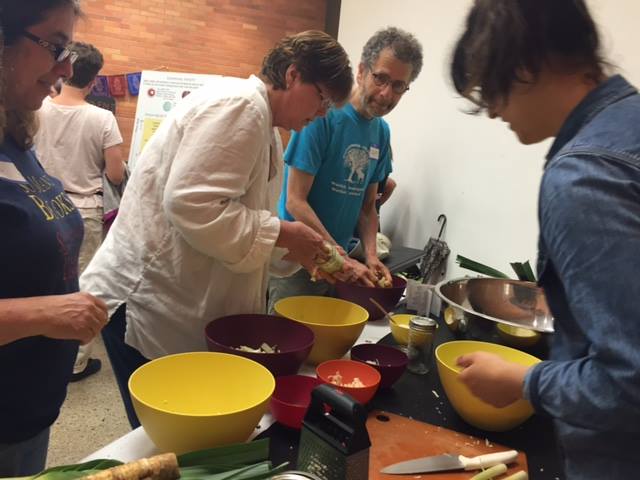
Despite periodic torrential rain, Matthaei Botanical Gardens was a beautiful place to be on June 14 for the Farm Education and Sustainable Food Fest. Marcy Epstein, Carol Lessure and Idelle Hammond-Sass talked to many people at the AARC table.


Blair Nosan from Hazon Detroit taught 40 people how to make sauerkraut.
Massaging the salt into the cabbage
Massage salt into the cabbage
Add flavors
Add flavors
Pack into jar.
Pack into jar.


There you have it.
There you have it. “Food Fest Sauerkraut June 14 2015”
11159498_825896817478447_5211131699392849125_n
Learning where the food comes from.
10347555_825896844145111_2818108066363202684_n
Challah Rising irresistible samples!
11430108_825896874145108_4239904000824685556_n
Oh the flavors of local food!
Local food, in so many flavors!
Delicious.


Filed Under: Event writeups, Food, Tikkun Olam Tagged With: food/land/justice

This Sunday, what an opportunity!

June 10, 2015 by Clare Kinberg

This Sunday, June 14, Matthaei Botanical Gardens is the place to be for the Farm Education Day and Sustainable Food Fest. There is really terrific programing and incredible food planned. Two of the things I am most excited about are the connections the planners have made with young Jewish social justice activists who are living in Detroit.

Blair Nosan (right) and Chava Knox at work at Eden Gardens.

Did you know that Hazon, one of the most creative, inspirational Jewish social justice organizations, is opening its Detroit branch this month? You can meet Detroit Hazon’s lead organizer, Blair Nosan,this Sunday at 11:15 for the workshop “Bread from the Earth: Jewish Practice and Sustainability.” The workshop will be co-led by Sue Salinger, the sister of AARC member Carole Kaplan. This is an opportunity not to be missed.

In addition, Detroit Jews for Justice is leading a workshop at 10:15, Mayim Hayyim: A Jewish Perspective on the Detroit Water Shut-offs with AJ Aaron. AJ was a Repair the World fellow last year.

AJ Aaron
AJ Aaron

If you need any inspiration over the next few days, read those links about the work Blair and AJ are involved in. And see you Sunday, let’s get inspired together!

Filed Under: Food, Tikkun Olam, Upcoming Activities Tagged With: Detroit, food/land/justice, Hazon

Is there a new Jewish back to the land movement?

June 3, 2015 by Clare Kinberg

green-things-logo-1Is there a new Jewish back to the land movement? Let’s talk about it together on June 14th when we gather at Matthaei Botanical Gardens for the Farm Education and Sustainability Food Fest and take a tour of Green Things Farm. Certainly Nate Lada, who with his wife Jill Sweetman are the owners and operators of Green Things Farm, sees a connection between his Hebrew Day School education and his commitment to sustainable agriculture. When he was a guest speaker at a UM Hillel Tu B’Shvat seder in 2012, Nate talked about the importance of agriculture and respecting the Earth as central to the Jewish tradition. Twentysomething graduates of the UM where they both studied Environmental Science, Nate and Jill have taken advantage of several opportunities created by longtime Ann Arbor environmental activists such as the Ann Arbor greenbelt program, a thirty year investment voted on in 2003. With the goal of starting a family farm, Nate and Jill spent two years (2011-2012) as part of the first cohort at Jeff McCabe and colleagues’ Tilian Farm Incubator Program. There Nate and Jill learned many of the basics of the business of farming while taking advantage of the program’s land, equipment, farming mentors, and community support. The land they bought to start their own farm, on Nixon near Warren about 5 miles north of downtown, was also part of the greenbelt program, in which the city of Ann Arbor bought development rights on the properties, making the land affordable for farming. [Read more…] about Is there a new Jewish back to the land movement?

Filed Under: Community Learning, Food, Tikkun Olam, Upcoming Activities Tagged With: food/land/justice, Shmita

Food/Land/Justice in the Washtenaw Jewish News

June 1, 2015 by Margo Schlanger

Here are the five articles from the Washtenaw Jewish News about our Food, Land, & Justice activities in 2014/2015, the Shmita year.

FLJ-all

Filed Under: Articles/Ads, Event writeups, Tikkun Olam Tagged With: food/land/justice, Shmita

Civil Disobedience at Stewart Immigrant Detention Center

April 14, 2015 by Clare Kinberg

By Rebecca Kanner

“Give me your tired, your poor,

Your huddled masses yearning to breathe free,

The wretched refuse of your teeming shore.

Send these, the homeless, tempest-tossed to me,

I lift my lamp beside the golden door!”

rebecca at SDC
Anton Flores, Jason McGaughey, Kevin Caron, Maureen Fitzsimons, and Rebecca Kanner were arrested on Saturday, November 22, 2014 at the gates of the Stewart Detention Center

On Saturday, November 22, 2014, I participated in non-violent civil disobedience at Stewart Detention Center, crossing the line onto Corrections Corporation of America (CCA) property to call for the institution’s closure. When participating in civil disobedience, I am practicing a lesson that I learned many years ago in my ninth grade civics class: that sometimes breaking the law is a viable action by concerned people to protect our democracy.

Expressing my concern, I walked across that line to shine a light on a facility that I have only learned about over the last several years. I attended my first vigil at Stewart Detention Center in 2010; I returned again in 2011 and my third time was this past November. Each time was an incredibly moving experience. I was touched to hear stories from family members and friends about those who were detained in the facility. I heard about the horrible conditions inside and the tragic situations of those men locked up. Hearing these voices moved me to act and with my action express solidarity with the immigrants imprisoned at the detention center.

The addition of Emma Lazarus’ 1883 poem, The New Colossus, to the Statue of Liberty in 1903 turned what was an icon of freedom into the Mother of Exiles, the “unofficial greeter of incoming immigrants” (John T. Cunningham). There have been times when our country was kinder to immigrants. Three of my four grandparents were immigrants, coming to this country as young children in the early years of the 20th century. They left the old country and the pogroms of Eastern Europe for a better life. My mother’s mother, Gramma Goldie, never did become a citizen and most of her life in the U.S., she was undocumented, though it was not talked about. But she was treated much differently than we treat immigrants today. She lived her life, raising my mother as a single parent, working, paying taxes, and collecting social security in her retirement. That was then and this is now. Now the immigration system is much changed. Now our country is much harsher, much meaner to the immigrant, to the stranger. [Read more…] about Civil Disobedience at Stewart Immigrant Detention Center

Filed Under: Posts by Members, Tikkun Olam

How an AARC Member Helped Strike a Blow against Discrimination

March 29, 2015 by Clare Kinberg

by Jonathan Cohn

Women who are pregnant now have stronger protection against workplace discrimination, thanks to the U.S. Supreme Court–and a member of the AARC who argued before the Court late last year.

On March 25, the Court issued its decision in Young v. United Parcel Service,  a case in which a pregnant woman (Young) claimed her employer (UPS) would not offer her the same kind of on-the-job accommodations it offered other employees with medical conditions. Young prevailed, winning the right to sue UPS under a law called the “Pregnancy Discrimination Act.”

Young’s lawyer was none other than Sam Bagenstos, who has been a member of the AARC since 2011. Sam, the Frank G. Millard Professor of Law at the University of Michigan, is a nationally recognized expert on constitutional, civil rights, and employment law. A graduate of the University of North Carolina and Harvard Law School, he has worked at the Justice Department and been a clerk to Associate Justice Ruth Bader Ginsburg. This was his third time appearing as an advocate before the nation’s highest court — and the second time that his client prevailed.

In academic and legal circles, Sam is probably best known for his work on laws about disability and discrimination. And it’s that expertise he brought to bear in the Young case, which called upon the Justices to parse the meaning of a 1978 law and what Congress had in mind at the time of enactment. By a 6-to-3 majority, with two conservatives joining the Court’s liberals, the Justices ruled that Congress wanted to make sure employers treated pregnancy no different than other medical conditions.

Sam Bagenstos
Sam (blue tie) outside the Court after the argument.

“The Court made clear that employers may not refuse to accommodate pregnant workers based on considerations of cost or convenience when they accommodate other workers,” Sam said. “The Court recognized that a ruling for UPS would have thwarted Congress’s intent in passing the Pregnancy Discrimination Act. This decision is a big step forward towards enforcing the principle that a woman shouldn’t have to choose between her pregnancy and her job.”

AARC members who don’t recognize Sam from his presence at congregation activities may know some of his family members — including his children, Harry and Leila, as well as his wife, AARC Board Chairperson Margo Schlanger.

Margo also happens to be a Michigan law professor and former Ginsburg clerk. No, they didn’t meet while clerking. But if you want the actual backstory, you’ll have to ask them.

By the way, you can listen to Sam delivering his oral argument at the Supreme Court here.

Filed Under: Posts by Members, Simchas, Tikkun Olam

  • « Go to Previous Page
  • Page 1
  • Interim pages omitted …
  • Page 6
  • Page 7
  • Page 8
  • Page 9
  • Go to Next Page »

Primary Sidebar

Search

Join Our Mailing List

Sign up for our twice a week newsletter to get details on upcoming events and catch up on our latest news.

This field is required.

Check your inbox or spam folder to confirm your subscription.

Upcoming Events

  • All day, May 10, 2026 – Beit Sefer
  • All day, May 17, 2026 – Beit Sefer
  • 9:00 am – 10:00 am, May 17, 2026 – Rosh Chodesh Minyan Sivan [ZOOM]
  • 7:00 pm – 8:00 pm, May 20, 2026 – Pop-in Torah Study with the Rabbi [Zoom]
  • All day, May 21, 2026 – May 23, 2026 – Shavuot

Latest News

  • AARC Has a New Member Area April 30, 2026
  • RSVP to “Lesson of the Homeland” and the Stories We Tell: A Conversation with Anat Zeltser April 16, 2026
  • Climate Action Shabbat article in the April 2026 Washtenaw Jewish News April 3, 2026
  • Reimagining Torah Study: Moving from Zoom to In Person by Rabbi Gabrielle Pescador April 1, 2026
  • Creative Spirit at the AARC Beit Sefer March 27, 2026

Footer

Affiliated with

Copyright © 2026 Ann Arbor Reconstructionist Congregation