Here are the five articles from the Washtenaw Jewish News about our Food, Land, & Justice activities in 2014/2015, the Shmita year.
FLJ-allBlog
Torah of the future at AARC’s Beit Sefer

At our Shavuot study this year, a group of AARC members discussed several Jewish texts and traditions surrounding the word “torah.” Sometimes Torah is used to name the five books in the scroll read weekly on Shabbat; sometimes “Torah” includes Talmud and other writings as well. At times Torah is understood as “law,” while, as Rabbi Michal pointed out, “torah” can also mean “aim,” as in a guide for our actions.
One of the Reconstructionist movement’s goals for religious education is to convey Torah as “the ongoing, creative, and sacred search for meaning in life, a record of human encounters with the Divine.” As the new director of our Beit Sefer, I embrace this creative and ongoing Torah as our model. Our goal is to instill in the students the sense that, with the tools of Jewish tradition, their lives are creating the Torah of the future. Just as the Jewish people’s experience of God, Torah, and peoplehood has changed and grown throughout history, the students’ own experiences will change Judaism.
Each aspect of Reconstructionist education is infused with creative, participatory purpose. For instance, the point of Hebrew language study isn’t only recitation of a Torah portion. We study Hebrew in order to participate in community and express ourselves: in ritual, prayer, and text study, fostering connections with Jewish civilization of the past, the present, and the future. These goals may be lofty for a supplementary elementary school, but we can achieve sparking the desire to reach for them, and the basis of the tools to get there.

Another hallmark of Reconstructionism is incorporating contemporary ideas and discoveries in science and psychology into Jewish practice. Starting Fall 2015, the AARC Beit Sefer will begin to use Project-Based Learning (PBL) as a teaching approach in our K-6 religious school curriculum. An inquiry- and innovation-based teaching method, PBL is a perfect fit for a Reconstructionist religious school. PBL lessons open with a driving question – something the students feel they need to know. The teacher then guides the students through a journey of discovery, using a variety of resources, such as storybooks, excerpts from texts, experimentation, parents, teachers and other students. Students choose how they will present the information they have discovered; the culmination of each project is sharing it with a larger audience. Questioning has always been the basis of Jewish learning, so combining these contemporary teaching methods in the Jewish classroom is a natural.
In the AARC Beit Sefer classrooms, the students will work in pairs or small groups, using our community’s deep human resources of artists, techies, musicians, teachers, etc. to investigate the yearly cycle of Jewish holidays, life cycle rituals, the practice of mitzvot, Jewish history, liturgy, and literature.
An example of a PBL lesson for the Kitanim, [Read more…] about Torah of the future at AARC’s Beit Sefer
Klezmer Dance All Age Fun!
Friday May 22nd was really a special and beautiful evening. The room filled with the warmest of blessings for Rabbi Michal. And then the fun really kicked in. Many thanks to Allison Stupka, Barbara Rust Boyk and the whole crew that organized the evening. Let’s have Klezmephonic over again! Nancy Meadow took terrific photos of our klezmer dance party!
“We heard God’s words without using our ears.”
“We heard God’s words without using our ears.” So Shavuot is described at the end of Shuli and Me: From Slavery to Freedom, the storybook Omer calendar by Joan Benjamin-Farren you will hear at the AARC havdallah and Shavuot observance. The story, told from a freed slave child’s point of view, imagines those first seven weeks in the desert. We have been following the cloud. Today we are camped at the foot of the mountain. We’ve washed our clothes. We are waiting.
After havdallah, Rabbi Michal will lead us in a discussion of approaches to the concept of torah; the capital “T” Torah, the five books in our traditional scroll, and other uses of the concept of torah. A couple that speak to me, for instance: In a Kol Nidre sermon Rabbi Mona Alfi quoted the medieval scholar, Bachya ibn Pakuda: “Days are like scrolls, only write on them what you want to be remembered.” She explained, “In essence, what Bachya ibn Pakuda was saying is that each life is a Torah for future generations to examine and learn from.”
A description of Carol Ochs’ book Our Lives as Torah: Finding God in Our own Stories, says “Through the process of seeing our experiences in relation to Biblical stories, we begin to recognize our lives as part of the ongoing story of the Jewish people–as Torah.”
Let’s meet there, at the mountain, and discuss: May 23rd 7:30pm till ? At the home, still, of Rabbi Michal and Jon Sweeney, 2960 Lakeview Drive. Dairy, dessert potluck. Early evening all ages, after havdallah for adults, childcare available. Email Clare or Rabbi Michal.
Klezmephonic and Drake Meadow: Bringing Jewish Music and Dance together the Ann Arbor Way
Can a Contra dance caller lead a Yiddish sher (scissors dance)? Darn right, if it’s Drake Meadow! We will all get to experience the fun of it on Friday May 22nd as we gather to honor Rabbi Michal and appreciate her leadership of our community over the past two years. A special Kabbalat Shabbat beginning at 6:30 will be followed by a potluck dinner and entertainment by Klezmephonic, a new Ann Arbor klezmer band.
Klezmephonic’s first show was at the Old Town Tavern in Ann Arbor in June 2014, and they’ve played pretty steadily ever since, most recently, to a packed Kerrytown Concert House. Klemephonic’s guitar player, Alex Belhaj, and clarinetist and vocalist Jennie Lavine both attended the November klezmer workshop led by Maxwell Street Band and co-sponsored by AARC. There Jennie met Margo Schlanger, AARC board chair and intrepid viola player and our other member musicians Deb Gombert, Paul Resnick and Deb Fisch. Also at the workshop were Dan Peisach and Ralph Katz, both of whom play with Alex in the Celtic klezmer fusion band, ‘Twas Brillig and the Mazel Tovs’, which plays an annual contra dance that, this past year, was called by Drake Meadows.
Drake says it’s not really too much of a stretch to combine Contra and klezmer. After all, he says, Contra draws on all European folkdance. For instance the Virginia Reel, the classic American folk dance is a British dance, and yet it bears a close resemblance to a dance from Czechoslovakia. Similarly, Drake explains, a sher is an Ashkenazi square dance, same basic structure. For more than you probably want to know check out this transcript on sher and Contra dance from a 2007 Symposium on Yiddish dance.
Klezmephonic’s Jennie Lavine is also hosting klezmer jam sessions through Oz’s music and the band is currently in the process of mixing and mastering their first album.
What goes into a Mezuzah?
What goes into a mezuzah? Just ask an AARC Beit Sefer (Religious School) student! On April 26th and Mary 3rd, AARC member and Beit Sefer mom Marcy Epstein led an all-school mezuzah making workshop. The students learned about the difference between the mezuzah case and the scroll inside, and how we have come to name each part as the mezuzah. They discussed why and how Jewish homes have mezuzot on our door frames and demonstrated the ritual of kissing the mezuzah both entering and exiting the rooms of our homes. The students explored the letter Shin and many of the words that it represents, and then they learned about the prayer on the mezuzah scroll, the Shema and the V’ahavta. Marcy shared how these two prayers became so important that we would want them ever present in our homes.
The students rolled out their airdry clay and formed them into beautiful original cases, working with shapes and wood pieces for texture. Then Marcy and the teachers made the letter Shin for each child and set their mezuzot cases to dry, reminding them that over the week they might think about what prayer they would like to say while entering and exiting their bedrooms. The next week, the kids painted and embellished their beautiful cases. They then copied the Hebrew of the Shema and first words of the V’ahavta onto origami paper “scrolls” along with their own original prayers and set them inside the mezuzah cases to make their personalized mezuzot. By adding their own prayers to the scroll in the mezuzah, the students learned about Jewish “lifehacks,” explained by Rabbi James Brandt, director of the Jewish Federation of the East Bay in a January 2015 Jewish Week article “as this generation’s equivalent of ‘do-it-yourself Judaism,’ represented by the groundbreaking 1973 publication of the The First Jewish Catalog (co-edited by Michael Strassfeld), which offered a model of creating Jewish life ‘outside the official system.’”
Marcy hopes that our families might share a mezuzah hanging with the kids, not only so they can know where on the door frame to look for a mezuzah, but also to celebrate their warming embrace of the ancient ways with modern import reflective of their lives.
So, if you ask the students at the AARC Beit Sefer, you might find that in addition to the shema on a scroll, what goes into a mezuzah case is love, care, creativity, and their own heartfelt (or silly, but definitely personal) prayers.
A Torah Story

Our Torah scroll was acquired, according to Bev Warshai, at the time when the Ann Arbor Reconstructionist Havurah was about to celebrate our first bat mitzvah, the Warshai’s daughter Gal. Although Bev and her husband Yuval belonged to both the AA Havurah and T’chiya, a Detroit Reconstructionist congregation, they wanted Gal’s bat mitzvah Torah service to be here in Ann Arbor. However, the Havurah did not have a Torah scroll, an ark, or a table to use during a service. Around this time, in 1997, several members of the Havurah–Aaron and Aura Ahuvia, Deb Kraus and Danny Steinmetz (and their children Isaac and Jonah Ahuvia (3 and 1 years old) and Molly Kraus-Steinmetz (2 years old)–drove together to Kenosha, WI for a regional Reconstructionist workshop. There they met a member of a Reconstructionist congregation in Chicago that happened to have an excess of Torah scrolls. How does a congregation acquire an excess of Torah scrolls? Danny suggests that “Back in the day, giving a Torah was a big thing, whether or not the shul needed another one. The symbolism of dedicating the ultimate sacred object (since the destruction of the Temple) in memory of deceased relatives is so strong, if a shul was around long enough and had enough members with some money, collecting Torah scrolls was not unusual.” Bev also remembers that two congregations merged, creating even more of an excess of scrolls. Deb remembers the initial discussion, “I was in a workshop and someone was lamenting that they don’t always have Torah readers and I said, ‘at least you have a Torah,’ at which point a person from a Chicago congregation said, ‘Talk to me after this. We have an extra Torah.’”
Arrangements were made. Because the Torah was a gift to the Chicago congregation, they could loan it to us and give us responsibility to take care of it. Although Yuval’s subsequent communications with the Chicago congregation indicated that they have relinquished all claims to the scroll, out of an excess of caution, AARC will continue to care for it in trust. If we ever come into possession of any other Torah, we could decide to gift this one on, again, to another congregation in need. But back to the story!
Yuval and Harry Fried made the trip to Chicago to bring the Torah scroll back to Ann Arbor. Alan Haber made the ark, and other necessities and niceties for a Torah service were collected. In future blog posts I will write more about those objects, including our Torah covers and our yad. So far, we know nothing more about the provenance of our Torah scroll. Since we’ve had it, the scroll has been repaired twice at Borenstein’s in Oak Park, including new wooden spindles. It still has need of stitching repairs and there are many faded letters that can make it challenging to read.
AARC has a fund for repairing or replacing the Torah, though it contains only a fraction of the money needed. Board member Jack Edelstein is leading a new effort to figure out the best path forward. If you’d like to be involved in this effort, contact Jack. And if you’d like to donate to the fund, click here.
Jewish Time: Counting the Omer and the 19 Year Cycle
By Clare Kinberg
Because my brother, Rabbi Myron Kinberg (his name is a blessing) died on April 19, 1996, which was the 30th of Nissan, I learned this year about the 19-year cycle of the Jewish calendar. This year, for the first time since he died 19 years ago, the secular date and the Hebrew date of his yahrtzeit coincided. This got me thinking about Jewish time. I knew that the Jewish calendar is a lunar-solar calendar; now I’m trying to come closer to (even a little) understanding of what that means. In astronomy, there is a natural 19-year cycle between the sun and the moon, called the Metonic Cycle. Every 19 years, or approximately 6940 days, the moon will have gone through 235 complete phase rotations, making the day of the month and day of the year the same. The Gregorian calendar uses 12-months in a year; 19 years of 12 months gives us 228 total months. The 228 months are seven less than the required 235 months of the Metonic Cycle. In the modern Hebrew calendar, the extra seven months are added in the 3rd, 6th, 8th, 11th, 14th, 17th and 19th years. During those “leap” years, the Hebrew calendar has 13 months. Perhaps the mathematicians among us will take some time to further explain this to me next time we meet!
There is another reason I am thinking about Jewish time. As I write this on April 21, the 2nd of Iyyar, it is the 17th day of counting the Omer, the Jewish ritual of counting the 49 days between Passover and Shavuot. There are many ways to think about these seven weeks. In an agricultural sense, it is the time between the early spring planting of the barley and its harvest, reminding us of our roots as an agricultural society. In a literary, metaphorical sense, the 49 days of the Omer is the time in which we entered the desert, crossed the sea, rejoiced, got thirsty and hungry, followed the cloud and stood at the foot of a mountain learning how to continue on as a people. Jewish mystics attended to these days as an inner journey. Rabbi Yael Levy explains the connections among all this in a beautiful Huffpost blog. On the last day of counting the Omer this year, May 22nd, we will be together for a special fourth Friday Shabbat potluck and dance party to honor and send off Rabbi Michal. The next day, Shavuot, will offer another opportunity to get together and study. Rabbi Samson Raphael Hirsch (1808-1888) is remembered as saying that the “catechism” of the Jews, our educational maxim, is our calendar. Our practice, our beliefs, our history, our spirituality all have expression in the days, weeks and months of the yearly cycle. Jewish time will be among the things I will be thinking about this Shavuot.
Also see: Counting the Omer During Quarantine
Civil Disobedience at Stewart Immigrant Detention Center
By Rebecca Kanner
“Give me your tired, your poor,
Your huddled masses yearning to breathe free,
The wretched refuse of your teeming shore.
Send these, the homeless, tempest-tossed to me,
I lift my lamp beside the golden door!”

On Saturday, November 22, 2014, I participated in non-violent civil disobedience at Stewart Detention Center, crossing the line onto Corrections Corporation of America (CCA) property to call for the institution’s closure. When participating in civil disobedience, I am practicing a lesson that I learned many years ago in my ninth grade civics class: that sometimes breaking the law is a viable action by concerned people to protect our democracy.
Expressing my concern, I walked across that line to shine a light on a facility that I have only learned about over the last several years. I attended my first vigil at Stewart Detention Center in 2010; I returned again in 2011 and my third time was this past November. Each time was an incredibly moving experience. I was touched to hear stories from family members and friends about those who were detained in the facility. I heard about the horrible conditions inside and the tragic situations of those men locked up. Hearing these voices moved me to act and with my action express solidarity with the immigrants imprisoned at the detention center.
The addition of Emma Lazarus’ 1883 poem, The New Colossus, to the Statue of Liberty in 1903 turned what was an icon of freedom into the Mother of Exiles, the “unofficial greeter of incoming immigrants” (John T. Cunningham). There have been times when our country was kinder to immigrants. Three of my four grandparents were immigrants, coming to this country as young children in the early years of the 20th century. They left the old country and the pogroms of Eastern Europe for a better life. My mother’s mother, Gramma Goldie, never did become a citizen and most of her life in the U.S., she was undocumented, though it was not talked about. But she was treated much differently than we treat immigrants today. She lived her life, raising my mother as a single parent, working, paying taxes, and collecting social security in her retirement. That was then and this is now. Now the immigration system is much changed. Now our country is much harsher, much meaner to the immigrant, to the stranger. [Read more…] about Civil Disobedience at Stewart Immigrant Detention Center
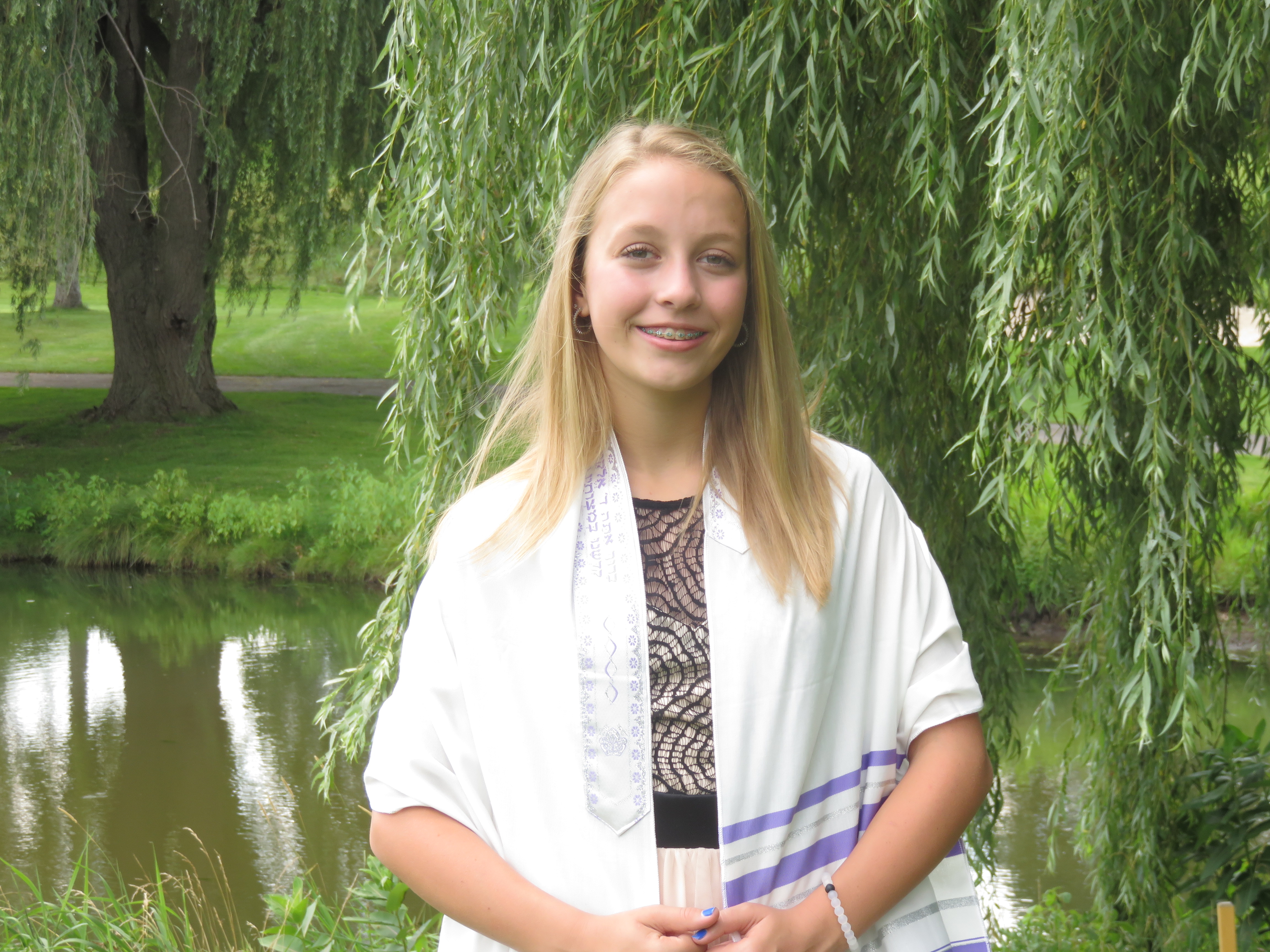
Odile Hugonot Haber on Parashat Shemini
Odile Hugonot Haber Bat Mitzvah Words, April 11 2015
We are reading in Leviticus now, and it is a good time to have a Bat Mitzvah, a recommitment, because in Hebrew, the book of Leviticus and its first chapter are named Vayikra,–“and the Lord Called.” I read in Avraham Burg’s Torah commentary, Very Near To You “When the time comes for the book of Leviticus, with all its sacrifices and their spattered blood, I raised my spines like a hedgehog…” We do too, so how do we understand these passages today?

The Hebrews came out to the desert led by Moses and Aaron, liberated from slavery, from alienated labor and from the whip of Pharaoh, the ruler and employer. They found themselves suddenly in front of the silence–and beauty–of the desert, a simpler life in accordance with the rhythms of nature. Yes, life in the desert can be humbling, very simple, bringing us back to our core. The few sounds in the silence, the plants that grow against the wind, the crackling of the sand, the trails of little animals, all that immensity of sky, earth and cloud. Definitely a new way of life.
The desert can be very intimidating, such a change! It was important to organize that emerging society, give it some structure and community. Rather than leave them in front of each other in distress to fight and divide, it was time to build on their freedom and support a spiritual life that would nourish them and open their minds and hearts. The tribes had to be kept assembled and form a new identity. So the services were created, the priesthood was formed, the people performed, then the laws were given from on high.
But what about the sacrifices of animals, the spilling of blood? How could it possibly mean something to us now? Very few of us are prepared to spill blood, and yet we are living from the continual sacrifices of others. Our nation and its might of military arsenals is continually spilling the blood of some of the poorest people on earth. Many animal species are moving to extinction because humans are gorging ourselves on materialism while the rest of nature is perishing around us.
The second temple has been long destroyed, animal sacrifices have been eradicated, and many of us here are vegetarian. So what are the sacrifices that Adonai wants to get from us at this time? “The building of the temple and the renewal of the sacrificial service are the climax of the Jewish state’s true rebirth and the redemption of the world,” as Rabbi Abraham Isaac Hacohen Kook expressed it, “to build the temple and the sacrificial service is the noblest and highest of aspiration.” It certainly beats materialism and shopping. Yet, Isaiah tells us that God does not delight in sacrifices and in rituals. God instead would like us to do the work of Peace and Justice around us. [Read more…] about Odile Hugonot Haber on Parashat Shemini