• Skip to primary navigation
  • Skip to main content
  • Skip to footer
Ann Arbor Reconstructionist Congregation

Ann Arbor Reconstructionist Congregation

  • Home
  • About
    • Overview
    • Rav Gavrielle Pescador
    • Our History
      • Photo Gallery
    • Our Values and Vision
    • LGBTQ Inclusive
    • Our Board
    • Our Sacred Objects
    • About Reconstructionist Judaism
    • Jewish Ann Arbor
  • Programs
    • Shabbat and Holidays
    • B’nei Mitzvah
    • Tikkun Olam
    • In the (Washtenaw Jewish) News
    • Health and Safety Expectations for In-Person Gatherings
    • Join our Mailing List
  • Religious School
    • About Beit Sefer
    • Teachers
    • Enrollment and Tuition
    • 2026-27 Beit Sefer Calendar
  • Blog
  • Calendar
  • Membership
    • Thinking about joining?
    • Member Area
  • Contact Us
  • Donate
You are here: Home / Blog

Blog

Dish for a Cold Winter Evening

March 3, 2016 by Clare Kinberg

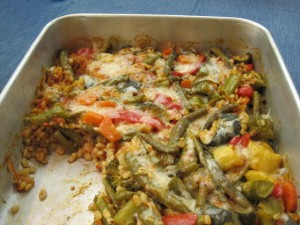
Rena's Basch's Veggie Barley Bake
Rena’s Basch’s Veggie Barley Bake
Veggie Barley Bake: A Rena Basch Recipe

Once upon a time, my friend Beth–a charming book club hostess–served this dish for dinner on a cold winter evening, and I went nuts for it.  I think of barley as a wonderful hearty and healthy grain, but it’s rarely served except as part of a beef barley soup. Barley has a rich nutlike flavor and an appealing chewy, pasta-like consistency. It’s quite versatile; you can use it as a breakfast cereal, as a substitute for rice in pilafs and risottos, in cold salads, and in hot soups and stews. Or in this casserole-like dish.

Beth said she loves serving this dish which she found in a very old, dog-eared cookbook; the kids eat it, it’s healthy with barley and lots of veggies, but it tastes like lasagna. What’s not to love about that? You can use whatever combination of veggies suits your fancy or your leftovers. You just need approximately 10 cups of chopped vegetables in all. If you have bits of different vegetables leftover in the refrigerator or freezer, this recipe is perfect for cleaning them up.

As I mentioned I went a little nuts for this dish, and have made many variations. Here are some versions:

  • The Book Club Selection: green beans and sweet potatoes (peeled and cubed, no need to pre-cook)
  • Locavorious This & That: As many of you know, I own and operate a locally grown frozen produce CSA, so I’m always trying to help folks use the frozen vegetables that come as part of their share. Some recipes call for a cup of this, or a cup of that. This recipe can use up all those leftover cups of this and that. For example: 16 oz frozen summer squash, (or ~ 4 cups fresh), ½ bag of frozen broccoli florets, ½ bag frozen green beans, a handful of red peppers and some leftover snap peas or shelled peas.
  • Another favorite: 16 oz frozen cauliflower florets (or ~ 4 cups fresh), 2 cups blanched greens such as kale or chard, and sweet potatoes (peeled and cubed) or more carrots

The Veggie Barley Bake Formula

  • 2 tbsp oil
  • 2 cloves minced garlic
  • 1 onion, chopped
  • 2 average carrots, sliced
  • 9 – 10 cups chopped frozen or fresh vegetables
  • 3/4 cup barley
  • 15 oz frozen stewed tomatoes, thawed + ½ cup water *or* 1 1/2 cups tomato broth *or* 15 oz can of diced tomatoes plus a little water
  • 1 tsp salt
  • 1 tsp. oregano
  • 2 cups shredded sharp cheddar cheese
  • Freshly ground black pepper

Preheat oven to 350 degrees.

Heat oil in large heavy skillet and sauté garlic and onion until softened, 3 -5 minutes. Add remaining vegetables and sauté, stirring a few times, for 5 minutes. If using all fresh vegetables, may want to add a little cooking time here, maybe 3 extra minutes. Add barley, tomatoes/tomato broth, and seasonings; bring to a boil, cover, and simmer for about 10 minutes.

Transfer contents of the skillet to a shallow 4 quart casserole; stir in 1 cup of the cheese. Cover and bake for 45 minutes. Veggies and barley should be tender. If not, cover and cook longer. Top casserole with remaining cup of shredded cheese if desired and return to oven uncovered for about 10 minutes.

More reasons to love barley: It’s good for you! It’s tasty! It’s full of fiber and nutrients! It can be used to make beer! Nice place to read up on barley’s health benefits is here.

Filed Under: Food Tagged With: recipes

Purim Gifts: Welcome Baskets for Refugee Families

February 25, 2016 by Clare Kinberg

welcome basketAARC Beit Sefer teacher Sharon Alvandi is a student in the UMich Jewish Communal Leadership Program, and an intern at Jewish Family Service learning to work with refugee families. Sharon has been very inspired by our AARC congregation, particularly the ways that the Beit Sefer students, parents and other community members come together to share learning and activities, investing in the character of the children. Through her work with JFS, Sharon is organizing a way for us to practice the mitzvot of Purim, giving gifts of tasty treats to one another/mishloach manot, and gifts to the poor/mattanot le-evyonim (for more about how these two mitzvot are related see this). Sharon writes:

There are many reasons to celebrate Purim and sort through a narrative that’s truly unlike any other in Jewish scripture. On Purim- the holiday of “lots”- we celebrate more than simply the idea of chance. When we listen to Esther’s story, we collectively celebrate character, resolve, and integrity. By presenting her true self–her Jewish self–to king Ahasuerus to appeal for the fate of the Jewish people of Shushan (present day Susa, Iran), Esther is a model of advocacy for herself and others. As a developing social worker, this story helps me think  about what it takes to act in a way that integrates all parts of who I am.

Purim also commemorates what it means to survive genocide or the threat of genocide. Each day when I work at JFS, I have the opportunity to observe the strength of character of the clients and the meticulous work of the case managers to serve a community of refugees in making the best choices in their first days in the U.S.   

JFS has resettled over 350 refugees since 2009.  Countries range from Iraq, Afghanistan, Somalia, Ethiopia, Iran, Syria, and Burma. JFS is set to resettle 150 individuals by October 1, 2016. AARC can help with the resettlement of families by joining with JFS  to assemble and donate Welcome Baskets for refugee families in Washtenaw County. We can do more than discuss violence that is taking place abroad. We can  welcome those in our community who have found refuge in a new place. This Purim, we can help make a space of comfort for their true selves.

Sharon has put together a list of personal care and household items the new families need upon arrival to set up their new homes. Check with this registry to see what is needed. We ask that you buy these items new and when you have, check off the registry. We will assemble the Welcome Baskets some time during the Purim Shabbaton March 25-27.

Filed Under: Beit Sefer (Religious School), Tikkun Olam, Upcoming Activities Tagged With: mitzvah, Purim

Be Happy! It’s Adar! But why?

February 17, 2016 by Clare Kinberg

FullSizeRender (3)Purim is a joyous, chaotic and raucous holiday. In this Jewish leap year, there are two months of Adar (I and II) and we celebrate Purim in Adar II. This year that will be in late March. Even in leap years, Purim is followed one month later by Passover (they both occur on the full moon).

Purim is a harbinger of spring. Like spring holidays celebrated in other cultures and religions–the Hindu celebration of Holi, Carnivale in Brazil and the Caribbean and Mardi Gras in New Orleans for examples–the elation over the departure of winter and the rebirth of the Earth is intoxicating. And Purim is clearly a holiday to be observed in the millennium, where identifying the difference between good and evil is at times totally challenging.

So MARK YOUR CALENDARS!  The AARC brings you a smorgasbord of preparatory events leading up to our Purim observance, which will culminate with Rabbi Michael Strassfeld joining us for the 4th Friday in March.  Stay tuned for RSVP details!

  • Throughout March:
    • costume and mask consultations
    • preparing Shalach Manot — the gifts of Purim
  • March 19–  Lessurbert Annual Cookie Baking (read hamantaschen) and pizza baking
  • March 25–  4th Friday Service and Potluck unveiling the beautiful, whole megillah for the whole family and dinner theater Purim Spiel. (Tot shabbat prior to the service)
  • March 26– Mincha service and learning with Rabbi Michael
This image and the one above are decorative sections from the Megillat Esther/Scroll of Esther used by AARC courtesy of Barbara Boyk Rust and Evelyn Neuhaus
This image and the one above are decorative sections from the Megillat Esther/Scroll of Esther used by AARC courtesy of Barbara Boyk Rust and Idelle Hammond-Sass

Have an idea of how to add to the fun? Contact Dina Kurz [dinakurz@gmail.com] (on behalf of the Purim Planning Committee) if you want to add an event (such as baking, costume or mask workshop, sangria making, etc.) to increase the merriment in advance of March 25.

Links to Purim last year here and here.


Filed Under: Upcoming Activities Tagged With: Purim

Meet our newest member, Patti Smith!

February 17, 2016 by Margo Schlanger

Welcome to AARC’s newest member, Patti Smith!
Patti Smith and Ken Anderson
Here’s what Patti writes about herself:
Since the age of 5, I wanted to live in Ann Arbor. I finally made it happen in my late 20s. I began adult life as a legal aid attorney, but quickly realized that was not going to work out. I switched careers to become a special ed teacher in my mid-30s. I am a late bloomer, but finally settled!
I am married to Ken Anderson, stepmom to two kitty cats (Ali and Cyrus), and we live happily in a very small house near Kerrytown. I am also a writer: I’ve published two local history books, and I write for Concentrate Media and Mittenbrew), and am currently working on selling my YA book. I am involved in the a2Geeks, 826Michigan, the Ann Arbor Film Fest, the Ann Arbor Storytellers’ Guild, the city’s arts commission and recreation advisory commission, and like to do improv and box. I also enjoy hosting dinner parties and recently decided to start hosting salons and be my Gertrude Steinest!
DownTownAnnArbor
And here’s one of the books.  I think Patti is our new Ann Arbor expert!    Please welcome her when she’s next with us.

Filed Under: Member Profiles

Our new yad, in the Washtenaw Jewish News

February 5, 2016 by Margo Schlanger

Renewed thanks to Idelle Hammond-Sass for donating her time and creativity to make AARC’s yad, and to Emily Eisbruch and Clare Kinberg for writing this article in the Washtenaw Jewish News.WJN_Feb-16-web--Yad-article

Filed Under: Articles/Ads, Sacred Objects Tagged With: Yad

Rena’s February Recipe: It’s Hot and Sweet

February 3, 2016 by Clare Kinberg

side-gochujang-sesame-butternut-squash-940x560Gochujang-and-Sesame-Roasted Butternut Squash

by Rena Basch

When the latest, miraculously delicious, trendy ingredients are promoted by for-profit cooking magazines, I ususally try to ignore them. Or just smirk smugly, as in “I’m not getting sucked into searching for the impossible-to-find, often expensive, use-it-once-and-never again latest-n-greatest ingredient.” But, there are exceptions. Gochujang. I love this stuff. Gochujang is a Korean hot pepper paste; a savory, spicy, sweet, and pungent fermented Korean condiment made from red chili, glutinous rice, fermented soybeans, and salt. It’s got this sweet & spicy thing going on. If you’ve had bi bim bap at a Korean restaurant, the flavor will be familiar, as it is an ingredient in the sauce typically served with bi bim bap. It’s not that difficult to find in the Asian sections of local grocery stores or any of the Asian grocery stores around town, such as the Galleria Market on Packard in Ann Arbor, or Hua Xing Asia Market on Washtenaw in Ypsilanti. Look for it in square-shaped red tubs.Gochujang container

On to the recipe. Gochujang & sesame roasted butternut squash from bon appetit magazine. According to bon appetit, “This would work with any other winter squash—acorn and delicata don’t even have to be peeled.” However I love it with the butternut, which roasts well, and is easy to find at this time of the year, unlike delicata which does not keep as well as the hard winter squashes. These days, I’ll say this is my favorite preparation of butternut squash.  Hope you enjoy it!

Ingredients:
2 tablespoons sesame seeds
2 tablespoons vegetable oil
1 tablespoon gochujang (Korean hot pepper paste)
2 teaspoons soy sauce
1 medium butternut squash, peeled, seeded, sliced ¼” thick
Scallions, thinly sliced
Flaky sea salt

Place racks in upper and lower thirds of oven; preheat to 425°. Whisk sesame seeds, oil, gochujang, and soy sauce in a large bowl. Add squash and toss to coat. Divide squash between 2 rimmed baking sheets, arranging in a single layer. Roast, rotating sheets once, until tender and browned on some edges, 25–30 minutes. Serve topped with scallions and salt.

Here’s the link to the recipe in bon appetit

Filed Under: Food, Posts by Members Tagged With: recipes

Tu B’Shevat Shabbaton

February 1, 2016 by Margo Schlanger

TreeOur Tu B’Shevat Shabbaton was a great success.  Read all about the text study here, and the seder here.


Seder
Tu B’Shevat Seder Plate
Rabbi Michael leads text study
Text study
The beit sefer kids
Planting parsley
Planting parsley at Tu b’Shevat — to be ready for Passover


We’re excited to announce a Tu B’Shevat Shabbaton, the weekend of Jan. 22, with three events, all led by visiting Rabbi Michael Strassfeld, Rabbi Emeritus of the Society for the Advancement of Judaism. The Shabbaton will be environmentally-themed throughout.


  1. Our regular Fourth Friday Kabbalat Shabbat service and potluck, at the JCC.  This will start with a Tot Shabbat gathering for preschoolers and their families, at 5:45 pm.  Childcare (and pizza for the kids) are available starting 6:15.  (RSVP to Clare Kinberg for either or both.) The service starts at 6:30.  Bring something for the vegetarian potluck dinner that follows.
  2. Saturday text study and discussion: 4 pm
  3. Saturday Tu B’Shevat Seder: 5:30 pm.  With vegetarian supper.  Free, but reservations are required.  RSVP at http://shabbaton-FoodLandJustice.eventbrite.com.  Note: there will be a separate kid-friendly event at the same time, done in time for its participants to join the full group for supper.

Rabbi Strassfeld explains: “The classic Jewish texts about the environment [Deuteronomy 20:19-20; Rambam, Mishneh Torah, Laws of Kings and Wars 6:8, 10] prohibit the wanton destruction of nature. The stress on wanton destruction implies that the destruction of natural resources is permissible if it benefits human beings. For the text study on Shabbat, we will study other Jewish texts to see how Judaism can help us to create a contemporary environmental ethic rooted in the value of all things.”

The Tu B’Shevat seder that will follow is structured around eating of four different kinds of fruit, coupled with readings, songs and kavanot/reflections. The  Kabbalists of Safed created a Tu B’Shevat seder in the 17th century, loosely modeled on the Passover seder. Over the past several decades, Jews across the world have used Tu B’Shevat as a time to focus on the environment. Rabbi Strassfeld notes, “Our Tu B’Shevat seder will combine the focus on personal growth of the Jewish mystics with contemporary ecological concerns.”  Detroit’s Congregation T’Chiyah and its Rabbi, Alana Alpert, will be joining the Ann Arbor community for the seder, as will several Hazon Detroit fellows.

The events are co-sponsored by AARC and the Jewish Alliance for Food, Land, & Justice.  They are a continuation from last year’s year-long exploration of the teachings of Shmita, and are funded by an impact grant from the Jewish Federation of Greater Ann Arbor.  AARC and the Alliance welcome all community members to join any or all these Shabbaton activities; the events are free, but online registration is required.

Our flyer is below.  Please feel free to download, print and share it!

[pdf-embedder url=”https://aarecon.org/wp-content/uploads/2015/11/2015-12-Shabbaton-ad.pdf”]


MJ_Strassfeld_photo-B&WRabbi Michael Strassfeld is the author, editor, or co-editor of numerous books and articles, including three versions of the Jewish Catalog, A Shabbat Haggadah: Ritual and Study Texts for the Home; and Jewish Holidays, a guide to the holidays used in many Jewish households.  Since the 1973 appearance of the first Jewish Catalog, subtitled “a do it yourself kit,” Rabbi Strassfeld’s books have been the go-to publications for progressive American Jews seeking explanations, contemporary readings, and resources relating to traditions and holidays.


Filed Under: Community Learning, Event writeups, Tikkun Olam Tagged With: food/land/justice, tu b'shevat

Four Worlds of the Tu B’Shevat Seder

January 27, 2016 by Clare Kinberg

by Idelle Hammond-Sass

TreesClappingWatercolorOn Saturday evening January 23, AARC visiting rabbi Michael Strassfeld led about 60 people on a ritual journey through the mystical four worlds of the Kabbalists, exploring the different qualities of each world and our relationship to them. The Tu B’Shevat seder, modeled loosely after the Passover seder, was created by the mystics of S’fad in the 16th century, but the original holiday itself grew out of ancient tithing, and later was associated with planting trees in Israel and caring for the land.

Seder-01-23-2016

In an earlier study session, Rabbi Michael led an exploration of Jewish teachings about the environment.  The Tu B’Shevat seder is more mystical, a product of rabbinic imagination. Each mystical “world” is associated with a category of fruit, its season, an aspect of self, and an intention–and accompanied by a glass of wine. The Haggadah for the Tu B’Shevat seder, put together by Rabbi Michael and AARC co-chair Margo Schlanger, was rich with readings and illustrations that deepened our understanding. And, yes, like Passover, it is structured on fours: four worlds, four glasses of wine, four seasons.

This ancient New Year of the Trees or “Rosh Hashanah L’ilanot” was also associated with the mystical feminine aspect of God, or Shechinah. We added Miriam’s cup to our seder, and said a blessing for Miriam’s well, for without fresh water, the trees and plants cannot flourish. The cup was dedicated to the people of Flint, whose water has been polluted.

Our room was set with a U shaped arrangement of tables beautifully set with platters of fruits and seeds (carefully following the no nuts rule of the JCC) that illustrate the four worlds. The platters were piled high with figs, bananas, grapes, apple, pomegranate, pears as well as olives, dates, apricots, raspberries: Fruits with pits, hard shells and soft, dried and fresh.

Tu B'Shevat Seder Plate
Tu B’Shevat Seder Plate

The beauty of the ritual pairs a mystical sphere or world with a fruit that symbolizes it, as well as mirrors our own spiritual state. For instance in the physical realm of Assiyah (winter, white wine) we ate fruit with protective outer shells, such as banana, pomegranate, or oranges. When we peel away our protection, and can be vulnerable, we can share the sweetness inside. If you are unfamiliar with the Kabbalah, this is a sweet way to become familiar with the four worlds of Assiyah (Physical), Yetzirah (Formation), B’riyah (thought), and Atzilut (Spirit).

A delicious and plentiful dinner was organized by Rena Basch and catered by El Harissa Café. (Khallid explained our menu, featuring a Tunisian egg Tangine, Lablabi, Mama Houria, a carrot dip, with a lovely salad with figs and pomegranate seeds, and poached pears with Michigan fruit sauce.)

This event was co-sponsored by Jewish Alliance for Food Land and Justice with an impact grant through the Jewish Federation of Greater Ann Arbor. The seder helped us reach our goals of bringing together people from the wider community and celebrating the deep roots we share in the Tree of Life.  AARC was joined by Rabbi Alana Alpert and members of Congregation T’chiyah of Oak Park, fellows from Hazon Detroit, and many others from the Ann Arbor community.  Like all ARRC events, we could not have done this without volunteers, and a big thank you to all who planned and worked so hard–Margo Schlanger, Clare Kinberg, Carole Caplan and Rena Basch.

For more information on Tu B’Shevat there are many good resources on the web at Hazon.org, and Ritual Well, to name a couple.  The Jewish Alliance for Food, Land and Justice Facebook page is active–come visit!

Filed Under: Community Learning, Event writeups, Posts by Members Tagged With: food/land/justice, Michael Strassfeld, tu b'shevat

Harvesting Jewish learning to nurture an environmental ethic

January 25, 2016 by Margo Schlanger

Rabbi Michael Strassfeld leads Tu B'Shevat Text Study
Rabbi Michael Strassfeld leads Tu B’Shevat Text Study

Yesterday, AARC and the Jewish Alliance for Food, Land, and Justice hosted 50 people for two lovely events, led by our visiting Rabbi, Michael Strassfeld.  Tu B’Shevat–the “birthday of the trees”–provided us a great occasion to focus for the weekend on Judaism and the environment.

Another post will talk about the Tu B’Shevat seder.  In this one, I want to share with people who couldn’t make it to the afternoon text study some of the passages and insights offered by Rabbi Michael.

We started with two verses from Deuteronomy (20:19-20):

When you besiege a city for a long time, making war against it in order to take it, you shall not destroy its trees by wielding an axe against them. You may eat from them, but you shall not cut them down. Are the trees in the field human, that they should be besieged by you? Only the trees which you know are not fruit trees may you destroy and cut down, that you may construct siegeworks against the city that is making war with you until it falls.

It’s an interesting passage, with several ideas in it.  For starters, the text suggests that even in war, ethical constraints remain–and not just the most urgent ethical constraints, dealing directly with human lives.  Fruit trees take many years to grow, and of course they are important sources of food.  So this rule against their destruction may be founded on the obligations the current generation has to the future.

It’s a limited point, though; the explicit permission to use other, non-fruit-bearing, trees as battering rams and so on makes that clear.  This is not a modern environmentalism; it’s expressing something narrower. Still, we learned, Maimonides extended the concept somewhat:

It is forbidden to cut down fruit-bearing trees outside a (besieged) city, nor may a water channel be deflected from them so that they wither. . . . [This applies] not only to cutting it down during a siege, but whenever a fruit-yielding tree is cut down with destructive intent.  . . . It may be cut down, however, if it causes damage to other trees or to a field belonging to another man or if its value for other purposes is greater (than that of the fruit it produces).  The Law forbids only wanton destruction.  . . . Not only one who cuts down (fruit-producing) trees, but also one who smashes household good, tears cloths, demolishes a building, stops up a spring, or destroys aricles of food with destructive intent, transgresses the command Thou shalt not destroy (bal tashit). 

So according to Maimonides, the passage in Deuteronomy amounts to a comprehensive ethical ban on “wanton destruction,” whether in time of war or not, whether of a fruit tree or something else.  This is broader, for sure–but still very limited.  It reaches only wanton destruction: destruction that is for no appropriate purpose.  And the focus remains on present-day human purposes.  It seems to me the passage from Maimonides doesn’t quite capture the cross-generational insight from the original Torah passage.  But that’s what we moved to next. [Read more…] about Harvesting Jewish learning to nurture an environmental ethic

Filed Under: Community Learning, Event writeups, Posts by Members, Tikkun Olam Tagged With: tu b'shevat

MLK Day and the Ten Commandments

January 17, 2016 by Margo Schlanger

by Margo Schlanger

In honor of Martin Luther King Day, Monday January 18, 2016 , I got together with the Beit Sefer kids the day before, to talk about the Torah and civil rights.

We started with this picture:

Martin Luther King, Jr, with Rabbis Maurice Eisendrath and Abraham Joshua Heschel
Martin Luther King, Jr., R. Maurice Eisendrath and R. Abraham Joshua Heschel, on the March from Selma to Montgomery Alabama, March 1965.

I asked the students what the Civil Rights movement was about.  They talked about African Americans’ claims on equality–voting, jobs, buses, restaurants, and more.

So why did Rabbi Eisendrath think it was important not just to carry the Torah during the Selma march in 1965, but for the Torah’s mantle to show the Ten Commandments?  We looked together at the commandments, focusing on the “Don’t” commandments, illustrated on the Torah mantle with the Hebrew word “לא” (lo — “no” or “don’t”).

Our conversation was mostly about three of the commandments: Don’t murder, don’t steal, don’t lie about important things (“bear false witness against your neighbor”).

What do these commandments have in common? Some people think we can develop from them (and the others in the ten) a full statement of the requirements of a moral life.  But so many things are left out.  If we can deduce a principle behind these commandments, maybe that principle can help.

The students first developed a “results-oriented” justification.  Who would want to live in a world where other people were allowed to murder and steal? they asked.  Then they moved to the justification that ties the Ten Commandments to civil rights–equality.  You don’t kill people, or steal from them, or lie to them, they said, because those other people are equal to you.  Their lives matter, their stuff matters, their feelings matter.

In other words, the students ended up in the same place as Rabbi Hillel.  We each stood on one foot while I repeated the Talmudic story:

Once there was a non-Jew who told Rabbi Hillel that he was thinking about converting to Judaism, but first, he wanted to know everything he needed to know, while he stood on one foot.  And so Hillel said, “What is hateful to you, do not do to your neighbor. That is the whole Torah; the rest is explanation.”

Filed Under: Beit Sefer (Religious School), Divrei Torah, Posts by Members, Tikkun Olam Tagged With: civil rights, Torah

  • « Go to Previous Page
  • Page 1
  • Interim pages omitted …
  • Page 60
  • Page 61
  • Page 62
  • Page 63
  • Page 64
  • Interim pages omitted …
  • Page 77
  • Go to Next Page »

Footer

Affiliated with

Copyright © 2026 Ann Arbor Reconstructionist Congregation