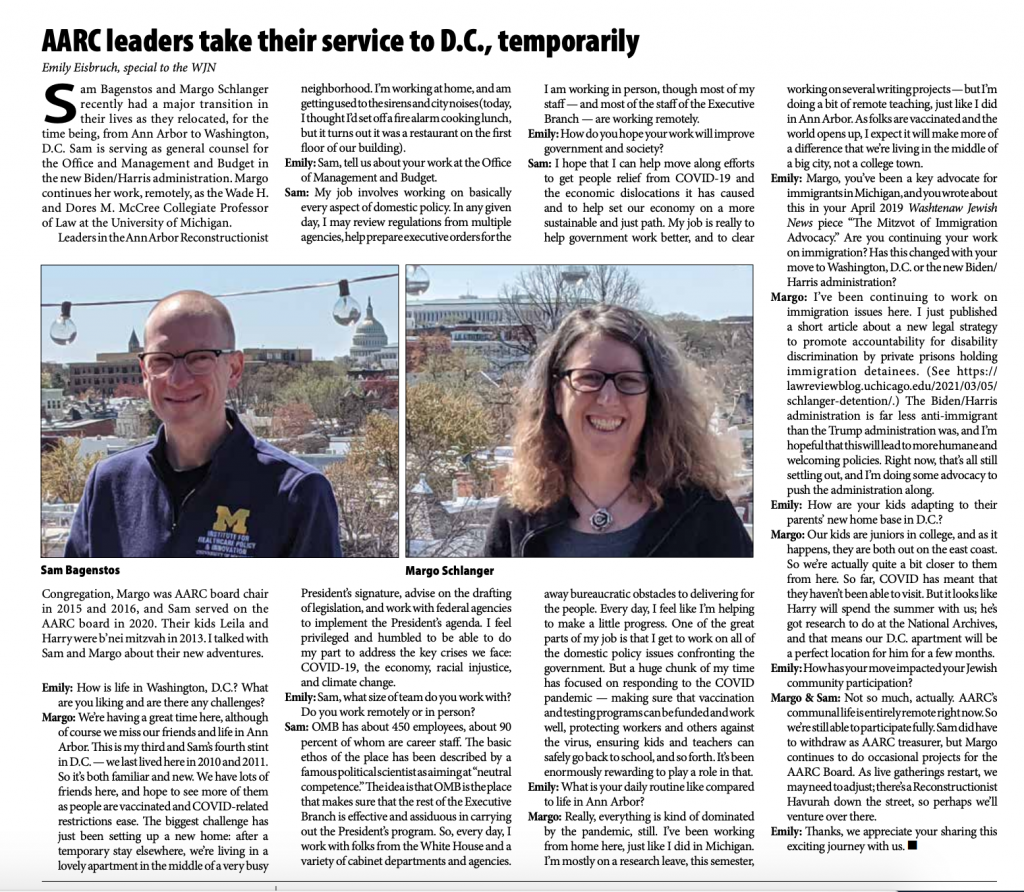
Thanks to Gillian Jackson for this article in the March 2021 Washtenaw Jewish News.


Reading Anita’s blog post about the Mitzvah Corps spurred me to write this appreciation of the generosity I am receiving from the group.
I am recovering very well from a major surgery that I had in the autumn of 2019. It has been a more extensive process than initially anticipated and my needs for assistance have surpassed anything I have experienced yet in this life. For many of us who take joy in giving care, it is a new challenge to allow ourselves to be cared for, especially when it is more care over a longer period of time than we imagined possible.
For the last few months and ongoing into the future I need rides to attend the physical therapy that is helping me with one of the key aspects of my healing, attaining structural balance and increasing freedom of motion.
Friends and family are helping me in many ways, and I need even more help as this is an extended period of healing. Also, given the world condition with the pandemic, I am not comfortable using public or private transportation like Uber, etc.
The congregation members, in particular, Anita Rubin-Meiller, Claudia Kraus Piper, Mike Ehmann, Janet Greenhut and Rebecca Kanner are helping me enormously.
First there’s the ride itself, their vehicles are clean and safe and feel appropriately tended given the pandemic, all these are stress relievers for me.
Secondly, they’re all great drivers! I am not able to drive at present and this loss of control is not easy for me. Being driven by individuals who are at ease and competent at the wheel offers a calming feeling of being cared for and protected.
Third, as healing is my full-time preoccupation, I am not seeing many people outside of my household in a given week. With the pandemic this is even more the case for all of us. When the driver comes to get me, I have the enjoyment of pleasant company and interesting conversation over the time we are together. Since this is an ongoing healing project for me, our relationships are developing gradually as our conversations evolve over the weeks and now months of our connecting in this way.
What’s the hub of the wheel of community? Connection. And the spokes of that wheel head out in many directions. The spoke that is helping me heal, giving me blessing, and affording me safe and consistent transportation over months to a vital part of my recovery is the spoke of generous giving of time and effort every Monday and Thursday at about 12:30 pm, when someone shows up at my home and takes me to PT. I am grateful and appreciative beyond words for all that it takes in order for this gifting to me to occur.
These mitzvah doers have a spoke of connection to me, yes, and through their goodness, to the One that connects us all. It’s a blessing.

As we mark a full year of life during a pandemic, the ability of this congregation to rally its resources in order to create robust programming is evident. Each weekend this month we have programs to help us process the past year and prepare for our next holiday celebration–Passover! All events are on Zoom, and links will be sent out in the AARC mailer the week before the event. If you would like to attend and do not receive our mailer, please email us for the link; everyone is welcome!
Two of our congregation’s most creative Debbies, who have collaborated on many a seder through the years, will host a discussion about creating your own haggadah for this year’s sederim.
Topics that will be covered:
Five things you need to consider before embarking
Knowing your audience
Helpful resources
Consistency of content and message: how to balance tradition and innovation
What elements you shouldn’t mess with
Join us for what should be a free-wheeling conversation on Zoom!
Teachers Patti Smith and Sharon Haar will lead a workshop on how to plan a virtual seder with friends and family over Zoom.
Join AARC to mark the one-year anniversary of the pandemic with a ritual to hold our personal and collective losses and our hope for healing. We will mourn the loved ones we have lost, acknowledge the changes in our lives, and set hopes and intentions for healing and better days to come.
Author Menachem Kaiser will read from his debut memoir Plunder: A Memoir of Family Property and Nazi Treasure (out March 16, 2021 from Houghton Mifflin Harcourt). The memoir is an incisive and engaging ‘3G’ story of a young man returning to his family’s ancestral home on the Polish-German border in search of a connection with a grandfather he never met—and the relatives he never knew he had. AARC is co-sponsoring this event: Register Here.
Join us on a journey into Dayenu (‘Enoughness’) through images, discussion and art-making:
Bring your art materials to the workshop. Bonus: Turn your art into an e-card, social media post or a page in your own Haggadah!
The pre-Passover ritual of bedikat chametz is a kind of leavened-product treasure hunt, where we search for hidden chametz in order to be able to enter into Passover—our freedom holiday—a little less encumbered. In this 2-part workshop, we’ll:
1. Learn about the bedikat chametz ritual with Rabbi Ora, and use its framework to reflect on what we can spiritually leave behind as we enter a new season (7-7:50 pm)
2. Get rid of our literal chametz with a Napolitano-style pizza-making workshop led by Rabbi Ora’s partner, Asa, a dedicated pizza hobbyist (7:50-8:30 pm)
Spending time in the kitchen making food together is one of those particular situations that no matter who you are with, good conversation and connection are surely to come. Some of my fondest memories are of time spent in the kitchen with loved ones. Last weekend’s Hamantaschen workshop did not disappoint! Etta Heisler and Laurie White provided some invaluable tips and techniques to help their fellow bakers perfect their Hamantaschen craft. In addition to their priceless anecdotes, members were given the opportunity to simply spend time together in the kitchen, and what a privilege this seems to be during this time of isolation!

Carol Lessure wrote a lovely reflection on the community that is built around times in the kitchen in ‘normal times.’ Enjoy!
AARC has always enjoyed silly, fun times during Purim. We have had many a Megillah reading, and lots of spiels, tons of costumes and of course yummy food enjoyed together. Last year, we had two face to face celebrations – crazy right?
When Gillian reached out to me about a Hamantaschen-baking workshop online, it reminded me of the many years that the Lessure Engelbert family hosted Hav families and friends to bake cookies in our home.
It all started with a call for homemade Hamantaschen for dessert at a catered luncheon followed by a Purim spiel a decade ago. Then, the Beit Sefer requested some to fill Mishloach Manot. I thought it would be more fun to tackle the big baking task together. What followed was a 7-year tradition of baking cookies at our home. At first, the little ones needed lots of supervision and quickly tired of the task; a few years later and the tweens took over and the adults could visit over coffee and snacks. Then families with younger ones came over and the teenagers showed them how to do it.
We figured out that people just liked hanging out – so we started popping pizzas into the oven after the cookies baked. Each family would bring a side dish to share for dinner. Our boys were happy to host and soon the tweens and teens would gravitate downstairs for Wii games while adults hung out on the main floor.
One year, I woke up with a fever and chills. I kept to our bedroom and the cookie-baking went on without me. It is truly a testament to our community spirit that not only did the cookies get made, but our guests left the main floor and kitchen cleaner and tidier than they found it! Not only that, but no one came down with whatever I had. Obviously, this happened long before we’d heard of COVID-19.
We thought it would be fun to share these memories and some vintage photos – may we be together again next year!


Carol’s “Best Hamantachen” (recipe is from Leva Lessure – aka Carol’s mom). Published in “Nobody Cooks Like Jewish Women” – NCJW National Capitol Area Section, 1992:
1 cup shortening (butter, margarine)
3 eggs (or make flax “eggs” with 1 tablespoon of fresh ground flax with 3 tablespoons of water for each egg you are substituting)
1 cup sugar
Cream sugar and butter together, add eggs one at a time
1 tsp of vanilla
3 tablespoons of honey (or agave for the vegans)
2 tablespoons of orange juice
Add these ingredients and mix well
4 cups flour
3 tsp of baking powder
½ tsp of salt
Sift the dry ingredients together – esp. baking powder so it doesn’t clump
Slowly add in dry ingredients into the blended wet ones
Once all the ingredients are well blended, cover tightly and refrigerate overnight. Take out only a small amount at a time and keep dough refrigerated – it will become very sticky when warm and difficult to roll and cut.
Cut two inch circles with a juice glass or cookie cutter, add a small spoonful of filling in the center and pinch the sides to form a triangle – leave a hole in the middle so that filling can be seen.
Baked on greased cookie sheets at 350 degrees for 12-15 minutes until edges begin to brown. Cool for 5-10 minutes because filling stays hot longer than the cookies.
We prefer Solo brand fillings: Poppyseed, Prune and Apricot are traditional in our family. Cherry, chocolate and sweet cream cheese are good too!

Dear Chevre,
For many years, the Mitzvah Committee has been functioning to meet the needs of AARC members in a variety of ways. These include offering rides to services or medical appointments; providing meals during an illness or after the birth of a child; assisting with shiva set-up, and with preparing the space for a Bar or Bat Mitzvah. There are currently 7 members on the committee.
In the year prior to pandemic lock-down, we met once a quarter for personal sharing, reviewing how the committee was functioning, and considering new ideas. Just before lock-down, some of our members were gearing up to offer new support groups, one for folks with aging parents and one for parents of teens. These were put on hold, as were the quarterly meetings.
On January 31, we had our first virtual gathering and noted that although we hadn’t been seeing each other in person, we were still functioning. Our members helped to organize and provide ongoing phone support for congregants; took part in providing meals for new parents; helped connect former members with Rabbi Ora for shiva support; and helped with groceries here and there for folks who felt too at risk to get to a store.
We continue to be open to looking at new ways to serve the AARC community, increase involvement from other members, and perhaps extend beyond our congregation with a community project. We welcome your requests for assistance and your interest in volunteering. Please fill out this mitzvah committee form if you feel ready to be part of the team. Initial contact can be made with Anita Rubin-Meiller, the committee chair, at anita1018@sbcglobal.net. Our next quarterly meeting will be on Sunday, April 25th.
“Too often we underestimate the power of a touch, a smile, a kind word, a listening ear, an honest compliment, or the smallest act of caring, all of which have the potential to turn a life around.” ― Leo Buscaglia

Join us in the month of February to bring levity and inspiration to your winter days! We have a Purim workshop, a Purim-tastic Shabbat, a Mishloach Manot exchange, and a new program about food and land justice to enrich and enliven you!
Laurie White and Etta Heisler will be leading a delicious workshop on how to make the perfect Purim confection via Zoom. We will provide the recipe on this blog in the days to come. Zoom link will be sent out on our mailer the week before the event; if you do not subscribe and would like to come, please email us. Dough will need to be prepared ahead of time, please see Etta’s website for the recipe.
Laurie White’s Recipe:
Rich Pastry Hamantaschen recipe
RICH PASTRY HAMANTASCHEN
2 C. all-purpose flour1/2 C. sugar2 t. baking powder1 C. butter (or margarine)2 eggsGrated rind of 1 orange1/2 C. finely ground walnuts2 T. brandy
1) Sift the flour, sugar and baking powder into a large mixing bowl. Using a pastry blender or fork, cut in the butter until the mixture resembles coarse crumbs.2) Add the eggs3) Add the remaining ingredients and work with your hands until the mixture forms a ball, Add more flour if the dough seems to sticky to handle. Wrap and refrigerate over night.4) Roll out to 1/8-inch thickness on a well-floured board or pastry cloth. Cut 3’ or 4’ diameter circles, using a cookie cutter or drinking glass.5) Using filling of your choice*, mix filling well. Drop a teaspoon into the center of each circle, and fold dough to form triangular pockets (You can put a bit of water around the edge to help with sealing. Pinch edges together firmly).
Bake in pre-heated 350 F. oven for 20-30 minutes, until pastries are golden brown.
Makes 2 1/2 – 3 dozen.
* I like prune jam (2. c.) with the grated rind of a lemon, 1 t. orange juice, 1/2 c. finely chopped walnuts, 1 t. cinnamon (1/4 t. nutmeg): apricot jam (and add cinnamon and nuts) or poppyseed filling (I usually add yellow raisins, cinnamon and lemon to the commercially prepared version)
Mohn (rhymes with fun) is both the German and Yiddish word for poppy seeds. Tasch (rhymes with gosh) is the word for purse or pocket.Mohntaschen were a pocket-like pastry filled with poppy seeds and popular with German Jews and non-Jews in the late Middle Ages. A dish eaten by Jews has always been more satisfying if there exists some connection between it and the history of the Jewish people, so it became “Hamantaschen” and designated as a treat at Purim.As an extra justification for adopting mohntaschen for the traditional Purim pastry, it has been suggested that poppy seeds were a symbol of manna, the food G-d gave to the Jews wandering in Egypt, and also one of the few foods Esther would have eaten in the Court of Ahasuerus since she would have been observing the Jewish dietary laws.

AARC and The Jewish Alliance for Food, Land and Justice are partnering with Ekar Farm and other national organizations to explore the connections between the biblical agricultural tradition of Shmita (“release”) — the Sabbatical year — and contemporary issues of economic, environmental, immigration, and food justice. In today’s program — the first in a six-part monthly series — we’ll learn from Nati Passow of Dayenu about Shmita. In the second hour, we’ll gather as a community (via Zoom) to unpack our reactions and consider their local significance. Register for the class here (note the suggested donation of $18), and learn more about the partnership and upcoming programs here. For questions, contact Carole Caplan-Sosin at caplan.carole@gmail.com

Fourth Friday services this month will be filled with Purim fun! We will witness the creative brilliance and dramatic flair of Beit Sefer families; hear the megillah, and be delighted by the Great Debate Part II: Hamantaschen VS Matzoh Ball Soup. The costume theme this year is creative headwear — come with your wildest hats and your most creative home-made noisemakers!
We will be doing abbreviated megillah readings in English and need some volunteers! If you are interested, we will provide you with your assigned chapter ahead of time. Please sign up here. If you’re interested in being one of the Great Debaters, email Rabbi Ora.
In addition to our Purim celebration, we are also organizing a Mishloach Manot Exchange for members. To participate, sign up here. You will be randomly matched with 2 other households to give 1 and receive 1 mishloach manot package (in a COVID-safe fashion) in advance of Purim. Need some Mishloach Manot inspiration? Check out these fun ideas!
We hope you are able to join us for this month of enlivening events! If you have any questions, please email us!


Here’s a Washtenaw Jewish News article on the collaboration between the Ann Arbor Reconstructionist Congregation and Congregation Agudas Achim (in Attleboro, MA), from the February 2021 Washtenaw Jewish News.

This article was also posted in the Reconstructionist Rabbincal College News.
Dear Chevra –
We moved temporarily to Ann Arbor for six months in 2008—and we showed up at the Hav (as this group was then known) pretty much right away. Our children, Harry and Leila, were 8 and we didn’t want a gap in their Jewish education, so getting them enrolled in the Beit Sefer was a priority for us.
Very quickly, the Hav became not just a source of Jewish acclimation/education for our kids but a crucial community for all of us. We didn’t move to Ann Arbor for permanent till 2011, but AARC meant it felt like coming home.
A decade on, we’re moving away, temporarily, to DC. Sam has started a new job in the Biden/Harris administration, and Margo is luckily able to work remotely for the UM Law School. The current pandemic has little by way of silver lining, but for us, it does have one: because AARC’s activities are still all virtual, we’re able to remain active members of the community from afar. Virtual services are obviously different from in-person gatherings—but we have already found them to be a really meaningful way to stay connected to our haverim at AARC, and we are thrilled we can continue to do so.
So we just wanted to tell everyone that we’ll be away but not gone, and we hope to see you and to stay in touch.
Le’shalom u’be’ahavah
Margo Schlanger and Sam Bagenstos

In the early months of the pandemic, it seemed a distant fantasy that the day would come when we would receive a vaccine against Covid-19. But thanks to the tireless work of an international team of scientists, public health entities, and pharmaceutical infrastructure etc., the day has indeed arrived. Some members of our congregation have already received their first doses, and though we know the future is uncertain, we are filled with hope.
After surviving so many months of adversity, there is so much to be grateful for. And, as we mark 400,000 lives lost in this country alone, we also struggle with how to mourn what and who we have lost. Certainly it will take many years to process this unique moment in history, but for now–we can open the doors to gratitude with prayer.
Such an immense gratitude and welling of emotion for this momentous time can be hard to express. Ritualwell, an online resource for Jewish ritual and prayer, has compiled a half-dozen new prayers and blessings, written in the last month, to help us express our gratitude on the occasion of receiving the vaccine. Please enjoy a sample of the blessings below, and feel free to share your own in the comments!
A Blessing of Gratitude for the COVID-19 Vaccine
by Trisha Arlin
Blessed Holy Wholeness:
As we roll up our sleeves
To receive this vaccine,
We take note
Of the inspiration and efficiency,
The hard work and creativity,
And the accumulation of knowledge and science
That brings us to this moment.
No miracles were wanted or needed
For this vaccine
And for that we are grateful.
Amen
Love Your Neighbor: A Blessing on Receiving the COVID-19 Vaccine
by Rabbi Ahuvah (Amy) Loewenthal
To You who enliven all flesh, To You who guides all creatures: See me as I enact Your commandment “love your neighbor as yourself.”
Ruakh Kol Basar, Adon Kol haBriot: Hareni m’kabel/m’kabelet alai mitzvat asei shel “v’ahavta l’reakha kamokha.”
From Darkness to Light: A Meditation on Receiving the COVID-19 Vaccine
by Rabbi Rebecca Kamil
As we move from darkness to light
May we take this vaccine as a sign of what is to come
A world reopened and renewed
Embracing family and friends
Gathering together in joy
May we also be mindful of what has been
The lives lost
The sorrow felt
And may the past and present intertwine
Giving us hope for the future