• Skip to primary navigation
  • Skip to main content
  • Skip to primary sidebar
  • Skip to footer
Ann Arbor Reconstructionist Congregation

Ann Arbor Reconstructionist Congregation

  • Home
  • About
    • Overview
    • Rav Gavrielle Pescador
    • Our History
      • Photo Gallery
    • Our Values and Vision
    • LGBTQ Inclusive
    • Our Board
    • Our Sacred Objects
    • About Reconstructionist Judaism
    • Jewish Ann Arbor
  • Programs
    • Shabbat and Holidays
    • B’nei Mitzvah
    • Tikkun Olam
    • In the (Washtenaw Jewish) News
    • Health and Safety Expectations for In-Person Gatherings
    • Join our Mailing List
  • Religious School
    • About Beit Sefer
    • Teachers
    • Enrollment and Tuition
    • 2025-26 Beit Sefer Calendar
  • Blog
  • Calendar
  • Membership
    • Overview
    • Thinking about joining?
    • Renew your membership
    • Member Area
      • Overview
      • Get involved!
  • Contact Us
  • Donate

efbrindley

Reconstructing Judaism Through the Lens of Dreaming – By Rabbi Gabrielle Pescador

February 11, 2026 by efbrindley

Reconstructing Judaism Through the Lens of Dreaming

Why questioning, creativity, and shared experience matter to me as your rabbi

By Rabbi Gabrielle Pescador
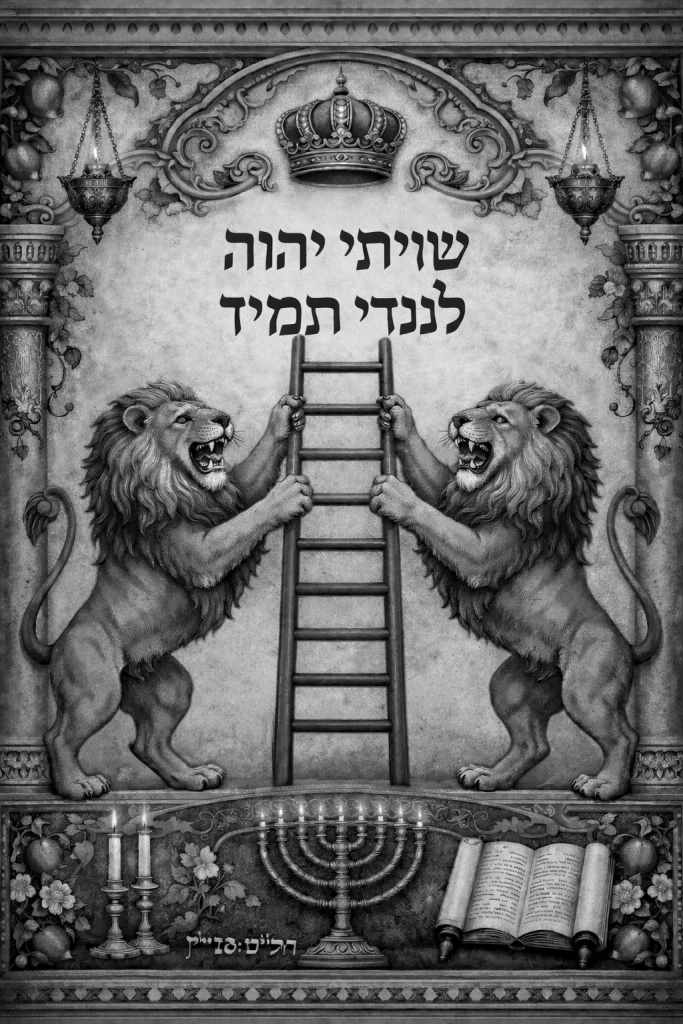


I recently had a powerful dream that has stayed with me—not because it was comforting, but because it was clarifying.

In the dream, there was an image of a lion hanging high on the wall of an attic. The attic was tall and narrow, almost chimney-shaped, with brick below and white walls only at the very top. A tall wooden ladder was required to reach the image. Facing the image was a small window.

A man and I were standing on the roof peering through that small attic window from the outside. The man shared with me that the previous evening, he saw a terrifying monster lurking inside.

I told him I would investigate the situation and began climbing the ladder. I was cautious and tentative at first, but with each step of ascent, my curiosity grew stronger than my fear.

As I moved from rung to rung, I noticed changes in the light that interplayed with the changes in distance and proximity to the top. These effects played tricks on my eyes and caused the image of the lion to change. From certain angles and degrees of light, the lion appeared animated, almost as if it might leap off the wall. When I finally reached the top of the ladder, however, I could see the two-dimensional image clear and stable in full light.

I shared my experience with the terrified man on the roof. I explained that the image itself wasn’t changing, but our perception of it was, depending on the amount of light and how close we were willing to get to the image.

When I reflected on the dream, I was struck by how explicitly Jewish its symbolic language was.


The lion evokes the symbol of Judah—strength, responsibility, sacred power. The image
functions like a shiviti: a visual practice meant to help us focus on and recognize the Divine Presence in our lived experience. Many traditional shiviti images are flanked by lions for precisely this reason. They are not meant to soothe, but to orient us toward truth and meaning.

The ladder, too, has unmistakable Biblical resonance, pointing to Jacob’s dream of the ascending and descending angels. The rabbinic imagination associates Jacob’s dream with spiritual inquiry and connection. We ascend rung by rung and sometimes need to step back down again. We investigate and then back off for a bit and retreat. The search for meaning has stops and starts, but the ladder remains—stabilizing us on that journey.

And the light—its changes, its timing, its absence and return—may be the most Jewish element of all.


Light, prayer, and living with change

Jewish prayer is structured around shifts in light: morning, evening, Shabbat candles, the Havdalah flame, the waxing and waning of the moon. The same references to light and darkness feel different at Shacharit (the morning service) than they do at Ma’ariv (the evening service). Those references can inspire awe in one moment and fear in another.

Judaism does not deny this instability of perception—it ritualizes it. Prayer trains us to live in liminal space, to notice how meaning changes as light changes, and to remain present anyway.

In the dream, the lion was most terrifying in the dark. That is not a failure of faith. It is a spiritual truth. Awe arises not from eliminating darkness, but from staying in relationship long enough to let light return.


Why this leads me to Reconstructing Judaism

I share this dream because it reflects why I am drawn—again and again—to Reconstructing Judaism, and why I feel at home in it as a rabbi.

Reconstructing Judaism is often described as “the intellectual denomination.” And yes—ideas matter. Thought matters. But that label is far too narrow.

What draws me to Reconstructionism is its insistence that Judaism is not sustained by intellect alone, but by the fullness of human experience: imagination, creativity, emotion, memory, art, ritual, culture, and shared communal life.

Mordecai Kaplan emphasized that Judaism is a living civilization—one that expresses itself not only through belief, but through creativity. For Kaplan, culture, art, music, and evolving human experience are not secondary to religious life; they are among the primary ways Judaism stays alive, meaningful, and responsive to the world we actually inhabit.

That insight continues to feel radical—and necessary.

Art, dreams, and communal meaning

Artistic and creative pathways are not “extras.” They are interpretive tools. They help us
metabolize power, change, grief, joy, and awe. They allow us to encounter Judaism not only as something we analyze, but as something we live.

Dreams belong here, alongside poetry, music, ritual, and visual art. They are symbolic languages through which the soul processes truth. They are not arguments to be proven, but experiences to be attended to—especially when they resonate with our tradition’s deepest patterns.

Reconstructing Judaism makes room for all of this. It refuses to reduce Jewish life to certainty or conformity. It invites us to question—not to dismantle Judaism, but to keep it alive. To climb the ladder. To let in more light. To expect surprise not as disruption, but as a way of understanding.

An invitation

I share this not as doctrine, but as orientation.

As your rabbi, I am drawn to a Judaism that is brave enough to keep becoming.

The lion in the dream is not meant to be feared. It is meant to be encountered—with curiosity, with courage, and with awe.

But the ladder may hold the deepest meaning.

A ladder is not self-sustaining. It must be steadied. It must be held. In the shiviti image above, two lions stand on either side, gripping the ladder between them.

We do not climb alone.

We hold the ladder for one another — through study, through art, through questioning, through shared prayer and shared experience. When one of us is afraid of what we see in the attic, another climbs. When the light shifts, we help each other interpret what is revealed.

The ladder remains between us — steady, imperfect, necessary — inviting us upward, together.

That, for me, is the promise of Reconstructing Judaism.
Filed Under: Uncategorized

Tu Bishvat Seder 5786 by Elizabeth Brindley

February 5, 2026 by efbrindley

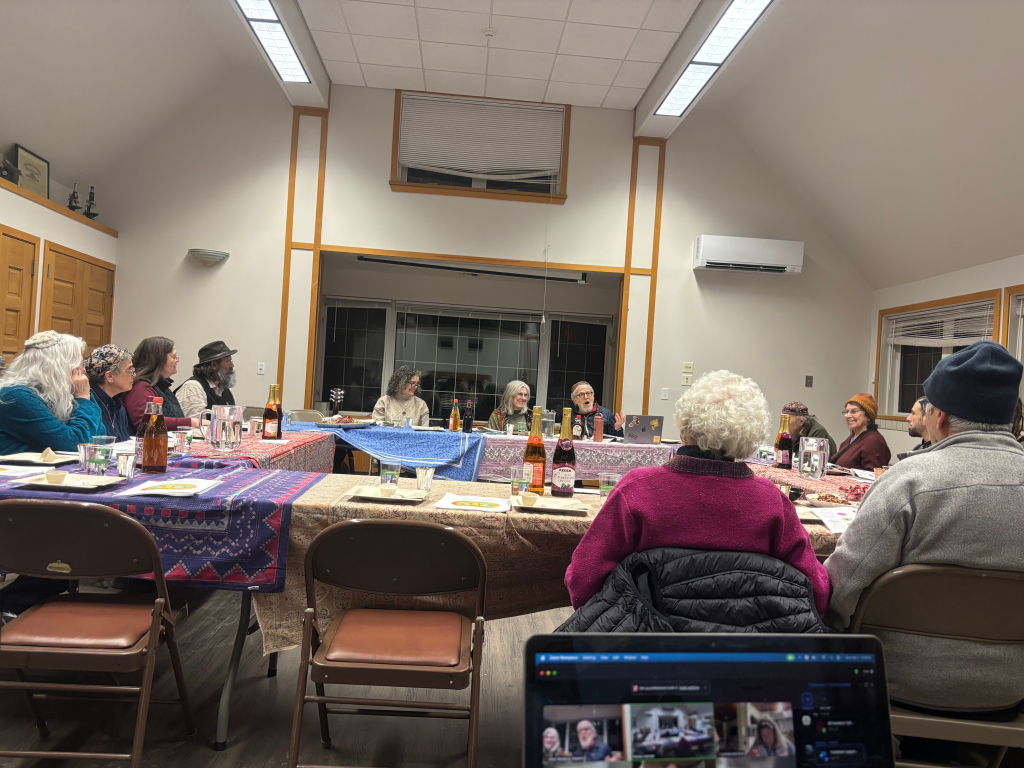
This past Sunday I had the pleasure of participating in my first ever seder. AARC joined Pardes Hannah for their second Tu Bishvat Seder at the Leslie Science Center, where we explored the four mystical worlds of the Kabbalists. Rav Gav and Rabbis Elliott Ginsburg and Aura Ahuvia led us on a winding path through these worlds, using delicious fruits a grape juice to illustrate their meaning.

Before this I had never had much interaction with Jewish Renewal. In fact, this may have been the first. But Rabbi Elliott and Rabbi Aura were warm and knowledgeable, and their community members friendly and welcoming. I learned too that Rabbi Elliott had been a teach of Rav Gav’s at ALEPH, and they remained friends after her ordination. I can’t imagine how proud a teacher must be to work alongside a pupil like that. It was beautiful.

The first world we explored was Assiyah, the physical world, is represented by the element of Earth, the winter season, and the physical aspect of ourselves. Oranges, pistachios, pomegranates and walnuts are eaten with a glass of pure white wine (or, in our case because insurance, white grape juice.).

Brief aside here: I am glad that my first Seder was one where we use grape juice instead of wine. I had absolutely no clue that this was a thing at seders, and I don’t think anybody would have thought to tell me about it ahead of time because why would it occur to them that I would not also know this? Also, the juice seems like it just would taste better mixed together later in the seder being juice rather than wine, but maybe that’s just me. Anyway.

After Assiyah, we meandered through Yetzirah, the realm of water and spring, of emotions and creativity, are represented by foods with edible outsides and inedible centers. Dates (my favorite!), olives (my second favorite!), cherries, carob, apricots and plums all represent this realm.

B’riyah represents the third world, of air and summer and the intellectual. For this we ate the entirely edible — berries, berries, and more berries for me. I’m sort of a berry crazy, and it was only because I was around basic strangers that I didn’t use my little goblin hands to just scoop all of them from the seder plate straight to my mouth.

We ate nothing as we spoke about the fourth world, the world of Atzilut. Fire and the fall season represent Atzilut, which is the realm of the spiritual and the mysterious.

The moon was full and bright and silver, and we could see it through the window behind the rabbis as we sang and danced and prayed together. As we learned together. As I surreptitiously stuffed more and more berries, pistachios and dates into my mouth. I will not forget my first seder, and thanks to my heads up about the cups of wine, I will remember future ones too.

I’m so pleased to have had this first experience with you all.

בָּרוּךְ אַתָּה ה’ אֱ-לֹהֵינוּ מֶלֶךְ הָעוֹלָם, שֶׁהֶחֱיָנוּ וְקִיְּמָנוּ וְהִגִיעָנוּ לַזְּמַן הַזֶּה.

Baruch atah, Adonai Eloheinu, Melech haolam, shehecheyanu, v’kiy’manu, v’higiyanu laz’man hazeh.

Blessed are You, Adonai our G-d, Sovereign of all, who has kept us alive, sustained us, and brought us to this moment.

Filed Under: Event writeups

Connections to Reconstructionism by Carol Lessure

January 21, 2026 by efbrindley

I am fond of saying that I was a Reconstructionist Jew before I ever heard of such a thing. 

Why do I say that? 

As I grew up in a small Jewish community in Evansville, Indiana, I often found myself questioning and also doing things my way. At that time, we had two synagogues serving a small Jewish community.  Evansville wasn’t a deserted island but as the joke goes, there was the shul we attended, and the one that we didn’t. 

As the Jewish community continued to age and shrink during my childhood, the two synagogues merged religious schools when I was in elementary school. I recall asking the reform Rabbi (of the shul we didn’t attend) why we couldn’t chant the Shema in his class. I came to learn that congregants didn’t chant anything at his synagogue but rather the service songs were sung by a musically trained, non-Jewish person accompanied by piano behind a screen. I failed to connect to the Rabbi or his services. 

By the time I was in high school, the two congregations fully merged after the two Rabbis retired. I remember it was challenging to meld reform and conservative traditions to the satisfaction of the majority of members. I taught in the religious school, led the local Jewish youth chapter, and ran children’s services on high holidays. I was involved and often did things my own way. 

The new synagogue became known as Temple Adath B’nai Israel and hired a new Rabbi and one of the first female cantors. Even today, the Temple website doesn’t make a strong connection to any denomination and seeks to include Jews from many different backgrounds. That is consistent with my own memory of the early years when the new congregation sorted out what traditions were most important and how to honor the needs of all its members. 

At college, the Hillel didn’t really suit me – so I rarely went to there. One year, I wanted a Passover seder that was more meaningful – so I wrote my own Haggadah and invited Jewish and non-Jewish friends to celebrate with me. The four sons became the four children, the Haggadah included Miriam and the midwives Shifra and Puah along with Moses and the plagues. We no longer read the traditional Talmudic style Haggadah that discussing what ancient Rabbis thought about the story in the Torah and the meaning of various phrases. The old Haggadah always seemed to me to be the opposite of what we are asked to do at this holiday – to share and tell the story of Passover. My “reconstructed” Haggadah has gone through various iterations over the past 40+ years. It is now assembled into spiral bound notebooks so that we can add and change sections as we find new songs and readings that are meaningful to our family. 

As a young adult in DC, I didn’t affiliate but continued to seek out Jewish spaces. For several years, a friend and I did Jewish community hopping visiting various Havurah-style services for Shabbat. When my friend married and became involved in a congregation in Maryland – that was my first introduction to Reconstrutionism. After she divorced, we continued our seeking. I still have a copy of “Chaveirim Kol Yisraeil – a Project of The Progressive Chavurah Siddur Committee of Boston” a prayer book that was used by one of the congregations that we attended. 

When I moved to Ann Arbor, my friend and I met up to attend the Havurah Summer Institute around 1996 – a gathering organized by the National Havurah Committee. It was an amazing experience with people from a wide variety of practices from around North America. It was there that I met Evelyn Neuhaus who made the annual trek east to the Institute each summer.  She was affiliated with the Ann Arbor Reconstructionist Havurah – aka “The Hav” – while I attended home-based monthly services with a Havurah of 30 somethings that included Beth Israel congregants and unaffiliated Jews including AARC member Sarai Brachman Shoup who I knew from grad school.  

Soon after, I started lurking around the Hav – attending High Holiday services at the Quaker house on Hill Street. I still recall standing next to Rena and Jeff Basch in 2001 – holding their infant son Ari – for a communal Aliyah for Parsha Vayeira on Rosh Hashana. I was pregnant with our first child, Avi. We were all delighting, like Sarah, in new beginnings. 

Within a year or so, Jon Engelbert and I became members. We found our Jewish home with the Ann Arbor Reconstructionists. Nearly a half century later, AARC continues to be our Jewish home. 

Reconstructionist Judaism encourages me to think about and find connections to our ancient Jewish traditions in a way that brings meaning to my modern life. I am grateful to have this community.    

Carol is 2nd from right, with friends at the 2025 AARC Retreat at Camp Tamarack

Filed Under: Member Profiles, Reconstructionist Movement

Why I Chose Recon by Dave Nelson

December 22, 2025 by efbrindley

I chose Reconstructionism via process of elimination. I know that sounds like a left-handed compliment at best, but stick with me.

I had a Jewish childhood that was confusing and unpleasant in ways that will be familiar to many Jews born in the 1970s or before: 

When I was small lots of folks had lots of opinions about Jews. These opinions were rarely accurate, and mostly either callously (if inadvertently) cruel or awkwardly and unjustifiably admiring (to your face, at least). 

My earliest memory of public school was being relentlessly bullied on the bus by a kid nearly twice my age who didn’t like Jews, but did like detailed descriptions of Jews being tortured and murdered throughout history. At home in the neighborhood, a friend’s parent interrupted our game of touch football to pointedly insist that my parents were “real top-drawer people.” It was the only time I recalled him saying anything to anyone, apart from yelling at his own children to cut something the hell out. Years later I finally put together the puzzle when I began to notice how often someone would learn I was Jewish (“Oh!? You don’t look Jewish!”) and then abruptly opine that Sandy Koufax had been one helluva ballplayer, or that Mel Brooks was a real funny guy, or that Carl Levin was an honest politician and that was really saying something.

But clumsy or mean gentiles were only half the unpleasantness in my unpleasant Jewish childhood. The other half was Jews who took offense to me calling myself a “Jew” when only one of my parents had been born Jewish (…and the father, no less!). 

Unsurprisingly, I had my bar mitzvah and didn’t set foot in a temple or synagogue again for nearly a decade. 

When Cara and I got married, the rabbi who officiated was lovely, but was not from the large Metro-Detroit Reform temple where my parents were members and I had been bar mitzvahed; that congregation was uninterested in officiating an interfaith ceremony in West Michigan. The rabbi who did officiate (semi-retired from a tiny West Michigan congregation) had only one condition: that we promise to raise any children as Jews.  Cara and I agreed without thinking much of it. My wife was raised Catholic, and was more than happy to raise Jewish children instead of Catholic ones. I didn’t object because I didn’t have any problem with being a Jew; I had a problem with being treated poorly by people who had unresolved issues with Jews and Jewishness.

Then we had kids, and those kids got old enough to need religious instruction in order for us to make good on our promise to the very nice man in the very thick glasses who’d officiated our mishugina wedding in a Saugatuck gazebo.

One of my freelance gigs at this time was copyediting the Washtenaw Jewish News, which meant I read every word about every Jewish organization in town at least twice each month. This made me oddly well-informed about local congregations and their programming, given that I had been avoiding Jewish organizations for going on two decades and had never intended to ever join one again. 

Being well informed wasn’t encouraging. This was 20 years ago, and some of what I saw local congregations promoting was too close to what had stung me when I was a kid: workshops on how to “cope” with your child’s or grandchild’s interfaith relationship, talk about how they “tolerated” people from all traditions, and so on. 

I didn’t want my wife and children to be “tolerated.” I wanted them to feel welcomed. (Never mind that this was also an extremely convenient reason to keep avoiding the Jews I’d been avoiding since I was a teen.)

Cara—who was stuck leading this charge, because she makes good on her promises and her husband was refusing to productively process his childhood trauma—asked what about these guys, these Reconstructionists? Did I have a beef with Reconstructionists?

I did not. I’d never heard of them. I’d been bullied by Reform Jews and Conservative Jews and Humanist Jews and just sort of ignored by Chasidic Jews, but never to my knowledge even met a Reconstructionist. The word wasn’t even in spellcheck! 

  So we came to AARC Kabbalat Shabbat. I didn’t really know what “Kabbalat Shabbat” was at the time, and when it was over I still didn’t really know what it was: The liturgy and order of service and songs seemed almost entirely foreign. For me, this was a feature, not a problem: nothing about AARC reminded me of the Judaism that had excluded me when I was small.  Besides, everyone was very friendly and helped me find which page we were on, and there was plenty of kale and quinoa to go around afterward.

All of that was nice. But what has kept me choosing Reconstructionism with the AARC is the religious school. 

I’d gone to religious school for years, and it had taught me to at once be ashamed of not being a “real” Jew while also being conceited about my natural superiority as a Jew moving through a goyische world (“when the ancestors of the right honourable gentleman were brutal savages in an unknown island, mine were priests in the temple of Solomon,” and so on).

At AARC my children learned to be comfortable and confident as Jews without any sense that this made them better (or even really meaningfully different) from anyone else. Over the years we’ve had different Boards, different Rabbis, different teachers and curricula, different members, but the heart of it has remained the same—which is good, because my children have learned this, but I still have a lot of work to do.

Filed Under: Uncategorized

AARC Participates in JFS Community Needs Drive – From the AARC Board

December 18, 2025 by efbrindley

Many of us have expressed the desire to take social action together as a congregation and also to connect more with other Jewish groups in our area. As yet another Hannukah miracle, we have a unique opportunity to do both this season. Because hundreds of newcomers and neighbors in need are counting on us this winter, AARC has partnered with JFS, Beth Israel Congregation, Temple Beth Emeth and others in organizing a “Community Needs Drive” to spread warmth and dignity to our local newcomers and neighbors. You can participate by donating needed supplies and/or helping to prepare the goods for the needy families.

Our goal is to collect donations of essential supplies—like soap, diapers, shampoo, toothbrushes, cleaning items, feminine products and grocery or gas gift cards—to bring physical comfort and a sense of belonging to hundreds of families in our community. When you come to services, or any other time you are at the JCC between now and December 22nd, you will find a large, labeled box to receive your donations.  We are grateful to the JCC for their support of this important work.

Thank you!

Filed Under: Uncategorized

Finding Awesome Places by Elizabeth Brindley

November 26, 2025 by efbrindley

“Mah nora hamakom hazeh!” – “How awesome is this place!” Jacob exclaims this after realizing he has had a divine encounter while sleeping on the side of the road, using a rock for a pillow.  He didn’t realize he was roughing it in the house of G-d, but lo! 

The phrase from this week’s portion, Vayetzei, first popped out at me a few years ago in Toba Spitzer’s “God is Here: Reimagining the Divine”.  At the time I was new to the prison system, struggling to adjust to the environment, and trying to fill the ample amount of downtime I had as a government employee with some Jewish thought.

The context Spitzer used it in, at the time, didn’t particularly speak to me, as reading the phrase a dozen times in the Torah portion apparently hadn’t, but this time the phrase stuck.  What did it mean to really be here, in this place?  Is any place holy if you’re present with it, or are there other conditions to this awesomeness?  I personally spend a lot of time in very unpleasant spaces – until I went on leave, at least one hundred and sixty hours of my month were spent in a facility that is at times violently punitive, deeply biased, and regularly smells like an oppressive blend of hot peppers, sweaty bodies, and overflowing grease traps. The air conditioning and circulation went out every time an inmate broke a sprinkler head in their cell, and that happened at least twice every day when someone got upset.  My co-workers and some patrons regularly spoke disrespectfully to me, if not downright abusively. My physical appearance was frequently scrutinized and openly criticized or commented on by both inmates and coworkers, and on more than one occasion inmates have tried to physically touch or seize me through the cuffport in their cell door while I was delivering reading materials. Once, my life was threatened by a patron because I could not provide a James Patterson novel. As much as I love my work, it is at times terrifying.  Most nights I came home smelling like capsaicin and wanting to shrink away from and forget all the awful human behavior I witnessed on the daily.  It was hard to imagine where G-d could be hanging out in this hellscape.

Where you find G-d probably depends on how you understand the concept, whether you believe it as an external or internal divine force or a non-force, or whatever have you.  Personally, I think of G-d as more of a state of peace and wholeness.  When you act out of loving kindness, out of community, out of forgiveness, any time you choose to practice a mitzvah or to be kind rather than give in to your (totally natural and understandable) baser habits, you’re in touch with the holy.  I think the Hebrew people wandered into the desert and at Mt. Sinai experienced something that we have spent 3000 years trying to articulate and make sense of. But regardless of how you conceptualize G-d, once you start looking for something, you tend to find it. So it was with my new mission to find G-d in such a miserable pit.  

Mutual aid between inmates is complicated and vulnerable to abuse by bad actors, but for the most part they are generous with one another.  Nobody has anything, and so they share it all.  Tablets to make phone calls home, sharing extra commissary when someone was short on money, and even inmates with paralegal experience preparing legal work free of charge for fellow inmates.  Is G-d in the person who appears with the help you need, just when you need it?  

Because my facility largely houses men with heavy sentences, we don’t release many people back home, but we do release one or two a month.  They walk out the front door wearing street clothes for perhaps the first time in more than a decade, and get to hug and kiss the loved ones waiting to pick them up.  They look so proud of themselves, so joyful to be free to make their own choices again.  Is G-d in the reuniting of a family, the repair of a community ravaged by racist practices and policies, or the ability to pick what you get to eat for lunch? 

Does G-d exist in the adult learners who finally, finally graduate with their GED or Diploma, or even a college degree – is G-d in their beaming faces? Is G-d dwelling in the inmate who tells me the library is the only place he feels like a person? Is G-d in the library, or maybe the collection of knowledge that might help these guys build the tools they need to turn their lives around? And if G-d is in these places, isn’t it my duty that I pursue them and continue to create the best conditions for them to occur? Is the pursuit of these conditions for others justice? 

I see G-d where I see people connecting now, and for as dark and awful as a prison can be, moments in it can be equally as beautiful and human.  There are always bright spots in the dark, and that is where G-d dwells.  Those are the awesome places.  

Filed Under: Posts by Members Tagged With: justice

Why I Chose Reconstructionist by Elizabeth Brindley

November 17, 2025 by efbrindley

I wasn’t born a Jew.

Well… maybe that’s not really accurate. The more I learned about Judaism, the more it felt like getting to know myself, so maybe I was always Jewish deep down. Judaism had never occurred to me as an option. I was raised Lutheran, but had never connected with it, and I had explored other practices like Wicca and Buddhism trying to find something that brought the peace and guidance I think I was really looking for. It wasn’t until I took a Jewish Children’s Literature class, which necessitated a basic understanding of Jewish beliefs, that I really started to wonder if this was a good fit. I liked the idea of Tikkun Olam, and Yom Kippur sounded like a really meaningful holiday. Eventually I decided to talk to a Rabbi, and I told myself I would keep practicing Judaism until I didn’t like it anymore. But the longer I’m here, the more I like it, so… here we are.

Regardless, I didn’t have a Jewish family around growing up, aside from Rabbi Scott z”l, a family friend, and much of my Jewish education has been in formal settings like a Jewish Children’s Literature at Eastern Michigan, a couple Judaism 101 classes, and a Beginner’s Hebrew Class. I’ve read A LOT of books about the history and various practice ways, but I focused a lot on the mystical, the yummy (food!) and the folk. I found my corner of Jewish study very quickly, but it took much, much longer to feel like part of the Jewish community.

Rabbi Robert Scott

SCOTT, Rabbi Robert. Beloved husband of the late Ardis K. Scott, cherished father of Jeffrey Paul Scott, David Simon Scott and Stephanie Tara Scott (Jeremy Wilson). Also survived by his loving dog Motek. Dear brother of Philip (Marsha) Scott. 

Being a convert can feel very insecure. Is it weird to tell you I’m a convert in conversation? Should I keep it to myself, tell you when it’s comfortable, tell you up front? Does it even matter to you? Will it change how you talk to me if you know? Do I know enough to be here? Am I doing something inadvertently to out myself as a convert?

Perhaps complicating things somewhat was that I converted in a Reform setting. If you’ve never participated in Reform practices, it is highly individualized. I think of Judaism like a spectrum. The most Orthodox, like the Chasidim, I explain like this: They follow ALL the commandments to the T, because God gave those commandments, and as you follow them you find meaning in them. You do and you understand, right? Reform attitude goes in the other direction — you practice the mitzvahs and rituals that make you (the individual) feel Jewish. I explain to folks who ask that Reconstructionist Judaism sits somewhere in the middle. There’s absolutely nothing wrong with either end of the spectrum, but I am a person who likes structure and tradition and community, and Reform spaces just felt too loose for me, and left me feeling untethered and a little lonely. It was hard to find Reform spaces where my penchant and desire for intellectual study, critical analysis or mystical experiences necessarily fit the culture. I love the folkways, the women’s practices, the hidden histories of Judaism. The “hot takes” as the kids say. They weren’t necessarily frowned on in Reform, but I was hard pressed to find anybody who had read The Hebrew Priestess or was super interested in the Witch of Endor, or Judaism’s attitude towards folk magic practices, much less wanted to talk about them or incorporate aspects into their personal practices. While the Rabbi of my home temple in Ohio is very progressive and we can discuss these topics, the larger culture of the Temple wasn’t quite there, which is something I learned I wanted after a few years into my Jewish practice.

My experience with Reconstructionist Judaism, however, has been the perfect mix of tradition and innovation. It was a Jewish friend from a Reconstructionist congregation who introduced me to the idea of Eco Kashrut, an altered form of Kashrut that values caring for the planet and its creatures or separating ourselves from other cultures, a view which I have slowly introduced to my family over the last few years. Every time I prepare a meal, I know that I have excluded meat and included as much local and homegrown produce as I could because I intentionally chose to. In fact, I knew AARC was the right place for me when my very first time working 4th Friday, the idea of vegetarian diet being the ideal in the Torah came up. It was reinforced recently when Rav Gav showed me her song list and it had several niggunim and chants from Rabbi Shefa Gold.

Reconstructionist Judaism’s idea that Judaism is an evolving civilization, not just a tradition, was one of the biggest draws I had to this community. I mean yes, you pay me to be here, but that doesn’t mean I don’t connect with or participate in services to the extent I can while I’m there. Now that I know AARC is here and what they’re about, it’s likely I would have two congregations I was part of. I would come join in even if you weren’t paying me to do so. I am proud that the Reconstruction Movement created teachers like Rabbi Sandra Lawson, who is queer and black. I’m proud that this movement celebrates its black, brown, female and queer members, not just accepts them. I firmly believe that this culture, which I have found to be full of joy and pride and commitment from those involved, is informed by RJ’s core values:

  • Learning from the vast storehouse of Jewish wisdom and practice while understanding that the past has a vote, not a veto;
  • Openness to insights from contemporary society, especially democratic practice and commitments to advancing equity;
  • Thinking, dreaming and making decisions in conversation with community—the community gathered around us today, the voices of our ancestors, and, as best as we can anticipate, the needs and aspirations of the communities of tomorrow;
  • Feeling empowered to reconstruct and co-create rituals, practices, texts and more in order to build the Jewish community we want to live in

I love the Reconstructionist space you (we) have made AARC. I am proud to be part of a community that celebrates its diversity, not just accepts it. Where are times I felt like my Reform practice was disconnected from the community. In the Reconstructionist space I feel not only connected to my spiritual ancestors, but to those people present with me, and those who have not yet joined us. Not to be dramatic, but it feels a bit like the Jewish folks sealing the covenant with G-d at Sinai. By innovating Judaism and continuing to connect it to our constantly changing and modernizing lives, we keep it alive for future generations to find peace and comfort in, and continue to build on thousands of years of memory and learning and community. Thank you, thank you, thanks for inviting me in.

Filed Under: Member Profiles, Posts by Members, Reconstructionist Movement

AARC Welcomes New Executive Director by Emily Eisbruch

November 13, 2025 by efbrindley

“AARC Welcomes New Executive Director”  By Emily Eisbruch was originally published in the Washtenaw Jewish News’ December 2025 Edition.


The Ann Arbor Reconstructionist Congregation (AARC) is delighted to
welcome Elizabeth Brindley as its part-time Executive Director. Elizabeth
started this new role in October. Her responsibilities include managing the
congregation’s administrative functions, publicity and outreach, event
coordination and more.


Elizabeth is a Michigan native, originally from the Saginaw / Bay City Area. In
addition to her role with the AARC, she also works in the Ohio Department
of Rehabilitation & Corrections as a librarian in a men’s maximum security
prison.


Elizabeth earned a Bachelor’s in Public & Nonprofit Administration from
Eastern Michigan, and a Master’s of Library & Information Science from
Louisiana State University. She has several other certifications as well,
including holding cosmetology and massage licenses in Michigan, being
Mental Health First Aid certified, and having worked as a roller skating
instructor in her early twenties.


“I centered a lot of my college studies around the decolonization of
repositories and on libraries as tools to create strong, healthy communities,
and I’ve found that I’m passionate about building communities that are safe,
inclusive and joyful for everyone,” says Elizabeth.


With humor, she notes that in her personal life she’s basically the
stereotypical librarian: she has six cats, wears almost exclusively handmade
cardigans, and reads anything she can get her hands on.


“My favorite fiction genres are Fantasy and Sci Fi, but if I’m honest I mostly
read nonfiction, particularly on social issues. I also really love history and
spiritual thought. I have a lot of hobbies: I cross-stitch, paint miniatures for
table top games like Dungeons & Dragons, and write a whole lot of different
stuff. My main project right now is a combination of a self-care manual for
corrections staff and research into alternative justice models that are more
humane and compassionate to the people in prisons, both those there by
force and those there for money.”


“We are absolutely delighted to have Elizabeth stepping into this newly
expanded role,” says AARC Board Chair Dave Nelson. “As our community
grows, so does our need for dedicated professional staff, which are the life
support system for a spiritually energetic community. We look forward to
seeing Elizabeth and the community thrive together.”


The AARC is a caring, inclusive and music-loving community of people who
want to practice and study Judaism, or simply be around people who share a
commitment to Judaism’s values. The AARC’s spiritual leader, Rav Gavrielle
Pescador, is known for her warmth, her collaborative spirit, and her
incredible voice and harp playing. You are invited to visit
https://aarecon.org/ or email info@aarecon.org to learn more about the
Ann Arbor Reconstructionist Congregation.

Filed Under: Articles/Ads, Congregation News

Meditations with Anita Return to 2nd Saturdays

November 5, 2025 by efbrindley

Second Saturday meditation resumes this coming Shabbat, November 8th, from 10-10:20.

In his book, “Jewish Meditation Practices for Everyday Life”, Rabbi Jeff Roth describes a practice derived from Reb Zalman’s teaching on the chant “It is perfect. All is clear. You are loved. and I am holy.”

Each line of the chant is related to one of the 4 worlds, i.e. Assiyah, Yetsirah, Beriyah, and Atzilut. Each world is related to a Divine attribute, i.e. acting, feeling, knowing and being. This creates a worthwhile framework for meditation.

Each month we will take some time with the chant, meditate on one of the worlds/attributes, and hopefully have a brief time for sharing. Come join us.

Filed Under: Upcoming Activities Tagged With: meditation

Greetings from the New Director

October 22, 2025 by efbrindley

Hello, Friends!
It’s me, AARC’s new Executive Director, Elizabeth Brindley. You’ll be hearing from me frequently from here on out, and I wanted to introduce myself. I’ll include a photo further down so you’ll know who you’re looking for if you ever want to find me at services.
I’m a Michigan native, but I’m originally from the Saginaw / Bay City Area part of the state. I’ve lived in Southern Michigan for the last decade or so, and I’m currently employed by the Ohio Department of Rehabilitation & Corrections. I work as a librarian in a men’s maximum security prison, and I’m always happy to talk about the experience if you want to ask about it. It’s as wild as you’re imagining. I’ve also been an executive board member for Six Feet Over since I moved down here ten years ago, although after so long we finally have a good batch of board members, and I am hoping they will let me take a little break in 2026. I’m the secretary, and it turns out not too many people are excited to take on nonprofit paperwork loads.
I have a Bachelor’s in Public & Nonprofit Administration from Eastern Michigan, and a Master’s of Library & Information Science from Louisiana State University, but also all sorts of other certifications. I have my cosmetology and massage licenses in Michigan, I’m Mental Health First Aid certified, and I worked as a roller skating instructor in my early 20’s. I centered a lot of my college studies around the decolonization of repositories and on libraries as tools to create strong, healthy communities, and I’ve found that I’m passionate about building communities that are safe, inclusive and joyful for everyone.
In my personal life I am basically the stereotypical librarian. I have 6 cats, wear almost exclusively handmade cardigans and read anything I can get my hands on. My favorite fiction genres are Fantasy and Sci Fi, but if I’m honest I mostly read nonfiction, particularly on social issues, but I also really love history and spiritual thought. I have a lot of hobbies. I cross-stitch, paint miniatures for table top games like Dungeons & Dragons, and write a whole lot of different stuff. My main project right now is a combination self-care manual for corrections staff and research into alternative justice models that are more humane and compassionate to the people in prisons, both those there by force and those there for money.
Thank you so much for welcoming me into your community and allowing me to help you meet the congregation’s goals. I’m looking forward to getting to know you all.

Filed Under: Congregation News

Primary Sidebar

Search

Join Our Mailing List

Sign up for our twice a week newsletter to get details on upcoming events and catch up on our latest news.

This field is required.

Check your inbox or spam folder to confirm your subscription.

Upcoming Events

  • 10:30 am – 12:00 pm, February 14, 2026 – Second Saturday Shabbat Morning Service
  • 9:00 am – 10:00 am, February 18, 2026 – Rosh Chodesh Minyan Adar
  • 7:00 pm – 8:00 pm, February 18, 2026 – Pop-in Torah Study with the Rabbi [Zoom]
  • All day, February 22, 2026 – Beit Sefer
  • 6:30 pm – 8:00 pm, February 27, 2026 – Fourth Friday Kabbalat Shabbat

Latest News

  • Reconstructing Judaism Through the Lens of Dreaming – By Rabbi Gabrielle Pescador February 11, 2026
  • Join the AARC book group with Rav Gavrielle on Sunday, March 15 February 9, 2026
  • Tu Bishvat Seder 5786 by Elizabeth Brindley February 5, 2026
  • Connections to Reconstructionism by Carol Lessure January 21, 2026
  • Tu B’Shevat as a Bridge: Growing Jewish Connection Across Communities January 11, 2026

Footer

Affiliated with

Login (for members only)

Log in

Copyright © 2026 Ann Arbor Reconstructionist Congregation