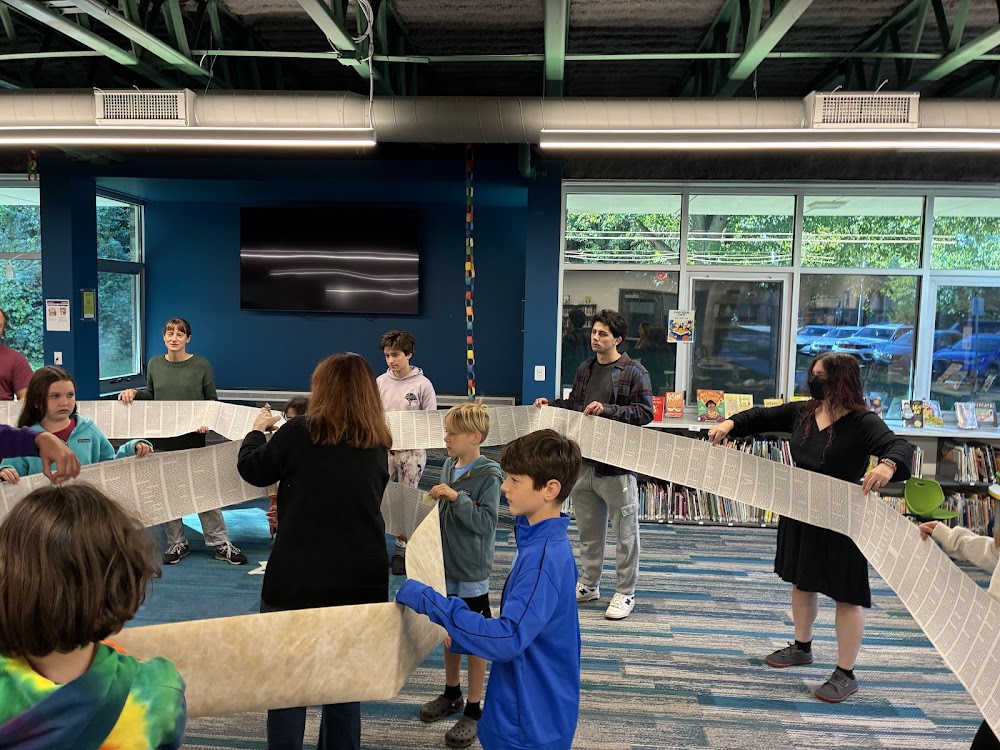
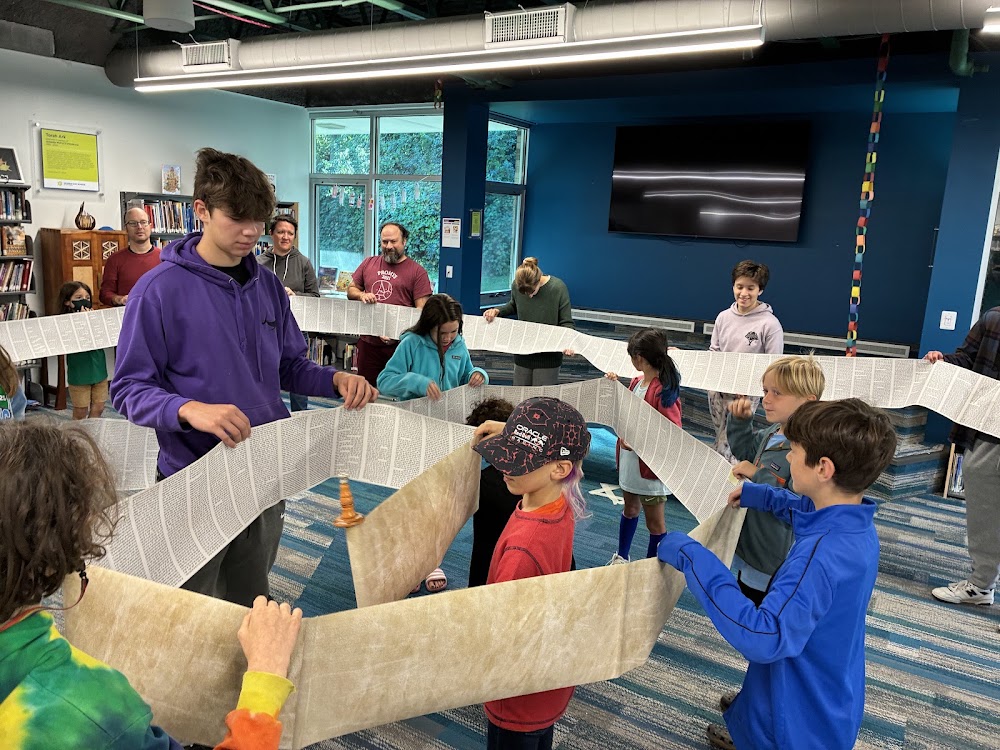
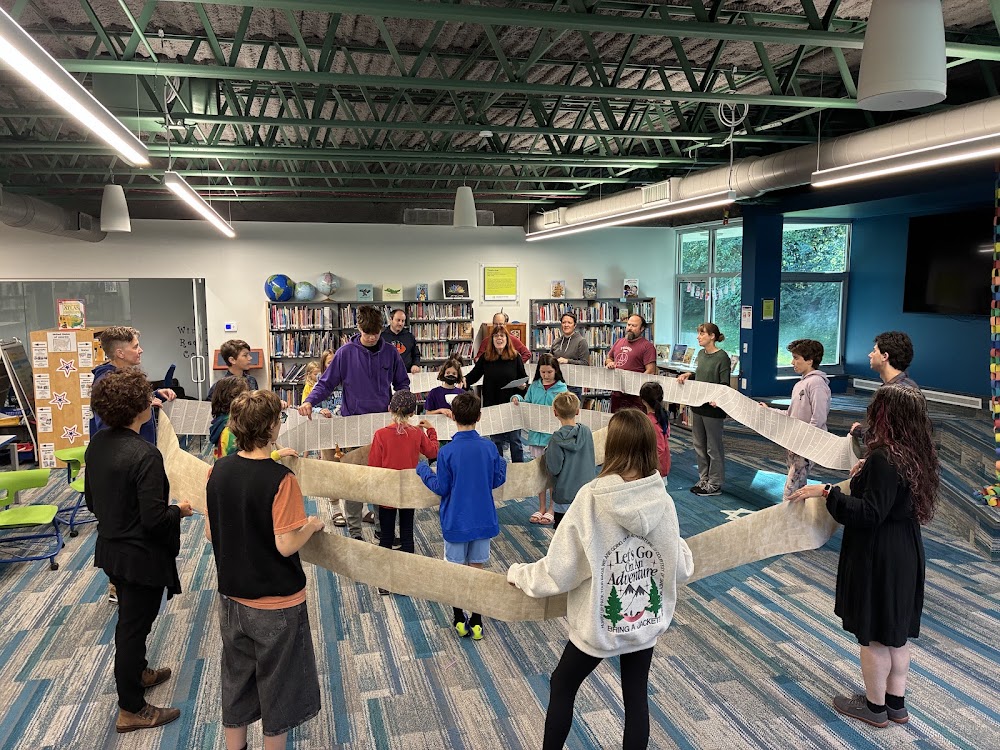
Since the first of several “Listening Circles” following the October 7th Hamas attack, Israel’s massive reaction, and subsequent expansions of hostilities, the responses of individuals and groups at AARC have been evolving and moving toward action.
After the October 7th attack, and later as the scale of Israel’s retaliation became clearer, six AARC members met to plan Listening Circles to “facilitate conversations about our pain, sense of disbelief, helplessness, anger, betrayal, and fear that conflict in our own congregation could split us apart,” according to Claudia Kraus Piper, one of the planners. The goal was to “speak about our anguish and to deeply listen to each other without trying to change minds or counter each other,” she added. “I see this as a really important foundation of AARC’s response.” Four well-attended Circles were held from 2023 to 2025.
“As part of the Listening Circle planning group,” said Idelle Hammond-Sass, “we knew and hoped there would be a move toward more action.”
One example of this move toward action is an ad hoc group whose members feel strongly about human rights in Israel/Palestine. It has met monthly since April for Shabbat dinners, and most recently, for lunch after Rosh Hashanah services. “Many of us have had seders in the last few years that focused on these issues,” said Deb Kraus. This group grew out of “having a few like-minded people over this year to break Passover and talk more generally about, Where do we go from here?” The gatherings have provided a safe space for those who felt their views were not always welcome in the Jewish community. The attendees represented a range of views on Israel/Palestine. Rather than planning joint actions, the group has chosen to support individual and small group efforts.
Within our congregation, the move toward action has also involved educational programs as well as various levels of activism, including calls for the congregation to sign petitions, such as those advocating a ceasefire. The Board’s decision not to take public stands has frustrated some members.
Addressing this, Chair Dave Nelson said, “As a Board, it’s not our role to sign onto political statements. It’d be presumptuous for the seven of us to give the impression we speak for 90-plus families with a multitude of perspectives.”
“The Board is here to take care of all the day-to-day tasks needed to support the community so that all our members have access to the vital wellspring of energy that drives them toward right action,” he added. “We see how this energy is helping foster so much activity in the congregation and beyond, and we’re pleased to know we’re playing even a small role in supporting that.”
The recent Yom Kippur workshop called “Scared Into Silence,” designed by Deb Kraus, Manya Arond-Thomas, and Deborah Fisch, looked at how fear gets in the way of being at-one within ourselves and with others. Participants first looked at this from a personal point of view, and this was followed by a group dialogue exploring how fear has impacted the ability or inability to speak about Israel/Palestine within the congregation.
Rabbi Gabrielle welcomed the Yom Kippur afternoon workshop. In fact, her Yom Kippur sermon acknowledged the horror and disproportionate suffering of the Palestinians, while also asking us to see the current conflict from the wider perspective of two traumatized peoples with a long history. And she asked congregants to make room for the range of views within our community.
“At the opening of the most recent Reconstructionist Rabbinical Association conference, it was suggested that rabbis need to be a ‘moral compass’ for their congregations,” she said, “but I want our members to find their own moral compass and to act individually and collectively in ways that call to them.”
Some of our members’ upcoming actions include:
AARC will present three programs open to the public this fall in a series called “New Perspectives, Timely Conversations.” Some will touch on Israel/Palestine issues. The programs are being organized by Sarai Brachman Shoup and Debbie Field. According to the flyer, the series “aims to provide fresh perspectives and raise new questions that will allow the community to think differently about Jewish identity.” Most sessions will consist of interview-style conversations with scholars, journalists, and educators about their work.
The first session is Sunday, October 11, 12:00pm–1:30pm and will feature Dr. Elliott Ratzman, a research fellow at U-M’s Raoul Wallenberg Institute and an experienced organizer and activist. The title is “Zipporah’s Sacrifice: Jewish Ethics and Race.” Dr. Ratzman will use the biblical story of Zipporah as a jumping off point to think about how we as Jews interact with the “others” whom we live among. To attend, email Sarai at sbshoup@gmail.com for the link to RSVP.
Manya Arond-Thomas will be traveling to Israel/Palestine in mid-October on “The Future is Peace Tour” (with Mejdi Tours), which focuses on Israeli and Palestinian peace groups promoting dialogue and understanding between different communities in the region. The travel agency owners, Maoz Inon and Aziz Abu Sarah, an Israeli Jew and Palestinian, are authors of the book The Future is Peace. Manya plans to make presentations about her experiences after her return.
Several AARC members who have Israeli citizenship will be flying to Israel to vote in the elections scheduled for October 27 in hopes of helping unseat Benjamin Netanyahu and his ruling coalition.
Sunday Schmooze – The MI Senate Campaigns: We Have Questions!
Abdul El-Sayed’s candidacy for the US Senate has Jews talking. Some are working to bolster support for him in our community, as his election is seen as key to Democrats taking control of the Senate. Others have concerns around his positions on Israel. A few members of the AARC and the Jewish Cultural Society, with support from Michigan Jews for Democracy, are organizing a program to help attendees process their decisions about how to vote in this election. Asked about the program, Dave Nelson said, “This sounds fantastic. It’s precisely the sort of thing we’d like to foster.” The program will be held on Sunday, October 18, 10:00 am – 12:00 pm at the Jewish Community Center. Bagels & coffee provided. Questions? Contact Kira Berman at kira.berman@gmail.com.
Watch for information about all these and other activities that feature AARC members’ engagement with Israel/Palestine issues in the weekly Tuesday Telegraph and on Reconchat.
The theme Rabbi Gabrielle has threaded through these yontif services is conversation. That’s easily connected to this prayer, Baruch She’amar: “Blessed be the one who spoke the world into being.”
It’s not just God who creates by way of speech – we all do. Words are how we make sense of the world, of course. But they can act as well as explain. Words join and separate us. They harm and heal.
The thing I offer as a Kavanah, an intention, for this next part of the service is this: I like to think of people as godly—but we are different from God, whom Baruch She’amar envisions as dominating the environment by speech. In the Pesukei d’Zimrah and other parts of the service, we praise God as exalted and unknowable. But for we humans, as we strive to use words for conversation, for joining and healing and collaborating, we need to be the opposite of exalted and unknowable. Instead, we need to show our conversation partners a commitment to equality and shared humanity. In decades of speaking and negotiating for a living, this is the thing I’ve learned—equality is the bare prerequisite to something good happening from a human interaction.
What does that mean? Equality at a minimum means that each one of us strives to know, all the time—not just as a matter of lip service but really down deep—that other people’s pain and other people’s flourishing matters just as much as our own and our loved ones’. This sounds so simple, but it’s so hard. It’s an aspiration we see in many places, though. Just for example, I teach torts, and this is the basic morality of tort law – I need to act with care not only towards my own interests and body but towards yours, too. And this applies not just to members of my own community but to other communities, who don’t share my nationality, language, or religion.
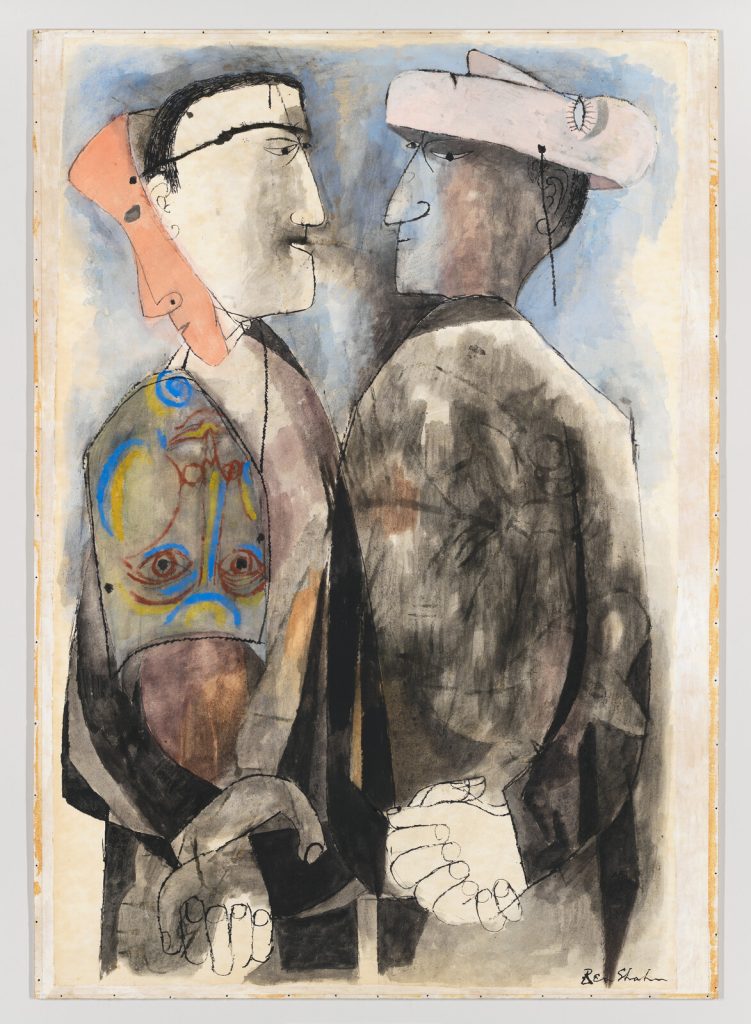
Ben Shahn, Conversations, 1958. Watercolor and ink on paper, 39 x 53 in. (99.1 x 134.6 cm). Collection of the Whitney Museum of American Art, New York.
As Jews, we are instructed to operationalize this view for the strangers among us. Leviticus 19:33 spells out the obligation, loud and clear: “When a stranger resides with you in your land, you shall not wrong him. The stranger who resides with you shall be to you as the native among you, and you shall love him as yourself, for you were strangers in the land of Egypt.”
But other texts make the case that far more is required—that we must honor the equality not of just those who are proximate, but those who remain far away. We learn this in Sifra Kedoshim and Genesis Rabbah. There we see that when Rabbi Akiva says that “love your neighbor as yourself” (Lev. 19:18) is the great principle of the Torah, Ben Azzai answers that a greater principle is Genesis 5:1: “This is the book of the generations of Adam — in the likeness of God He made him.” All of us are equally holy.
It’s also the message of today’s Mincha haftarah reading, Jonah. One key to that story is to understand that Nineva was a goyische city. That’s part of the reason Jonah is so uninvested in its survival—part of his grave moral failing that God scolds him for.
Back to conversation—conversation is about sharing. Not necessarily agreeing, but sharing views and ideas and possibly growing closer. The only way that works is from a place of radical equality. This is a crucial and endless personal struggle for each of us to have with ourselves.
More broadly, unfortunately, it seems right now that there are many people—including many in the name of Judaism—who deny human equality, who deny that no one person or group matters more than another.
This time, right now, demands that we look at people of cities and villages and refugee camps—Ninevah and Gaza City, as much as Jerusalem and Tel Aviv and Detroit and Ann Arbor—and see all those humans as equal. Our community needs to stand against that, to learn from Jonah’s moral failure, stand with Ben Azzai, and commit to holy, equal conversation. Then perhaps we too can speak a world into being.
בָּרוּךְ שֶׁאָמַר וְהָיָה הָעוֹלָם, בָּרוּךְ הוּא
Baruch she’amar v’hayah ha’olam, Baruch hu.
Blessed be the one who spoke the world into being.
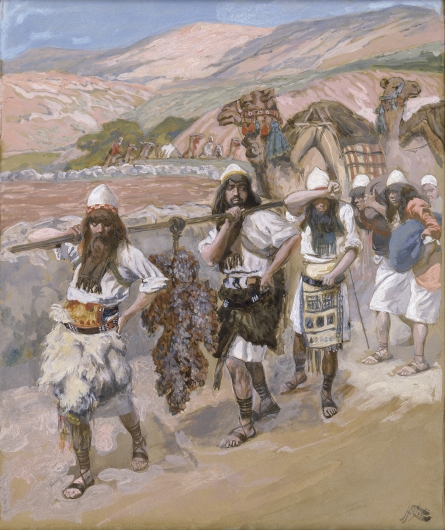
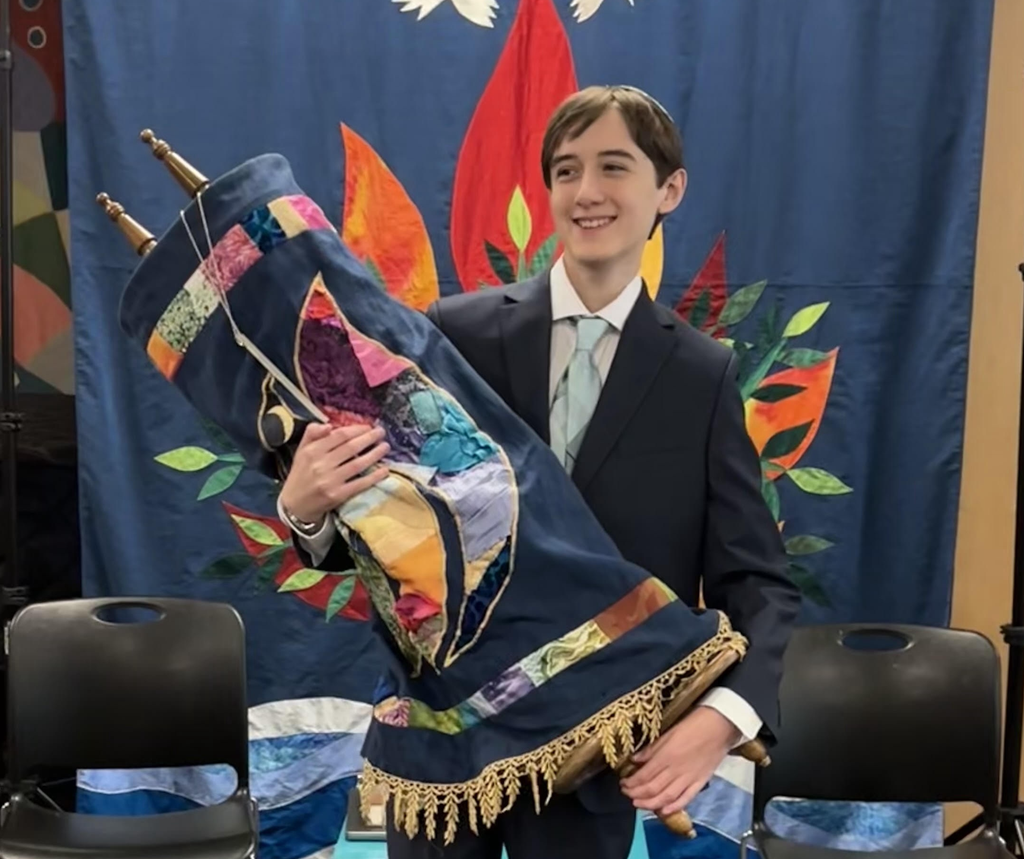
In my portion God tells Moses to send scouts to Canaan. Moses, of course, does this and when the scouts come back they tell the whole community what they saw. The scouts tell them that it is a very good land, but there are people living there who are called the Anikites. The Anikites were very strong and would crush the Israelites if they tried to take Canaan.
Only two of the scouts, Calab and Joshua thought that the Israelites could take the land but the community did not agree. The community thought they would be destroyed.
So God gets angry over this because the Israelites are disobeying God. So God punishes them by making them wander in the wilderness for forty years while everyone of that generation dies except Calab and Joshua. Because Caleb and Joshua were loyal. And then after forty years God let the Israelites into the land.
Now there are a couple of things in my Torah portion that I find interesting and even problematic. One, God punishes the Israelites harshly for their lack of faith. But the way I see it God is punishing them because of their fear. They’re afraid that they are going to be destroyed by the Anikites and I don’t blame them.
Although, the portion doesn’t talk about this, I doubt that the Israelites wanted to kill the Anikites or at least I hope they didn’t. Which brings me to my second point.
In Numbers 13:2 God tells Moses to send scouts to Cannan because they are giving the Israelites that land, but God and the Israelites have no rightful ownership of that land. God is talking to Moses like they own Canaan but other people live there and considering that there was a war between them and the Israelites I doubt that the Canaanites approved of this plan. I also find it interesting that God plans to give this land to the Israelites but then forces them to fight for the land.
I don’t think my Torah portion is a very good model for how we should act because in it God forces people to fight for land that other people are inhabiting and I doubt that most of the Israelites want to hurt these people. And when the Israelites don’t obey, God sends them into the wilderness. Moses tells God to be forgiving which in my opinion is a much better model for how we should be. But God still sends them into the wilderness. I think that this portion is trying to teach about trust and faith but it does it in a very violent way that I don’t approve of.
Now I have a question for you: if someone is telling you to do something that you think is wrong, what do you do and how do you respond? I want you to take a moment to reflect on this and perhaps share your thoughts with your neighbor at the lunch after services.
Now I would like to thank a couple people for getting me where I am today. First, I would like to thank my parents for supporting me and helping me through this. I also would like to thank our Rabbi for helping me with my D’var Torah, the prayers, and countless other things. And thank you to Deborah Fisch for putting the supplement together. And last but not least, I would like to thank Deb who has helped me with a lot of stuff, Including my portions and my halftorah. I would like to thank all these people because without them I would not be here today doing this.
My Torah portion combines two portions: B’har and B’chukotai.
B’har talks about the Sabbatical and the Jubilee year. The sabbatical year, also called Shmitta, occurs every 7 years. In the sabbatical year you cannot farm on your land to let the land grow back naturally. In that time you cannot harvest, plant or prune. And if something does grow then animals, poor people and slaves are allowed to eat that produce. Hebrew and contracted slaves are also released.
To ensure that people have enough to eat during Shmitta, in the 6th year – the year before shmitta – God commands the Israelites to grow enough crops to last two years. Another detail about Shmitta is that all debts are canceled. The sabbatical year is still observed in Israel.
The year after seven sabbatical years is called the Jubilee or the Yovel. The Jubilee is also a year of rest and a time when a home or property is returned to the original owner – if the ownership has changed in that time. In the Jubilee you also do everything that you’re supposed to do in the sabbatical year.
The main difference between the Sabbatical and Jubilee years is that in the jubilee there is an aspect of returning property ownership back to how it was in the previous jubilee however in the sabbatical year it is more about stopping people from being mean, and to be fair to the land – and to the people.
B’chukotai, the second half of my Torah portion, talks about curses and blessings. For example, if you follow God’s laws then you will be blessed and your crops will grow and you will not be attacked by anyone or anything, and you will win battles.
However if you don’t follow the laws then you will be cursed and you will lose all of your battles and continue getting punished.
This doesn’t completely make sense to me because some of the rules in Torah do not apply anymore. Why should people be punished for things that do not make sense? And some of these commandments are longer practiced, even according to the rabbis – like the jubilee. It would be almost impossible to celebrate now. This could cause problems because people would lose a lot of money if they had to return the homes they bought to the original owners. Our economy would crumble.
Shmitta, however, is practiced in Israel and the Jewish law around it is very complicated. But I don’t think it would work in this country. However, in the spirit of shmitta – of being kind to the land – we could try to use farming methods that help the land and make it easy for crops and nature to flourish.
That is what I’m trying to do for my Bar Mitzvah Project. For my bar mitzvah project I am planting a garden in the Eddie Center with wild and native plants in Chelsea – where I live – because these plants perform much better in our environment.
Native plants are important because they provide something for native animals to eat and they make healthy roots that can help the land and prevent problems with it. Native plants grow easily and naturally and do not need as much human intervention to flourish, if any. So you don’t need toxic pesticides and you don’t have to use as many energy consuming devices for the plants to grow successfully. Because these plants are native to this region and have adapted to it. They grow well in this environment.
How does my Bar Mitzvah Project relate to the themes in my Torah Portion?
It could be easier for the land in my city to rest because it does not need as much human intervention (beyond planting) because the native plants were made to survive there. This is a way of observing Smitta where I live.
So I choose the blessings rather than the curses in my Torah portion. If you let the land regrow naturally with indigenous plants then it helps you and the animals and the environment. It helps all of us.
My question for you is – how could you practice shmitta in your life?
I would also like to thank my parents for starting this and my brother for surviving going places for me to be able to learn. And I’d like to thank my uncle Neil for reading his portion and my friends for coming and Jack, Aaron, and Elliot for helping me learn blessings. And I’d like to thank Deb Kraus for helping me learn haftarah and Torah and those blessings – and the rabbi for helping me learn blessings for the service and my speech and leading the service with her. I’d also like to thank Deborah Fisch for putting the supplement together – and the congregation of course for being there so that I can become a more active part of it and especially everyone who came and helped set up or is going to help clean up.
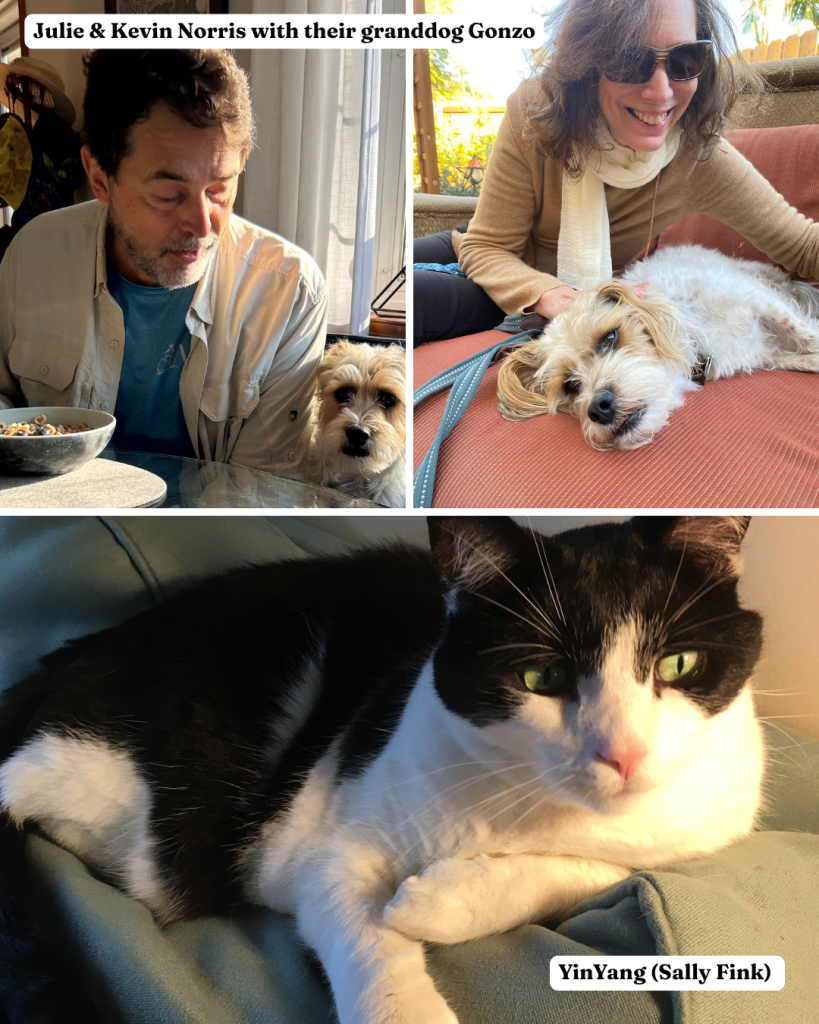
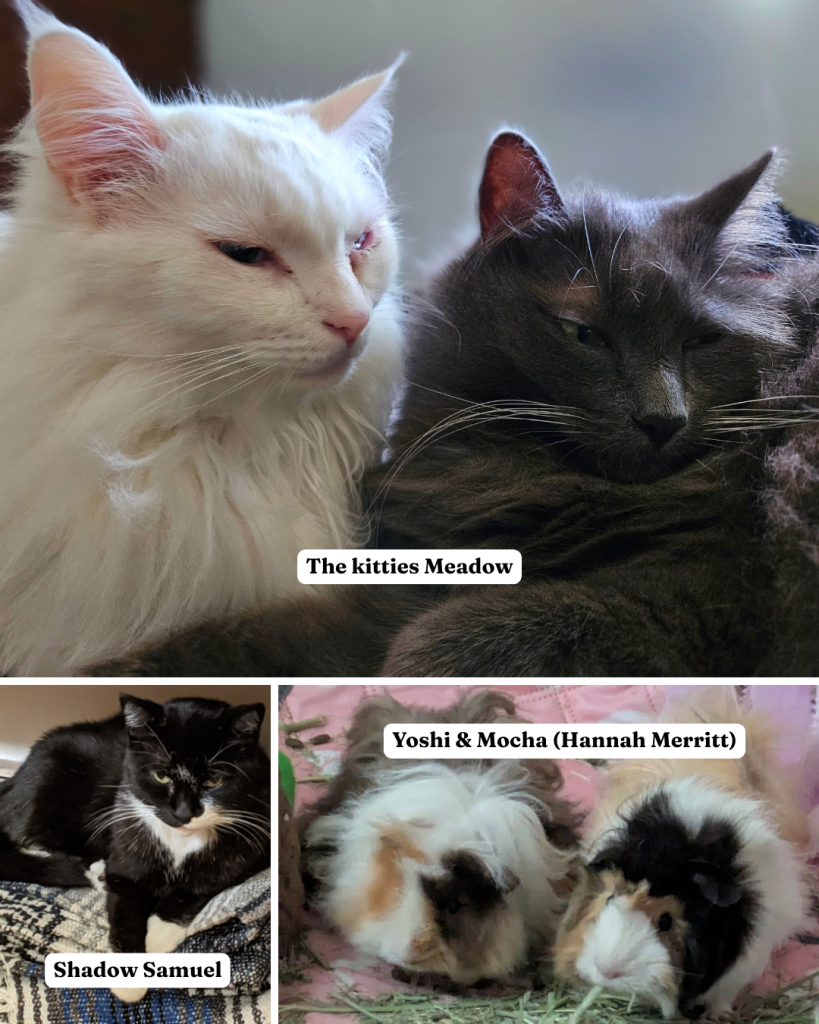
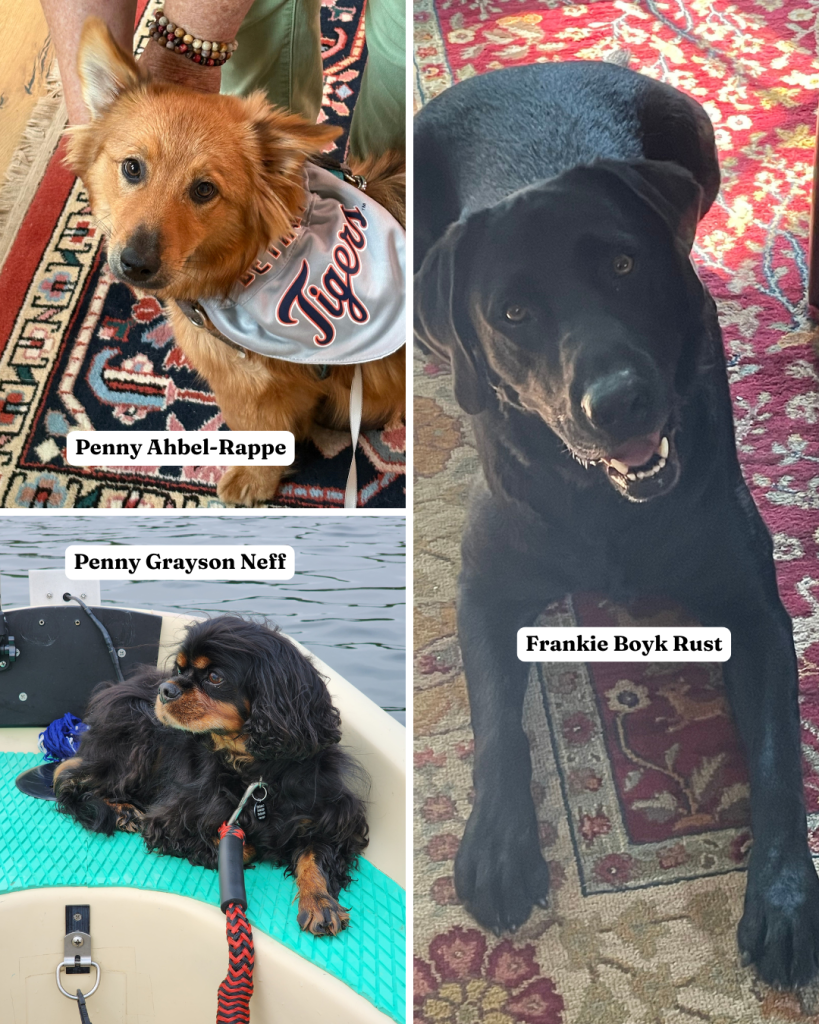
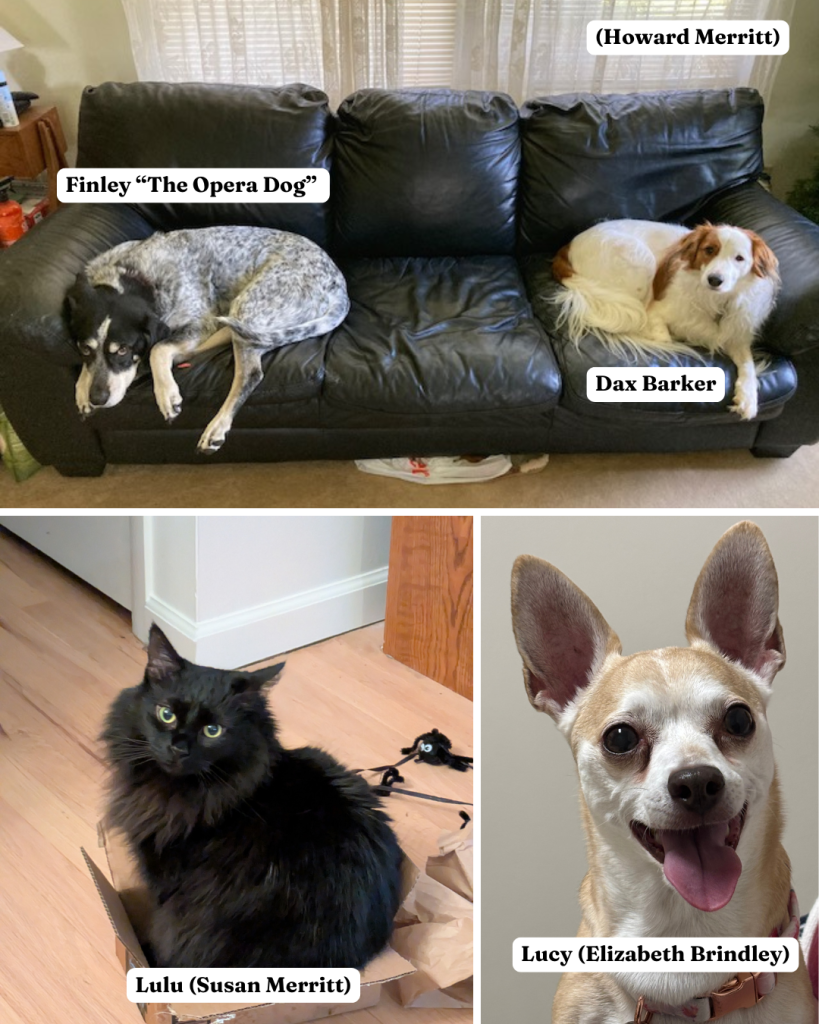
Originally, Rosh Hashanah La’Behemot served as an agricultural and financial deadline to count and tithe newborn livestock for Temple offerings. This year, we’re reimagining it as a time to appreciate our furry beloveds! Please enjoy these photos of AARC’s animal members:
If you’d like to know more about the origins of Rosh Hashanah La’Behemot, check out Mishnah Rosh Hashanah 1.
Just like we always hoped, our community is growing. We’re gaining new members, hosting more programs, and welcoming more and more faces to our services. To make sure services and programs continue to run smoothly, AARC has hired an assistant to help me out.
Please allow me to introduce Sebastien Keeler. Here’s what he has to say about himself:
Hi everyone!
My name is Sebastien Keeler and I’m happy to be joining you as part of AARC.
I live in Ypsilanti, and used to run the Jamerican Grill food truck with my late husband. Originally, I moved to Ypsilanti to go to Eastern Michigan University where I got a Master’s degree in hotel/restaurant management in 2014.
I enjoy collecting and playing video games; my favorites are from the SNES/Sega Genesis era. I play several musical instruments and have been playing the euphonium in the Canton Concert Band since 2016.
Summertime is my favorite season and I love going on road trips with my Doberman, Fred.
I held an active role at my old synagogue in Pennsylvania, and I’m truly happy for the opportunity to do the same here. I’m looking forward to continuing working with AARC and meeting all of you.
“Jewish Federation launches community new board member training” was written by Eileen Freed. It appeared in the July 2026 edition of Washtenaw Jewish News.
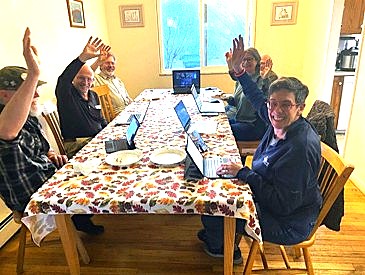
This winter, 40 board members from almost every local Jewish congregation and organization gathered for a three-part educational experience coordinated by the Jewish Federation of Greater Ann Arbor and funded by the Jewish Community Foundation.
The aim of the Jewish Community Leadership Training series was to provide important general information about nonprofit board service for new and current board members of local Jewish organizations, large and small. The Jewish Federation hoped this information would drive increased board effectiveness at participating organizations. Other key goals were for participants to develop cross-communal connections, learn best practices from one another, better understand the local Jewish communal landscape, and increase collaboration.
Under the leadership of facilitator Carrie Hammerman, formerly the Chief Strategy and Programs Officer at the NEW Center, a three-part curriculum was developed and delivered. Session One focused on “The Basics,” such as board and governance responsibilities; board structure, roles, committees, meetings and recruitment; and challenges of volunteer boards. The session was facilitated by University of Michigan Professor Emerita Janet Weiss. Professor Weiss taught nonprofit and public management for 40 years in the Ford School of Public Policy and the Ross School of Business and founded the UM Nonprofit Board Fellows Program at UM, which has provided opportunities for over a thousand graduate students to serve on nonprofit boards in Michigan, and to learn hands-on about board service.
The second session focused on fiduciary responsibilities — organizational financial policy and fundraising. Greg Lewis, an executive coach and consultant and longtime lecturer at Ross School of Business, led the group through understanding the financial obligations of the board and how to serve as stewards of the organization’s finances. Participants received handouts about financial terms and engaged in an exercise around reading financial statements. This was followed by Carrie introducing “the elephant in the room” — the very key role board members play in ensuring financial stability through fundraising — giving, educating, and connecting for the benefit of the organization. Carrie encouraged the group to get comfortable with and find joy in fund development. People serve on boards because they care about the cause or mission, and fundraising is simply giving people the opportunity to support the organization to which they commit their time and leadership. Former development director at JFS and UM’s Museum of Natural History and current team leader for the Temple Beth Emeth Life & Legacy team Robin Little spoke to the group about the importance of incorporating planned and legacy giving into the culture of the community’s Jewish communal organizations.
The final session focused on better understanding the Jewish community organizations and structures in Washtenaw County. Jewish Federation CEO Eileen Freed gave a presentation on Ann Arbor’s Jewish history, receiving much appreciated input from the participants regarding their organizations’ important milestones. She spoke about the Jewish community today and shared opportunities and incentives for community collaborations.
Temple Beth Emeth Board Chair Jack Billi thanked Freed for the “very valuable series of sessions for training our community leaders. I hope we can carry forward some of the excellent suggestions for future areas of collaboration.”
Rabbi Gabrielle Pescador and the board members of the Ann Arbor Reconstructionist Congregation (AARC) believe that serving on the board of a congregation is “a terrific way to give back to the community, but it can come with challenges.” The AARC leadership were eager to attend the training to learn and network with board members of other area congregations, and the AARC was strongly represented at all three sessions.
“Rabbi Pescador and our board strive to create a warm, supportive leadership cohort that will reflect in the vibe and experience of the congregation,” wrote AARC Board Member Julie Norris in a reflection after the final session. “We work to serve our congregation by fostering an inclusive and caring environment for our current and future congregants. This training helped further these intentions.
“Our Board members sat together during the training, which strengthened our team, and enabled us to quickly discuss and begin applying the valuable learning points directly to our growing Reconstructionist congregation. The sessions were an effective mix of teaching best practices and allowing for participant interaction.”
Dave Nelson, Chair of the AARC’s Board, said, “The program was substantive, informative, and engaging. We really appreciated the opportunity for concentrated time together to reflect on our own leadership, processes, and planning.” He added that “the dinners were delicious and the quinoa stuffed squash was especially good.”
Norris continued, “We are grateful to Federation for the significant work that went into producing this high-quality training. Our hope is that having this resource will encourage our congregants and members of the greater Jewish community to volunteer for board service with more confidence. We now have access to an excellent training program with extensive accompanying resources, all tailored to our unique and wonderful Ann Arbor community.”
The Jewish Federation plans to offer this series on a regular basis, taking the input from this inaugural group to make adjustments. For more information, contact the Jewish Federation at info@jewishannarbor.org.
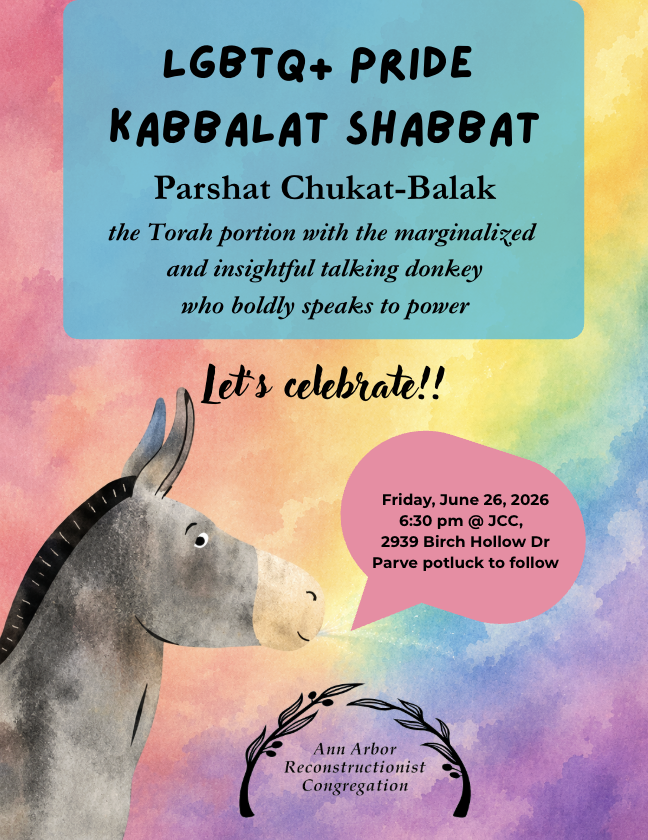
We are thrilled to share that Ann Arbor Reconstructionist Congregation invites you to an evening of prayer, poetry, music, and community at our LGBTQ+ Pride Kabbalat Shabbat, on Friday, June 26, 2026 at 6:30 pm, at the JCC, 2939 Birch Hollow Dr. A parve potluck follows the service. Come as you are. Bring your whole self. Bring a friend. Bring a parve dish to share (no meat, no dairy, but eggs ok)!
A Torah Portion Made for This Moment
The week’s parsha, Chukat-Balak, is the perfect queer-positive parsha to center our thoughts around Pride and the LGBTQ+ experience. At its heart is a jenny — a female donkey — who sees what the powerful male prophet Balaam cannot: the angel of God standing directly in his path. When she speaks, she disrupts everything. She’s marginalized, overlooked, and dismissed — and she’s the one with the clearest vision of truth.
Sound familiar?
The central drama of this portion is Balaam’s repeated attempt to curse the Israelites, which God transforms, again and again, into blessing. “A people that dwells apart, not reckoned among the nations” — words Balaam meant as an insult that become, through a queer lens, a source of pride. To be outside the norm, to resist definition by society’s narrow metrics, to be “strange” in a world that rewards sameness — these are not curses. They are, read rightly, blessings.
Transforming Curses into Blessings, Because Pride is Protest
There’s a wonderful saying–I have it on 2 t-shirts–that “Pride is Protest.” It’s an odd phrase, but an important one: we need to always remember that LGBTQ+ Pride was born out of the Stonewall Uprising, in the early hours of June 28, 1969, when queer patrons of the Stonewall Inn in Greenwich Village, New York City, resisted a police raid. This is why we celebrate Pride in June, and why we must always keep in mind that we have turned the hideous efforts to shame and humiliate vulnerable members of the community into a reason to celebrate, march, dance in the streets, wear all sorts of rainbow decorations, and celebrate LGBTQ+ people.
Inspired by the Chukat-Balak parsha and Pride month, we’ll engage in a special ritual to help us each release a curse, hurt, or fear bogging us down and then embrace a hope or blessing to lift us up and give us pride, just as Balaam’s curse was transformed, into something new and positive.
Poetry, Music, and the Sacred Art of Being Seen
The evening will be woven through with poetry and song that honor LGBTQ+ lives and sacred belonging. We are thrilled to welcome Detroit-based poet Stephanie Glazier, a Lambda Literary Fellow, who will read her own work at the service — including her moving poem Agent Orange, Again, a meditation on prayer, rage, love, and the wildness of God. Stephanie’s manuscript Of Fish & Country has been recognized by the National Poetry Series, the Alice James Book Prize, and many others. Her work has appeared in the Michigan Quarterly Review, The Southern Review, and Alaska Quarterly Review, and she served for years as poetry editor of Gertrude, the celebrated LGBTQ+ literary journal. Having her voice with us on this night is a true gift.
The service will also draw on the poetry of Mary Oliver (who was, in her own life, a testament to love on one’s own terms), and on the music of Debbie Friedman — including Miriam’s Song — performed by an ensemble of musicians and singers from our community who are bringing their whole hearts to this evening.
Our Interpretive Amidah, adapted from Mishkan Ga’avah: Where Pride Dwells, will include a blessing for our LGBTQ+ ancestors — those who fought to love, who insisted on their dignity, who contributed their fierceness and art and voice to this world. We walk in their memory.
Celebrating All of Who We Are
The children’s blessing will name LGBTQ+ figures from our tradition — Joseph, David and Jonathan, Naomi and Ruth — alongside the matriarchs and patriarchs, because our stories have always been part of the story. We’ll close with Fred Small’s beloved Everything’s Possible, a lullaby for every child that holds open all the doors of a life: “You can be anybody you want to be / You can love whomever you will.”
Throughout the service, we’ll use fluid, expansive language for the Divine — because our tradition has always known that God is bigger than any single name.
Pronoun stickers will be available. All are welcome at this table.
## Join Us
**LGBTQ+ Pride Kabbalat Shabbat — Parshat Chukat-Balak**
Back in January, Jeff Basch posted on Reconchat about an interfaith coalition on immigration coming together in Ann Arbor. When he asked if any of us were interested, it called out to me.
I had worked for eight years as a Spanish interpreter in courts, hospitals, schools and community mental health. I was often there in people’s most difficult, intimate moments—during jail visits, medical procedures, school meetings with parents, and in the privacy of therapists’ offices.
In those years, I got to know the Latino community. What I saw were people working multiple jobs to feed and clothe their kids, paying social security taxes they’d never collect on, and trying their best to live under the radar. They took jobs no one else wanted. They prioritized family and friends. They went to church. They are not so different from any of us. And they are here for the same reasons most of our ancestors came: To escape danger and/or seek a better life for themselves and their kids.
They do not merit the harsh, dehumanizing treatment they are receiving. The Torah calls on us 36 times to care for the stranger in our midst, often cited as the most frequently mentioned commandment. If there ever were a time to heed the call to defend our immigrant neighbors, it is now.
In what became the Interfaith Funds for Immigrant Justice coalition, 23 congregations committed to raising $100,000 so that the Michigan Immigration Rights Center (MIRC) could hire more legal staff. At the AARC, David Speyer quickly organized an immigration-themed Purim party to raise money. In mid-March, Kira Berman put on a benefit cocktail party. You can read about our next fundraiser below.
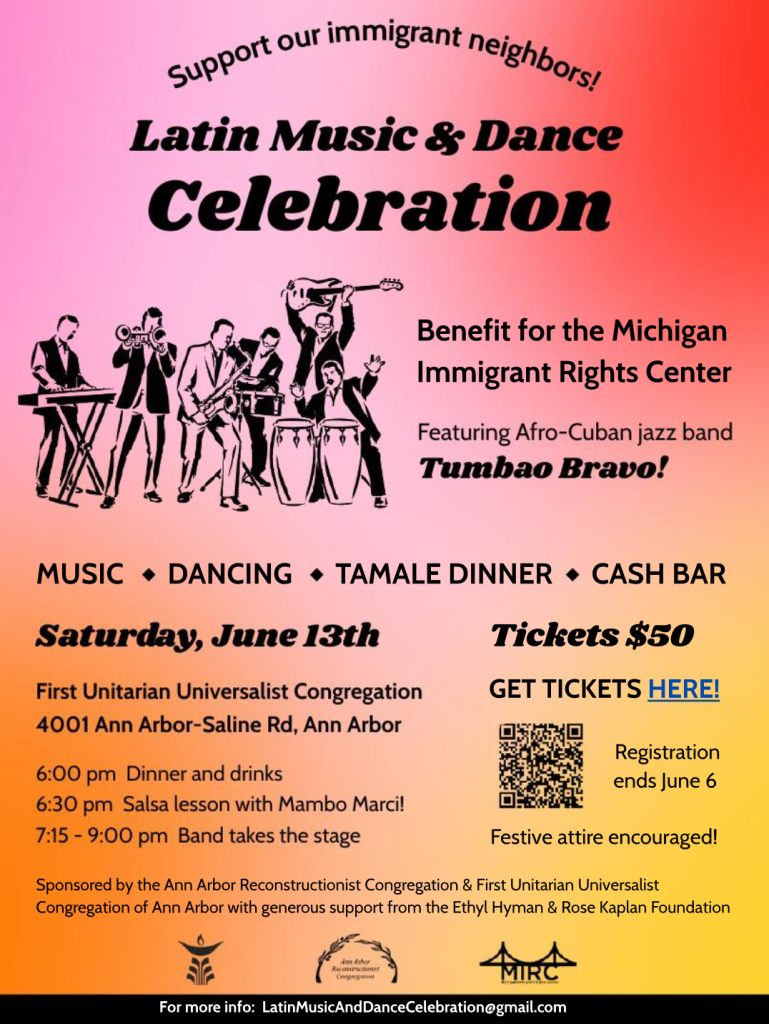
The Latin Music & Dance CELEBRATION! on Saturday, June 13, 6:00-9:00 pm, is our next benefit for MIRC. Paul Vornhagen’s Afro-Cuban jazz band Tumbao Bravo will headline an evening of music for listening and dancing. We’ll be at the Unitarian Universalist Congregation of Ann Abor, which is co-sponsoring the event with us and providing the venue.
The doors for the event will open at 6:00 with dinner from Pilar’s Tamales and a cash bar. A salsa lesson with Mambo Marci from YA Salsa will start at 6:30. The band will take the stage at 7:15.
During the intermission, we’ll hear from Molli, a member of the UU congregation who answers the MIRC hotline. She’ll share some of the stories she hears from callers and help put a face on the people we are supporting.
It should be a fun, high-energy evening. And a chance to take a break from the depressing daily news cycle, find a little joy, and show support for our neighbors. Please plan to attend!
Tickets are $50 per person. The deadline for registering is June 6. Those who cannot attend are encouraged to donate. Buy your tickets or donate here!