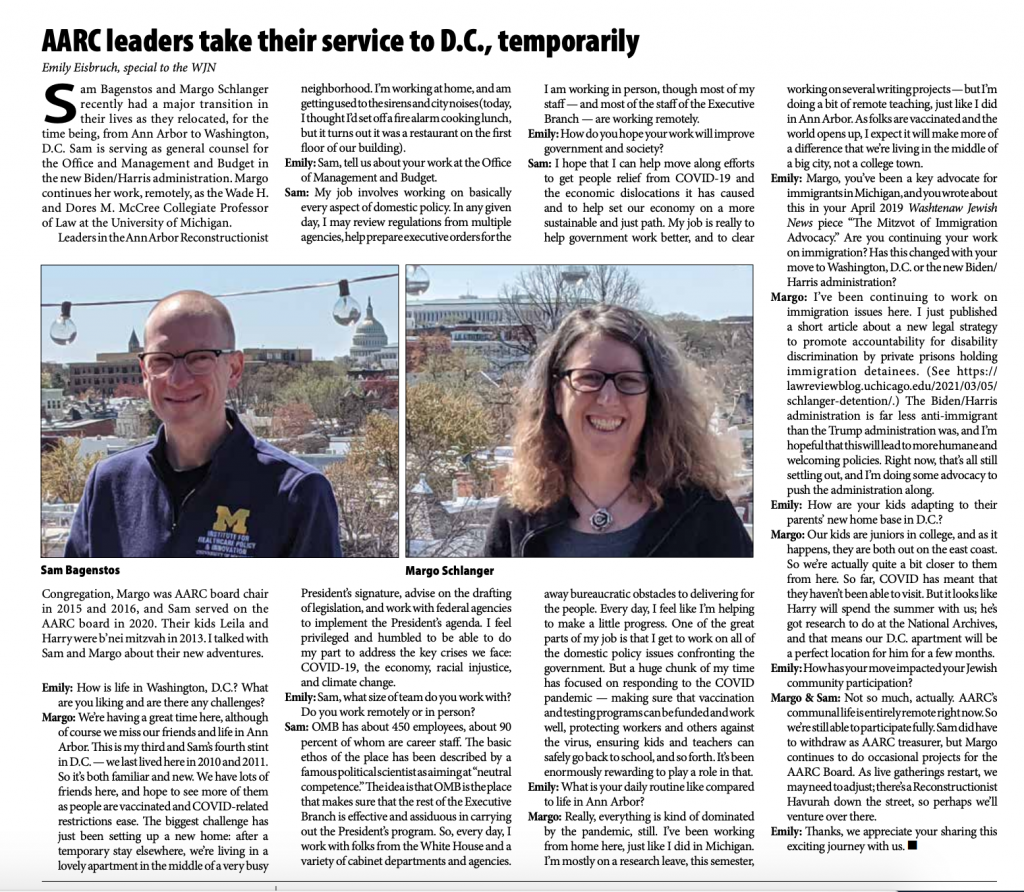
This article appeared in the May 2023 Washtenaw Jewish News.

This article appeared in the May 2023 Washtenaw Jewish News.

UPDATE July 6, 2022: CANCELLED! Unfortunately Rabbi Natan has tested positive for COVID and cannot conduct services or do his book talk on July 9, 2022. Stay tuned for a rescheduled future program. Second Saturday Kabbalat Shabbat, July 9th, – Services cancelled.
By Quinn Diacon-Furtado as a Special for the Washtenaw Jewish News
Rabbi Natan Margalit will be the guest service leader at the Ann Arbor Reconstructionist Congregation’s Second Saturday Shabbat service at the Jewish Community Center, 2935 Birch Hollow on July 9, 10 am to Noon. Following the service, Margalit will lead a book talk on his new book, The Pearl and the Flame.
The Pearl and the Flame from Albion-Andalus Books examines how Judaism, along with other indigenous and traditional cultures, has preserved the understanding of the world through patterns and relationships. Margalit grounds key systems sciences concepts, such as emergence, embeddedness and tipping points, in Jewish language and spiritual tradition. This blend of spirituality and systems sciences offers a timely integration of old and new, suggesting approaches that stand to move humanity away from cultures of control and towards cultures of relationship.
The Pearl and the Flame also chronicles Margalit’s secular upbringing in Honolulu, his exploration of Orthodox Judaism in Jerusalem, and his own spiritual path rooted in ecological interconnectedness. A theological and ecological thinker and teacher, Margalit’s stories and experiences highlight the integration of ecological thinking and core Jewish concepts, positioning Judaism at the forefront of our struggles against our current social crises.
“There aren’t too many rabbis who can weave together pieces of wisdom from Wendell Berry, Mary Douglas, and Kalonymous Kalman Shapira, the rebbe of the Warsaw Ghetto,” comments Rabbi Sid Schwarz, author of Judaism and Justice: The Jewish Passion to Repair the World. “It reflects the genius of a book that is an antidote to an ever more fragmented world.”
Rabbi Jill Hammer, author of The Jewish Book of Days: A Companion for All Seasons, comments on Margalit’s suggestion that the Jewish tradition of sacred communal storytelling can shift the paradigm and encourage ecological revolution: “Margalit’s book, full of down-to-earth personal stories as well as astute cultural observations, beautifully strings the pearls of Judaism and ecological thinking together to create a relevant and nourishing whole.”
Margalit, a rabbi and scholar with 30 years of experience in teaching, writing, organizing and congregational leadership, earned his Ph.D. in Near Eastern Studies at U.C. Berkeley. He has taught at Bard College, the Reconstructionist Rabbinical College, Hebrew College Rabbinical School, and now is chair of the Rabbinic Texts Department at the ALEPH Ordination Program (AOP). He is also Director of the Earth-Based Judaism track of the AOP, and is founder of the non-profit Organic Torah, now a project of ALEPH. For more information on Organic Torah and Earth Based Judaism, visit aleph.org.
As Keshet’s opening Pride Month page says, ‘Welcome, You Are a Blessing!’ Happy Pride to the AARC LGBTQ community and its allies! Pride Month reminds us of the importance of welcoming everyone to the table and celebrating all that they are. This month also gives us the opportunity to shine a light on the LGBTQ community, advocate for them, and honor them. Jewish tradition specifically teaches that the infinite variety and diversity of humanity is a mark of Divine artistry and creativity (Mishnah Sanhedrin 4:5). So we honor you, our LGBTQ community and celebrate you during this very special month!
If you would like to get out and celebrate Pride Month, check out the following events in SE Michigan and Online!
NextGen Detroit Pride Shabbat, June 1oth: https://jewishdetroitcalendar.org/event/pride-shabbat/
Pride shabbat at Temple Beth Emeth, June 10th: https://www.jewishannarbor.org/event/tbe-pride-shabbat/
Jewish Democratic Women for Action invites you to “Celebrating PRIDE with Purpose and Activism” with three notable LGBTQ+ leaders: June Gutterman, recently retired CEO of Jewish Family Services of Ohio; Laurie Osher, a state representative from Maine; and Jon Cohen, director of community mobilization for Keshet. June 16th, 4pm- https://www.keshetonline.org/event/celebrating-pride-with-purpose-and-activism/
Join Joy Ladin and Keshet CEO Idit Klein for Pride & Joy, an online gathering in honor of Pride month and to celebrate Keshet’s successful Dare to Dream campaign, June 23rd, 7pm- https://www.keshetonline.org/event/pride-joy/

So what is leyning? Wish I had time to look up why chanting torah is called leyning, because I’ve always wondered. Like many things in this corner of the Jewish world, and very unlike me in general, I haven’t questioned much about why. I’ve focused on the how’s.
This course, which I just decided to call L2L, is designed for people who know Hebrew at least phonetically, and want to learn to chant. Maybe just to know, or to help your kids someday with b’mitzvah. Maybe to participate in a torah service. Maybe even to have an adult bar or bat mitzvah!
So, back to what is leyning. If you look in a chumash or even at some of the prayers in our siddur, you will see funny little symbols that aren’t vowels. For example, check out the shema or the v’havta or ma tovu, or any prayer in the prayerbook that originated as torah. How can you tell a prayer originated as torah? This is getting circular, but you can tell if there are those funny little symbols around the words that aren’t vowels. (and you can always check under the line to see where in Torah this is from).
Those funny little symbols around the words that aren’t vowels are called trops, and they are the most efficient little musical indicators of how to chant that I have ever seen. There are about 24 used regularly (and about 4 that show up quite rarely) and this class is going to teach you what they are and how to sing them.
My plan would be to convene soonish, maybe mid March, and start to learn some of the basic trops, the ones that are used over and over (there are maybe 4-6 trop combos that comprise about 75% of all the torah). I envision us as a group committing to covering a torah service sometime at a fall Shabbat morning (we have some latitude about which month, as long as it’s the second Saturday, so we can choose a torah portion we want to dig into) and all of our learning would be on the few lines that you personally will commit to (I mean, you don’t have to do this, but I think it would be good if at least some people do). Then we will work weekly until we have it learned. If people want to make this a b’nai mitzvah, I think we could make that happen!
I am willing to do this gratis (the hav has given me so much and I am lucky enough to not have money concerns) but do want people who are willing to commit for the full ride. I mean, things always come up that are unanticipated, but short of that, I will assume that you want to do this and have time. I’d also like to do this only if we have 3 or more committed people. I would also love to meet in person (my house?), COVID permitting, since singing on line is such a pain.
In case you don’t know me, my credentials for doing this is teaching over 55 kids (and one adult) for their bar/bat mitzvahs over the last 20 years. I myself learned how in conservative Hebrew School in Florida, but never had a bat mitzvah, first chanting from a tape Rob Dobrusin gave me at my aufruf in 1993. Who knew it would turn into a side gig that would give me so much joy?
If you are interested, send me an email at drdebkraus@gmail.com. Thanks!
Written by Rebecca Kanner and Emily Eisbruch for the Washtenaw Jewish News

Lots changed during the COVID 19 pandemic, including, for many of us, how we worshiped and how we socialized. What a joy to experience the happy reconnections in the summer of 2021, as vaccines enabled the resumption of many in-person events. Now, on the brink of the New Year 5782, the Ann Arbor Reconstructionist Congregation (AARC) is taking stock of lessons learned during the pandemic and taking steps to capture and continue some of the positive innovations.

As one example, the pandemic inspired an increase in creative outdoor activities for the AARC Beit Sefer (religious school). A Tu B’Shvat program centered on Ann Arbor’s champion trees and a bike/hike relay experience connecting Beit Sefer families are two examples. “The healthy connection with the outdoors, and focus on Jewish environmental education is an emphasis we plan to continue,” says Beit Sefer director Clare Kinberg. “For the upcoming school year we have plans for a monthly Beit Sefer program at The Farm on Jennings, a farm providing a diverse selection of certified naturally grown produce and flowers, owned and operated by AARC member Carole Caplan.”
At the congregational worship level, we recently invested in state-of-the-art equipment to deliver hybrid worship experiences that are meaningful both for in-person and online participants. According to Seth Kopald, who is a Board member and part of the AARC’s Tech Committee, “We bought quality equipment so everyone will hear and see things clearly, and hopefully it will help those on Zoom engage on a deeper level. We really want people to feel a part of the services and other events. We are together even when we are apart.” In July, the AARC was pleased to convene an outdoor Kabbalat Shabbat service and to kick off using the new sound system, with the event streamed live on Facebook.

In another innovation, color-coded name tags (using green, yellow or red circle stickers) were offered for those in-person at the July Kabbalat Shabbat. The colorful stickers were applied on name tags to indicate an individual’s comfort with hugs versus handshakes versus socially distanced smiles. The stickers provide an easy mechanism for people to signal their level of readiness (or not) for friendly physical connection. The congregation will decide whether to continue offering the stickers moving forward.
Mishpocha groups, formed during COVID to facilitate AARC members keeping in touch, have proved highly successful. AARC members serve as hosts for small groups that meet weekly or biweekly on Zoom, providing a cohort for check-in, support, and even sometimes for sharing music, poetry and short stories. The friendships and new bonds continue as we emerge from the pandemic, and the Zoom check-ins may also continue.
Here’s a friendly reminder that High Holiday services are a great time to check out the Ann Arbor Reconstructionist Congregation. Our live-streamed services are open to all. For more details, we invite you to visit the AARC website at https://aarecon.org/ or reach out to Gillian Jackson at aarcgillian@gmail.com.
To see this article in the September 2021 Washtenaw Jewish News, scroll to Page 8 here.
https://washtenawjewishnews.org/PDFs/WJN-09-21-web.pdf
Written By: Gillian Jackson and Clare Kinberg

PRIDE SHABBAT: Saturday June 12, 10 AM Ta Shma, 10:30 AM Shabbat service. Join us for a Pride-focused ‘Pray What’ to learn how our traditional prayers have been reconstructed (by Reconstructionists and non-Reconstructionists!) to include non-heteronormative models of love and relationship, and a Shabbat morning service honoring and amplifying the many voices of our queer elders, siblings, and children.
Zoom link for services will be sent out the week before the event; if you are not on our mailing list and would like to participate, please email us!
LGBTQ Jewish History Workshop with Keshet: Sunday June 20, 2-3:15 PM. This interactive workshop for AARC members and friends explores key moments in LGBTQ Jewish history in the United States and the implications of this history for our work on LGBTQ equality and belonging in Jewish life today.
Note: This workshop assumes some basic familiarity with LGBTQ identities and will not provide an introduction to gender identity and sexual orientation. Participants can familiarize themselves with these terms and concepts through Keshet’s LGBTQ Terminology sheet, available in our online Resource Library.
Zoom link for services will be sent out the week before the event, if you are not on our mailing list and would like to participate, please email us!
Happy Pride Happy Hour: Saturday June 26, 6-9 PM. AARC members Robin Wagner and Sharon Haar invite our LGBTQ+ members to drinks and light dinner on their patio to celebrate Pride Month. To RSVP, please fill out this sign-up genius.
Read this gorgeous essay, Queer Delicacy: An Ancient Approach to Halakhah, by Congregation Agudas Achim’s Rabbi Alex Weissman
Watch this symposium on Jewish Queer History from the Center for LGBTQ and Gender Studies in Religion recorded this year on May 2. Twenty years after the publication of Queer Jews, this symposium in memory of its co-editor David Shneer brings together many of the most thoughtful Jews in the movement: Dr. Bernie Schlager, Christie Balka, Dr. Gregg Drinkwater, Avi Rose, Rabbi Jane Rachel Litman, Ali Cannon, Hadar Ma’ayan Dubowsky, Rabbi Steve Greenberg, Rabbi Robert Judd, TJ Michels, Rabbi Mychal Copeland, Dr. Marla Brettschneider, Sandi Simcha DuBowski, Dr. Ruti Kadish, Eve Sicular , Rabbi David Dunn Bauer, Dr. Jodi Eichler-Levine, Koach Baruch Frazier, Dr. Samira Mehta, Dr. Lori Lefkovitz, Jaron Kanegson, Dr. Jonathan Krasner, Moderator: Idit Klein), Rabbi Aviva Goldberg, Rabbi Evette Lutman, Dr. Kathy Simon. It’s long, enjoy parts of it at a time.
Watch some queer theatre from the National Queer Theatre of NYC. Their Criminal Queerness Festival, June 22-26 presents explosive new plays by LGBTQ artists from countries that criminalize queer and trans people.
“‘Together we can make a safe home:'” Space, Violence and Lesbian Activism” is a presentation on 1970s St. Louis lesbian history. Learn about AARC Beit Sefer director Clare Kinberg’s story. LGBTQ history is personal!
This article appeared in the May 2021 Washtenaw Jewish News.

Our congregation came prepared this year to make the best of the second Passover holiday during the pandemic. It was a true community effort, with a month of member-led enlightening workshops scheduled in an effort to support a meaningful holiday.
The month started off with a create-your-own-Haggadah workshop with Debbie Zivan and Deb Kraus. Once everyone had a chance to start building their own Haggadah, Sharon Haar and Patti Smith led a class that provided useful tips for navigating Zoom seders. Leading up to Passover, Idelle Hammond-Sass and Carol Levin led congregants in a reflection on the idea of dayenu, or ‘enoughness,’ using art-making as a tool of exploration. Days before Passover, Rabbi Ora taught participants about the meaning and ritual for getting rid of chametz, with a special pizza-making workshop following the lesson. The holiday wrapped up with a ‘Songs of Freedom’ musical hour with Laurie White and Paul Resnick.
It is a blessing that our congregation was able to make use of the myriad talents that our membership embodies. Thank you so much to all of our Passover volunteer workshop leaders. Our community is grateful to you!

Our AARC Beit Sefer students learned this year that the symbols on a seder plate, plus the matzah and grape juice/wine, are not only props to assist the drama of telling the story of the Exodus. Like everything we eat and use, the seder plate symbols come from somewhere and are made by someone. They symbols themselves can express our values such as regard for the environment. Combining this value with the school’s effort to get the kids outside, I devised a “Locally-Sourced Seder Symbol Search.” The requirement was for each seder plate symbol to be made in Michigan, and we succeeded:
Recon Zoom meetings took many forms in 2020 – including creative art workshops. Our Yom Kippur workshop focused on Jonah and the Whale. For Hanukkah, we shared Rabbi Shefa Gold’s readings about rededication and resilience, Rabbi Lord Jonathan Sacks on Gorbachev’s connection to Hanukkah, and third century sages, Rav and Shmuel, on lighting the lights. We reflected on art, parsed the Blessing for Creating, by Rabbi Adina Allen from the Jewish Studio Project and interpreted the ancient and contemporary midrash with our own visual and written commentary.
We’re planning more Zoom Art Workshops for 2021 –
Idelle & Carol
Art by Rita Gelman
Art work by Marcy Epstein
Art work by Carol Levin
Art work by Gillian Jackson
By David Erik Nelson
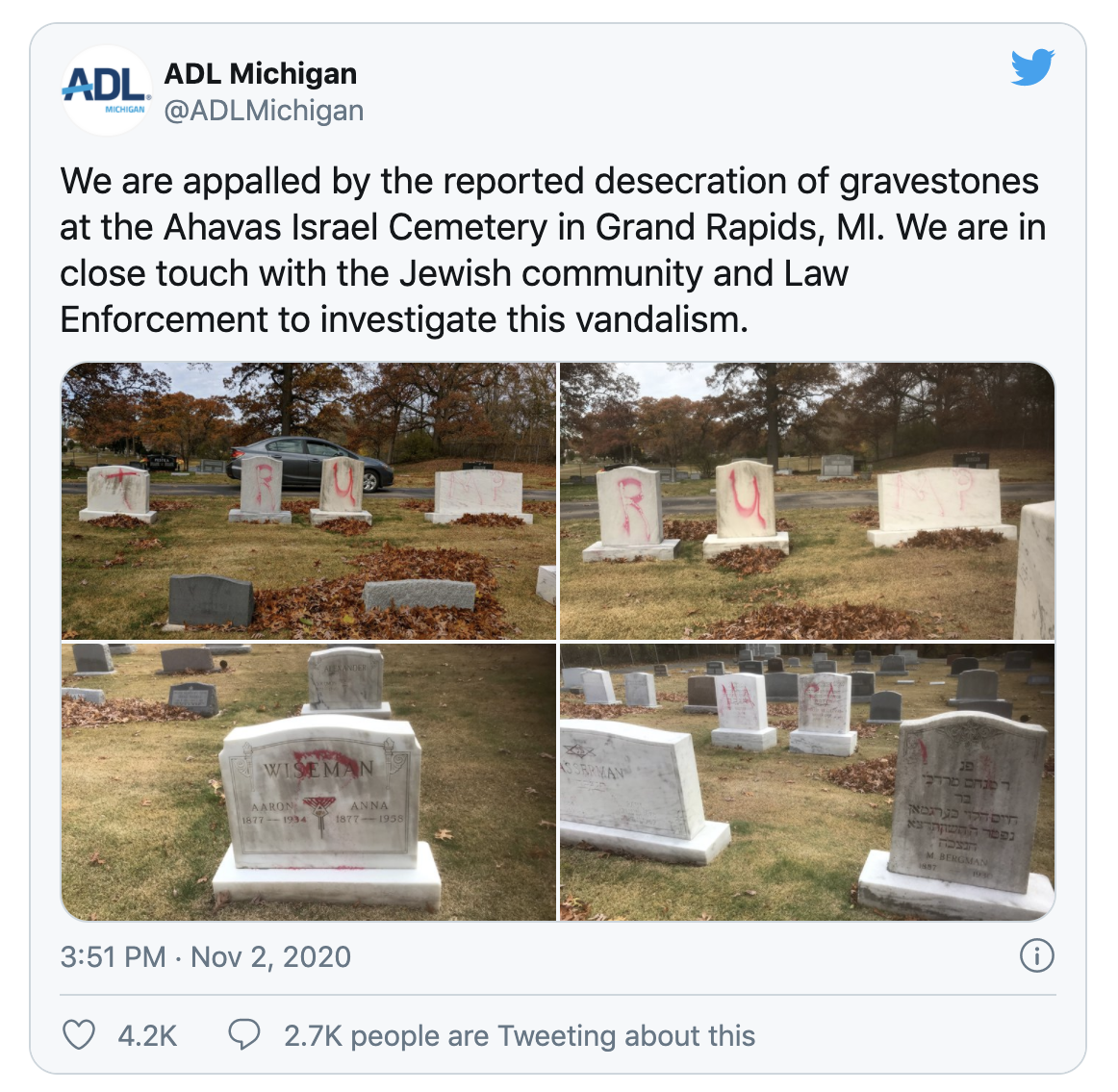
You almost certainly heard about the desecration of a Jewish cemetery in Grand Rapids shortly before the election, where “TRUMP” and “MAGA” were spray-painted over the names of the honored dead.
[source]
Maybe these pictures worried you. Maybe they frightened you. Maybe they embarrassed you—because, let’s be honest: it’s shameful to be bullied, to get the “Kick Me!” sign pasted to your back again and again, century after century.
Or maybe you didn’t feel much of anything. Maybe you’ve grown numb; one more slap in the face at the tail end of four years of unprovoked suckerpunches, it can all sort of blur together. I get that.
I don’t exactly have words for how it made me feel.
I saw these pictures of the Jewish cemetery in Grand Rapids, and I immediately thought back to the swastikas spray-painted on Temple Jacob last winter, way up in the Upper Peninsula town of Hancock. And I thought about the dozens of swastikas and slurs that defaced our local skatepark back in 2017.
(I go to that skatepark a lot. It was hard not to take it personally.)
And I thought about the increase in anti-Jewish hate crimes here in America over the past four years. I thought about the increasingly violent nature of those crimes.
I thought about the bomb threats. And the synagogue shootings. And the stabbings. And the rallies. And the men with guns in the capitol.
And so on.
And I felt hopeless. And I was afraid.
So I emailed the rabbi of Congregation Ahavas Israel, who maintain the cemetery in Grand Rapids that was desecrated on election’s eve. I wrote to voice our support and solidarity, and to ask what they might need to restore the cemetery.
Rabbi David J.B. Krishef replied almost immediately:
“Hi Dave — the cemetery was cleaned by a small group of people who live around the corner and took it upon themselves to clean the stones without even letting us know what they were doing, and a few other people, including one from Ann Arbor, who drove in and decided to wash the paint off. We are grateful for all of the love and support and positive notes we’ve received.”
It dawned on me that this second half of the story is rarely reported, but often the case:
A lone jackass skulks around smearing his petty foulness in the dark; the whole community—not just Jews, but people from all over the community unwilling to let ugliness linger—return in the light to set things right.
That’s what happened in the cemetery in Grand Rapids. And when I went back and checked, I discovered it’s also what happened at Temple Jacob in Hancock.
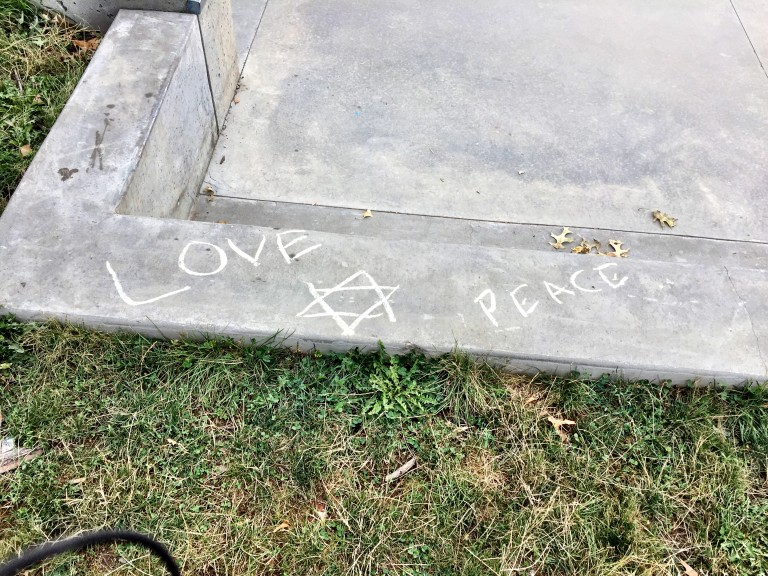
And that’s what happened here in Ann Arbor, too; I know, because I saw it: I went to the skatepark the day after it was tagged. The city had already power-washed away the paint. And unknown members of the community at large had come through with colored chalk and, every place where there’d been a symbol of hate, replaced it with a message of welcoming and love:
[source]
What I saw in Ann Arbor was not the exception; it was the rule, even now, in this time of widely reported “unprecedented division and unrest.” And maybe it feels like we’re mired in a time of unprecedented division and unrest because we only report the first half of the story—the smeared paint, the thrown punch, the shots fired—and then move on to the next catastrophe, without checking back to see what comes after the paint and the screaming: a nation of folks ready to take it upon themselves to fix whatever any single angry loner chooses to break.