• Skip to primary navigation
  • Skip to main content
  • Skip to footer
Ann Arbor Reconstructionist Congregation

Ann Arbor Reconstructionist Congregation

  • Home
  • About
    • Overview
    • Rav Gavrielle Pescador
    • Our History
      • Photo Gallery
    • Our Values and Vision
    • LGBTQ Inclusive
    • Our Board
    • Our Sacred Objects
    • About Reconstructionist Judaism
    • Jewish Ann Arbor
  • Programs
    • Shabbat and Holidays
    • B’nei Mitzvah
    • Tikkun Olam
    • In the (Washtenaw Jewish) News
    • Health and Safety Expectations for In-Person Gatherings
    • Join our Mailing List
  • Religious School
    • About Beit Sefer
    • Teachers
    • Enrollment and Tuition
    • 2025-26 Beit Sefer Calendar
  • Blog
  • Calendar
  • Membership
    • Thinking about joining?
    • Member Area
  • Contact Us
  • Donate
You are here: Home / Blog

Blog

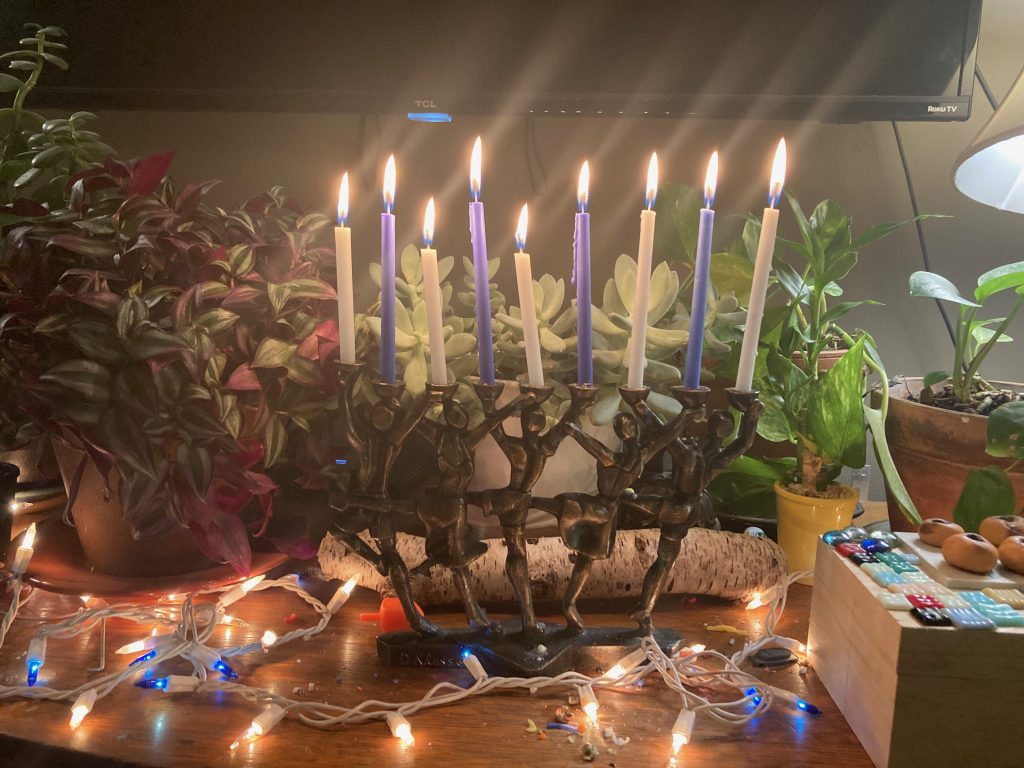
Home Hosted Hanukkah Schedule 2022!!

December 14, 2022 by Gillian Jackson

Wow what a super fun eight days we have coming! Take a look at the myriad of excellent opportunities for celebration and community and sign up to attend!

First Night of Home Hosted Hanukkah Potluck at Marcy Epstein’s House! December 18th, 6:00-8:00pm. First night at Marcy’s– bring your Hanukkiah, have a latke, bring a vegetarian dish with serving utensil! Capacity: 20, kid-friendly, white elephant, dreydl– dogs in house, please mask if you can, three steps to front door. SIGN UP TO ATTEND HERE, Address will be sent to registrants (Marcy’s house is in the Burns Park area) 

Second Night: Stop by the Giant Menorah Gelt Drop in Liberty Plaza! On Monday Dec 19 at 6 PM, Chabad House will be Lighting Up the Night at a grand celebration for the entire community at Liberty Plaza! The Giant Graffiti Menorah will stand tall as a symbol of our Jewish pride and unity, and the exciting Chanukah activities will be fun for the whole family! 
Enjoy latkes, donuts, hot drinks and live music while dancing with the Dreidel Mascot. Get ready to experience the spectacular Chanukah Gelt Drop, with chocolate coins and other treats raining down from our city’s finest fire truck ladder. Airbrush your very own Chanukah beanie and feel the joy of Chanukah and community spirit! 
Third Night: Home Hosted Hanukkah Karaoke Night! at Shannon Rappaport’s House, Tuesday December 20th, 5:30-8:30. Donuts, hors d’oeuvres, wine and kid snacks. Dreidel, candle lighting, karaoke! 2 steps to access house, house has cats and a dog. Sign up to attend HERE, address will be sent to registrants.  
Fourth Night: Candle for Tzedakah, Wednesday December 21st, 5:30pm. For one night of Hanukkah, community members and families come together to give to those in need. One Candle begins at 5:30 PM with a pizza dinner, edible dreidel making (marshmallows, pretzels, frosting, Hershey kisses), gift wrapping, and fun crafts! If a kosher meal is required, please indicate so on your registration form. Register to attend HERE. At 6:15, we’ll welcome magician and comedian Jonathon LaChance as seen on the television show Penn & Teller: Fool Us. This hilarious show will be lots of fun for the whole family!

This year, we’re partnering with The Bottomless Toy Chest! The Bottomless Toy Chest is a nonprofit organization with the goal of providing toys, crafts, and interactive activities to children undergoing cancer treatment. Please join us by bringing a new toy in its original packaging to the event! If you are unable to join us, boxes will be in the lobby prior to the program to collect new toys.
Fifth Night: Home Hosted Hanukkah Campire Stories and Singing at Etta Heisler’s House. Thursday December 22nd, 7pm-8:30pm. Outdoor party. This party will feature large fires available where you can warm up, as well as warm beverages to enjoy. The Heisler’s will provide mozzarella sticks and jelly donut holes as well as hot coffee, tea, hot cocoa, and cider. This night will feature a dramatic reading of Herschel and the Hanukkah Goblins and Hanukkah songs around the fire. Fire pits are handicap accessible, bathrooms require stairs. Bring cash/coins for the tzedakah box, OR use a qr code to make a community donation to Community Action Network’s Bryant Community Center. Masks required inside. SIGN UP TO ATTEND HERE. 
Sixth Night: Fourth Friday Kabbalat Shabbat and Hanukkah Service, Friday December 23rd, 6:30-8:00 pm. Hybrid Service at the JCC of Ann Arbor. Come connect with community, rest, recharge, rejuvenate. Everyone welcome. We are asking everyone that comes in person to read the Health and Safety Guidelines. Vegetarian, nut free potluck after services. Please bring a dish to pass. **This will be a special Hanukkah Shabbat Service co-led by Margo Schlanger and Rebecca Kanner. 
Seventh Night: Home Hosted Hanukkah Bonfire at Rena & Jeff Basch’s House. Saturday December 24th, 5:30pm-8:30pm. Gather for candle-lighting, bonfire, and a chili dinner around the fire. Bring a menorah & candles. Bring/wear warm campfire clothes. Capacity 25-30 ish. COVID restrictions – stay home if you’re feeling ill or test positive. Food details: Rena will make a big pot of chili or maybe two, and a toppings bar. Will also have warm and cold beverages for children and adults. If people want to bring something, here are some ideas – salad, corn bread, fruit, dessert, Fireball! Sign up to attend HERE, address will be sent out to registrants. 
Eighth Night: Home Hosted Hanukkah Potluck at Eileen Dzik’s House. Sunday December 25th, 6pm. Come gather for latkes and singing. Vegetarian potluck – desserts welcome! Sign up to attend HERE, address will be sent out to registrants. 

Filed Under: Upcoming Activities Tagged With: community, Hanukkah, home hosted hanukkah, Reconstructionism

Brenna Reichman’s Dvar Torah From Her Bat Mitzvah on December 10th, 2022

December 14, 2022 by Gillian Jackson

Hi everyone! 

So, picking up where I left off with the introduction to today’s torah portion. Jacob and Esau have come back together twenty years after the “birthright incident”. Jacob arrives with his large family and with his gifts of goats, sheep, camels, and cows. 

I’m going to share my version of the exchange that ensues:

Esau: Is all of this yours?

Jacob: Yes! It is to find favor in your eyes. (Or, I don’t want you to kill me!)

Esau: I have enough, brother. Let what is yours be yours. (Or, I don’t need your stuff!)

Jacob: No, please. If I have truly found your favor, accept these gifts. For seeing your face is like seeing the face of G-d. G-d has been gracious to me and I have everything.

(Or, I really really don’t want you to kill me!)

Esau accepts the gifts. 

Both of the brothers declare here that they have enough, and my theme today is enoughness. First, I will offer a couple of interpretations from the rabbinic commentary and then I will share some of my own reflections.

First, what does enough mean to Jacob and Esau in this exchange?

Rashi, who was alive about 1000 years ago, differentiated the ways that the two brothers spoke of their enoughness. Jacob said, I have everything, meaning all that I need. While Esau said, I have an abundance, suggesting a greed for more than he needs. But, in the same breath, Esau says, “let what is yours be yours.” Rashi says of this that Esau conceded the blessings to Jacob. To me this suggests the opposite of greed. But Esau can both lean towards greed, and desire reconciliation with his brother. Aren’t we humans all a bit complex. 

Another medieval rabbi known as Radak had a slightly different take. When Esau said, “let what is yours be yours”, Esau is trying to convey that he had not suffered as a result of Jacob receiving their father’s blessing.

Another source I used was a gift I got myself during my preparations, The Torah: A Women’s Commentary. Here, one of Jacob’s insistences is translated as, please accept my gift of blessing. This is interpreted as, please take my blessing, by which Jacob may be trying to compensate for having stolen the blessing from Esau twenty years ago. However, to me, this seems very much like a sorry-not-sorry move. Jacob doesn’t regret what happened. He never outright apologizes. But he does seem to want to reconcile, or at least to not be killed.

And the last rabbinic commentary I will share today is from Rabbi David Teutsch, a reconstructionist rabbi who is still alive today. In A Guide to Jewish Practice – Everyday Living, he writes on the topic of consumption, or to me, material enoughness. Here he acknowledges that there is a place for consumption to add pleasure to daily living. As long as we don’t compromise our financial security or the greater public good, nor undermine our ability to give tzedaka, which is defined as charitable giving with an eye towards justice. I found this commentary on the idea of enough, more relevant to our lives today.

Now on to my reflections.

I started out on this intellectual project thinking that I would be able to come up with a definition of what is enough, and how to live my life in that place of enoughness. By which I mean, what size house should I live in, how much of my income or savings should I donate, how should I make decisions about purchases for things I need versus things I want. And what about my carbon footprint. I have so many questions about how to live in a way that doesn’t hurt others. I know in my heart that my too-much, is someone else’s not-enough. But of course there’s no right answer to these questions. This is the stuff of being an adult and striving to be a good planetary citizen.

But still, I can’t get this question out of my head. What does it mean to have enough? For Jacob and Esau it meant many wives, handmaids and children (insert feminist commentary here), as well as livestock, and servants (insert human rights commentary here). Perhaps it also meant reconciliation. But what does it mean for me, or for us, today, in this time and place? Side note and full disclosure, I just bought tickets to Cancun for spring break. But back to my existential musings on enoughness.

For those of you that don’t know, I’m a nurse practitioner, and one of my jobs is at the sole women’s prison in Michigan, which is about a 15 minute drive south of us, in Ypsilanti. I think my work in a prison setting leaves my mind especially unsettled in the enoughness department. I’m going to share a few moments from my day this past Monday.

I was working in one of the clinics that is located within a housing unit. In the background, officers are yelling “one at a time in the bathroom”, and “get out of your doorway”. At that moment I thought enoughness would be unencumbered access to a bathroom for all those people who are incarcerated. I also thought enoughness for me would be working in an environment without yelling and humans being hostile to other humans.

That same day I overheard an officer asking a new arrival if she meant to put herself as her emergency contact. She replied, I don’t have anyone. What would enough look like for her?

Also on Monday, I was performing a routine exam, and the patient said, “that’s really nice that you do these exams in here”. I replied, of course! There’s a lot of care I can’t get for you, but this I can do. She was essentially thanking me for doing my job. In that moment, was I her enough?

This is how most days are at the prison. This level of in-your-face need.

Life in the prison is often about survival. I can’t count the number of times one of the people who are incarcerated has said to me, “I don’t want to die in here”.

All of this leads me to more questions:

Why do I get to thrive when so many that I come into contact with are merely surviving? 

For those of us that are comfortable and our survival is taken for granted, how do we define our enough? 

What does it mean to have too much and acknowledge that we are not special or deserving but to still have it?

We are prone to comparing ourselves to others, which further muddles the search for answers to these questions. Just as Jacob and Esau were comparing and competing in the exchange about the gifts. There is a sense that each was trying to say, no, I have more than you.

Reflecting on the prison environment lays bare all the different parts of enough: the array of needs we humans have, from the physiologic to the psychologic.

Let us contemplate on this for a moment:

Food, water, warmth, shelter.

Safety, health.

Social needs, friends, family, partners, community.

Financial security.

The need to be respected, valued by others, and feel that we are contributing meaningfully.

The need to learn and expand our knowledge.

Connecting with nature. 

Spiritual needs.

Creative expression, music, art.

For the people I come into contact with at the prison, to have a chance to survive and thrive would mean enough access to housing, education, access to child care, addiction treatment, lives free from violence, a society free from racial biases, their freedom, and much more. 

Now, as is customary in our congregation, I will pause to hear from some of you. Here is my question, but feel free to comment on anything I’ve said. 

In a world where so many people can barely survive, under what conditions is it okay to thrive?

Thank you for your contributions. I would love to continue this conversation with each of you in the months and years ahead of us.

I’m going to end with a quote that resonated with me. I found this from Ellen Dannin in a Reconstructing Judaism blog post. (And side note, it says in her bio that she is a former member of the Ann Arbor Hav!) She writes:

“What we ought to be concerned with is not material possessions – though we should be grateful for them. Rather, our real focus ought to be relieving suffering, being diligent about the obligation to live in a Godly way, being grateful for the good things that come our way while not assuming we deserve them, and instilling these understandings in the next generation.”

In other words, giving thanks and giving back.

And I think for today, this is enough.

Filed Under: Divrei Torah Tagged With: bat mitzvah

Emergent Strategy and Congregational Transformation

December 5, 2022 by Gillian Jackson

By Etta Heisler

This is the text of a d’var Torah, Torah teaching, that Etta gave on the occasion of the 2022 Annual Member Meeting. If you prefer, you can watch a video recording of Etta reading this d’var on YouTube.

—

Change is coming.

What do we need to imagine

to be prepared? 

I know I’m scared.

I know from brokeness there’s whole.

“Change is Coming” song by Molly Bajgot inspired by text in adrienne marie brown’s book Emergent Strategy: Shaping Change, Changing Worlds.

Welcome! Wow, it is so good to be here today, and so good to be in community with you always.

In the spirit of thinking about our community and congregation as an ecosystem, I am going to talk today about some ideas from adrienne maree brown’s text Emergent Strategy which draws on wisdom from nature and connects it to both the experience and strategy of social transformation.

A few quick words on brown – she is a writer, facilitator, doula, and activist, and describes herself as “growing healing ideas in public” through her work. What I love about brown, one of the many things I love, is that her world view draws as heavily as it does from the thinking of activists and community organizers like Grace Lee Boggs as it does from somatic healing and the science fiction writings and ideas of Octavia Butler. As usual, women and queer folk of color lead the way in theories of social transformation and I am going to share some of these teachings with you now.

When I was asked to give this d’var, I drove over to my friend’s house who was borrowing my copy to pick it up. I flipped immediately in the book to the 6th chapter called “nonlinear and iterative: the pace and pathways of change.” In this section, brown describes the Occupy movement, and the Movement for Black Lives (also known as Black Lives Matter) as movements that grew from “common longing, from a relinquishing of control, and from a celebration of leaderfull transformation.” (106)

When I reread that line, it hit me right in the kishkes. I felt it like a kick in my stomach. “LeaderFULL transformation.”

I thought of my dread when I learned Rabbi Ora was leaving, the rollercoaster of rabbinic interviews this spring, and the joy and comfort of watching our community at high holidays this fall. Initially, I felt a bit hopeless on the day we learned of Rav Ora’s departure – leaderless and wandering – until you all showed me that in fact, we are leaderFULL. When I read that line, it felt like I was looking at this room of us in the mirror. I smiled. I actually got chills.

After sharing some observations of these movements, brown goes on to describe grief as a “time-traveling emotion.” (106) As many of you know, AARC has been a container, conduit, and comfort for me in my grief through the loss of my beloved Savta, then through the general mourning of the pandemic, followed quickly by my niece’s sudden death last year. It is in this brief side discussion of the emotional experiences that come with transformation that brown talks about the infinite paradoxes of grief. She lists them in fact for nearly half a page, and in that list she writes first that “water seeks scale, that even your tears seek the recognition of community.” (110) I immediately imagined the room at the UU church where we hold our Yizkor service each fall filling to the ceiling with our tears, and all of us swimming around. A few lines down in the list, brown writes that “that the sacred comes from the limitations.” (110)

At this point, I put my book down and repeated that phrase to myself. “The sacred comes from the limitations.” Into my mind came an image of a Rose of Jericho – or resurrection plant. It is a kind of moss that grows in the valleys or dried riverbeds/wadis in the desert. I saw them often when I was in Israel/Palestine. It stands shriveled and gray until rains come and then it opens up, its stems and fronds fill, and the wadi is briefly full of green. This is one way that nature has evolved for both scarcity and abundance. That in times where resources are low, creation becomes desiccated, curled in, and protective. But it is also alive, resilient, observing, waiting. When the rain returns, it blooms.

Perhaps in our AARC ecosystem, we are a field of Jericho roses. The question is, is it the dry season or the rainy season?

As the chapter continues, brown describes a trip to Occupy Wall Street. In some detail she illustrates the variety of ways she observed people contributing and supporting one another in the context of a decentralized, “leaderfull” movement built on people’s longing, needs, and responses. I could smell it, I could hear it – the sound of raised voices rippling across the crowd repeating words on “the people’s microphone,” food tables, medics and tents and art and music.

And then, in a new paragraph, she writes one line: 

“No one is special, everyone is needed.” (111)

We have a similar teaching in Judaism, in a hasidic tale that explains that Reb Simcha Bunam carried two slips of paper, one in each pocket. On one, a phrase from the Talmud: “For my sake, the world was created.” and on the other, a line from Avraham in the Torah: “I am but dust and ashes.” 

No one is special. Everyone is needed. Scarcity and abundance. Sacredness born of limitation. Paradoxes that have been around as long as desert moss and the times of our biblical forbearers.

At this point, brown goes into some wonderful thoughts on anti-capitalism (111-113) that are less relevant to the points I am trying to make today, but it’s still really good shit, so I’ll trust you to check the book out and read it for yourself. All of it leads into her thoughts on how to think about those voices who are critical of change – the questioners, the “what-if”-ers, the “we have to know our goals before we can decide how to get there” voices inside of us. brown observes, rightly in my opinion, that because capitalism was created to make profit off of people, capitalism is best served when everyone agrees and takes predictable action. Well, transformation just doesn’t happen that way.

brown goes on to discuss that while critique is a necessary part of the learning and iteration that transformation requires, transformation, as brown puts it, requires a “high tolerance of messiness and many, many paths being walked at once.” (119) (brown describes this messiness as “chaotic beauty” (119) – though I prefer to think of it as a beautiful cacophony.) 😉 In other words, there are multiple melodies, numerous “right” ways for us to move forward. And furthermore these ways must, by their very nature, be walked and explored in parallel, rather than one at a time.

So, in the tradition of every good d’var Torah, I ask: what are we to glean from all this? What wisdom can we draw as we embark on another year of our congregational evolution? How can we navigate these parallel and divergent paths and be curious and open to the iterations that stand before us even if some of them confuse us or take us way off course? brown has a perspective on this too, a metaphor offered by one of her teachers, Jenny Lee at Allied Media Projects. brown writes that the role of organizers, of change makers, “in an ecosystem is to be earthworms, processing and aerating soil, making fertile ground out of the nutrients of sunlight, water, and everything that dies, to nurture the next cycle of life.” (116) In this paradigm, brown offers, failure does not exist. In fact, everything we do either grows deeper roots or “decomposes to leave lessons in the soil for the next attempt.” (116)

In the AARC ecosystem, all of the efforts we share, all that we discuss, imagine and make – every idea, conversation, question, experiment, disagreement, celebration – all of it makes the fertile ground from which the next blossom of our community will emerge. It will take time. We will stumble and get turned in circles. We will need to cultivate it with our own longing and curiosity. To get there, we must simply do as adrienne maree brown instructs us on page 120 and say “I invest my energy in what I want to see grow. I belong to efforts I deeply believe in and help shape those.”

May it be so. Ken yehi ratzon.
Read adrienne maree brown’s bio or purchase Emergent Strategy to learn more. To dig in even further, you can listen to the Octavia’s Parables podcast hosted by adrienne maree brown.

Filed Under: Posts by Members Tagged With: adrienne maree brown, emergent strategy, membership meeting, reconstructionist

Can we think of AARC as an “ecosystem”?  

November 27, 2022 by Rena Basch

“Metaphors make the mind.”

By: Rena Basch

After having Rosh Hashana lunch at Zingerman’s Deli, the title of an article in the Zingerman’s newspaper caught my eye: “Replacing the Great Resignation with the Great Regeneration. New metaphors can change our minds and lives.”  

The concept of “regeneration” is what got me to pick up the paper, as it feels like our congregation is in a period of regeneration. Upon reading the article, however, I was truly moved by founder/author Ari Weinzweig’s proposal: when you change the metaphor in your mind, you change the world or at least change the culture of your organization. He proposes to change the metaphor of an organization to an “ecosystem,” and he calls the metaphor of Zingerman’s a “poetic organizational ecosystem.” 

When you change metaphors you literally change your mind and your ways of thinking.  Research shows that metaphors you use shape how you think, creating the frames in which you see things.  If you think of an organization as an ecosystem, it creates a holistic and generative mindset, more aligned with nature and natural processes.

With business, people inside and out of that world describe, think and speak about business organizations in metaphors of competition, sports, machines, and even war. These metaphors lead people to think primarily in terms of winners and losers, of efficiencies, of control, and creates a culture around these things.   Even non-profits and congregations tend to use similar metaphors, thinking of the organization as a business, team or family.  Even these metaphors of team or family still contain elements of control, competition and hierarchical thinking that influence culture and decision-making.

While it is true that both businesses and nonprofit organizations have to make some decisions based on the bank account or profit and loss statements, they could also consider other components and elements of the organization. What if factors that create and support the health of every aspect of the system could be equally weighted?  What if organizations could make measures of “success” more than just the finances, and more like the overall holistic nurturing and growth of the whole poetic organizational ecosystem? 

AARC is not producing Reubens or selling high quality foods, but we are growing people and cultivating community. We are growing the values of nurturing, support, care, spirituality, tikkun olam, kindness and love. Let’s try to embed the ecosystem model in our minds as we think about AARC, as we participate in AARC, as we make decisions about AARC. Looking forward to seeing everyone at the Annual Membership meeting on Sunday, December 4 at 10 am!

-Rena Basch, AARC Board Co-Chair

Filed Under: Articles/Ads, Upcoming Activities

Join A Community Wide Discussion About Antisemitism, This Sunday November 20th!

November 17, 2022 by Gillian Jackson

AARC is a co-sponsor for this weekend’s facilitated conversation about antisemitism in Ann Arbor.

Sunday November 20th, 9am-1pm at the JCC of Ann Arbor. Register Here!

This weekend’s event is the manifestation of a coalition of Jewish organizations within Ann Arbor working together to find solutions to address antisemitism in our area. The conversation will consist of three parts. The first part of the morning will be a lecture by Steve Ginsburg about antisemitism in America. After the lecture attendees will split up into breakout groups to have facilitated conversations about their lived experiences of antisemitism. The conversations will be facilitated by a group of volunteers that have taken part in the planning of this event. The final portion of the morning will be a group wide discussion about how the Jewish community can formulate a community wide response to anti-semitism.

The hope of the organizers of this event is that this conversation will be the first step in an organized effort to combat antisemitism in Michigan. They intend to identify people to take ownership of this work and champion action going forward. In the end the Federation hopes to come out with a plan for future conversations and identify who wants to be part of the work.

As of now registration is nearly full, but Rachel Wall from the Federation still encourages everyone who wants to attend to sign up. If they encounter any problems regarding capacity, they will reach out to participants with ways they can participate in the future. The Federation has also offered childcare if needed. If you would like to use childcare, please email Rachel ASAP.

Filed Under: Upcoming Activities Tagged With: antisemitism, Jewish Federation

Introducing Beit Sefer’s New Teacher: Evan Friedman!

November 3, 2022 by Gillian Jackson

Hi, I’m Evan! I’m from Oak Park, Illinois, and recently finished my undergraduate degree in International Relations at the University of Michigan, where I also studied Hebrew for 3 years. Growing up, I was an active member of my home congregation, Oak Park Temple, where I was a bar mitzvah and confirmation student, teacher’s assistant, summer camp counselor, and eventually taught a Hebrew/early b’nai mitzvah class. I was also a camper and staff member at Olin Sang Ruby Union Institute summer camp (URJ OSRUI) in Oconomowoc, Wisconsin for years. 

I wanted to join Ann Arbor Reconstructionist Congregation because it is clear to me that, much like the congregation that I grew up with, this is a wonderful community that values togetherness, learning, and an openness of spirit and thought. I’ve found a home in Ann Arbor over the past few years and my fortune continues in finding AARC, where I hope to keep learning, growing, and connecting with my Judaism. 

I’ve had an awesome first two weeks and am looking forward to more!

Thanks, 

Evan

Filed Under: Beit Sefer (Religious School) Tagged With: Beit Sefer

Beit Sefer is Off To a Fantastic Start!

October 26, 2022 by Gillian Jackson

Marcy Epstein sure has hit the ground running as the new director of Beit Sefer! Every week has been packed full of thoughtful, intentional, rich Jewish learning and lots of Jewish food!

So far our school has gone on a Sukkot campout, learned to make Challah, practiced Jewish dancing, and celebrated Simchat Torah! This is all in addition to spending time at the JCC learning Hebrew with Shani and studying Torah. This upcoming weekend we will be headed out to Wasem Orchards to pick apples while learning about the Garden of Eden and Abraham’s journey to Canaan!

Enjoy the pictures from the year so far and spread the word about our new robust Beit Sefer programming, its tons of fun!

Photo Credit to many members of the Beit Sefer Mom Squad (Tara Cohen, Naomi Levin, Brenna Reichman, Carol Levin, Gillian Jackson, and Marcy Epstein!)

Filed Under: Beit Sefer (Religious School) Tagged With: Beit Sefer, jewish learning

What is Evil

October 19, 2022 by Gillian Jackson

Yom Kippur Sermon 2022, Rabbi Debra Rappaport

One of my teachers in rabbinical school used to say that all rabbis have basically one sermon that they continue to give in different forms throughout their rabbinate. Of course that made me really curious about what the essence of my one sermon might be. Sometimes I think it’s some variation on “be kind” and/or “be conscious;” it’s certainly about the importance and potential of community. I also believe what Richard Bach wrote: “we teach best what we most need to learn’’ – lest you think I come in with all this figured out. I share these perspectives on my sermon writing because I do tend toward practices for wellbeing and cultivating positive traits in ourselves for the sake of the highest good for our communities and world. 

But on Yom Kippur, I find the dark side compelling. Maybe it’s the scapegoat story we just read, prodding at my psyche, wanting to know – what are those sins and what does it mean to confess them onto a goat to sacrifice to God and onto another goat to send into the wilderness? The story raises the aspect of the numinous, the aspects of forces of wickedness or evil that perhaps defy neat categories of sin and confession and the possibility of teshuvah. The trends of the past several years have also forced me to do some rethinking of my theology, that godliness is in every one of us and we just have to make good choices. Because so many humans are making bad choices – ranging from unkind to harmful to cruel. Hate-based speech and actions are on the rise; violent gun attacks on crowds and schools are on the rise; Putin’s heartless war on Ukraine is the most Euro-centric example we’ve had of stunning, inhumane cruelty inflicted on fellow human beings. There are so many more ordinary instances of human evil, including domestic violence, limiting access to voting, banning books and curriculum topics. It’s harder to be in a state of mind in which I believe these are simply differences of opinion and I believe everyone wants the highest good. 

I don’t use the word “evil” much. It seems to evoke the demonic, like there is some force, the devil out there that might get us – which I don’t really believe. Yet our tradition uses the word “evil” rasha frequently, including in today’s liturgy and Haftarah. 

Here’s my question: According to Jewish sources, is evil a force in its own right, that we can annually send away on a goat to Azazel? Or is it in each one of us, something to reckon with and integrate? What, if anything, do our sources offer to help us combat the forces of wickedness, of cruelty? It doesn’t feel like my place to tell you which places of wrongdoing or the evil of collective negligence need your attention. There are so many to choose from. But it does feel like my place to offer up Jewish sources in the hope that they can inspire you to do your part. We’ll start with some of what we encounter directly on Yom Kippur, then I’ll offer a brief survey of Jewish teachings – which have a lot to say about it! 

Specific to the High Holiday liturgy, the Unetaneh Tokef poetic prayer talks about all the ways we could die, then offers: u’teshuvah, tefillah and tzedakah (repentance, prayer, and doing justice) ma’avirin et ro’at-ha’gezerah, lessen the evil of the decree. I think this use of evil refers to our human vulnerability, or the fact of death, more than to human wickedness. Bad things just happen in the world. This is the sort of “evil” in which children develop cancer, families die in car or plane crashes, a pandemic takes millions of lives. In these instances, our clear obligation is to respond, to call upon our spiritual and material resources toward healing, loving, resilience and choosing life. Asking “why” in these moments, while a natural place for our minds to want to go, is not fruitful because we can’t know. 

In the Haftarah we just read, Isaiah 58:6-7 “No, this is the fast I desire: To unlock fetters of wickedness – rasha, And untie the cords of the yoke To let the oppressed go free; To break off every yoke. It is to share your bread with the hungry, And to take the wretched poor into your home; When you see the naked, to clothe him..” Here, rasha wickedness is equated with heartlessness toward the suffering of others. 

The Biblical story that involves human evil begins with the Tree of Knowledge of Good & Evil. When Eve and Adam ate from the Tree of Knowledge of Good and Evil, childhood innocence ended. Humans were now in a world of consequences, and even more importantly a world of self-consciousness, having to take responsibility for our actions. We have access to knowledge of good and evil, to a conscience. 

Satan, or HaSatan appears in the Hebrew bible not as a devil or evil incarnation, but as an adversary. The word’s root means to obstruct or oppose. In Job, HaSatan (the Satan, not a proper name) is translated as the prosecutor. In all cases, haSatan is one of God’s servants or angels. The notion of opposition is clear, he’s more like your partner “playing devil’s advocate” than the devil himself. Facing an adversary, we are then called to recognize that that too is God, and to bring our most exemplary selves. 

The rabbis following the Torah developed the idea of wickedness within each and every one of us. They called it the yetzer-ha-ra, the evil inclination, which we can imagine sitting on one’s left shoulder arguing with the yetzer ha-tov, the good inclination on our right shoulder, like in the Capra movie. Our job is to keep the yetzer ha-ra, our wild impulses, under the yoke of the laws of Torah. 

Medieval philosopher Maimonides understood both God and God’s Created world as essentially good. He understood evil as the privation or absence of God. “Evil in comparison with good is like darkness in comparison with light. It is not the contrast between one being and another being, but between a being and its absence. …For Maimonides, to speak of good and evil as two independent entities would have been as if we offered a child a partnership: come, let us bake a bagel: you supply the flour and water and I supply the hole. This example would face us with the absurdity of comparing a void and an entity, evil and good. The hole is not something which exists in its own right. It is merely the result, and accompanying symptom, of a certain structure of the universe, which is itself good.” (Shalom Rosenberg, p. 29) In Maimonides’ worldview, human evil is the consequence of stupidity, ignorance, blindness, and irrationality – all related to the lack of knowing God. Human evil stems from distortion of our subjective lens. Unlike God, we can never see the full picture. So in this model, because evil does not exist as an independent force or power but as the absence of God, humans have the obligation to learn about the way of the world and thereby choose good. 

Some early Kabbalistic theology actually saw sitra achra – the dark side – as a force independent of God. This dualism didn’t last. The dominant theology of the mystics emerged in a story of creation in which longing for companionship inspired God to create. Only Adam Kadmon, the original creation, could not contain God’s brightness – so sparks of God scattered throughout the world, encased in klippot, shards or shells which appear to contain evil but actually contain sparks of redemption. Our work is to free the sparks of holiness from their klippot through teshuvah, and bring more holiness into the world and thus to heaven too. In other words, in every negative encounter, every place that’s difficult or where suffering is experienced, there is a spark of holiness somewhere within that, and our job is to find and free that spark. 

Zooming forward a millennium, I want to share philosopher Hannah Arendt’s observations after covering the Eichmann trial in 1961. After living through the Holocaust, arguably the most radical evil in human history, and hearing the testimony of one of its most horrific perpetrators, she came away with the understanding of evil as banal – NOT trivial, she spent the rest of her life clarifying. What she meant by describing evil as banal is that it is not deep. Here I quote her: 

“It is indeed my opinion now that evil is never ‘radical’, that it is only extreme, and that it possesses neither depth nor any demonic dimension. It can overgrow and lay waste the whole world precisely because it spreads like a fungus on the 

surface. It is ‘thought-defying’ as I said, because thought tries to reach some depth, to go to the roots, and the moment it concerns itself with evil, it is frustrated because there is nothing. That is its ‘banality’. Only the good has depth and can be radical.” (The Jewish Writings, p. 471) 

“Precisely because these criminals were not driven by the evil and murderous motives we’re familiar with – they murdered not to murder but simply as a part of their career – it seemed only too obvious to us all that we needed to demonize the catastrophe in order to find some historical meaning in it. And I admit, it is easier to bear the thought that the victim is the victim of the devil in human disguise – or as the prosecutor in the Eichmann trial put it, of a historical principle stretching from Pharoah to Haman – the victim of a metaphysical principle, rather than the victim of some average man on the street who is not even crazy or particularly evil.” (p. 487-88) 

This is chilling. The worst human evil is perpetrated when people are being shallow, unwilling or unable to connect with the depth of our interbeing. It’s happening in our world. We can blame the explosion of social media, making everything about image and ratings. We can blame reducing communications and relationships to Twitter. We can blame late stage capitalism. But all the energy we might spend blaming is wasted. 

What Hannah Arendt said most succinctly, and all of our tradition teaches, rings true to me. Evil is simply not a force that we can sacrifice to God or send away with the scapegoat, as our Torah reading described. Rather, the story invites us to think about what wiping the slate clean might entail. We need to put our energy toward responding, and each of our sources points in a direction that supports a balancing and healing response. 

Adam and Eve brought us conscious awareness. Let’s not hide from it or bury it in business. 

Isaiah reminds us to tend to the suffering of others, now! 

Interpersonally, when we’re faced with wickedness or simple frustration, we have the choice to look for and lift up the presence God or of good, the holy sparks in husks of wickedness. I recently heard a story of a cab driver whose ride didn’t come out right away. It was a poor neighborhood, and he knew his fellow drivers would have waited the obligatory two minutes and left. But he decided to give the person the benefit of the doubt. He rang the doorbell; inside was a frail elderly woman; and all the furniture was covered as if no one lived there. He helped her out to the car. She shared that she was on her way to hospice care, and didn’t have any living relatives. He ended up taking her around to the various places that had mattered in her life; and he refused to charge her anything. That is lifting up the sparks. The driver himself was nourished, by having responded with love in such a tender moment. 

Maimonides taught that we should each consider ourselves as well as all the world half meritorious and half culpable all year long. And we should believe that if we were to commit just one sin, we would incline ourselves and the entire world toward guilt and bring about destruction; and, contrarily, that if we were to fulfill just one mitzvah we would incline ourselves and the entire world toward merit and bring about salvation and redemption. Every choice, every action can have that impact. I walked in Nichols Arboretum yesterday. I witnessed the difference made by a few people’s attention to the natural environment, generations ago. The biodiversity in there was remarkable. 

The Musar movement gives tools for practicing responding well in each moment, through cultivating middot, values. Musar acknowledges that all worthwhile values exist on a continuum. In the mussar worldview, “evil” and wickedness come from an extreme at either end of a virtue continuum. For example, at one end of a continuum of humility would be excessive pride, and at the other end, excessive self-effacement. Neither extreme is in service of the highest good; evil applies when one is off-the-charts in one direction or the other – megalomania on one end, or at the other end the kind of invisibility that leads to despair or violence. Musar, while not focused on evil, understands wickedness and harm as coming out of the extremes of good qualities each one of us has. It is our soul’s work to practice moderation where we tend to the extremes. Each one of us must find our own soul curriculum within the context of each value, like humility, patience, giving the benefit of the doubt, kindness, and so on.1 

Hannah Arendt offered this: “We resist evil by not being swept away by the surface of things, by stopping ourselves and beginning to think.” she adds, “the more superficial someone is, the more likely he will be to yield to evil. An indication of such superficiality is the use of clichés, and Eichmann, God knows, was a perfect example. Each time he was tempted to think for himself, he said: Who am I to judge if all around me – that is, the atmosphere in which we unthinkingly live – think it is right to murder innocent people?” (479-80) Again, a chilling example of what can unfold if we don’t stop some of the trends happening in the public square. 

Yom Kippur is the time to reflect on what we are mindlessly doing or colluding with. What are you willing to see and respond to you that you weren’t last year? What are you willing to speak out about? Where are you willing to put your time and other resources? As we progress through this season, may we be mindful of all the little choices that make the entire world tilt toward merit. As we are called by God, let’s Choose Life! 

L’shanah tova u’metukah! 

Filed Under: Rabbi's Posts Tagged With: High Holidays 2022, Rabbi Debra Rappaport, Yom Kippur

Fasting and Nourishment

October 19, 2022 by Gillian Jackson

R’ Debra Rappaport, AARC, Kol Nidre 5783 / 2022 

I’ve been wanting to write this sermon for a very long time. It’s called “Fasting & Nourishment.” I’ve always been curious about why so many Jewish people, especially those who don’t observe the letter of the Jewish law throughout the year, take the Yom Kippur fast so earnestly. Tonight I’m going to reflect on the layers of significance of a 25 hour fast on the holiest day of the year. 

In full disclosure, I don’t observe a halakhic, pure fast of abstention from all food and water; and I understand the appeal, and it’s complicated. At its best, fasting on Yom Kippur gives us the opportunity to bring increased awareness to the true nourishment we receive from all we consume, food and otherwise. I believe that bringing conscious awareness to all of what we take in is an important aspect of honoring the godliness in each one of us, created b’tzelem elohim, in God’s image. When we honor our own bodies and souls, we are able to show up for others at our best, and do our piece of tikkun olam. So here are some teachings from our tradition and some reflections for today. 

Why fast on Yom Kippur? 

Where does the custom of fasting on Yom Kippur originate? The Torah commands that all the Israelites on this day are to practice self-denial, bring a holy offering, and not do our ordinary work. (Lev. 16:29 and Lev 23:27-32) The Hebrew for self-denial is: נּוּ֣ע ַתְּ 

כםֶ֗תיֵשׁ ֽ ֹפ ְנַאת־ ֶThe root, ayin-nun-heh, became a word for fasting. Literally, though, t-annu et nafshotechem translates to “afflict or humble your body-soul.” While the Torah does not define what is meant by affliction, it makes clear that if you don’t observe the command, you are to be cut off from the community. Karet, being sent away by your community, was the worst possible punishment for our forebears: one could not live without community. The threat was significant; people would observe. 

In the rabbinic era, the early centuries of the common era, the Mishna – also known as Oral Torah – elaborates on what the Torah means by self-affliction, saying: “On Yom Kippur, the day on which there is a mitzvah by Torah law to afflict oneself, it is prohibited to engage in eating and in drinking, and in bathing, and in smearing oil on one’s body, and in wearing shoes, and in conjugal relations.” (Yoma 73b) 

But, lest we think that simply following the laws of the written and oral Torah suffice, the prophet Isaiah, in our Haftarah we’ll read tomorrow, emphatically adds a moral layer to our fast: (Isaiah 58:3-7) Isaiah rejects the idea of our fast as some self-wallowing thing we do just to appease God. God says, I will be appeased when you not only feed the hungry and share your home with those experiencing homelessness, and make sure people have clothing. God says, I will celebrate your fast when you “unlock the fetters of wickedness… and free the oppressed” According to Isaiah, our fast must be accompanied by acts of justice to be meaningful. 

Our tradition also has other examples of fasting. Some fasts are the physical demonstration of atonement, of teshuvah. Tomorrow’s afternoon Haftarah, the story of Jonah, tells of the people of Nineveh’s fast of atonement. Another biblical type of fast is in supplication, a way of showing God you’re serious and humble about your prayers; Our Purim heroine Esther demonstrates this type of fast for three days before approaching King Ahashueros on behalf of the Jewish people. 

The fast of Yom Kippur evokes all these and more. Rabbi Yitz Greenberg describes Yom Kippur’s fasting from all bodily functions as a way to come face to face with our mortality. By denying all our physical needs, we enact a death within life, in order to embrace life all the more passionately. Writer Penina Adelman articulated the beauty of the Yom Kippur fast in these words: “Praying when fasting feels the way I imagine it to be when one who is facing death prays. Priorities become as clear as a finely tuned radio. Feelings are sharp and at times as overwhelming as a tidal wave. The senses are more vivid and vibrant. I am inside the birdsong, the flower’s scent, the fallen leaf’s changing colors. How ironic that on a day when we are denying our physicality, we may experience the physical world more strongly than ever.” 

To recap so far, Jews fast on Yom Kippur because it’s commanded, and we fast to remember all those among us who don’t have enough to eat and who are afflicted by those in power taking advantage of those with less power; to speak out, to identify with the afflicted and to take action to support them. We fast to to physically enact our teshuvah, to encounter our mortality, to focus so deeply on our prayers, as these all speak to waking up from our sleepwalking through life and really embrace what we’re here for. And we fast in solidarity. 

Complicating factors/Other Aspects 

All of these traditional reasons we fast on YK are powerful, and perhaps even more relevant today. Yet there are complicating factors. 

Some of us have a medical condition in which fasting makes you sick or does harm to our bodies or our mental health. Some of us have eating disorders, in which case an association of fasting with holiness can truly be life-threatening, not life-affirming. 

Fasting is a striking act of asserting agency over our bodies. It’s a powerful spiritual practice when having agency over our eating and our bodies in general is the norm, but it has often not been the norm – for women, for people who are enslaved, for people who live in poverty. Today is a day to appreciate that our fast is a choice. 

Moreover, as a society, we are less than healthy in our eating habits and in our relationships with our bodies. While some among us have serious eating disorders, most of us have some level of disordered eating. With endless access to food, we eat when we’re bored, we eat when we’re anxious, we eat when we’re sad – often our eating is not connected with our metabolism. We eat without paying attention, while we’re driving, or at our computers. Families give mixed messages about when to eat and when not to eat: you should eat if it’s dinner time even if you’re not hungry, you shouldn’t snack even if you are hungry and so on. 

In this room, I imagine everyone has ultimate agency over your own food consumption, and yet we are all impacted and distorted by our culture and our inheritance. If we are descendents of survivors of Nazi camps or other severe trauma from deprivation, that trauma is literally in our cells, perhaps triggered by fasting. And possibly healed by leaning into our actual agency today. 

Further complicating our relationship with food, we can’t help but psychically consume messages from our consumer culture about body image, how we’re supposed to look, what we should eat, what we shouldn’t eat. Commercials entice us with foods and beverages that would make our doctors cringe. And then we add gendered layers of the messages around eating. Women’s relationships with our bodies, I believe, have suffered more than men’s for all who are alive today. Even as there are now a lot of body-positive messages that counter the thin and fit (and let’s not forget white and blond) expectations of the dominant culture, more and more men and certainly non-binary folks are suffering from body image expectations completely disconnected from their embodied experience. Feminism has taught us to honor our lived experiences, and sometimes prioritize them over the dominant culture’s dictates. 

So where does all this leave us with regard to fasting? 

My intention is to raise awareness and thus intentionality about our choices around what we consume. I feel like this fast – whether you’re literally fasting from food or practicing humility and self-denial in other ways – can focus our attention on all the little choices that contribute toward more sickness OR more wellbeing for our world. Our individual choices are like stones dropping into a lake – the ripples reach far and wide. I offer a spiritual take on our personal relationship with our bodies, and then a bit of reflection on the ripple effects. 

A couple weeks ago, I learned a Hasidic text from my teacher R’ Jonathan Slater, from Likutei Morohan, a collection of teachings from Rebbe Nachman of Bretslav, the great-grandson of the Ba’al Shem Tov, founder of Hasidism. “Each of us must have great compassion for our physical body, to show it every illumination and each insight that the soul attains, so that the body might know, as well, of that insight.” R’ Nachman actually uses a passage from the Yom Kippur Haftarah to support this teaching. In our passage from Isaiah, which we usually read as “don’t ignore your kinfolk’s need” The Hebrew is לּםָֽע ַת ְת ִאֹל֖￾ ֥רְשׂ ָבּ ְמ ִוּ “‘do not ignore your own flesh’ (Is. 58:7). Precisely ‘your own flesh’! Do not turn away from having compassion for your own flesh, i.e., your own body. We must have great compassion for the body, to make it transparent, so that we can inform it of all the illuminations and insights that the soul attains.” When the body attains this state of good health and feeling cared for, “it is good for the soul, as she sometimes falls from her high estate. When the body is bright and shining, the soul can raise itself up and return to her state through the body. That is, through the delight of the body the soul can remember and return to her own delights.” This interdependence of our bodies and souls rings so true for me. What I like about the teaching is that Reb Nachman suggests that we need to tend to the health of both body and soul. And when we do that, either one can return us to balance with the other. Sometimes my mind gets so caught up in ideas that I lose my connection with what is really present in the moment. Then it’s my body, a physical experience, that re-integrates my body-soul. Fasting can bring us back to connecting with our physical selves. When your stomach is literally rumbling or your head aching, it is much harder to ignore. A reminder that, not only is my body here, but my body needs attention and care. This is about recognizing that tending to our bodies is also tending to the godliness within us. 

There are so very many implications of each of our food choices – on biodiversity, on global food distribution, on waste and greenhouse gasses, on local sustainability vs corporate profits, on animal welfare, organic vs cheap, and so much more. Jonathan Safran Foer, in We Are the Weather, intimates all these implications when he writes, “We do not simply feed our bellies, and we do not simply modify our appetites in response to principles. We eat to satisfy primitive cravings, to forge and express ourselves, to realize community. We eat with our mouths and stomachs, but also with our minds and hearts. All my different identities – father, son, American New Yorker, progressive, Jew, writer, environmentalist, traveler, hedonist – are present when I eat, and so is my history.” If you’re like me, you infer various food choices from each of these markers of identity. Each of us has our own identities and communities; and each circle establishes norms of appropriate eating. Which means that each choice we make influences others’ choices. 

Foer also speaks of the even wider ripple effect of our personal food choices: “Our food choices are social contagions, always influencing others around us – supermarkets track each item sold, restaurants adjust their menus to demand, food services look at what gets thrown away, and we order ‘what she’s having.’ We eat as families, communities, generations, nations, and increasingly as a globe. Individual consumer choices can activate collective action that is generative, not paralyzing. … We couldn’t stop our eating from radiating influence even if we wanted to.” (p. 201) 

What does this day’s fast mean to you? Are there other fasts you might contemplate, like taking the day off of your device? Or off of certain apps? The day is an opportunity to bring mindfulness to all of our choices. Does this nourish? Or does it make you sick? 

My prayer in the year ahead is that we grow in compassion for our embodied selves, and for the wellbeing of our neighbors. May this Day of Atonement increase all of our awareness of what and how we consume. May we discern what is actually nourishing for our bodies in real time as living organisms. May our choices have meaningful positive impact on the healing of our earth. I won’t wish you an easy fast. Wishing you a meaningful one. May you be inscribed for good in the book of life. 

For Further Study and Action: 

● AJWS From the Sources: Texts on Social Justice; Rosh Hashanah and Yom Kippur: Bounty and Scarcity 

● Mazon: A Jewish Response to Hunger ● Hazon’s Jewish discussion guide to Jonathan Safran Foer’s book We Are the Weather: Saving the Planet Begins at Breakfast

Filed Under: Rabbi's Posts Tagged With: High Holidays 2022, Rabbi Debra Rappaport, Yom Kippur

Rosh Hashanah Morning D’var Torah

October 19, 2022 by Gillian Jackson

Rabbi Debra Rappaport, AARC, 5783/2022

Introduction to the Torah Service

As we move into the Torah service, I want to give you a bit of context for what we’re about to read. The Rabbis of the Talmud designated two different – both poignant and challenging – stories for the two days of Rosh Hashanah that were to be observed in diaspora. As an interesting aside, Rosh Hashanah is the only holiday for which the second day is still observed in modern Israel. Most of the time, when congregations observe one day of Rosh Hashanah, we read one or the other of these stories. This year, Deb and I thought it would be meaningful to read the eventful parts of both stories, and no, it’s not a longer Torah service, it’s the same number of aliyot you usually do. 

Why do we read these particular stories? 

The rabbis of the Talmud first linked Rosh Hashanah with the birth of Isaac, thus connecting the new year with new life in fulfillment of God’s promise to Abraham and his descendants. The Talmud also linguistically links Biblical verses about remembering to sound the shofar on Rosh Hashanah with God remembering Sarah in our Torah reading, and Hannah in our Haftarah reading. God remembered them, and their children were conceived on Rosh Hashanah (BT Rosh Hashanah 11a). This is our traditional first day reading, where we’ll start.

The subsequent chapter of Torah, Akeidat-Yitzhak, the binding of Isaac, connects the story of Abraham’s trial – being told by God to sacrifice his son – with aspects of the shofar service. According to a rabbinic legend, Abraham bargained with God at the end of the trial, insisting that, because he had done his part by not withholding Isaac, God must now protect Isaac’s descendents by remembering on their behalf this act of sacrifice every Rosh Hashanah, the annual Day of Judgment. God agrees to this demand and tells Abraham that, in order to remind God of this agreement, Isaac’s descendents should blow a ram’s horn on Rosh Hashanah in remembrance of the ram that was sacrificed instead of Isaac (Midrash Tanhuma, Vayera, 23).

After the Torah service, we’ll share some reflections. So I invite you to follow along in whichever language you understand, and ask yourself, what can we learn for our lives and our world by looking at the stories together?

[Aliyot from Genesis 21 and Genesis 22]

After Hagbah and Galilah

These stories, read together, wow. Each year, they certainly invoke God-wrestling! And reckoning with our own judgmental natures. 

20th century Israeli poet Haim Guri, in a poem called Inheritance, ended his version of the binding of Isaac with these words: 

The child, freed of his bonds

Saw his father’s back.

Yitzhak, it is said, was not sacrificed.

He lived a very long time,

Seeing the good, until the light of his eyes dimmed.

But that hour 

he bequeathed to his descendants

still to be born

a knife

in the heart.

What we’ve inherited is heavy. Many poets, including Yehudah Amichai, Chana Block, Alicia Ostriker, and more have captured the paradoxes of these stories in their words, helpful somehow in integrating them. Sometimes I’m grateful for annual opportunities to wrestle with our patriarchal stories; sometimes I want to say to my fellow Jews: team, it’s time for some new foundational stories, stories of collaboration.

But these are our stories, our people’s stories. The rabbinic endeavor has always been to redeem them, to find the good. Here’s what I offer in that lineage: these are stories of human trauma. We tell them to learn from them, not to emulate our ancestors’ behaviors. 

I offer three teachings I’m receiving from the two stories taken together.

  1. The first is that our job of teshuvah, making amends and turning into our best selves, needs to include empathy. Marsha Pravder Mirkin teaches in depth about this in Beginning Anew: A Woman’s Companion to the Holidays. Mirkin explores the interpersonal backdrop of these stories, looking at moments of empathy (like Abraham arguing with God on behalf of the righteous citizens of Sodom) and many moments prior to these stories in which Abraham shows an extraordinary lack of empathy toward his wife. She picks up on the wording of God’s response to Abraham, regarding Sarah’s complaint. God tells Abraham, “shema b’kola” (21:12) – listen or hearken to Sara’s voice – and then God promises to make nations of both his sons. Mirkin writes, “Traditional interpretation takes these verses to imply that God meant Abraham to obey Sarah and expel Ishmael. Such traditional interpretations often hear language through a patriarchal sensibility. However, a feminist understanding of this language creates a world of difference between “listening to her voice” and “obeying.” Sarah was distraught, she was lonely, she was frightened. She needed Abraham to empathize with her feelings, to listen to her feelings. She did not need him to take action, nor do we need to hear God’s words as a request that Abraham take action.” The message here is that in several pivotal moments, our protagonists were not able to see or hear what was really before them, and that teshuvah requires cultivating empathy for ourselves and others, and an intentional effort to give people the benefit of the doubt.
  2. A second learning also comes from noticing what was absent for our patriarchs and matriarchs. Avram had been told by God to leave his land and his people to go somewhere new. He and Sarah did not have any community. Sarah didn’t have friends to vent her insecurities to. Abraham didn’t have friends who might have said, “are you sure that’s what God told you?! – what are you thinking? Maybe you should wait…” This past week I learned that my dear friend’s son and his wife are splitting up, even though they still love each other a lot. In the year and a half they’ve been married, this couple has lived in three places, during the pandemic. They had no opportunity to build community. It’s too much pressure on any one family to figure out challenges by ourselves.
  3. Last but not least, I want to share where I find inspiration in these stories: In the darkest, most severe life-or-death moments, a third way opens up. In both cases, the protagonist hears a call from God or an angel, alerting them to change course. Then they both see with new eyes. Hagar, at the moment she is wailing her son’s immanent death, “God opened her eyes,” and she saw a well of water. Similarly, Abraham heard a call to not sacrifice Isaac, and then vayisa Avraham et eynav vayar’a – Abraham lifted up his eyes and he saw – and check it out, there’s a ram! The learning is not only about finding another way when we feel trapped, but in coming back to our physical senses, hearing, seeing, knowing through more than our minds, knowing through integrated experience what is true. And aligning ourselves with that.
    My personal version of this involves some combination of being in nature, moving my body, and prayer, which when things feel really dark will eventually bring me to a big cleansing cry. Somehow the world then moves from grey tones back to full color, and choices seem to soften around the edges. Unfortunately I can never think my way out of those sorts of binds, so something feels powerful and true about sensory interventions. 

These Torah stories place the struggles of our own lives in the context of human nature, and remind us just how difficult life can be. In closing these reflections, I offer a quote from Jewish Buddhist master teacher Joseph Goldstein: 

Seeing the suffering in the world around us and in our own bodies and minds, we begin to understand suffering not only as an individual problem, but as a universal experience. It is one of the aspects of being alive. The question that then comes to mind is: if compassion arises from the awareness of suffering, why isn’t the world a more compassionate place? The problem is that often our hearts are not open to feel the pain. We move away from it, close off, and become defended. By closing ourselves off from suffering, however, we also close ourselves to our own wellspring of compassion. We don’t need to be particularly saintly in order to be compassionate. Compassion is the natural response of an open heart, but that wellspring of compassion remains capped as long as we turn away from or deny or resist the truth of what is there. When we deny our experience of suffering, we move away from what is genuine to what is fabricated, deceptive and confusing. (from Seeking the Heart of Wisdom)

May we all learn from what Sarah and Abraham were tragically unable to grasp. May this holy season help our hearts open so that we may return, shuv, to presence with our essential compassion and essential inter-connectedness with all life.

Filed Under: Rabbi's Posts Tagged With: Rabbi Debra Rappaport, Rosh Hashanah

  • « Go to Previous Page
  • Page 1
  • Interim pages omitted …
  • Page 17
  • Page 18
  • Page 19
  • Page 20
  • Page 21
  • Interim pages omitted …
  • Page 75
  • Go to Next Page »

Footer

Affiliated with

Copyright © 2026 Ann Arbor Reconstructionist Congregation