• Skip to primary navigation
  • Skip to main content
  • Skip to footer
Ann Arbor Reconstructionist Congregation

Ann Arbor Reconstructionist Congregation

  • Home
  • About
    • Overview
    • Rav Gavrielle Pescador
    • Our History
      • Photo Gallery
    • Our Values and Vision
    • LGBTQ Inclusive
    • Our Board
    • Our Sacred Objects
    • About Reconstructionist Judaism
    • Jewish Ann Arbor
  • Programs
    • Shabbat and Holidays
    • B’nei Mitzvah
    • Tikkun Olam
    • In the (Washtenaw Jewish) News
    • Health and Safety Expectations for In-Person Gatherings
    • Join our Mailing List
  • Religious School
    • About Beit Sefer
    • Teachers
    • Enrollment and Tuition
    • 2025-26 Beit Sefer Calendar
  • Blog
  • Calendar
  • Membership
    • Thinking about joining?
    • Member Area
  • Contact Us
  • Donate
You are here: Home / Blog

Blog

Praying for Israel

October 8, 2023 by Rav Gavrielle

(Note: this post will be continually updated with additional prayers. Last updated October 24, 2023)

Dear Ones,

As we are reeling from the shock of the attacks on Israel, some of us are also wrestling with the complexity of our emotions relating to our varied dreams of pathways to peace in the region. No matter what our political leanings are, my hope is that we agree that now is the time for prayer. There are captives, casualties; many are wounded and traumatized, and sadly, the situation is likely to get much worse for both civilians and combatants. Let us pray for them all, and at the same time, let us pray for peace, as remote as that possibility seems right now. Below is a selection of prayers for the State of Israel and the Middle East, for the hostages, and for peace and justice for the Israelis and Palestinians.

May we know peace in our times.

With love,

Rav Gavrielle

Prayer for Peace in the Middle East
(Kol Haneshamah for Shabbat & Chagim, pp. 421-420)

Rock and Champion of Israel, please bless the State of Israel, first fruit of the flourishing of the fruit of our redemption. Guard it in the abundance of your love. Spread over it the shelter of your peace. Send forth your light and truth to those who lead and judge it, and to those who hold elective office. Establish in them, through your presence, wise counsel, that they might walk in the way of justice, freedom and integrity. Strengthen the hands of those who guard our holy land. Let them inherit salvation and life. And give peace to the land, and perpetual joy to its inhabitants. Appoint for a blessing all our kindred of the house of Israel in all the lands of their dispersion. Plant in their hearts a love of Zion. And for all our people everywhere, may God be with them, and may they have the opportunity to go up to the land. Cause your spirit’s influence to emanate upon all dwellers of our holy land. Remove from their midst hatred and enmity, jealousy and wickedness. Plant in their hearts love and kinship, peace and friendship. And soon fulfill the vision of your prophet Nathan: “Nation shall not lift up sword against nation. Let them no longer learn ways of war.”
And let us say: Amen.

Prayer for Peace in Israel During Wartime
(by Rabbi Ron Aigen)

Rock and Redeemer of the People of Israel, Guardian of the Covenant —
bless and protect the State of Israel and all of her inhabitants.
Guard this good land established with liberty, justice, and peace
as conceived by the Prophets of Israel.
Open the hearts and minds
of all the leaders of the nation, her sons and her daughters,
to guide them in the paths of peace and justice with true strength and wisdom.
Strengthen the hands of those who defend and protect our holy land,
and crown their efforts with success
that they might establish your reign of righteousness,
free from all oppression and fear.
May the work of their hands be established
and the words of Your prophets be fulfilled:
“And they shall beat their swords into plowshares,
and their spears into pruning hooks:
nation shall not lift up sword against nation, nor shall they learn war anymore.”
Amen.

Prayer for the Middle East
by Rabbi Sheil Peltz Weinberg

Two people, one land, Three faiths, one root, One earth, one mother, One sky, one beginning, one future, one destiny, one broken heart, One God.
We pray to You: Grant us a vision of unity.
May we see the many in the one and the one in the many.
May you, Life of All the Worlds, Source of All Amazing Differences, Help us to see clearly.
Guide us gently and firmly toward each other. Toward Peace.

Prayer for the State of Israel
Siddur Mishkan Tefilah, p. 377

O Heavenly One, Protector and Redeemer of Israel, bless the State of Israel which marks the dawning of hope for all who seek peace. Shield it beneath the wings of Your love; spread over it the canopy of Your Peace; send Your light and truth to all who lead and advise, guiding them with Your good counsel. Establish peace in the land and fullness of joy for all who dwell there. Amein.


Prayer for the Land and State of Israel
by David Seidenberg

Our father, our source in heaven and on Earth, Rock of Israel and its redeemer, bless the state of Israel, so that she may become the beginning of the flowering of our redemption.

Shield her with Your embrace of love and spread over her Your sukkah-shelter of peace, and send Your light and Your righteousness to her heads, ministers, advisers, and to the nation that elects them, and to her judges, may they be stalwart to bring Justice, and strengthen the voice of those who support democracy. Align them all with the spirit of justice from You, as it says, Zion through justice will be redeemed and her captives through righteousness (Is. 1:27).

Rescue all of Your land, from the Jordan River to the sea, from the spilling of blood, and all of her inhabitants, under every government, from haters without and hatred within, and grant peace in the land, and secure calm to her defenders, lasting joy to all her inhabitants, and true hope for all her peoples.

And let us say: Amen.

Prayers for the Hostages:

  1. Acheinu (Prayer for the Captives)

(Music by Abie Rotenberg)

Acheinu kol beit yisrael, ha-n’tunim b’tzarah u-vashivyah,
ha-omdim bein ba-yam u-vein ba-yabashah,
ha-makom y’raḥeim aleihem, v’yotzi∙eim mi-tzarah lirvaḥah,
u-mei∙afeilah l’orah, u-mi-shibud lig’ullah,
hashta ba-agala u-vizman kariv, v’nomar amen.

For all our family of the House of Israel, who face anguish and captivity, whether on sea or on land: May the Divine have compassion upon them, and bring them from distress to relief, from darkness to light, from subjugation to redemption, now, speedily, soon, and let us say: Amen

2. Psalm 142 & Special Mi Shebeirach

Psalm 142

מַשְׂכִּיל לְדָוִד
בִּהְיוֹתוֹ בַמְּעָרָה תְפִלָּה׃
קוֹלִי אֶל יְהוָה אֶזְעָק,
קוֹלִי אֶל יְהוָה אֶתְחַנָּן׃
אֶשְׁפֹּךְ לְפָנָיו שִׂיחִי,
צָרָתִי לְפָנָיו אַגִּיד׃
בְּהִתְעַטֵּף עָלַי רוּחִי וְאַתָּה יָדַֽעְתָּ נְתִיבָתִי,
בְּאֹֽרַח זוּ אֲהַלֵּךְ טָמְנוּ פַח לִי׃
הַבֵּיט יָמִין וּרְאֵה וְאֵין לִי מַכִּיר,
אָבַד מָנוֹס מִמֶּֽנִּי אֵין דּוֹרֵשׁ לְנַפְשִׁי׃
זָעַקְתִּי אֵלֶֽיךָ יְהוָה אָמַֽרְתִּי אַתָּה מַחְסִי,
חֶלְקִי בְּאֶֽרֶץ הַחַיִּֽים׃
הַקְשִֽׁיבָה אֶל רִנָּתִי כִּי דַלּֽוֹתִי מְאֹד,
הַצִּילֵֽנִי מֵרֹדְפַי כִּי אָמְצוּ מִמֶּֽנִּי׃
הוֹצִֽיאָה מִמַּסְגֵּר נַפְשִׁי לְהוֹדוֹת אֶת שְׁמֶֽךָ,
בִּי יַכְתִּֽרוּ צַדִּיקִים
כִּי תִגְמֹל עָלָי׃
A prayer by David at a time of enlightenment,
written when he was hiding in the cave.
My voice calls out to YHVH,
my voice begs my YHVH to listen.
I pour out my words before Hashem
to tell of all my troubles.
When my soul wraps itself around me protectively,
you know my path – on every road I take they lay traps for me.
Look to the right and see – I don’t recognize anyone;
I have lost all avenues of escape, no one is looking for me.
I call out to you, YHVH, I say you are my protector,
my portion is still in the land of the living.
Listen to my prayer for my calamity is boundless;
rescue me from my pursuers who are so much mightier than me.
Take my soul out of bondage so that it can thank your name;
the righteous will crown themselves with me
when you act with benevolence towards me.

Special Mi Shebeirach

מִי שֶׁבֵּרַךְ אֲבוֹתֵינוּ
אַבְרָהָם יִצְחָק וְיַעֲקֹב
יוֹסֵף מֹשֶׁה וְאַהֲרֹן
דָּוִד וּשְׁלֹמֹה
הוּא יְבָרֵךְ וְיִשְׁמֹר וְיִנְצֹר אֶת הַשְּׁבוּיִים׃
(שמות של השבויים)
בְּתוךְ שְׁאָר אֲחֵינוּ בֵּית יִשְׂרָאֵל הַנְּתוּנִים בְּצָרָה וּבְשִׁבְיָה.
The One who blessed our forefathers,
Avraham, Yitsḥak, and Yaakov,
Yosef, Moshe, and Aharon,
David and Shlomo,
may they bless and safeguard and preserve the captives:
(name of captive(s))
among their brethren in the House of Yisrael in trouble and captivity.
בַּעֲבוּר שֶׁהַקָּהָל מִתְפַּלֵּל בַּעֲבוּרָם,
הַקָּדוֹשׁ בָּרוּךְ הוּא יִמָּלֵא רַחֲמִים עֲלֵיהֶם,
וְיוֹצִיאֵם מֵחֹשֶׁךְ וְצַלְמָוֶת,
וּמוֹסְרוֹתֵיהֶם יְנַתֵּק,
וּמִמְּצוּקוֹתֵיהֶם יוֹשִׁיעֵם,
וִישִׁיבֵם מְהֵרָה לְחֵיק מִשְׁפְּחוֹתֵיהֶם.‏
In the merit of the prayers of this holy assemblage who pray for them,
may the blessed Holy One shower compassion over them,
and deliver them from darkness and strife,
remove their bondage,
deliver them from their afflictions,
and return them speedily to their families.
”יוֹדוּ לַה׳ חַסְדּוֹ
וְנִפְלְאוֹתָיו לִבְנֵי אָדָם“ (תהלים קז:לא)‏
Let them give thanks to YHVH for his lovingkindness,
and for his miracles to the children of Adam.
וִיקֻיַּם בָּהֶם מִקְרָא שֶׁכָּתוּב:
”וּפְדוּיֵי ה׳ יְשׁוּבוּן
וּבָאוּ צִיּוֹן בְּרִנָּה
וְשִׂמְחַת עוֹלָם עַל רֹאשָׁם שָׂשׂוֹן
וְשִׂמְחָה יַשִּׂיגוּ
וְנָסוּ יָגוֹן וַאֲנָחָה“ (ישעיהו לה:י)‏
וְנֹאמַר אָמֵן.‏
And establish for them that what is written,
“And the ransomed of YHVH shall return,
and come with singing unto Tsiyon,
and everlasting joy shall be upon their heads;
They shall obtain gladness and joy,
and sorrow and sighing shall flee away.”[2]
and let us say, Amen.

Mi Shebeirach

(Debbie Friedman)

Mi shebeirach avoteinu
M’kor hab’racha l’imoteinu
May the source of strength
Who blessed the ones before us
Help us find the courage to make our lives a blessing
And let us say Amen

Mi shebeirach imoteinu
M’kor habrachah l’avoteinu
Bless those in need of healing with r’fuah sh’leimah
The renewal of body, the renewal of spirit
And let us say Amen

Healing Prayer from Torah

(Numbers 12:13, Yedid Nefesh)

אָנָּא אֵל נָא רְפָא נָא לָהּ

Ana El na refa na la, “God please heal her.”

Link to musical setting by Nava Tehilah:

Prayers for Peace:

Oseh Shalom

Oseh shalom bimromav
Hu Ya’aseh shalom aleinu
Ve’al kol Yisrael, v’al kol yoshvei tevel
Ve’imru, imru, Amen.

“Maker of Peace on high, make peace upon us, on all of Israel and all the inhabitants of Earth, and let us say, Amen.”

See various musical settings of Oseh Shalom below:

Brit (Covenant) – Hosea 2:20:

וְכָרַתִּי לָהֶם בְּרִית בַּיּוֹם הַהוּא עִם־חַיַּת הַשָּׂדֶה וְעִם־עוֹף הַשָּׁמַיִם וְרֶמֶשׂ הָאֲדָמָה וְקֶשֶׁת וְחֶרֶב וּמִלְחָמָה אֶשְׁבּוֹר מִן־הָאָרֶץ וְהִשְׁכַּבְתִּים לָבֶטַח׃

V’charati lahem brit bayom hahu im chayat hasadeh v’im of hashamayim v’remes ha’adamah v’keshet v’cherev u’milchamah eshbor min ha’aretz v’hishkavtim lavetach

“On that day, I will make a covenant for them with the beasts of the field, the birds of the air, and the creeping things of the ground; I will also banish bow, sword, and war from the land. Thus I will let them lie down in safety.”


Rabbi Nachman’s Prayer for Peace

May it be Your will,
Holy One, our God, our ancestors’ God,
that you erase war and bloodshed from the world
and in its place draw down
a great and glorious peace
so that nation shall not lift up sword against nation
neither shall they learn war any more.

Rather, may all the inhabitants of the earth
recognize and deeply know
this great truth:
that we have not come into this world
for strife and division
nor for hatred and rage,
nor provocation and bloodshed.

We have come here only
to encounter You,
eternally blessed One.

And so,
we ask your compassion upon us;
raise up, by us, what is written:

I shall place peace upon the earth
and you shall lie down safe and undisturbed
and I shall banish evil beasts from the earth
and the sword shall not pass through your land.
but let justice come in waves like water
and righteousness flow like a river,
for the earth shall be full
of the knowledge of the Holy One
as the waters cover the sea.

So may it be.
And we say:
Amen.

A Prayer for Compassion (by Trisha Arlin)

Blessed One-ness, Blessed Connection,

Kadosh Baruch Hu:

We pray for all who are in pain

And all who cause pain.

We pray for those of us

Who are so angry

That we have lost compassion for the suffering

Of anyone who is not a member of our group.

And we pray for those of us

Who cannot see the suffering

Behind the loss of that compassion.

We pray for the strength

To resist the urge to inhumanity

That we feel in times of fear and mourning.

We pray for the courage

To resist the calls to inhumanity

That others may make upon us in times of crisis.

Blessed One-ness, Blessed Connection,

Kadosh Baruch Hu:

May we find relief from our hurts and fears

And may we not, in our pain,

Lose our empathy

For the hurts and fears of others.

We pray for all who are in pain

And all who cause pain.

Amen

A Prayer for this Moment

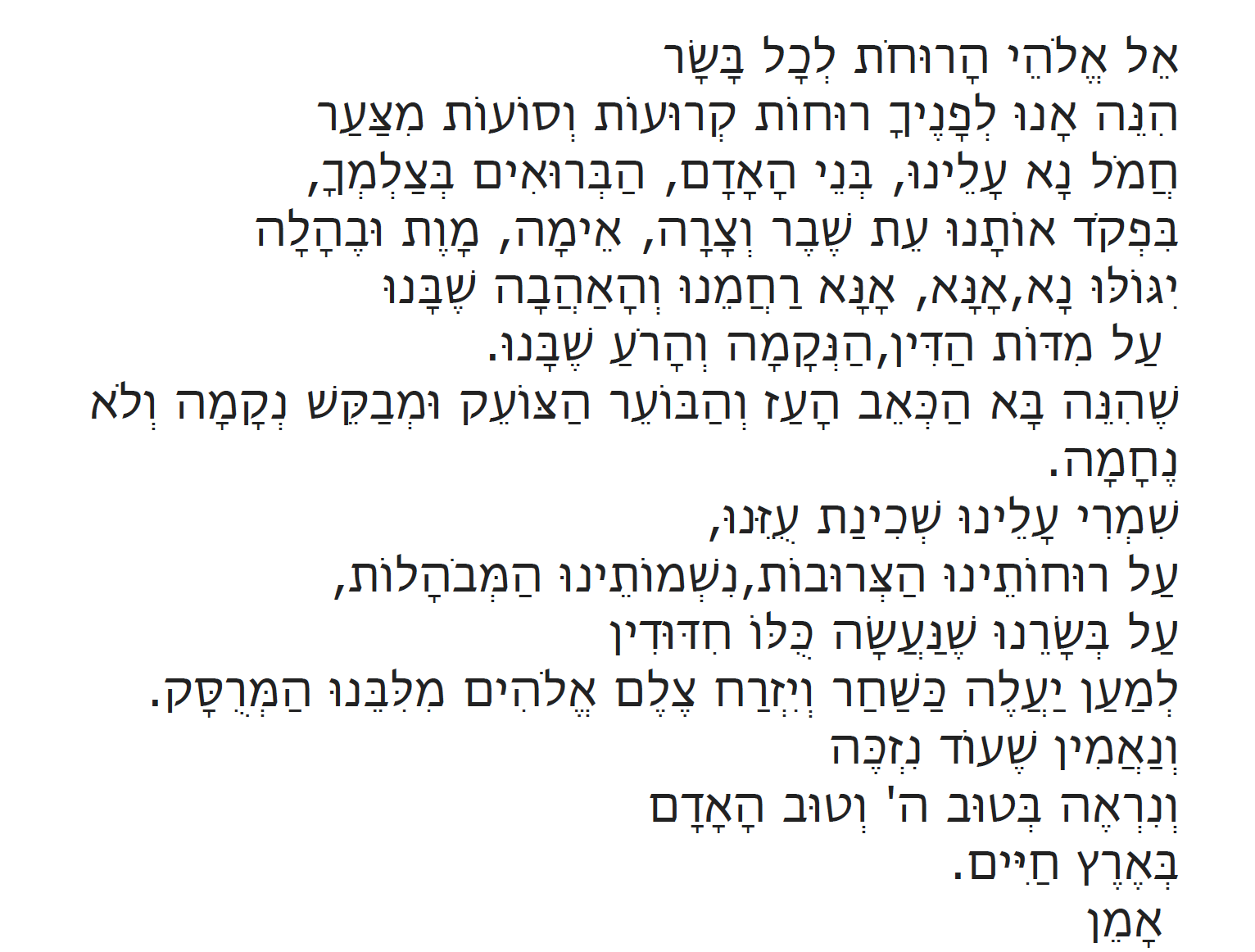
By Dr. Melila Hellner-Eshed

God of the spirit of all flesh,

Here we are before You, broken spirits, torn by grief;

have mercy on us, mortals created in your Image.

Watch over us in a time of destruction and tragedy, terror, death and panic.

Please, please:

may our compassion be revealed, may the love within us

overwhelm the harsh judgment, vengeance and evil within us.

Behold: fierce, burning pain cries out, seeking revenge, not comfort.

Watch over us, Shekhinah, our strength,

over our scorched spirits, our terrified souls,

over our completely infuriated flesh.

May the Divine Image rise, shining like the dawn,

from our crushed hearts.

May we have faith that we will merit

to witness the goodness of the Holy One,

the goodness of humankind,

in the land of the living.

Amen

A Prayer for Israel in this Time of War

By Rabbi Naomi Levy

God, our Strength and Protection, we pray for the State of Israel in this devastating time of war, shock and grief. Our hearts are breaking. We pray for the lives of the civilians and soldiers who have been heartlessly Kidnapped by Hamas. Watch over them, shelter them, bring them home.

We pray for the souls of the innocent victims who were brutally murdered. Send comfort and strength, God, to the grieving. Send healing to the injured, and strength and wisdom to their doctors and nurses. We pray for all our family in Israel in this time of tragedy and crisis.

Watch over Israel, God, spread Your shelter of peace over the land and over all our siblings who live there. Shine Your light upon Israel’s leaders, officers and advisers, that they may overcome divisiveness and act with clarity. Protect those who defend Israel, let them be safe and victorious over those who attacked our people. May they root out terrorists while preserving the lives of innocent civilians in Gaza, and create a pathway toward true and lasting peace. Bring peace, God. Let it rain down from the heavens like a mighty storm. Let it wash away all hatred and bloodshed

Peace, God, please, God.

God of the brokenhearted, God of the living, God of the dead, gather the souls of the victims into Your eternal shelter. Let them find peace in Your presence. Their lives have ended, but their lights can never be extinguished. May they shine on us always and illuminate our way. Amen.

Filed Under: Poems and Blessings, Rabbi's Posts

Technology Supports Inclusivity at AARC, in the Oct. 2023 Washtenaw Jewish News

October 5, 2023 by Emily Eisbruch

Filed Under: Articles/Ads, Uncategorized

Malchuyot Drash

October 1, 2023 by Gillian Jackson

By Deb Kraus

Malchuyot is about majesty, kingship, power.  

Because this past year I finally visited Israel and Palestine, I can’t think about power without thinking about the abuse of power.  We don’t usually tackle this problem from the Bimah and while I know what I’m about to say is pretty mainstream in our core community, I am aware that some visitors may be shocked by my candor.  But Marge Piercy challenged us in a poem last night, “where have I spoken out? Who have I tried to move?”  And the message I picked last night from theblessing box said, “may my words 

So here goes: 

Our group went to several Palestinian communities where power, on the part of the Israeli government, and the  soldiers and settlers they support, has been institutionalized:

 Ir David (city of David) is a national archeological site in disputed territory that appears to exist solely to document the presence of ancient Jews, so as to lay claim to the area.  18 year-old soldiers stand around in their crisp brown uniforms chatting with each other uzi’s strapped to their belts.  In Silwan, which is where Ir David continues to expand, Palestinians are being thrown out of their homes, and to add insult to injury, they are expected to pay to have their homes demolished.  

On another day, we picked olives near Bethlehem with a Palestinian family whose home has been destroyed not once, not twice but four separate times.  We used our power as Jewish Americans to prevent them from being bullied during the harvest.

But the situation which was the eeriest to me happened when we visited Yad Vashem, the national Holocaust Museum.  We were stunned to realize how many of the same tactics were used by both regimes.  For example, people’s homes are routinely broken into in the middle of the night and those detained have no due process. Palestinians can’t travel without going through slow , crowded checkpoints and out-of-the-way airports.  It is illegal for our guide, a Palestinian Christian, to live with her husband, an Arab Israeli.  Palestinians have few rights and no voice, and constantly live in fear that their basic needs will be taken away, if in fact, they ever could count on them at all.  

I know what collective trauma can do to a people, and I want to emphasize that I get “never again,” truly I do.  But in this case the new Israelis made the calculation that military strength and personal intimidation, humiliation, were the ways to insure “never again.”  And over time. this results in those 18 year-old soldiers I mentioned already, acting like this is normal.  And it results in settlers, some now in their third and fourth generation, militantly believing that this land, which is clearly within Palestine, is indisputably theirs.  

And so the oppressed became the oppressors.  Most ironically, of course, this has not resulted in peace or security for anyone.

I knew about all this, of course.  I’m a good progressive Jew.  But to see the many facets of this was mind-numbing.  And as an American Jew, this happens in my name.  In all our names.  

Sheila Weinberg, who we just quoted in her prayer for peace in the Mideast, was our trip leader along with her husband Maynard.  One day she pondered, “Jews never had power before.  And you never know how you’ll deal with power until you have it.”  This was after visiting Hebron, where settlers daily rain garbage and human waste down on Palestinian merchants… just meters away from where Abraham—Ibrahim—is buried.

While the Mideast is not simple, the overall message is: Power is so easily misused.  

So as we rise and prostrate ourselves for the Grand Aleynu, let us think about our relationship to our power and privilege and vow to become more aware of it.  And to stand up for the powerless, in our groups but also beyond them.  Do what you can, when you can, even if just so Marge Piercy’s words don’t sting as much next year.  For awareness is always the first step towards change.

Filed Under: Posts by Members Tagged With: High Holidays 2023

Kavanah Alef 3

October 1, 2023 by Gillian Jackson

By: Jim Morgenstern

One of my favorite aphorisms says:  Institutions [and religion, universities, corporations all qualify!] … “Institutions by their nature transform experience into dogma.” 

The inference that is drawn [ albeit subconsciously!] is that by practicing the dogma we will recover the actual experience.  Clearly not correct.

Yom Kippur is a Jewish moment in the year where we have the great desire for recovering the experience [of t’shuvah / Kipur /  atonement].  And we do not lack for dogma or rituals or practice: Consider:  We have Five services in lieu of the usual one or two or three or four, we have more prayers in every service than usual, we recite the  confessionals aloud as a group, we fast for 25 hours, we retell the ritual of the scapegoat and Temple service, etc.  Tennis shoes, anyone ?  I do not mean to ignore these pieces of dogma – They are all useful tools in our toolbox or arrows in our quiver – choose your metaphor!  

If I go through my to-do list of ritual today and check off each item as I accomplish it – will I therefore automatically experience the feeling of t’shuvah?   Is it sufficient to focus on V-ing all my check-boxes? Or is there a gulf between the practice and the experience and if so how do I bridge that gulf?  and no – I do not have the magic answer to this.  moreover, I think it unrealistic to expect that a single answer would be applicable to all in the community.  

It strikes me that one of the key aspects of today’s Judaism is that our spiritual experience is the responsibility of each of us individually — I do not now have go-betweens between me and God … no pope, no ‘high priest’, no “spiritual leader” to intercede for me.  To me,  the beauty of the Reconstruction Movement is that it recognizes THAT individuality of practice.  

But I need to ask the burning question:  How can I during the course of my day transform the practice of the dogma of Yom Kippur into the experience that I seek? 

I think that the best I can do for myself is to recognize that this gulf exists – between executing the rituals, practicing the dogma as it were,  and recovering the experience.  I think that aspiring to the Yom Kippur experience extends beyond executing the checklist of rituals and I need to open myself to the search towards recovering the experience.

gmar hatimah tovah

Filed Under: Posts by Members

Cultivating Gratitude in Challenging Times

October 1, 2023 by Gillian Jackson

By Carole Caplan-Sosin

I was out in the hoop house when I got the call. It was late march and all of my winter planning had turned into spring planting, and I was now surrounded by hundreds of tiny seedings which were to become the farm’s produce and products for the coming year.

I hesitated to answer when I saw that it was her. There’s no planning, no preparation, you know, for a call like that.

“Hello dolly,” I finally said.  “Mom”, she answered, “it’s cancer.” A blackness that had almost devoured me ten years earlier, began to grow thick around me and threatened to suck me in. 

I’ve been asked to speak this morning on how one cultivates gratitude in challenging times. I honestly thought this would be an easy piece to write. After all, I’ve had my share of challenging times, and as a yoga teacher and teacher trainer I’ve been talking about gratitude practices for years. But the truth is, as I sat down to write, all that became clear was just how difficult it is to cultivate gratitude—especially in challenging times! Sometimes gratitude simply seems out of reach.  It’s ok.

In the US in 2022, an estimated 290,000 new cases of invasive breast cancer were diagnosed among women and over 40,000 died from the disease.  At age 30 you have less than one-half of a percent chance of being diagnosed. Elana had turned thirty less than three weeks before her diagnosis. We were stunned. I packed for San Diego, where she was living with her father, not knowing when I would return. 

It was on the plane ride out that an unwelcome but familiar fear began to take hold. Ten years earlier her father had dragged me—and our family— through a long, unnecessary and devastating court case. With good therapy, however, I had learned to refer to this time of my life simply as “the crash,” and see it mainly through a rear view mirror.  Still, I realized I hadn’t spoken to this man in years, but would now have to be with him daily for months to come. But the panic eased with incredible gratitude I had that a friend was letting me stay in her beautiful San Diego home, and that, somehow, amazingly, her home was no more than 8 or 9 houses away from his. Sometimes gratitude comes gifted from and for what others do for us. Let them.

Every night at dinner since they were very small, I would ask my kids to share their best and worst thing of the day. Rules were you could have two bests, but never two worsts. My first night in San Diego Elana announced her worst was that she had been diagnosed with cancer, but her best was that her parents were together with her, sharing shabbat dinner in her father’s home. Sometimes gratitude just shows up and blows your mind.

A breast cancer diagnosis is a portal through which you pass and are changed forever. We agreed that we would look towards the BEST POSSIBLE outcome—whatever that might be, grateful for the incredible privilege we had to get Elana the care that she needed. Elana extracted and froze her eggs, proactively shaved her head and thoughtfully donated her long curly hair. We bought wigs and scarves to adorn her beautiful baldness, but we also bought donuts and bagels to bring to each chemo and doctor visit, consciously offering thanks to those who devoted their lives to helping families like ours. Elana decorated each box with colorful markers as we waited in endless waiting rooms. It wasn’t a lot. But it was something we could do. Sometimes gratitude comes from and for what we can do for others. Just do it.

You will not hear me say that ‘everything happens for a reason’. I’m just not convinced life works that way.  And I will never say that I’m grateful for Elana’s cancer. Yet who knew a possibility existed where my ex and I could talk and laugh and sing karaoke and love our child together as she went through the horrible thing she did? Who knew that Elana’s cancer journey would allow me to so deeply heal that part of me horribly damaged years earlier? Sometimes gratitude disguises and surprises. Let yourself be amazed by it.

But can we actually cultivate gratitude? I don’t know. Maybe the best we can do is surrender to all that we can’t control, and learn to live with radical acceptance of what shows up in our lives. Perhaps work to cultivate a lifestyle that allows for the possibility of moments of gratitude to become accessible. I walked early every morning in California and consciously took notice of the flowers, the sun and the sea. It filled me just enough so that I would have something to offer her when I arrived as she woke each day. Sometimes gratitude is no more than the by-product of softening inner spaces that we hold so tightly closed. Let gratitude set you free.

While I was in California tending Elana, the weeds on the farm grew uncontrollably, swallowing perennials whole. Fruit trees bent and broke under the weight of untended fruit. Those seedlings that I had nursed that previous winter and early spring—they all died. But tomorrow is Elana’s cancerversary- and together we will celebrate her being one year cancer-free. Of the 4 million breast cancer survivors in the United States today, it’s easy to be grateful that my daughter is one of them.

I pray that this year we all may find gratitude, or that gratitude may find us so that our minds may be a little more open, and our hearts a little more free.  G’mar tov.

Filed Under: Posts by Members Tagged With: High Holidays 2023

Zichronot Drash

September 25, 2023 by Gillian Jackson

by: David Erik Nelson

Zichronot, “Remembrances.” This is the second of the three major themes of Rosh Hashanah. It’s the meat sandwiched between Malchuyot—”Kingliness,” which is the All-of-Everything of the physical Universe we enjoy—and the enigmatic sounding of the Shofar.

There’s a tendency to treat Zichronot as being about self-inspection: The High Holidays are a time for taking stock of the prior year, for looking to how we can avail ourselves better in the coming year. So we remember what passed, and try to mend the misses.

That’s a good practice.

But I wanna suggest that its liturgically off the mark, and overly negative. 

Zichronot is rooted in the word Zichor—the command to “remember“. And Zichor is more often used in Torah to talk about God remembering or noting someone, not people reflecting on past deeds.  

In Pslam 25, David writes: 

Remember, Adonai,

Your compassions and Your mercies—

for they are from eternity.

Remember not the sins of my youth, nor my rebellion.

According to Your mercy remember me,

    for the sake of Your goodness, Adonai.

Those “remembers” are Zichor. Likewise, it’s Zichor when HaShem remembers Noah and the beasts in the ark, and so makes the floods subside.  It’s Zichor when the Eternal remembers Hannah and Rachel and gives them children, and Zichor again when Elohim remembers that we were slaves in Egypt. It’s Zichor Samson cries out for when he needs a little more oomph to crush the Philistines.

Additionally, while our modern reading of this Season of Remembrance often fixates on the negative —the errors we’ve made, the harms we’ve done —more often than not, those ancient Zichors are asking the Universe to recall what has been good in us and worthy.

I raise this only because we have an awful habit of only remembering what is shameful, only fixating on what hurts.  No one thinks about their stomach when it feels fine; none of us can think of anything else when it aches.

So that’s my hope for this year . . .  that we be willing to ask of ourselves, and of each other, the thing that ancient Jews asked of that Terrifying and All Powerful Being They Sensed Encompasses Us All:

To remember fondly, to see what’s good in the person sitting across from you at the dinner table, to accept and seek to expand and amplify the good in what you are, and have been, and will be in the coming year.

Amen.

Filed Under: Posts by Members Tagged With: High Holidays 2023

Shofarot: Rosh Hashanah 2023

September 25, 2023 by Gillian Jackson

By Anita Rubin-Meiller

I am an early morning person, so it was not surprising that as I was wondering what to offer for this brief drash, I awoke with these words of the Sufi poet Rumi on my mind:

“The breeze at dawn has secrets to tell you- Don’t go back to sleep”

Every year we gather together at Rosh Hashanah to hear the same message sounded through the shofar: wake up, wake up, keep returning to waking up. What is this awakening we are meant to be engaging with this day, the whole month of Elul that preceded it, and the 10 days of Teshuvah that will follow it until we gather again? In his seminal book for the High Holidays, “This is Real and you are Completely Unprepared”, Rabbi Alan Lew offers us many possible answers to that question. In a chapter entitled “the horn blew and I began to wake up” he writes: (this is a time)”to devote serious attention to bringing our lives into focus; to find out who we are and where we are going.” If I am like most human beings, than we all know that this is NOT an easy endeavor. It is a challenge to accurately and clearly assess ourselves, to be completely honest about all the dimensions of our aliveness – our physical, mental, spiritual, emotional and relational states.

I am an early morning person and it is easy for my heart to open to the secrets the breezes of the dawn might hold. It is easy for me to delight in the early morning quiet, in bird song and sunrise and to engage in meditative, contemplative, self-reflective practices at this time of day…feeling openhearted and close to God. But as the day progresses it is easy to be possessed by habitual mind states – expectations, planning, dissatisfactions, wants and to move through at least parts of my day on “automatic pilot”. 

“Don’t go back to sleep” Rumi and the shofar shout at us; return again and again to awakening.

My daughter Melissa and I have had a very close and loving relationship with many shared joys and adventures and with plenty of challenges that we have both worked hard at resolving. Her visit home last December however was experienced by both of us as fairly disastrous. We each held the other to blame in numerous ways and after she left, I felt that I did not want to talk to her for a very long time. That feeling was an awakening, a call that I had better look within.

The second line of Rumi’s poem reads: “You must ask for what you really want. Don’t go back to sleep.”

What I really wanted then and now is for a loving, non-reactive, honest and understanding relationship with my daughter. I knew that that had to start with me and so I journaled a lot and went to see a therapist. In that way I came to see what stirred inside of me that contributed to our difficulties during that visit. I saw how guarded I needed to be growing up; how risky it was to be vulnerable or speak my truth. I saw how frequently I was judged and criticized and deemed “too sensitive”. I saw how I have continued to carry this protective impulse even in my most dear relationships where it is the least necessary. I saw how that interferes with honest communication, especially when I am feeling concerned, critical or hurt. I awoke to knowing more deeply that to have what I really want in all my relationships I need to bring awakened attention to hearing the messages of my mind and heart clearly and to discerning if something needs to be communicated even when it is uncomfortable, or if it is something I need to work on within myself. 

I know that what I want to manifest in my life, what I am most called to live from are qualities of love, compassion, gratitude and joy. I know that the path to doing that includes actions of connection, deep listening, daily spiritual practices and faith. This does not mean I am capable of staying awake to making them manifest at all times. Sometimes I will lose my way. Sometimes the world, or the dynamics of a relationship will overwhelm.

Rumi concludes: “People are going back and forth across the doorsill where the two worlds touch. The door is round and open. Don’t go back to sleep.”

We go back and forth across the doorsill many, many times, with and without awareness, knowing and forgetting our intentions. We can only do our best to return again, to awaken to being genuinely who we are. Don’t go back to sleep.

Filed Under: Posts by Members Tagged With: High Holidays 2023

Poem for Rosh Hashanah 2023

September 25, 2023 by Emily Eisbruch

By Emily Eisbruch

Summer ends, fall comes near

The Jewish days of awe are here

With prayer and music we manifest our tradition 

As we co-create this year’s edition 

Unetaneh tokef, Who shall live and who shall die

This is serious and somber, no way to lie

Honey is eternally golden and sweet

But at the days of awe, many forces meet

Apples are good, yet sometimes tart and sharp

Well, thank goodness for Rav Gavrielle’s harp

As we gather at the new year’s start

We open our spirit and our heart

Let’s work to grow, stretch and learn to love more

Welcome new friends and embrace the year 5784

Filed Under: Posts by Members Tagged With: Poetry

Greetings from Rav Gavrielle

September 5, 2023 by Rav Gavrielle

Dear AARC Community,

I want to wish you all a happy and meaningful Elul journey and let you know how excited I am to be serving as your rabbi. Since starting this position in July, I continue to be truly touched by how warm, welcoming and helpful people are. Your willingness to collaborate and volunteer your time, heart and soul, and share your remarkable gifts is truly inspiring. It has been a true joy getting to know those of you who have come to services, Elul classes, the picnic and other gatherings.

I look forward to meeting more of you at the Havdalah Selichot service on September 9th and during the High Holy Days and embrace the opportunity to build meaningful relationships, and support and enrich your experience of Jewish life.

Brachot,

Rav Gavrielle

Filed Under: Rabbi's Posts

Yom Kippur Workshops 2023

August 31, 2023 by Gillian Jackson

On (non)chosenness

Why did Mordecai M. Kaplan decide to eliminate the chosen people concept from Judaism when he reconstructed Judaism as an evolving religious civilization, what was the response at the time (1945), and what are the implications for us today if we accept Kaplan’s rejection of chosenness? Deborah Dash-Moore will lead a discussion of this historical and timely topic.

September 25, 2:15-3:30pm

Safe space

We will once again offer a room for people who want to share what is coming up for them on Yom Kippur this year. Done 12-step style (an uninterrupted time to share with minimal feedback offered), we ask only that you plan to arrive on time, stay for the whole time, and respect confidentiality. Deb K. has led this event in the past, but is open to someone else leading instead or co-leading with her.

September 25, 2:15-3:30pm

A modern telling of the book of Jonah:

Rav Gabrielle will introduce us to a short play, Jonah: A Dramatic Midrash, by Mark Nazimova, that can be performed as a “table reading” – i.e., no props, unless someone has a giant whale belly to contribute! We will use the reading as a point of departure for discussion. WE WOULD STILL LIKE SOMEONE TO FACILITATE THIS WORKSHOP; no directorial experience is required.

September 25, 3:45-5:15pm

Singing Together

Members of the Davening Team will be at hand to sing us through the afternoon. Join when you are able to sing together. This group will meet outside if weather permits.

September 25, 3:45-5:15pm

Filed Under: Upcoming Activities

  • « Go to Previous Page
  • Page 1
  • Interim pages omitted …
  • Page 12
  • Page 13
  • Page 14
  • Page 15
  • Page 16
  • Interim pages omitted …
  • Page 75
  • Go to Next Page »

Footer

Affiliated with

Copyright © 2026 Ann Arbor Reconstructionist Congregation