Over the years, quite a few articles have described our lovely Beit Sefer.[pdf-embedder url=”https://aarecon.org/wp-content/uploads/2015/09/Beit-Sefer-all.pdf”]

Ann Arbor Reconstructionist Congregation
Over the years, quite a few articles have described our lovely Beit Sefer.[pdf-embedder url=”https://aarecon.org/wp-content/uploads/2015/09/Beit-Sefer-all.pdf”]

At our Shavuot study this year, a group of AARC members discussed several Jewish texts and traditions surrounding the word “torah.” Sometimes Torah is used to name the five books in the scroll read weekly on Shabbat; sometimes “Torah” includes Talmud and other writings as well. At times Torah is understood as “law,” while, as Rabbi Michal pointed out, “torah” can also mean “aim,” as in a guide for our actions.
One of the Reconstructionist movement’s goals for religious education is to convey Torah as “the ongoing, creative, and sacred search for meaning in life, a record of human encounters with the Divine.” As the new director of our Beit Sefer, I embrace this creative and ongoing Torah as our model. Our goal is to instill in the students the sense that, with the tools of Jewish tradition, their lives are creating the Torah of the future. Just as the Jewish people’s experience of God, Torah, and peoplehood has changed and grown throughout history, the students’ own experiences will change Judaism.
Each aspect of Reconstructionist education is infused with creative, participatory purpose. For instance, the point of Hebrew language study isn’t only recitation of a Torah portion. We study Hebrew in order to participate in community and express ourselves: in ritual, prayer, and text study, fostering connections with Jewish civilization of the past, the present, and the future. These goals may be lofty for a supplementary elementary school, but we can achieve sparking the desire to reach for them, and the basis of the tools to get there.

Another hallmark of Reconstructionism is incorporating contemporary ideas and discoveries in science and psychology into Jewish practice. Starting Fall 2015, the AARC Beit Sefer will begin to use Project-Based Learning (PBL) as a teaching approach in our K-6 religious school curriculum. An inquiry- and innovation-based teaching method, PBL is a perfect fit for a Reconstructionist religious school. PBL lessons open with a driving question – something the students feel they need to know. The teacher then guides the students through a journey of discovery, using a variety of resources, such as storybooks, excerpts from texts, experimentation, parents, teachers and other students. Students choose how they will present the information they have discovered; the culmination of each project is sharing it with a larger audience. Questioning has always been the basis of Jewish learning, so combining these contemporary teaching methods in the Jewish classroom is a natural.
In the AARC Beit Sefer classrooms, the students will work in pairs or small groups, using our community’s deep human resources of artists, techies, musicians, teachers, etc. to investigate the yearly cycle of Jewish holidays, life cycle rituals, the practice of mitzvot, Jewish history, liturgy, and literature.
An example of a PBL lesson for the Kitanim, [Read more…] about Torah of the future at AARC’s Beit Sefer
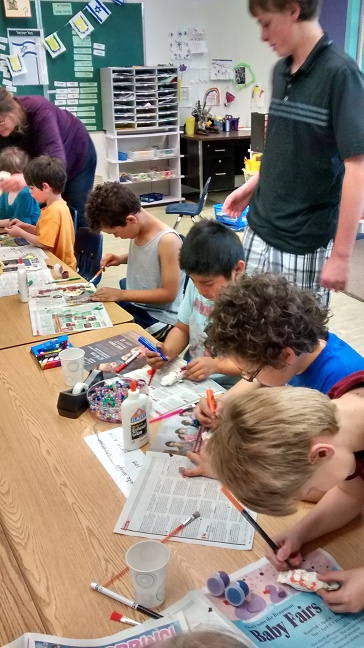 What goes into a mezuzah? Just ask an AARC Beit Sefer (Religious School) student! On April 26th and Mary 3rd, AARC member and Beit Sefer mom Marcy Epstein led an all-school mezuzah making workshop. The students learned about the difference between the mezuzah case and the scroll inside, and how we have come to name each part as the mezuzah. They discussed why and how Jewish homes have mezuzot on our door frames and demonstrated the ritual of kissing the mezuzah both entering and exiting the rooms of our homes. The students explored the letter Shin and many of the words that it represents, and then they learned about the prayer on the mezuzah scroll, the Shema and the V’ahavta. Marcy shared how these two prayers became so important that we would want them ever present in our homes.
The students rolled out their airdry clay and formed them into beautiful original cases, working with shapes and wood pieces for texture. Then Marcy and the teachers made the letter Shin for each child and set their mezuzot cases to dry, reminding them that over the week they might think about what prayer they would like to say while entering and exiting their bedrooms. The next week, the kids painted and embellished their beautiful cases. They then copied the Hebrew of the Shema and first words of the V’ahavta onto origami paper “scrolls” along with their own original prayers and set them inside the mezuzah cases to make their personalized mezuzot. By adding their own prayers to the scroll in the mezuzah, the students learned about Jewish “lifehacks,” explained by Rabbi James Brandt, director of the Jewish Federation of the East Bay in a January 2015 Jewish Week article “as this generation’s equivalent of ‘do-it-yourself Judaism,’ represented by the groundbreaking 1973 publication of the The First Jewish Catalog (co-edited by Michael Strassfeld), which offered a model of creating Jewish life ‘outside the official system.’”
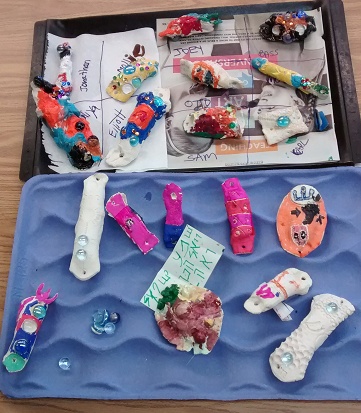 Marcy hopes that our families might share a mezuzah hanging with the kids, not only so they can know where on the door frame to look for a mezuzah, but also to celebrate their warming embrace of the ancient ways with modern import reflective of their lives.
So, if you ask the students at the AARC Beit Sefer, you might find that in addition to the shema on a scroll, what goes into a mezuzah case is love, care, creativity, and their own heartfelt (or silly, but definitely personal) prayers.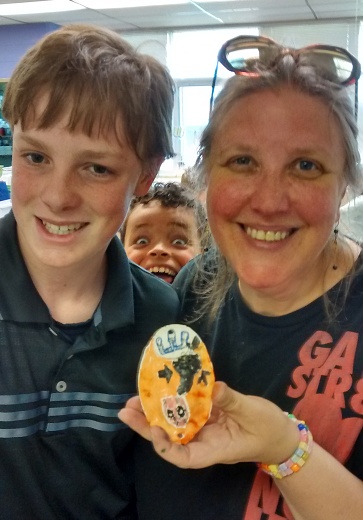
By Rebecca Ball
Photos by Sara Goldshlack

Being new to the AARC Beit Sefer, and to attending a Beit Sefer in general, my family and I weren’t necessarily sure what to expect this year. We have not been disappointed! The learning and camaraderie and overall fun that my sons have experienced has been so positive. I am extremely impressed by all the thought and work that has been put into the curriculum and activities the students are enjoying.
One activity in particular that has been quite rewarding has been the school-wide Tzedakah Project. For this project, the students decorated their own tzedakah boxes to bring home. They earned money at home by doing chores and other tasks for their parents. The students discussed in class the things they did to earn the money, such as making dinner for the family or shoveling snow or cleaning their rooms. After several weeks of earning money, the students brought in their boxes and voted on the agency to which they would donate. They chose the Humane Society of Huron Valley, and were proud to discover that they had raised over $125 for the animals! 
The school then had a volunteer from the Humane Society come to visit with an adoptable dog. She described to the students the programs and supplies towards which the students’ money would go. The children had the chance to pet the dog and learned about showing compassion towards animals. Many were even interested in learning how to volunteer at the facility. The authentic, real-world experience that this project provided helped our young people to live the experience of tzedakah rather than merely hearing about it. Giving tzedakah is a righteous act in Judaism, simple justice and possibly the most enlightened of all the commandments. Our Beit Sefer has beautifully illustrated this joyful obligation for our children.

