Our once a month Shabbat morning service is informal and relaxing, a lovely way to learn and share Jewish tradition while forming closer bonds of community. September’s Second Saturday will be Rabbi Ora’s first as our new rabbi.
4365 Platt Rd, Ann Arbor, MI 48108 (Platt and Ellsworth)
Accessible North Shelter
AARC will provide drinks, charcoal and paper products. You bring something to grill, a side dish to share, and your summer stories! The BBQ will be at a new location this year, Lillie Park.
Our annual BBQ picnic is a very nice time for all ages to relax together, introduce new people to the congregation, reconnect after summer travels.
Thinking of joining? New member? Want to meet Rabbi Ora? Everyone welcome!
Since Beit Sefer Director, Clare Kinberg is teaching the K’tanim (Little Ones) this year, Beit Sefer Committee Chair, Becky Ball will convene the meeting.
Please, at least one parent from each family attend.
Yesterday I represented AARC at a planning meeting for the August 25thCommunity-Wide Shabbat at Hillel. It looks like most of the Ann Arbor congregations–Temple Beth Emeth, Beth Israel, the Orthodox Minyan, Pardes Hannah, and AARC–are coming together at Hillel to welcome Shabbat with song and have brief services and a meal. The evening will begin with activities for families with kids. The Hillel staff is arranging for extra parking. I hope many members of AARC will come out for this inaugural annual Community Wide Shabbat.
It was interesting to learn at the meeting, for the 3rd of 4th time this month, that many people who work at the JCC don’t know that the Ann Arbor Reconstructionist Community (AARC) and the Jewish Cultural Society (JCS) are different organizations. I do love JCS: “Ann Arbor’s Secular Humanistic Community,” and we do both rent space at the JCC and have Sunday morning schools for our kids. But Reconstructionist Judaism is distinctive in our approach to building community that emphasizes spiritual aspects of Judaism, commitment to evolving religious practice, and inclusivity of a wide range of relationships to God and godliness. There are some great resources on these ideas on our website.
We need more opportunities for the local Jewish community to get to know us. Which leads me to the bulletin board.
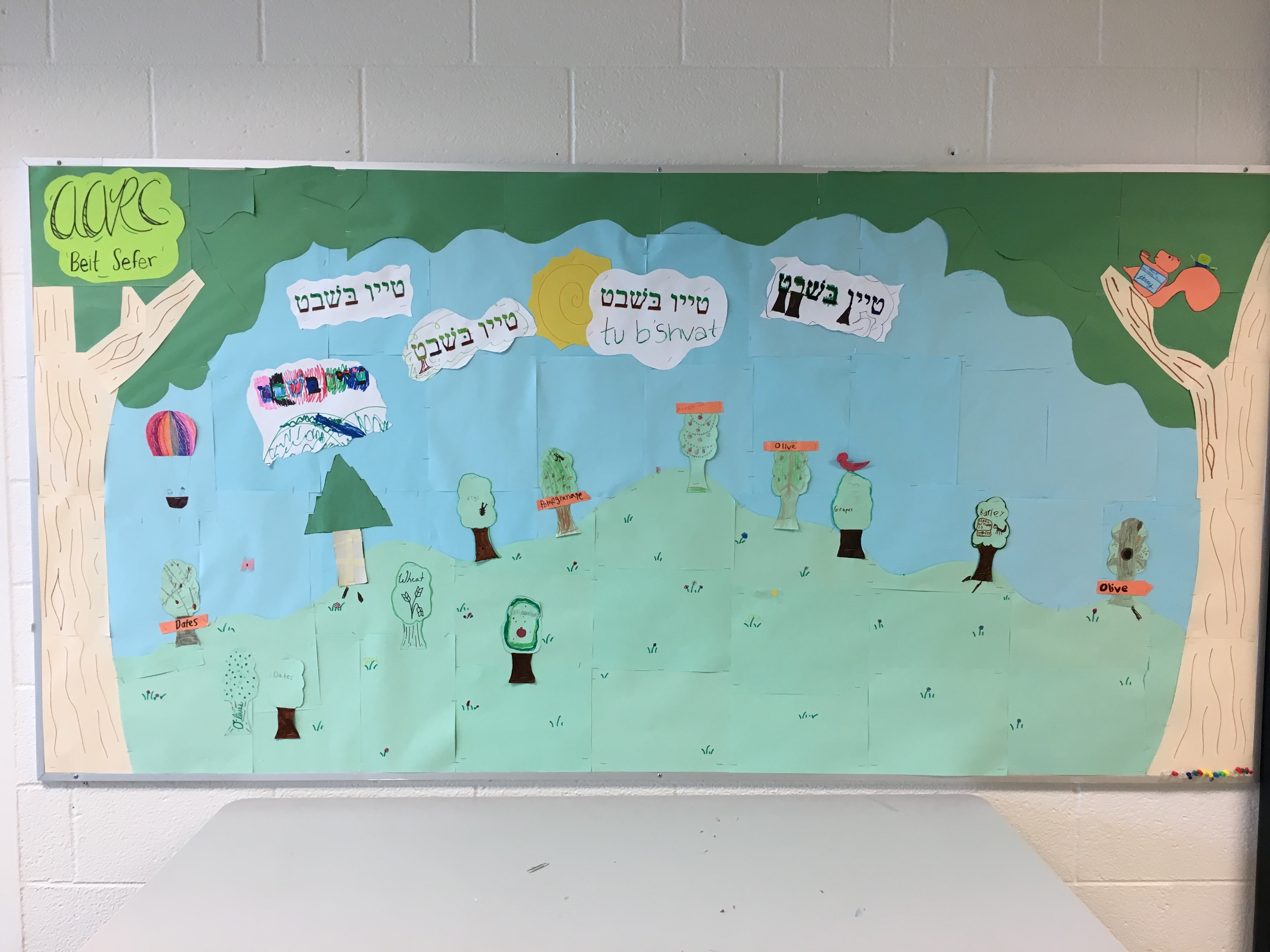
Last year, the G’dolim and K’tanim designed a Tu B’Shevat bulletin board that celebrates nature and the seven species of foods in the Torah. We are ready for a new one!
We have some prime wall space at the JCC which needs some updating. We could be using the bulletin board to put ourselves out there in eye-catching informative fashion. Do you have any ideas? Is graphic design a forte of yours? We have lots of photos of activities, our handmade and distinctive ritual objects, our members. The bulletin board could highlight our new rabbi, the upcoming High Holidays, our dynamic school for kids. Plus thoughtful, fun people in the congregation. Can you help design some of this into a bulletin board, soon, before the end of August? Contact Clare ckinberg@gmail.com.
Yesterday I got all excited when I realized that the upcoming total solar eclipse (August 21) coincided with Rosh Hodesh Elul, the new moon of the Jewish month in which we prepare for the High Holidays. What meaning could I derive from this momentous coincidence? Almost immediately my friend Max Jasny informed me that solar eclipses always occur on the new moon, but not every new moon. Max and I have a lot of things in common, for one, he works as an administrative assistant at Martha’s Vineyard Hebrew Center, a small congregation in a beautiful place, with a Reconstructionist rabbi. But clearly, he knows more about astronomy than I do!
Still, a total solar eclipse on Rosh Hodesh Elul has been viewed only five times in the last 250 years. It is a moment that can be grabbed to acknowledge the grandeur of the universe and the many opportunities the Jewish calendar cycle gives us to reset our personal and communal clocks.
This week I had two important meetings in planning for next year: The High Holiday Logistics Committee (Allison Stupka, me, Idelle Hammond-Sass, Mike Ehmann and Rebecca Kanner) kicked into gear with a potluck on Allison’s back porch. We planned the “big move” of all our prayer books and ritual items from the Jewish Community Center over to the UUA building which we rent for Rosh Hashana and Yom Kippur. We are so looking forward to having the services led by our new rabbi, Ora Nitkin-Kaner. As in all past years, AARC ticketless HH services are open to all and are smoothly run with lots of volunteer energy. You can view the volunteer sign up here. At least, put the dates in your calendar.
The Beit Sefer/Religious School Committee also met this week. Allison Stupka (busy girl!), me, Becky Ball and Stacy Dieve met at Becky’s home and planned two upcoming events for prospective, new and returning Beit Sefer families. We will be having a “popsicle party” on Wednesday August 30th at 6:30pm at the JCC for all returning Beit Sefer families and all families who are checking us out as a possible place for their kids to attend religious school. We’ll play on the playground (or gym if the weather is bad), share summer experiences, reacquaint the kids, and take the opportunity to show prospective families the school.
We also planned a religious school Open House at the JCC during Sukkot on Sunday Oct 8 for prospective families who may have connected with us during High Holidays and are still needing a religious school for their kids.
Coming Up in July…
July 28, Fourth Friday: Kabbalat Shabbat and Vegetarian Potluck at the JCC. This will be the last Fourth Friday that Rabbi Alana will lead for us at the JCC.
July 29, Saturday, Isabel Ahbel-Rappe’s bat mitzvah: Rabbi Aura Ahuvia will lead services.
When Reconstructionist Educators get together: Teaching Hebrew Prayer
I think a lot about teaching Jewish prayer to our kids. So, I was drawn to a recent thread of discussion on the Reconstructionist Educators (RENA) email list about teaching Hebrew prayer. One director started off the discussion by saying that the students in her school usually seem bored by learning Hebrew prayers, perhaps because “prayer is so disconnected from their lives.” She is thinking about replacing Hebrew prayer study with short sessions of silence, meditation, and writing. Another person shared a reference to a lesson plan on kids writing their own prayers. The long-time director at Congregation Beth-El Zedeck in Indianapolis wrote about his school’s “tefilah laboratory” where the students learn and write prayers and practice them in the sanctuary, where the environment affects their experience. Another director wrote about engaging families with young children with prayer. A theme running through the discussions is looking at the relationship between learning Hebrew and learning prayer: connected, yet separate, too.
This year our Beit Sefer will again be experimenting with different ways to engage our students in prayer. We want students to feel comfortable with Jewish and Hebrew prayer, to understand Hebrew prayer as an expressive mode of spirituality, to know that Jewish prayer has evolved over time, and that they can be involved in creating prayer. We want to prepare them to begin getting ready for bar or bat mitzvah, if that is the path they are on, which requires familiarity with Hebrew and Hebrew prayer. And we want them to be able to access their own spirituality through Jewish prayer. I am grateful to have a place to learn what other Reconstructionist educators are thinking about these topics.
I’d been intending to write about the RENA conference I went to back in the low key month of Cheshvan (early November)! The annual conference is for Directors of Reconstructionist religious schools, a group that at most has 100 eligible participants. There were about 15 directors at the conference.
The Jewish Community of Amherst (MA), a Reconstructionist congregation, hosted the first two days of the meeting, and for the last day we traveled about half hour away to the Springfield Jewish Community Center. We also spent an afternoon at the National Yiddish Book Center, located on the Hampshire College campus. We had sessions on developing new structures for supplementary education, project-based learning, experiential Jewish education, and other innovations..
Now that I’ve put off writing for so long, I see that long-range impact of the conference is the group’s ongoing discussions and resource sharing, made richer and more accessible now that I’ve met the correspondents. Next year’s conference is in Boulder, CO. I look forward to attending again.
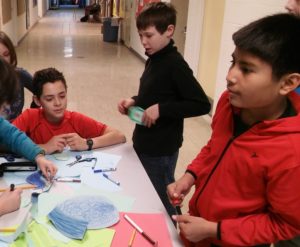
Some of the G’dolim working on our bulletin board.
Our G’dolim students, their teachers and madricha will be leading Second Saturday Shabbat morning service on May 13th. For many liberal American Jews, the Kabbalat/Welcoming Shabbat service on Friday evening is a well-attended social event of the week. The more sparsely attended (except for Bnei Mitzvah) Saturday morning service, when traditionally שחרית/Shacharit/Morning prayers and blessings are combined with reading from the Torah, is a more prayerful, relaxing time conducive to contemplation and learning. Perhaps a hard thing for pre-teenagers to lead for the congregation. But you may be surprised by how thoughtful they can be.
The students have learned the structure of the Shabbat morning service—still a mystery to many adults. They have a beginning familiarity with the prayers and melodies our congregation uses, and they have prepared a discussion on the Torah portion, Emor, which is packed with possibilities. We hope many of you will come pray and learn with us on May 13.
Second Saturday Shabbat Morning Service
May 13, 2017, 10am-noon
Jewish Community Center of Ann Arbor, 2935 Birch Hollow Dr. 48108.
by Clare Kinberg, Beit Sefer/Religious School Director
Religious education in our AARC Beit Sefer translates Reconstructionist Judaism’s values into the classroom. For instance, it is important to accept, respect and celebrate the diversity of views,experiences and backgrounds of each student and their family. Another important value is that Judaism continues to evolve and that each of our students and their families are part of that evolution.
For our Open House last Sunday, I created a brief slideshow that tries to briefly convey how our religious school puts Reconstructionist Judaism’s values into practice. Here’s a link to the slideshow, hope you enjoy it. Comments are on. Let’s discuss!
Pictures telling the story of AARC Purim this year. Thank you Nancy Meadow, Fred Feinberg, Keith Kurz, and Emily Eisbruch for the photos.
A week before Purim, Marcy Epstein hosted several families in a hamantashen, hotpot and havdallah party
Shlomit taught the Beit Sefer kids to sing Mishenichnas Adar/When Adar arrives we increase our Joy!More hamantashen baking, by Rose and Rena Basch in the Feinberg kitchen. Thanks, Greg, for running them over to TBE!
Because of the big power outage, we had to move our Purim celebration and Temple Beth Emeth graciously opened their doors. Our megillah reading organized by Dina Kurz, with terrific music accompaniment organzied by Debbie Gombert, was concluded with a display of the Friendship Scroll, with new megillah case built by Alan Haber with bronze crown by Idelle Hammond-Sass (blog post on this coming soon).Alan with the case closed.Is it Esther or is it Dina Kurz?The “Persia High School” drama…..
The shpiel writers and directors.
We continued the fun the next day at Beit Sefer, when the kids all donned hats, exchanged shalach manot bags, and of course, told the story of Queen Esther saving the Jews of Persia.
The whole Beit Sefer showed their creativity in celebrating Tu B’Shevat this year.
The Yeledim put on a play based on the book Something from Nothing by Phoebe Gilman, a retelling of a classic tale of reuse or as it is expressed in Hebrew bal tashchit/do not destroy needlessly.The Tu B’Shevat performers take a bow
Tu B’Shevat Bulletin Board: A work-in-progress, a whole school effort!More cooperative Tu B’Shevat Bulletin Board makingThe G’dolim and K’tanim designed a new Tu B’Shevat bulletin board that celebrates nature and the seven species of foods in the Torah (wheat, barley, grapes, olives, figs pomegranates, and dates). All the students and madrichim worked on the bulletin board together.At the Beit Sefer Tu B’Shevat seder all who had February birthdays raised their hands.
Finally, Drake taught us the traditional Tu B’Shevat folk dance Tzadik ka’ tamar yifrach, which translates in to movement the line for Psalm 92, The righteous shall flourish like the palm tree and grow like a cedar in Lebanon.And it was fun! Watch the dance in motion in the video below, thanks to Fred Feinberg.
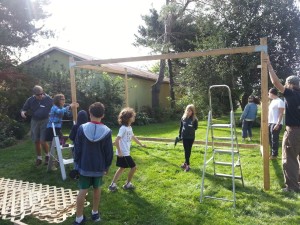
Last year, we built the sukkah on a beautiful day, hope it’s as nice this year!Beit Sefer students really did the building. Come on out and help!
This coming Sunday morning, Oct 16, 2016 9:30 to 11:30 during our regular Beit Sefer/Religious School time, AARC will be building a Sukkah at Carole Caplan’s farm, 6900 Jennings Rd. The students, teachers and parents will build the sukkah just like last year, and we welcome help from all AARC members and friends. We will scour the land for s’kach (raw, unfinished vegetable matter) roof cover; we’ll make decorations; we’ll sing some songs in the finished sukkah! Please give yourself enough time to arrive by 9:30 so we can get the sukkah built in time to enjoy it. The eight day holiday of Sukkot begins at sundown on Sunday Oct 16.
Our really delightful Children’s High Holiday machzor/prayerbook closed with the Ufros aleinu prayer which is part of the evening Hashkivenu prayer. The prayer asks God to spread over us a sukkat shalom/shelter of peace. As Rabbi Rachel Barenblatt says,
“During evening prayer there’s an extra blessing added — extra because it doesn’t appear in morning or afternoon prayer — which asks God to shelter us through the coming night. We pray ופרוש עלינו סכת שלומך, ufros aleinu sukkat shlomecha, ‘spread over us the sukkah of Your peace.’” Here’s a link to her blogpost “Shelter and Peace.”
And here’s link to the Hashkivenu prayer as sung during St. Louis’ Central Reform Congregation’s evening service. Recording features a wonderful group of CRC musicians: Rabbi Randy Fleisher, Leslie Caplan, Marty Miller, Andrew John, and Steve Friedman.
When we build a physical sukkah together, we can bring the meaning of this even closer. Enjoy, and see you Sunday.
Last year, on the first day of our religious school, Beit Sefer, I told a story about the word Hebrew word “tebah”תֵּבַ֣ת. When we meet again for the first session this year (10am Island Park) I want to tell the same story. I’m pretty sure at least some of the kids will remember it if I tell it again. I hope so, but it doesn’t matter.
Beit Sefer Students and Teachers on the last day of class last year May 2016
It is Jewish tradition to tell the same stories over and over again. And every time a story is told, even with the same words, it is a different story, because the hearer has changed. You are not the same person you were last time you heard the story. As adults, we’ve heard many stories in the Torah dozens of times. Yet, what you hear and understand from a story, using the exact same words, is different every time you hear it.
Here is the story at I told it last year:
The stories that Jews tell from the Torah are some of our oldest stories. In fact, something like 200 generations of Jews have passed down the stories that are in the Torah. One of the oldest ones, and a story that is told by lots of different peoples, is the story of a great flood that covered the earth, and one family–Noah, his wife Nehama and their children–and the ark they built to ride on the waters of the flood and to save the plants and animals so that the earth could start over.
In Hebrew the word for Noah and Nehama’s boat is tebah. A tebah is a special boat that keeps its passengers safe. In the whole Torah there is only one other tebah: while Noah and Nehama’s tebah was large enough to hold a pair of every animal and every plant on earth, the other tebah was so small it held only one baby passenger. In the Torah stories, about 100 generations after the great flood, the baby Moses was born and his sister, the prophet Miriam, built a small tebah, a basket more like a cradle than a huge ark, to save Moses’ life. When Moses was a grown man, so the story goes, he led the Jews out of slavery. So while one tebah played a part in saving life on earth, the small tevah played a part in saving the Jewish people.
Since one word, tebah, is used to mean such different things, a colossal ship made of gopher wood and a baby basket made of reeds, perhaps the meaning of tebah, is “life-saver.”
Or maybe it is the stories themselves that are the ark, the boat, that keeps us afloat. The stories I mean are both the stories that have been passed down generation to generation, and the stories we are creating with our own lives.
Basket-boat
Last year, on the opening day of Beit Sefer, we passed a small boat shaped basket around a big circle of parents and students. As we passed the basket, we each recited, “This basket holds our stories, pass it on.” Then, the person accepting the basket replied, “Thank you, I will learn the stories and pass them on.”
This year on opening day, we are going to make the baskets, and we are going to make a new story, all together. Beit Sefer begins at Island Park at 10am. Parents are asked to stay for a meeting, and to play a special role in writing a story and helping the students launch a tevah on the Huron River. Immediately following the launch, will be our AARC Annual Picnic. Noon to 3pm. Bring protein to grill, a side dish to share. AARC will provide drinks and paper goods.

Second Saturday Shabbat Morning Service


 by Clare Kinberg