This year, the Hebrew month of Elul begins September 1 — a nice coinciding of the secular and Jewish calendars. I think of Elul as a kind of pumping-the-brakes on the freewheeling expansiveness of summer; even though it’s usually still warm outside, Elul is a whispered reminder: Fall is coming. Slow down. Get a little quieter. And begin turning inwards.
Why? Because there is work to be done.
It’s tradition to dedicate the 29 days of Elul to reflection, study, and preparation for the coming Days of Awe. Elul challenges us to use each day to re-connect with our values and attune to the yearning of our souls.
Conceptually, the idea is noble, but acting on it is a bit more challenging. Here are a few resources to help you get started:
Learn more about Elul from Rabbi Yael Ridberg at Reconstructing Judaism
Psalm 27 (“Achat Sha’alti”) is traditionally recited every morning in Elul. Here’s Rabbi Brant Rosen’s interpretation of Psalm 27
Listen to a special episode from the Judaism Unbound podcast, Unbounding Elul
Here’s a simple calendar that helps you set a single intention for Elul and track it throughout the month
Thinking ahead? Sign up now to receive a daily email prompt for reflection during the 10 days between Rosh HaShanah and Yom Kippur
Is your favorite part of the High Holy Days the music? Here are 2 new niggunim we’ll be using this year – you can get a head start on learning them by clicking the links below:
Micah Shapiro’s Hashiveini
The Klezmatic’s interpretation of Shnirele Perele


 My name is Bec Richman, and I am so excited to come to Ann Arbor Reconstructionist Congregation for the High Holidays as your Song Leader. I am currently living in Philadelphia, PA with my beloved partner, Josh (who is also excited to join AARC for the High Holidays).
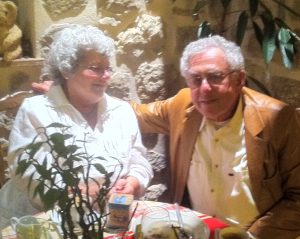 Phyllis and I are approaching our 25th wedding anniversary next year. She’s a retired professor of education, having researched, taught and practiced educational psychology, student engagement and project-based learning at the UM School of Education for almost 40 years. I’m a “nominally retired” adjunct professor at the UM School of Public Health, having researched, taught and practiced public health policy, genetics policy and community engagement for 37 years. Phyllis grew up in Brooklyn (Brighton Beach), studied at Brown (then Pembroke) and received her Ph.D. at UCLA. I grew up in Detroit, attended Harvard College and Harvard Law School, and spent the next 10 years working in our Detroit-centered family business. After the business was sold I transitioned into academe when a series of voluntary positions in Detroit’s and Michigan’s health systems led to my being invited to join the UM Public Health faculty. Now that I’m reducing my university work-load, I’ve been increasingly active coordinating the Michigan advocacy activities for J Street.
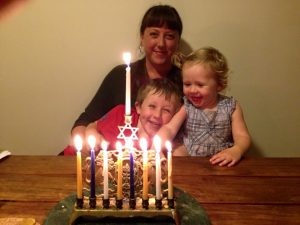 My daughter Ana, from my first marriage, went to the University of California Santa Barbara and “never returned.” She’s now a public interest environmental lawyer defending the California coastal environment from the constant threats of developers. She and her husband, Tim, have given me two awesome grandchildren, Toby “the Younger” and Kaia (pictured here with Ana). Phyllis and I escape the Michigan winters by moving to Santa Barbara for several months each year.
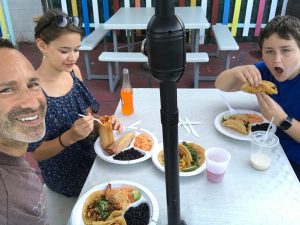 We are very excited to be new members of AARC! We are a family of four and more, living in two households and with multiple faiths, but united in our journey through life together. We are: Noah, Jennifer, Ella (age 14) and Miles (age 11). Noah is a law professor at Wayne State University and University of Michigan, Jennifer works at Zingerman’s Delicatessen, Ella is a freshman at Skyline High School, and Miles is a 6th grader at Forsythe Middle School.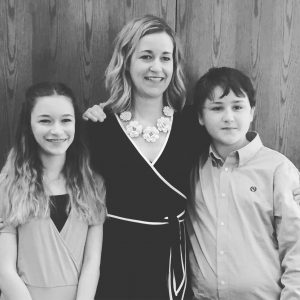
 Even the days of Selichot before Rosh HaShanah are not days of judgment – just the opposite, they are days of mercy and desire, the last set of forty days when Moshe Rabbeinu was on the mountain and the Holy One showed him favour. It is only on Rosh HaShanah that the judgment begins… Moreover, the Ten Days of Repentance are not called “days of judgment”. Just the opposite, they are days of mercy, during which Hashem avails Godself to every individual. Only Rosh HaShanah and Yom Kippur are “days of judgment”…
 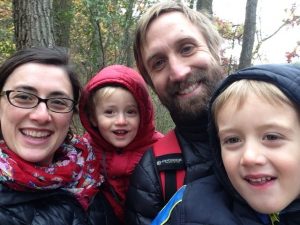 We are so glad to be new members of AARC! We are a family of four: Myself (Gillian), my husband Alex, our 5-year-old Wesley, and our 3-year-old Wade.
 On July 2, 2018 in La Opinión, the largest Spanish-language newspaper in the United States,