
Reconstructing Judaism Through the Lens of Dreaming
Why questioning, creativity, and shared experience matter to me as your rabbi
By Rabbi Gabrielle Pescador
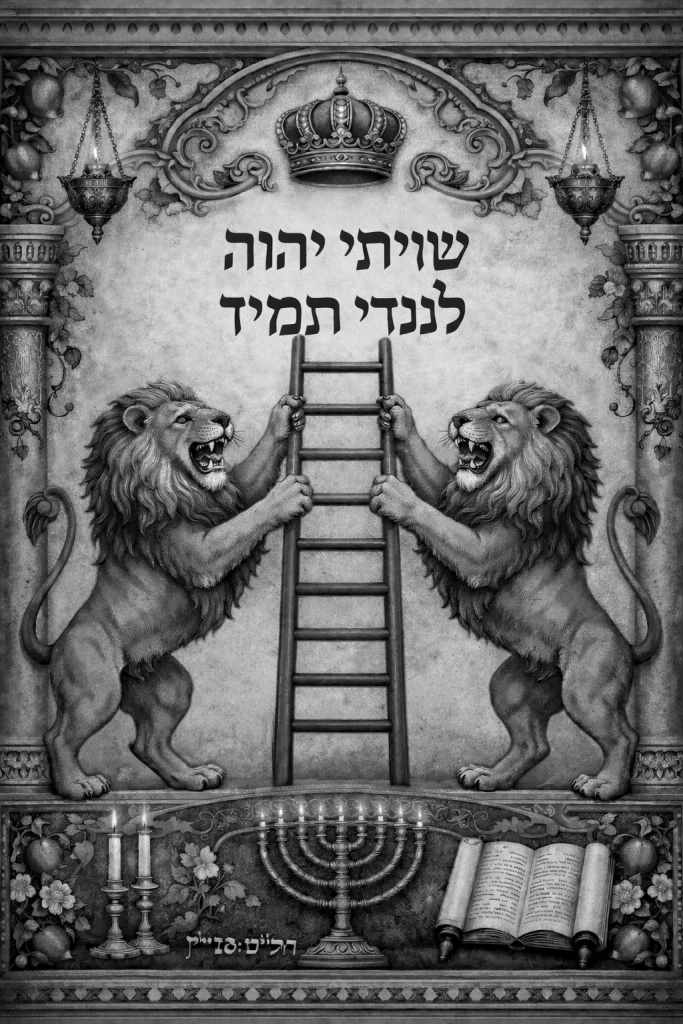
I recently had a powerful dream that has stayed with me—not because it was comforting, but because it was clarifying.
In the dream, there was an image of a lion hanging high on the wall of an attic. The attic was tall and narrow, almost chimney-shaped, with brick below and white walls only at the very top. A tall wooden ladder was required to reach the image. Facing the image was a small window.
A man and I were standing on the roof peering through that small attic window from the outside. The man shared with me that the previous evening, he saw a terrifying monster lurking inside.
I told him I would investigate the situation and began climbing the ladder. I was cautious and tentative at first, but with each step of ascent, my curiosity grew stronger than my fear.
As I moved from rung to rung, I noticed changes in the light that interplayed with the changes in distance and proximity to the top. These effects played tricks on my eyes and caused the image of the lion to change. From certain angles and degrees of light, the lion appeared animated, almost as if it might leap off the wall. When I finally reached the top of the ladder, however, I could see the two-dimensional image clear and stable in full light.
I shared my experience with the terrified man on the roof. I explained that the image itself wasn’t changing, but our perception of it was, depending on the amount of light and how close we were willing to get to the image.
When I reflected on the dream, I was struck by how explicitly Jewish its symbolic language was.
The lion evokes the symbol of Judah—strength, responsibility, sacred power. The image
functions like a shiviti: a visual practice meant to help us focus on and recognize the Divine Presence in our lived experience. Many traditional shiviti images are flanked by lions for precisely this reason. They are not meant to soothe, but to orient us toward truth and meaning.
The ladder, too, has unmistakable Biblical resonance, pointing to Jacob’s dream of the ascending and descending angels. The rabbinic imagination associates Jacob’s dream with spiritual inquiry and connection. We ascend rung by rung and sometimes need to step back down again. We investigate and then back off for a bit and retreat. The search for meaning has stops and starts, but the ladder remains—stabilizing us on that journey.
And the light—its changes, its timing, its absence and return—may be the most Jewish element of all.
Light, prayer, and living with change
Jewish prayer is structured around shifts in light: morning, evening, Shabbat candles, the Havdalah flame, the waxing and waning of the moon. The same references to light and darkness feel different at Shacharit (the morning service) than they do at Ma’ariv (the evening service). Those references can inspire awe in one moment and fear in another.
Judaism does not deny this instability of perception—it ritualizes it. Prayer trains us to live in liminal space, to notice how meaning changes as light changes, and to remain present anyway.
In the dream, the lion was most terrifying in the dark. That is not a failure of faith. It is a spiritual truth. Awe arises not from eliminating darkness, but from staying in relationship long enough to let light return.
Why this leads me to Reconstructing Judaism
I share this dream because it reflects why I am drawn—again and again—to Reconstructing Judaism, and why I feel at home in it as a rabbi.
Reconstructing Judaism is often described as “the intellectual denomination.” And yes—ideas matter. Thought matters. But that label is far too narrow.
What draws me to Reconstructionism is its insistence that Judaism is not sustained by intellect alone, but by the fullness of human experience: imagination, creativity, emotion, memory, art, ritual, culture, and shared communal life.
Mordecai Kaplan emphasized that Judaism is a living civilization—one that expresses itself not only through belief, but through creativity. For Kaplan, culture, art, music, and evolving human experience are not secondary to religious life; they are among the primary ways Judaism stays alive, meaningful, and responsive to the world we actually inhabit.
That insight continues to feel radical—and necessary.
Art, dreams, and communal meaning
Artistic and creative pathways are not “extras.” They are interpretive tools. They help us
metabolize power, change, grief, joy, and awe. They allow us to encounter Judaism not only as something we analyze, but as something we live.
Dreams belong here, alongside poetry, music, ritual, and visual art. They are symbolic languages through which the soul processes truth. They are not arguments to be proven, but experiences to be attended to—especially when they resonate with our tradition’s deepest patterns.
Reconstructing Judaism makes room for all of this. It refuses to reduce Jewish life to certainty or conformity. It invites us to question—not to dismantle Judaism, but to keep it alive. To climb the ladder. To let in more light. To expect surprise not as disruption, but as a way of understanding.
An invitation
I share this not as doctrine, but as orientation.
As your rabbi, I am drawn to a Judaism that is brave enough to keep becoming.
The lion in the dream is not meant to be feared. It is meant to be encountered—with curiosity, with courage, and with awe.
But the ladder may hold the deepest meaning.
A ladder is not self-sustaining. It must be steadied. It must be held. In the shiviti image above, two lions stand on either side, gripping the ladder between them.
We do not climb alone.
We hold the ladder for one another — through study, through art, through questioning, through shared prayer and shared experience. When one of us is afraid of what we see in the attic, another climbs. When the light shifts, we help each other interpret what is revealed.
The ladder remains between us — steady, imperfect, necessary — inviting us upward, together.
That, for me, is the promise of Reconstructing Judaism.

