
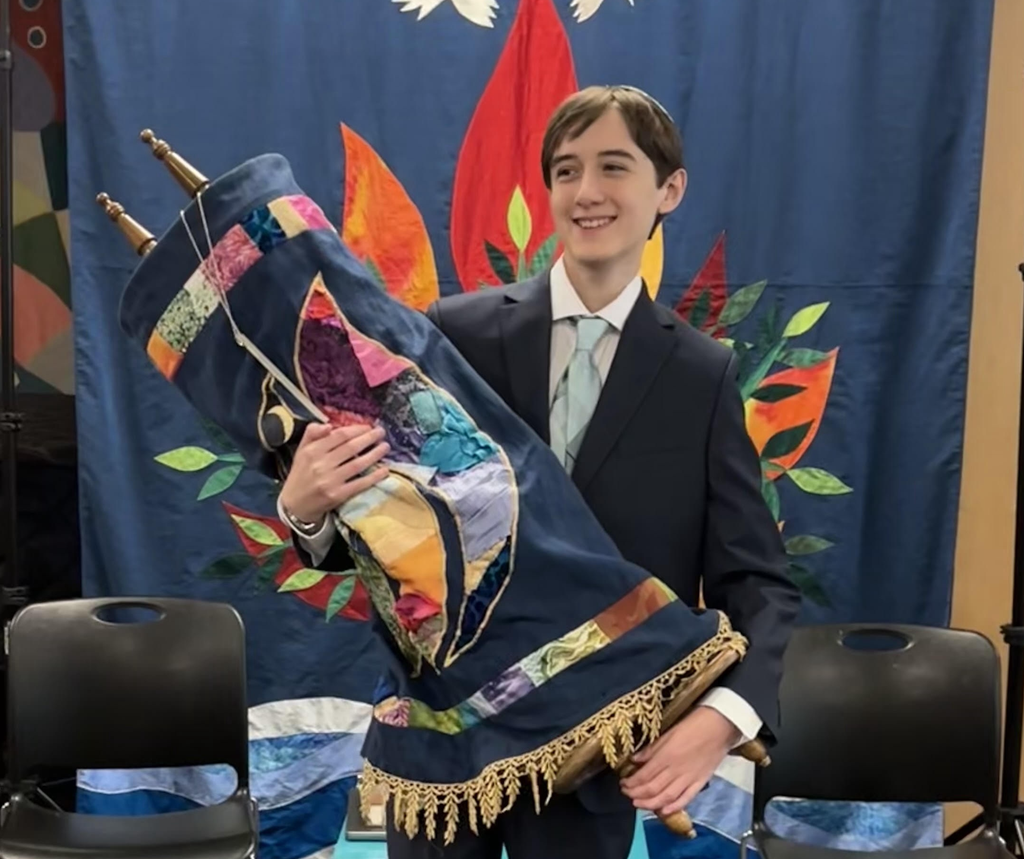
My Torah portion combines two portions: B’har and B’chukotai.
B’har talks about the Sabbatical and the Jubilee year. The sabbatical year, also called Shmitta, occurs every 7 years. In the sabbatical year you cannot farm on your land to let the land grow back naturally. In that time you cannot harvest, plant or prune. And if something does grow then animals, poor people and slaves are allowed to eat that produce. Hebrew and contracted slaves are also released.
To ensure that people have enough to eat during Shmitta, in the 6th year – the year before shmitta – God commands the Israelites to grow enough crops to last two years. Another detail about Shmitta is that all debts are canceled. The sabbatical year is still observed in Israel.
The year after seven sabbatical years is called the Jubilee or the Yovel. The Jubilee is also a year of rest and a time when a home or property is returned to the original owner – if the ownership has changed in that time. In the Jubilee you also do everything that you’re supposed to do in the sabbatical year.
The main difference between the Sabbatical and Jubilee years is that in the jubilee there is an aspect of returning property ownership back to how it was in the previous jubilee however in the sabbatical year it is more about stopping people from being mean, and to be fair to the land – and to the people.
B’chukotai, the second half of my Torah portion, talks about curses and blessings. For example, if you follow God’s laws then you will be blessed and your crops will grow and you will not be attacked by anyone or anything, and you will win battles.
However if you don’t follow the laws then you will be cursed and you will lose all of your battles and continue getting punished.
This doesn’t completely make sense to me because some of the rules in Torah do not apply anymore. Why should people be punished for things that do not make sense? And some of these commandments are longer practiced, even according to the rabbis – like the jubilee. It would be almost impossible to celebrate now. This could cause problems because people would lose a lot of money if they had to return the homes they bought to the original owners. Our economy would crumble.
Shmitta, however, is practiced in Israel and the Jewish law around it is very complicated. But I don’t think it would work in this country. However, in the spirit of shmitta – of being kind to the land – we could try to use farming methods that help the land and make it easy for crops and nature to flourish.
That is what I’m trying to do for my Bar Mitzvah Project. For my bar mitzvah project I am planting a garden in the Eddie Center with wild and native plants in Chelsea – where I live – because these plants perform much better in our environment.
Native plants are important because they provide something for native animals to eat and they make healthy roots that can help the land and prevent problems with it. Native plants grow easily and naturally and do not need as much human intervention to flourish, if any. So you don’t need toxic pesticides and you don’t have to use as many energy consuming devices for the plants to grow successfully. Because these plants are native to this region and have adapted to it. They grow well in this environment.
How does my Bar Mitzvah Project relate to the themes in my Torah Portion?
It could be easier for the land in my city to rest because it does not need as much human intervention (beyond planting) because the native plants were made to survive there. This is a way of observing Smitta where I live.
So I choose the blessings rather than the curses in my Torah portion. If you let the land regrow naturally with indigenous plants then it helps you and the animals and the environment. It helps all of us.
My question for you is – how could you practice shmitta in your life?
I would also like to thank my parents for starting this and my brother for surviving going places for me to be able to learn. And I’d like to thank my uncle Neil for reading his portion and my friends for coming and Jack, Aaron, and Elliot for helping me learn blessings. And I’d like to thank Deb Kraus for helping me learn haftarah and Torah and those blessings – and the rabbi for helping me learn blessings for the service and my speech and leading the service with her. I’d also like to thank Deborah Fisch for putting the supplement together – and the congregation of course for being there so that I can become a more active part of it and especially everyone who came and helped set up or is going to help clean up.

