• Skip to primary navigation
  • Skip to main content
  • Skip to primary sidebar
  • Skip to footer
Ann Arbor Reconstructionist Congregation

Ann Arbor Reconstructionist Congregation

  • Home
  • About
    • Overview
    • Rav Gavrielle Pescador
    • Our History
      • Photo Gallery
    • Our Values and Vision
    • LGBTQ Inclusive
    • Our Board
    • Our Sacred Objects
    • About Reconstructionist Judaism
    • Jewish Ann Arbor
  • Programs
    • Shabbat and Holidays
    • B’nei Mitzvah
    • Tikkun Olam
    • In the (Washtenaw Jewish) News
    • Health and Safety Expectations for In-Person Gatherings
    • Join our Mailing List
  • Religious School
    • About Beit Sefer
    • Teachers
    • Enrollment and Tuition
    • 2025-26 Beit Sefer Calendar
  • Blog
  • Calendar
  • Membership
    • Thinking about joining?
    • Member Area
  • Contact Us
  • Donate

Rabbi's Posts

AARC’s Year of Water

January 22, 2025 by Rav Gavrielle

“No, no, we are not satisfied, and we will not be satisfied until ‘justice rolls down like waters, and righteousness like a mighty stream.'” – From Martin Luther King’s I had a Dream, quoting Amos 5:4

וְיִגַּ֥ל כַּמַּ֖יִם מִשְׁפָּ֑ט וּצְדָקָ֖ה כְּנַ֥חַל אֵיתָֽן׃

But let justice well up like water,

Righteousness like an unfailing stream.

(Amos 5:4)

I would like to take this opportunity, on MLK Day 2025, to announce AARC’s Year of Water. We will be bringing attention to water justice and infusing water wisdom from Jewish tradition into our prayer services and other programming during the rest of 5785. We do not have to wait until Shmitta years to shed light on the importance of the miztvah of taking care of our planet.

It is my hope that turning our attention to the theme of Water will not interfere with our other efforts of Tikkun Olam, but rather, that such holy work will sustain and nurture us in all our endeavors, for if we work toward purifying and cleansing our waterways, we also purify and cleanse ourselves. As we already know, 60% (give or take) of us is made up of water.

I know that our community is deeply invested in Tikkun Olam, which has many many different faces, as there is so much brokenness in the world. Our community’s commitment and interest in Tikkun Olam is one of the things that I cherish most about us. May we continue on that path of repairing and healing the world with strength and resilience, as a community and as individuals.

B’ahavah,

Rav Gavrielle

Filed Under: Rabbi's Posts

Words for a Pre-Election Shabbat

October 31, 2024 by Rav Gavrielle

Dear Ones,

With our deep concern about the outcome of the upcoming election, I thought it would be helpful to create a special ritual for entering this particular shabbat.   

After lighting the Shabbat candles, let each of us sing Shalom Aleichem, the liturgical poem in which we traditionally call in the ministering angels and angels of peace.  In reciting these words tomorrow evening, let us call in what Abraham Lincoln referred to as “the better angels of our nature” — the spirit of empathy, compassion and interconnection, of family, friends and community.  Let us sing Shalom Aleichem with all our hearts, and use our holy imagination to form a resounding chorus of households that activates the angelic potential of our community so strongly that it magnetizes the angelic potential of all the citizens of this country.  

Then for a chatima, a final blessing, let us offer the prayer below, based on the magnificently crafted language of the founding fathers of this country:

We the People of the United States pray for a more perfect union, to establish justice, insure domestic tranquility, promote the general welfare, and secure the blessings of liberty to ourselves and our posterity for the United States of America, and for all the people who dwell on this Earth.  And let us say Amen.

Shabbat Shalom & Shalom Aleichem (Peace be upon you).

Love,

Rav Gabrielle

Link to Shalom Aleichem (Nava Tehila):  https://youtu.be/xt0ZoWfYMUk?si=RgS2kH-WNXaLOFVX

Text for Shalom Aleichem:

Shalom aleichem mal’achei hasharet

Mal’achei elyon mimelech mal’achei ham’lachim

Hakadosh baruch Hu.

Bo’achem leshalom mal’achei hashalom

Mal’achei elyon mimelech mal’achei ham’lachim

Hakadosh baruch Hu.

Bar’chuni leshalom mal’achei hashalom

Mal’achei elyon mimelech mal’achei ham’lachim

Hakadosh baruch Hu.

Tzetchem leshalom mal’achei hashalom

Mal’achei elyon mimelech mal’achei ham’lachim

Hakadosh baruch Hu.

Filed Under: Rabbi's Posts Tagged With: community, rabbi's posts

Yom Kippur Sermon 5785

October 16, 2024 by Rav Gavrielle

The Torah Reading on Yom Kippur discusses the instructions to Moshe and Aharon concerning the priestly service of atonement for the Children of Israel on Yom Kippur.  The reading begins with the acknowledgement of the recent death of Aharon’s two sons, Nadav and Avihu who were consumed by Divine fire, an acknowledgement that Aaron is in the early stages of mourning and likely reeling from the shock of losing two children on the same day, in the same moment, in such a shockingly dramatic way.  

In an earlier chapter, we learn that right after the dramatic deaths of Nadav and Avihu, Moshe instructs Aharon not to mourn nor be distracted from his priestly duties and reminds Aharon that his job is to distinguish between the profane and holy.   Aharon has to be impeccable regardless of his personal circumstances.

Aharon responds to Moshe’s instructions with silence – vayidom – from the root DaMaM.  Aharon said nothing.  It is interesting to note that in biblical Hebrew there is another verb with the same root letters in the same order, that means “to wail,” which points to the possibility, or even likelihood, that Aharon had to wail in silence.   

Many of us know what that feels like, especially now.  To wail in silence.

Compare Aharon’s response with Moses’s grief after losing his sister Miriam, the story of Moses hitting the rock that many of us know so well.  

The Gemara tells us that Miriam’s well had sustained the Israelites in the wilderness.  After her death, the well disappeared, and the Israelites became thirsty and complained bitterly. As a result, God commanded Moses to speak to the rock to yield its water.  But Moses couldn’t keep it together.  He does not follow God’s directions; instead, Moses insults the Israelites and calls them “disobedient rebels” and hits the rock twice with his staff.  Moses allowed his emotions to take over, which took him off his game, and for that he was severely punished and could not enter the Promised land — even after dealing with Pharoah, leading the Israelites out of Egypt, crossing the Red Sea, after receiving the Torah on Sinai, even after leading the Israelites through the desert for 40 years.

Being impeccable, remaining centered no matter what, is hard enough at the best of times, when everything is running smoothly, but when we are upset, angry and especially grieving, it seems nearly impossible.

So, what can we learn from holding these two biblical narratives together?  

One thing is that life goes on, regardless of what we’re going through.  I remember how devastated I was when my father died, and then when my mother died a few years later, I thought I couldn’t feel any worse, but I was so wrong.  I cried and cried and cried, to the point that my husband worried about me and challenged me: “Do you want to go into the grave with your mother?  Is that what you want?”  

Although his words stung, they affected me deeply.  I realized that I couldn’t stop living because my mother died, because I no longer had parents.  Yes, I loved, adored and missed them, but I realized this is my time to live.   

In Torah, we are taught to choose life – bacharta bachayim l’maan tichyeh – “choose life in order to live,” while we carry the memory of loved ones, while we carry grief.  Both personal and collective grief, and this year we know about collective grief all too well.

Let’s face it.  This past year has been a living nightmare.   And yet we are here, in this sanctuary.  That, in of itself, is an act of hope.   This is our time to do the best we can, to do teshuvah, to live and to be together and find meaning in our tradition, in our lives.  

Another thing we can learn from these two stories in Torah is that we should not be expected to be perfect. Moses who the rabbis say was the highest prophet, the most adept, in closest communication with God, had trouble keeping it together.  He is the one who loses it and hits the rock.  Yet, he instructs his brother not to mourn, to carry on and be impeccable.  Moses did not go into silence.  Frankly, Moses was a bit of a kvetch.  He would complain to God and to the Israelites.  He did not keep silent.  But his brother Aaron, the high priest, did.  Vayidom.  He wailed in silence and carried on with his holy business in impeccable detail.  But at what cost to himself?  We can only imagine.

Uvshofar gadol yitakah, v’kol k’mama daka yishama – when the great shofar is sounded, when it cries out, a small quiet voice can be heard.

As the thunder of grief is screaming in our ears, let it not stifle that small quiet voice within.  Let it not snuff out our inner spark.  Let us not go into the grave with those we have lost, because WE ARE HERE.  Hinenu.  And as we step into hinenu, let us not carry the burden of perfection, as individuals, as a community, as a country, as Jews.  It is too much to bear and it is unattainable.

As we grieve, let us make room for hope.  We can do both.  We’re here to day to do teshuvah, to try to transform, to try to forgive ourselves and others, to try to be more compassionate, interconnected human beings in the midst of this ongoing hurricane.  We’re here to try to do this sanely, with compassion, generosity and hope.  

Within the extreme polarities that are battering us day after day, my teacher, Lori Lipten, tells us that we must “learn how to live within the paradox of embodying authentic power and vulnerability; hope and despair; birth and death; love and fear; wisdom and unconsciousness; resentment and forgiveness; trust and doubt; reaction and responsiveness; distraction and presence; calm centeredness and anxious control; us and them; mine and yours.”  

As we learn to dance within these contrasts, we can touch the beauty of something far different than we believed was possible. We do not need to war with either side of these contrasts to wake up and evolve.   

Let us not allow our grief to make us cynical.  As 20th century Talmudist and Jewish philosopher Rabbi Soloveitchik wrote, “grief and lament have their place, but they cannot, must not, be given the final word.”  The artist Nick Cave puts it a bit differently.  “Unlike cynicism, hopefulness is hard-earned, makes demands upon us… Hopefulness is not a neutral position either. It is adversarial. It is the warrior emotion that can lay waste to cynicism.”  

So let us be warriors for hope that is fueled by love, generosity and compassion that is not undermined by the tyranny of cynicism, the tyranny of fear, nor the tyranny of perfectionism.  

G’mar Chatima Tova – May we all be sealed for a good and fulfilling life in the coming year. May we be safe, healthy, courageous and hopeful.

Filed Under: Rabbi's Posts Tagged With: High Holidays, Yom Kippur

Rosh Hashanah Sermon 5785

October 16, 2024 by Rav Gavrielle

In today’s Torah reading, we learn that Sarah has trouble conceiving, and instructs Abraham to be with her handmaiden Hagar, who then gives birth to Ishmael.  Hagar lords motherhood over Sarah which makes Sarah resentful, and although years later, Sarah miraculously gives birth to Isaac, she still feels insecure and starts scheming to secure Isaac’s status in the family hierarchy, and has Abraham banish Hagar and Ishmael into the wilderness with limited provisions.

Today’s Haftarah also pits two women against one another over fertility issues, Hannah and Peninah, the wives of Elkanah.  Hannah can’t bear children, which devastates her.  Peninah, on the other hand, is fertile, and lords this over Hannah.  Elkanah tries to reassure Hannah and tells her that she is worth more than 10 sons, but Hannah cannot be consoled, and prays intensely, with bitter tears.  She bargains with God – if God gives her a son, then she will offer him for priestly service.  

Hannah’s way of praying grabs the attention of Eli the priest who notices that her lips are moving but without sound, and so he accuses her of drunkenness.    Hannah explains that she is not drunk but rather praying intently.  Eli believes her and gives her a blessing: לְכִי לְשָׁלוֹם  (lechi l’shalom) – go in peace  – and assures her that God will grant her request.  And Hannah bears a son.

There is another parallel between the two biblical narratives, regarding making an offering of the son with first-born status. In the case of Hannah, she willingly makes an offering of her son Samuel to priestly service.  With Sarah and Abraham’s son Isaac, it is more complicated and one of the most problematic stories in Torah.  God commands Abraham to take a knife to Isaac and offer him as a sacrifice.  Thankfully an angel intervenes, and Isaac is spared.  When Sarah hears that her precious son had almost been sacrificed, she dies of shock.  

In comparing the two stories of making an offering of the first-born son, we see differences in the states of consciousness of the two mothers in question.    Hannah doesn’t give into the pettiness and jealousy that we see in Sarah’s treatment of Hagar.  Hannah doesn’t have Elkanah banish Peninah and Peninah’s children.  Instead, Hannah turns to faith whereas Sarah’s faith appears questionable.  Upon overhearing the angels tell Abraham that she will conceive a child in her old age, Sarah laughs; it seems that Sarah had given up on her dream and loses faith.  Hannah, on the other hand, does not give up, she does not laugh, but cries bitterly and prays. 

We read in Talmud (Brachot 32b): “From the day that the Temple was destroyed the gates of prayer have been closed, but the gates of tears are not closed.”  The Ralbag of medieval France adds that combining prayer and tears brings one closer to God. 

 In other words, our feelings count, our tears count, our grief counts. 

Through Hannah’s tears, vulnerability and authenticity, she draws closer to God, and to her emotional and spiritual truth.  She keeps the conversation going; she bargains and promises to make an unselfish offering in service of the community.  No animals, no people were slaughtered or sacrificed on an altar; the power of words and the power of tears were used instead.

Hannah’s story teaches us that our feelings count and asks us to examine how the yearnings of our heart can be turned into offerings.  What we want and what we long for, what we are grieving over can crack our hearts open and inspire us toward generosity, sharing and giving.  The story of Hannah encourages us to be in conversation with our own hearts and not stifle that inner voice.  

The rabbis of the Talmudic period were so affected by Hannah, that they said (Berachot 31) we must all move our lips when we pray.  We do this together, as a community.  Our individual yearnings, our individual conversations with God, that flow from our own hearts, are held together with the individual yearnings and conversations with God that flow from the hearts of the people sitting next to you, and the people sitting next to those people.  

In this space, we yearn as unique individuals and we yearn together.  We cry as individuals, and we cry together.  

The contrast and parallels between Sarah and Hannah’s stories have a lot to teach us.  We can see that our biblical ancestors were capable of evolving from one generation to the next.  Through her deep, authentic prayer Hannah makes a tikkun on Sarah’s pettiness and jealousy.  Hannah changes the paradigm and breaks a cycle of dysfunction by transmuting her suffering in a more enlightened way, that is not only good for her, but for future generations.  

None of us had perfect parents nor perfect ancestors; none of us are perfect human beings.  Reviewing our developmental and family history safely, with softness and compassionate curiosity, allows us to see patterns of conditioning and shaping.  Some of us may find it useful to do this in a professional therapeutic setting.  Some of us may prefer to journal, meditate, go for cranial sacral treatments or Reiki.  Some of us do all of that to walk the path of self-discovery, which is work worth doing and doing safely.  It is the work of liberation and healing, not just for us, but for the future generations who stand on our shoulders.  

Just as our biblical ancestors have evolved so can we.  If they can break through cyclical dysfunctional patterns and find healthier ways of acting and being, so can we.  These stories invite us to awaken to the dysfunctional patterns that we have absorbed because of personality, ethnicity, culture, history, tradition, and our very religion.   These stories charge us to open our hearts and minds, to be bold, to challenge the status quo, and embrace the sacred wisdom of the past while at the same time release what is no longer working.

Hannah, spoke directly to the Source of Being.  She did not go through a mediator or priest.  She allowed herself to be vulnerable without apology, to stand in her authenticity with strength and resolve.  She did not get rid of the competition nor abuse her privilege.  She prayed with all her heart.  She did not let her grief stifle her inner voice.  She remained hopeful in her pain by continuing to be in conversation with God and as such, she elevated her consciousness and made a commitment to share the gift that she might receive, and in so doing she shifted the paradigm for all of us.   Hannah’s story inspires us to move in this direction.  Zichronah livrachah.  Remember her and her story for she is a blessing for all of us.  Learning from the contrast of her story and Sarah’s is a blessing for all of us.   May we continue on the holy path of learning from our ancestors, for their sake, for our sake and for the sake of future generations.

Filed Under: Rabbi's Posts, Uncategorized Tagged With: High Holidays, Rosh Hashanah

Chag Hanukkah Same’ach!

December 7, 2023 by Rav Gavrielle

Hanukkah begins at sundown on Thursday, December 7th and ends at sundown on Friday, December 15th.  

Image of Menorah from Billings Montana Gazette

A brief Hanukkah teaching:

According to our tradition, we light the Hanukkah menorah (Hanukkiyah) by a window as a symbolic gesture of spreading light to others.   During times of increased danger (anti-semitism) the sages say that it is okay to place the menorah on a table away from a window.  (Talmud Shabbat 21b:8)  

Project Menorah is a grassroots movement that offers another way of addressing anti-semitism during Hanukkah, that allows Jews to proudly display the menorah in public view and at the same time encourages non-Jews to place an image of a menorah, along with their other holiday decorations, in their windows during the December holiday season in fellowship with Jewish friends and neighbors. It is a simple way to show support for the Jewish community.

Watch this short video on an inspirational story of how the Billings Montana Gazette printed 50,000 images of a menorah for people to put in their windows during the holiday season to help their town defeat acts of hatred against Jews.

Blessings of love and light,

Rav Gavrielle

Links to Hanukkah Music:

Illuminating (Maccabeats) – https://youtu.be/Kd_vS0IINIE?si=iFHAHPpnz9jyIN9J

Ocho Kandelikas (by Flory Jagoda) – https://youtu.be/0fHPK6CEN1k?si=KD0tbhJOCW3rqjlL

Hanukkah O Hanukkah – https://youtu.be/fcXj8Qt76mQ?si=sHA7lEqIDKrOnAqZ

Hanerot Hallalu (Warshawsky) – https://youtu.be/3WyMN4QIbbU?si=h85FAeRCZ0Xtr2f8

Dreidl Dreidl – https://youtu.be/WKreDYVWark?si=HxFvTfApj1-oxwSB

Love Surrounds You (Ross and Rondeau) – https://youtu.be/JwTsTUs0KIY?si=qXCb9M02WkWSh5cp

Filed Under: Rabbi's Posts Tagged With: Hanukkah

Resources for the Current Situation in Israel and Gaza

October 24, 2023 by Rav Gavrielle

As the crisis in Israel and Gaza deepens, below are some resources which I hope you find useful, supportive and nurturing.  Please note that this post will be updated from time to time so please check back.  (Last updated: January 31, 2024)

Reconstructing Judaism Website

  • Reconstructing Judaism website, which has a wealth of information about the war, ways to help, and ways to find spiritual support. 
  • Reconstructing Judaism and the RRA condemn the attack on Palestinians in Vermont

Educational Resources

  • Prayers, Resources and Articles on Israel-Palestine 2023, compiled by Rabbi Shawn Zevit and Mishkan Shalom Members Reconstructionist Synagogue in Philadelphia.
  • This list of readings put together by Jewish women academics. The references aim to inform readers interested in learning about Israel, its history, and Israeli perspectives on the Israel-Hamas conflict. It includes both academic and literary titles and does not claim to be exhaustive.  It is a working document.
  • Unpacked.education – Deepening engagement about Israel and Judaism. Particularly useful resources for teens.
  • Moment Magazine interview with Fania Oz-Salzberger, coauthor of the book Jews and Words with her father Amos Oz, who talks about how she and other Israelis are coping with the dramatic upheaval since the start of the war, her personal experience, her hopes and fears for Israel, and how she is processing what she is experiencing.
  • More Books:
    • The Israel-Palestine Conflict: Contested Histories (Neil Caplan)
    • Side by Side: Parallel Histories of Israel and Palestine (Sami Adwan, Dan Bar-On, Eyal Naveh and Peach Research Institute in the Middle East, eds)
    • Struggle and Survival in Palestine/Israel (Mark LeVine and Gerson Shafir, eds)
    • End of Days Ethics, Tradition, and Power in Israel (New Perspectives in Post-Rabbinic Judaism), 2023. The book presents an argument against Israel’s occupation of the Palestinians and the suppression of their rights from the perspective of a modern Israeli religious Jew.
    • One Land, Two Stories (Shaul Gabbay and Amin M. Kazak
  • Letter from Gershon Baskin (Israeli journalist and former chair of Israel/Palestine Center for Research and Information) to Ghazi Hamad (of Hamas leadership) on Wednesday November 1, 2023: Link
  • Signs of Compassion, Empathy and Hope. “Jewish Israelis and Palestinians consistently underestimate the other group’s hope for peace.” NPR piece by Ari Daniel.
  • Hope Amidst Violence and Conflict. WBI/JCC Positive Psychology Hour, Oded Adomi Leshem, Scholar at Hebrew U, discusses how hope theory can aid us at this time of collective sorrow and rage and how it can propel us into action.
  • Fighting a Just War (Shalom Hartman Institute), an interview with Tal Becker, Senior Fellow at the Hartman Institute, Legal Adviser of the Israeli Ministry of Foreign Affairs, and a veteran member of Israeli peace negotiation teams, about the ethics of Israel’s current operation in Gaza. (Conversation on ethics of war, fighting terrorist organizations with the capacity of armies, maintaining and sowing compassion in order to avoid unbridled use of force, and the confusion created by the dissemination of misinformation.)
  • Interview of Mosab Hassan Yousef, son of Hamas founder.
  • “When Both Silence and Statement Become Complicity,” Charlotte’s Web Thoughts, a podcast episode on the complexity of taking sides.
  • “The Sermons I Needed to Hear Right Now.” Ezra Klein interview of Rabbi Sharon Brous (of Ikar), who urges us to strengthen both our tribal and universal attachments, to keep our hearts open not just for the suffering of the Israelis but to also extend our circle of care and concern to include the suffering of the Palestinians.
  • Peace in Israel/Palestine, collection of resources curated by Rabbi Irwin Keller of Ner Shalom. Note the video on the contents page – Israel And Palestine: How Did We Get Here And Where Could We Go From Here? (Jan 2022) – featuring a presentation by Rabbi Maurice Harris, Israel Affairs Specialist at Reconstructing Judaism.
  • Israel’s forgotten hostage: Avera Mengistu remains in Hamas captivity after 9 years
  • Rabbi Seth Farber discusses halakhic issues regarding burial in Jewish cemeteries of Israelis (many of them killed at the Nova party) who were not halakhically Jewish (according to Israel’s chief rabbinate), as well as current halakhic issues in Israel concerning cremation and temporary burial.
  • ‘And,’ not ‘Or’: Empathetic Complexity and the Israeli-Palestinian Conflict & Efforts to Resolve It, MSU Serling Institute hosts a discussion by Director Yael Aronoff (Jewish) and Monmouth University political science professor Saliba Sarsar (Palestinian).
  • Sermon by Rabbi Sharon Brous looks to a medieval midrash to articulate the necessity of working toward bridge building in the face of deep trauma. As she states “adding grief to grief will never heal the broken heart.”
  • Analysis | Three-quarters of Palestinians Support Hamas’ Attack on October 7, Says New Poll. Why? Two new polls offer insights into the Palestinian mind-set during wartime. To understand the findings, we must consider the conceptual world of respondents who live in a society that has never been free and is invariably at war.
  • Defeat Hamas or Rescue the Hostages? (Hard Questions, Tough Answers- January 22, 2024). Yossi Alpher is an independent security analyst. He is the former director of the Jaffee Center for Strategic Studies at Tel Aviv University, a former senior official with the Mossad, and a former IDF intelligence officer.

Anti-Semitism

  • Resources and tools for addressing anti-semitism
  • Incidents of anti-semitism (compiled by ADL) since October 7, 2023.
  • Articles from the Shalom Hartman Institute.
  • Why Israel, a blog created after October 7, 2023, by a Jewish Canadian historian who is currently living in Israel.
  • Clip from an interview of Merav Michaeli, leader of Israel’s Labor party, on Irish radio in response to being asked repeatedly about Palestinian suffering only, without any mention or acknowledgement of Israeli suffering.
  • Michal Cotler-Wunsh, Special Envoy for Combatting Antisemitism, gives a speech at the UN on the ever-mutating virus of antisemitism. In her words, “never again is right now.”
  • Website on transcending Jewish trauma. Take a look at the map of internalized anti-semitism of Ashkenazi Jews in the US. The map is meant to be used as a tool for healing and collective transformation. Click on this article which offers writer, editor, and democracy activist Micah Sifry’s perspective on trauma-based reactions to the Israel-Gaza war.
  • Shine a Light, a website with educational resources and articles on anti-semitism.

Jewish-Palestinian Dialogue and Bridge Building

  • American Friends of the Parents Circle – Palestinian and Israeli Bereaved Families for Peace
  • Zeitouna: Group of Palestinian and Jewish women spreading its message of the power of relationships to create meaningful change.  
  • Sisterhood of Salaam Shalom
  • Muslim Jewish Solidarity Committee
  • Standing Together
  • Hand in Hand, an organization with the mission of building partnership and equality between Jewish and Arab citizens of Israel through a growing network of integrated Jewish-Arab schools and communities.
  • The School for Peace (SFP) at Neve Shalom – Wahat al-Salam (NSWAS) was established in 1979 as the first educational institution in Israel promoting broad scale change towards peace and more humane, egalitarian and just relations between Palestinians and Jews. The School for Peace works with Jewish and Palestinian professional groups, women and youth, creating a genuine egalitarian dialogue between the two people. Through workshops, training programs and special projects, the SFP develops participants’ awareness of the conflict and their role in it, enabling them to take responsibility to change the present relations between Jews and Palestinians.
  • Beyond Dialogue: Former Israeli and Palestinian Combatants Acting Together, Karuna Center for Peacebuilding.
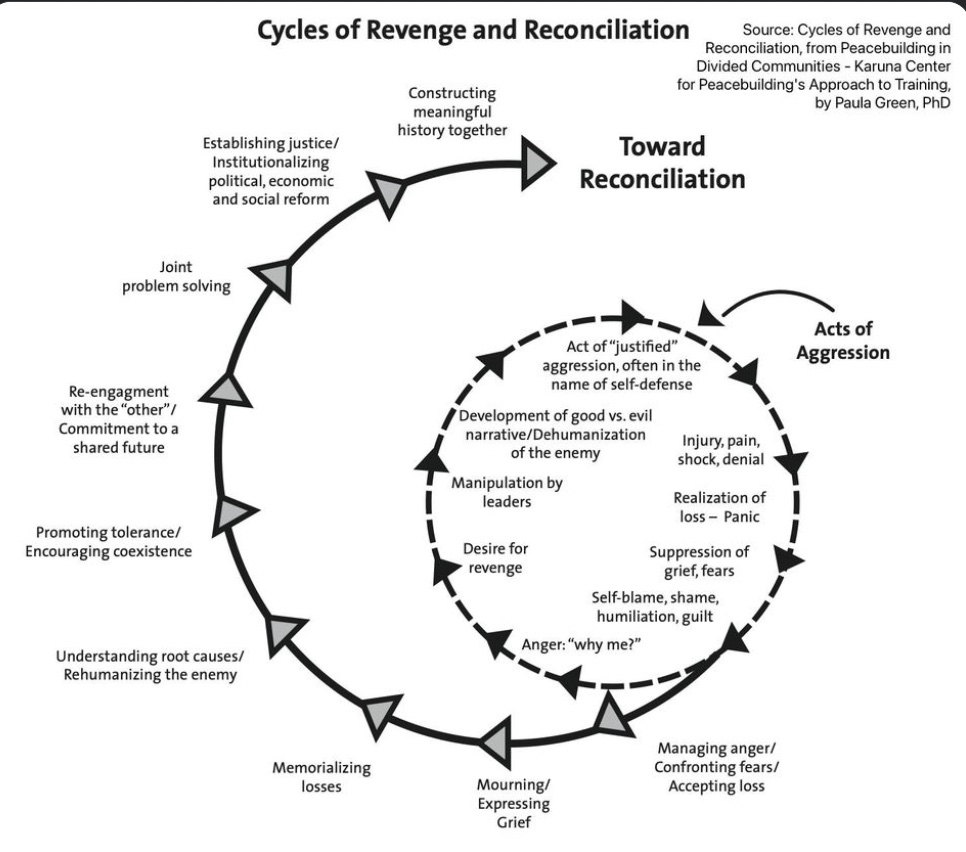
  • The illustration below was used by Jewish-Buddhist peace-builder Dr. Paula Green in working with warring communities around the planet. In her view, rushing to justice without tending to grief does not lead to peace but only perpetuates the cycle of revenge.
  • Interview of two Dartmouth proessors — Susannah Heschel, chair of Jewish studies, and Tarek El-Ariss, chair of Middle Eastern studies — set out to create a forum for students to discuss their thoughts in a respectful non-polarized manner.

Where to Donate

  • Jewish Community Federation: Israel Emergency Fund 
  • Reconstructing Judaism: Ways to Help in this Time of War in Israel and Palestine
    • This page has information about and links to:
      • Magen David Adom (affiliated with the International Red Cross) 
      • World Union for Progressive Judaism Emergency Appeal
      • Dror Israel Emergency Response
      • New Israel Fund

Resources for Talking to Children about the Crisis

  • Jewish Learning Works, Israel in Crisis: Resources for Educators (has links to many valuable resources for parents as well as educators:)
  • Additional resources for parents include:
    • The Forward: How to talk to your kids about the violence in Israel and Gaza
    • UNICEF: How to talk to your children about conflict and war
    • The Jewish Educator Portal: How to Talk to Children about Israel Today
    • How to Talk to Children about Anti-Semitism
    • Unpacked.education – Deepening engagement about Israel and Judaism. Particularly useful resources for teens.
    • Perfect Jewish Parents, podcasts from the Shalom Hartman Institute, on challenges of talking about Israel, Judaism, the Holocaust, God, the significance of living a Jewish life.

Resources for Spiritual and Emotional Support:

  • 101 Healthy and Productive Ways to Respond to the War
  • Hashpa’ah (Spiritual Direction): Hashpa’ah is a traditional Jewish term for the relationship with a Jewish spiritual director/companion or mashpia/h (in Hebrew). The Mashpia/h offers guidance and support on matters of faith and practice, relationship with the Divine and meaning, calling and purpose of life itself.  To learn more about haspa’ah: Evolve. To find a spiritual director:
    • Ruach
    • ALEPH Spiritual Directors (refer to names on the list highlighted in yellow)
    • Find A Spiritual Companion
  • Moving the Body:
    • walking in nature, exercise, dance, yoga, tai chi, chi kung
    • Walking Minyan – Community prayer in nature (can also be a solo practice).  Please contact rabbi@aarecon.org for more info.
  • Prayer
    • Shabbat and Kabbalat Shabbat Services
    • Praying for Israel
    • Meditation (various techniques and traditions including mindfulness and focusing on the breath). 
      • Jewish contemplative techniques
    • Song Circles – Forming a group to sing niggunim for peace and healing.
    • Tehillim (Psalms) Circle – It is customary to say Psalms for people who are sick or in distress.  In a Tehillim circle, the entire book of Psalms is read on a given day.  Individuals within the circle are assigned specific psalms to recite.  The number of psalms depends on the number of people in the group.  If people are interested in this practice, please contact me at rabbi@aarecon.org.  This is also an opportunity to invite participation from the wider Jewish community. 
  • Shabbat Practice
    • Take the opportunity to rest.
    • Turn off devices and especially refrain from continual checking of the news and political discourse.
    • Organize a shabbat dinner with family and friends.  Try to avoid talking about politics or the latest news.
    • Go for a long walk in nature with family, friends or on your own.
  • Mishpocha Groups: Many of our members have formed mishpocha groups during the early part of the pandemic.  During this time of crisis, your mishpocha group can be a source of support and healing.  You may want to open or close your meetings with a prayer for healing, a prayer for peace or a moment of silence to allow space for individual prayer.
  • Reaching Out to Friends and Family: Looking for opportunities to be with people you love and care about can be a tremendous source of comfort and healing.  Tell people how much you care about them.  When physical contact is understood as mutually safe and appropriate, being with loved ones is an opportunity to be nurtured by hugs.

Filed Under: Rabbi's Posts

Yom Kippur Sermon 2023 by Rabbi Gabrielle Pescador

October 22, 2023 by Gillian Jackson

Aaron shall place his hands upon the head of the live goat and make confession for all the transgressions of the children of Israel.

Our Torah portion goes into detail about the Yom Kippur priestly practice. Aaron, the high priest, has to prepare himself and perform all the details impeccably. He risks death in order to do this. He wears special garments, has a ritual bath. He then atones for himself and his own household. Only after that can he enter the holy of holies and offer a sacrifice to atone for the Israelites and sprinkle blood on the altar seven times as an act of purification.

Our tradition tells us that in post-biblical time, in our time, prayer takes the place of the sacrifices, of korbanot, of ways of drawing near to God. We no longer have a high priest to perform sacrifices of atonement and rituals of purification on our behalf. The closest we have is the shaliach tziboor – the prayer leader. Whether that person is a rabbi, hazzan or lay leader, the shaliach tziboor is supposed to pray “on behalf” of the congregation, to lift their prayers. In fact the Shulkhan Arukh and other rabbinic writings list requirements for the shaliach tziboor; for instance that person should be pious, knowledgeable, have a pleasant voice and be well liked. 

There is a lot we can learn from rabbinic discourse as well as from our Torah portion on the subject of spiritual leadership, of what it means to be a shaliach tziboor. In order to help others, like the high priest, like the shaliach tziboor, we must first make sure that we have taken care of our own souls, and our own intimate relationships before we can serve the community well. If the promise for the Jewish people is to be mamlechet kohanim – a kingdom of priests – we are all called to imitate priestly qualities but in an inclusive, more democratic way. We all have to become the shaliach tziboor. 

How do we do this? We begin by doing what we are doing today – by doing teshuvah, by owning up to our errors and dysfunctional tendencies, and by taking responsibility for our part in a dispute or conflict. We are called to mend our ways and be impeccable – and I don’t mean perfect, because that’s not possible – but to be awake, present, focused, ethical and just, as we recalibrate ourselves. 

To draw from our wisdom texts, we are to cultivate a pleasant voice. That does not mean that we have to be professional singers, or even sing on key; it means that our voices should communicate pleasantly, with love, compassion and respect. As for being well-liked, I don’t think that is about being popular or charismatic, but more about being a mensch, being a trustworthy and decent person, and keeping our hearts open, and doing so especially in the face of conflict, and in interacting with people we find challenging. 

In one of our Elul workshops for instance we talked about finding things to appreciate in the people whom we find difficult. Doing this does not erase or bypass the challenges in our relationships, but what it does do, is help us to not turn people into unidimensional figures. 

Because we are more than our errors, we are more than our flaws, more than our irritations and hang-ups. If not, teshuvah is not even worth thinking about. And like I said last week (probably more than once), teshuvah is not just a solo practice; we do teshuvah in order to love well – to have compassion for ourselves and others, and to love beyond our besties, to love beyond our community, to love beyond the personal. To love God.

Like the high priest who purifies the Israelites by sprinkling sacrificial blood seven times, we purify ourselves with gratitude, as gratitude exercises the heart; it expands the heart. And if we want to draw from the 7, gratitude practice is a 7 day a week enterprise. If we exercise gratitude on a regular basis, we are able to zoom out and see more broadly, which helps us to reframe and recontextualize our struggles, and see how much we have in common with people we may find challenging. Through gratitude we may even understand their point of view a bit better.

In taking on the responsibility of the high priest, by being part of mamlechet kohanim, a kingdom of priests, each of us contributes to the wellbeing of the community. We lead from the bimah, from where the Davening Team is situated, to my right, from where you offer readings and kavanot at the microphone also to my right, and from your seats through active participation. Frankly, we are all leading by showing up here today. We lead by supporting one another, wherever we are, however we can, inside the sanctuary and in our daily comings and goings. We do this by being awake to the truth of “what is” before us and by keeping our hearts open so that we can find a way to build bridges of connection and understanding, and by appreciating what each one of us has to offer.

G’mar chatima tova – may we all be sealed for a good and fulfilling life in the coming year.

Filed Under: Rabbi's Posts Tagged With: High Holidays 2023

Kol Nidrei Sermon by Rabbi Gabrielle Pescador

October 22, 2023 by Gillian Jackson

We pray for peace. Oseh Shalom. We pray for the world to be experienced as one beating heart. How can this be achieved with all the polarities in the world? How can we make peace, how can we bring all the pieces together? 

Many of us try to stay on top of the news and commentary on it, we donate and volunteer, we champion good causes, we try to be good citizens, we try to be inclusive, we try to do our part. And I don’t know about you, but I’m completely exhausted from it, from all the information, all the misinformation, emails and calls to action. My head is spinning from the noise, from the worry, from the continual shock of how far things have gone awry. Don’t get me wrong, I want to be awake to world and not stick my head in the sand. I try to stay awake and do what I can. And sometimes it seems like all I can do is pray – for strength, for inner peace to get me through it.

In the very act of praying is the acknowledgement that we need help, that we need support. We can’t do it all. In praying we slow down and surrender a bit. In doing that, we come closer to experiencing the world as one beating heart. We come closer to recognizing that we have to take care of our individual beating hearts. The call for self-care is essential, especially now – to meditate, exercise, eat properly, to take time for relationships, for quiet and slowing down, to take time for rest, to turn off our phones, step away from the computer and rest, to let the mind wander, to read poetry, to walk in nature, to pray, to find ways to let go of all the schmutz that we are carrying around.

Our tradition has special slowing down medicine – and that is shabbat. To create a shabbat practice, a day without an agenda, a day to just be, a day to be with friends and family, a day to listen attentively to the inner voice, a day to listen attentively to the voice of a dear one.

If I may, I would like to plant a seed for the new year, and that is to invite you to find shabbat buddies. To have shabbat dinner together, to take turns hosting, to tell stories and engage in real heart-to-heart conversation, as a weekly ritual. Share spiritual practices, favorite poetry.

Perhaps a shabbat afternoon walk would work for you, or a visit to your shabbat buddy’s home for afternoon tea and snacks. Maybe I shouldn’t be talking about snacks today, but I’m sure you get the idea. Turn off your devices and enjoy one another heart-to-heart. Bear witness to the soul of the other. 

According to author Judith Shulevitz, shabbat allows us to escape from commerce and allow space in time, that if done in community can become a cultural asset. She stresses that shabbat is easier to do in community than as a solo practice. It’s harder if you’re the only one doing it. And I’m not talking about being halachic, but just carving out regular time to slow down even if only for a few hours. It doesn’t have to be for the whole 25 hours of shabbat; the invitation is to set aside a few sacred hours with ritual regularity. And sure, continue with your solo self-care practice. Just consider adding a spiritual mutual-care practice, a practice of restful true meeting with the other – to listen, to bear witness, to be playful, to share, to maybe study a bit of Torah together, to sing or pray together, to take pleasure in being with another. The invitation is to make time for this, to rest in the other and be refreshed. 

Slowing down is what will save us in this time of chaos and uncertainty. To use a Wizard of Oz metaphor of the ruby slippers, slowing down is the power we’ve had all along, that we always have access to. It doesn’t mean that we stop doing, that we stop caring about what’s going on in the world. It means that we have what it takes to stop spinning in circles with over-thinking and worry, continually making to do lists and ticking items off that list. We have shabbat. Shabbat is our pair of ruby slippers, that helps us come home – to ourselves, to our friends and families, to the God sparks within – that helps us come home to God.

Filed Under: Rabbi's Posts Tagged With: High Holidays 2023

Rosh Hashanah 2023 Sermon By Rabbi Gabrielle Pescador

October 22, 2023 by Gillian Jackson

This is a season of birth and rebirth. The Torah portion for today speaks to that theme, beginning with the birth of Yitzchak, a miraculous gift from God to Sarah and Abraham in their old age. After decades of trying to conceive without success, Sarah had given up on the dream of having a child and told Abraham to sleep with her maidservant Hagar, and Yishmael was the result of that union.

In today’s Torah portion, Yishmael first appears at Yitzchak’s weaning party. When Sarah sees Yishmael, she gets so upset that she tells Abraham to kick the boy and his mother out of the household. Sarah feels threatened by the presence of Abraham’s first-born son, so she takes steps to secure her own son’s position in the family hierarchy. Abraham is not happy about Sarah’s plan, but God tells him to listen to his wife. So Abraham casts Hagar and Yishmael out with limited provisions and Yishmayel nearly dies of thirst. 

There is a lot that is troubling about this Torah portion. Our forefather Abraham seems to have no moral backbone; he goes against his better judgment and follows a plan that endangers the lives of others, of his own flesh and blood. Our foremother Sarah shows signs of jealousy, hunger for power and extreme lack of compassion. And yet, we pray in their merit. We did this a half hour ago, earlier in today’s service, at the beginning of the Amidah; we recited their names in our prayers, Elohei Avraham, Elohei Sarah, “the God of Abraham, the God of Sarah.” They are supposed to be tzadikim, righteous people. They are the couple known for their open-tented hospitality. Clearly that is not the case in today’s Torah portion. 

We have to face that our biblical ancestors are flawed and not just a little flawed. The truth is that we don’t have examples of perfect human beings in Torah.

Isaac seems almost invisible to us, as he is limited and does not come into his fullness due the severe trauma of coming so close to being sacrificed by his own father. Rebecca and Jacob co-conspire; they lie and manipulate to steal Esau’s birthright. Joseph is a braggart and also lies and manipulates, and his brothers are so jealous of him, that they throw him into a pit to die. Moses is short-tempered and reluctant, and at times overly protective of his position of power. David is so covetous of Uriah’s wife, that he sleeps with her, gets her pregnant and then tries to cover up his misdeeds by sending Uriah to the front lines of battle to die; and then David marries Uriah’s wife. These are just a few of the many more examples of flawed behavior in the Tanakh. Yet these same flawed figures also have moments that are worthy of praise. They are generous, loyal, brave, self-sacrificing, wise. Some have deep moments of spiritual connection. Some reflect deeply on their lives and try to make amends and do deep teshuvah. We see the teshuvah impulse in the book of Psalms which is attributed to King David. 

We read the stories of our biblical ancestors over and over again, week after week, year after year, and look for lessons in their lives. You could say that their flaws make them seem more human, more relatable. That does not mean, however, that we should erase or excuse their flaws. Because they have impact. 

Our flaws also have impact.

In Torah, human frailty appears hyperbolic which makes it harder to ignore. The frailties become a giant mirror that we can hold up to ourselves to ask difficult questions. Who among us has ever been jealous or shown signs of entitlement, arrogance, anger or impatience? Who among us has ever lacked compassion for another, or been blinded by our needs and desires? Who among us has fought to maintain control? Who among us has bent the truth to manipulate an outcome? And yet, even if we have erred in those directions, we are not all that. Yes we are flawed, but that’s not the whole story. We have also been generous, loyal, brave, self-sacrificing, wise. Some of us have had moments of deep spiritual connection. Some of us are here today because we are deeply committed to doing teshuvah. And at times, that can be super hard because we also know that some of our actions have had a negative impact on others. We can’t erase that. But still, while holding the truth of what we’ve done, we can also do better, because teshuvah is a journey that also has impact. 

Torah teaches us that the journey of trying to create a rich meaningful life, of trying to build  family and community is of key importance – of trying to find a place for God/goodness to dwell  within us. All of that is the path to redemption. Like with our biblical ancestors, there are so  many obstacles in the way; some are out of our control and some are not. The obstacles that  are more within our control are likely more ego-based. They are the flaws that we can do  something about. 

In recognizing the flaws of our ancestors, we are asked to recognize the flaws in ourselves, in our communities and in our history. During the Days of Awe, we focus on what needs to be corrected and healed. And at the same time, we must give ourselves and our ancestors kavod, for journeying, for trying in the state of brokenness.

We have made mistakes and we are more than our mistakes. We are not perfect and never will be. Perfect does not exist. Perfect is static and lifeless. Trying, being awake to the moment, responding with our heart, serving with love, having the courage to recognize the truth of who we are in the moment, is the work of Teshuvah. We must commit to that journey. That is why we are here today. 

Filed Under: Rabbi's Posts Tagged With: High Holidays 2023

Erev Rosh Hashanah Kavanah By Rabbi Gabrielle Pescador

October 22, 2023 by Gillian Jackson

Shalom everyone. It’s so good to be here to celebrate the High Holy Days together and take a  deep dive into the process of teshuvah, to exame where we have missed the mark and how we  can get back on track, and to acknowledge what we have done well and what we want to  conDnue doing in the coming year.  

Rosh Hashanah, is an opportunity to recalibrate, to renew. AFer blowing the shofar on Rosh  Hashanah we recite: hayom harat olam, “today the world is born.” Through teshuvah, we birth  a new world; we have a fresh start.  

What kind of world do we want to create this year? What kind of inner life do we want to  create? What kind of worlds do we want to co-create with others?  

The truth is that we create worlds all the Dme, with our thoughts, speech and acDons. The  difference is that during the High Holy Days, we try to be more conscious of that and reflect on  what we need to correct and how we can make the most of what we have to offer in this world.  We also are to take note that teshuvah is not just a solo acDvity as we are social beings who do  not live in isolaDon. We are connected to one another and affect one another.  

Full disclosure, I think about this idea of connecDon, of interconnecDon, a lot, especially when I  am leading services, and so I have come up with a kavanah to help me feel the room, which I am  going to share with you this evening. My kavanah is a short visualizaDon that is based on  science believe it or not, on quantum foam. You may have heard of it.  

At the tiny quantum level, empty space isn’t really empty. It’s actually a vibrant place, with tiny  subatomic particles appearing and disappearing, in constant motion. It is a dynamic space that  bears some resemblance to the effervescent behavior of the foam on the top of a freshly poured  beer, with bubbles appearing and disappearing and for that reason, scientists call it “quantum  foam.”  

So now I will share my quantum foam meditation/kavanah with you.  

Before I start a service, I look around the room and take in all the faces. Join me and take a look  around and see who’s here (the familiar and unfamiliar faces, the people streaming on youtube).  Now close your eyes or soften your gaze and hold all the people in the kahal in your mind’s eye and  imagine dynamic beer bubbles between all of us in constant motion. We respond to the foam and  it responds to us as individuals and as a group. As we move, the foam moves. As the foam  changes, we change. Each of us are involved in all the subtle changes. Each of us affects the other.  

Let’s breathe into that awareness.

And now for the next step. Let’s visualize the foam lighting up. Imagine light streaming through  the bubbly space between us, streaming through us, lighting up all of us, weaving us together into  a giant tallit of radiating light.  

Breathe into that. Can you feel the person next to you? In your row? Can you feel the room?  

Now take a few moments to concentrate on the breath and center yourself and bring your  attention back to just you. Feel your feet on the ground and your hips on your chair, still paying  attention to the breath, inhaling and exhaling, and when you are ready, open your eyes and look  around the room and take in all the beautiful neshamot, all the beautiful sparks of light held  together as ONE.

Filed Under: Rabbi's Posts Tagged With: High Holidays 2023

  • « Go to Previous Page
  • Page 1
  • Page 2
  • Page 3
  • Page 4
  • Interim pages omitted …
  • Page 7
  • Go to Next Page »

Primary Sidebar

Search

Join Our Mailing List

Sign up for our twice a week newsletter to get details on upcoming events and catch up on our latest news.

This field is required.

Check your inbox or spam folder to confirm your subscription.

Upcoming Events

  • All day, May 17, 2026 – Beit Sefer
  • 9:00 am – 10:00 am, May 17, 2026 – Rosh Chodesh Minyan Sivan [ZOOM]
  • 7:00 pm – 8:00 pm, May 20, 2026 – Pop-in Torah Study with the Rabbi [Zoom]
  • All day, May 21, 2026 – May 23, 2026 – Shavuot
  • 6:30 pm – 8:00 pm, May 22, 2026 – Fourth Friday Kabbalat Shabbat

Latest News

  • AARC Has a New Member Area April 30, 2026
  • RSVP to “Lesson of the Homeland” and the Stories We Tell: A Conversation with Anat Zeltser April 16, 2026
  • Climate Action Shabbat article in the April 2026 Washtenaw Jewish News April 3, 2026
  • Reimagining Torah Study: Moving from Zoom to In Person by Rabbi Gabrielle Pescador April 1, 2026
  • Creative Spirit at the AARC Beit Sefer March 27, 2026

Footer

Affiliated with

Copyright © 2026 Ann Arbor Reconstructionist Congregation