
by Clare Kinberg
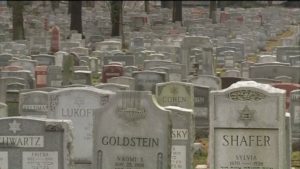 There’s a complicated story surrounding my feelings about the Feb 18, 2017 vandalism at Chesed Shel Emeth Cemetery in University City, MO. I’m not even thinking right now about the fact that my family buried my mother there last month, on Jan 5. Yes, I am very upset that the peace of the space around my mother’s fresh grave has been so unnaturally disturbed. But the seat of my feelings has other sources.
On Sept 5, 2016, 5 months before we buried mom in Chesed Shel Emeth, I visited a very different, historic cemetery in the rural and remote, rolling hills of Southwest Michigan; a sparse, church cemetery where my Aunt Rose, my father’s sister, lies buried in an unmarked grave. I found her resting place, after 40 years of looking for her, through determination and chance. She died in 1982; her obituary in the Cassopolis Vigilant says “there are no known survivors at this time.” Estranged from her family, including even her young son, Joe, since the 1930s, Rose remained separated in death. Until this week, I’d fantasized about bringing her body home to the shtetl, which is, of course, Chesed Shel Emeth. Her mother and father are there, her grandfather, too. All three of her brothers and a sister. But Chesed Shel Emeth is not where Rose wanted to be. And now, I almost feel grateful that she isn’t there, that her rest is not disturbed like all the others. 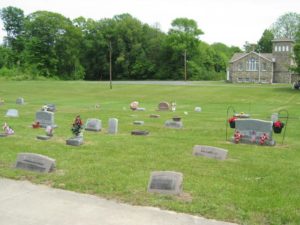
To be honest, the thought of bringing her home to Chesed Shel Emeth was only a passing thought. I’ve given serious thought, though, to the headstone I plan to order for her, to mark her space under the earth. Rose (Kinberg) Arnwine does have known survivors, and her extraordinary life will be noted.
Both Rose and I are the non-conformists of the family. But I can still claim Chesed Shel Emeth for my own. I’ve walked its narrow paths countless times. I love to stand in the midst of the gravestones and be enclosed into its familiarity. In 1897, my father’s–and Rose’s–grandmother was buried there, when she died ten days after giving birth to my great aunt Mary. It was in the first years of the cemetery, when they buried Russian Jews who didn’t have the money for a plot or a headstone. Chesed Shel Emeth is the shtetl, the home of the poor, and the very poor, all laid up next to the better off. There’s a plethora of peddlers, tailors, and junk dealers …and the jobbers they became.
With my mom’s papers, I find invoices and paid checks from my father and Uncle Leonard to Chesed Shel Emeth Burial Society, beginning in 1951, for “burial graves.” They paid on some sort of regular basis through the 1960s. Every name on a headstone in Chesed Shel Emeth echoes with the voices of our parents and teachers, our neighbors and schoolmates, the grocers and shoe salesmen, teammates, cousins, and friends. The families that moved from downtown on North 10th St. to midtown near Cates and Kingshighway, to Westminster, to Kingsbury in University City, to Olivette and Ladue and finally further west to Chesterfield. Of the 17,000 people buried in Chesed Shel Emeth, so many with families like mine, with generations buried there, I think I am connected, through marriage and proximity, to each and every one. I look at each headstone and think, I know you, I know you, I know you.
Aunt Mary, who grew up shuttled between the Jewish orphan home in Cleveland and various relatives, was the only one who stayed in touch with Rose. The shtetl was not entirely kind to either of them.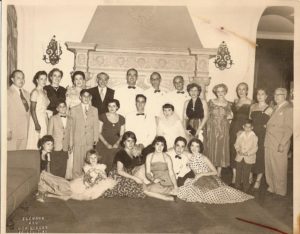
Rose’s son Joe married in 1952, to Joyce (who died just a month before mom, in Alabama). Everyone is at the wedding, except Rose: Aunt Mary and her grown children stand next to my mom and dad, Dad’s siblings and their children. Today, only my siblings Robert and Sheila from this picture are alive (I wouldn’t be born for 3 more years). Five of them are in Chesed Shel Emeth: Mom and Dad, Uncle Leonard and Aunt Ethel, and Tillie. The rest are scattered, New York, Chicago, California.
I wonder if Aunt Mary brought this picture to Rose. Was it among Rose’s things when she died, thirty years later? What did happen to Rose’s things when she died? The Cass County probate court has lost her record, but I haven’t given up the search. After all, I found her. Or at least the unmarked patch of grass where she is buried.
The Chesed Shel Emeth shtetl was no longer Rose’s home, but, oh, the home she did create. A stop on the Underground Railroad, on Paradise Lake, Vandalia, MI. When her East Texas-born African American husband bought 25 acres of farmland there in 1943, did it feel safe to them? Familiar, like the rural county he’d grown up in? Was it more like the Russian shtetl her grandfather came from than the brick duplexes of St Louis or the crowded Black Belt in the south side of Chicago? In Cass County, MI, Rose and Zebedee raised chickens and sold eggs. She was active in her church. She lived on the same piece of land for 40 years. Her resting place is quiet.


Joe Buchwald Gelles says
Very moving piece, would love to know more about the last paragraph. My entire extended family is buried in Chesed Shel Emeth, except of course for the side that never made it out of Europe.
One of my earliest memories is going by the cemetery, maybe on foot, and seeing a whole bunch of old men under a tent shelter — probably for a funeral under the hot summer sun. But I thought they were there waiting to die!
We plan to be there this spring for an unveiling.
Mark says
This is beautiful, Clare. Thanks for publishing it here.
Anita Rubin- Meiller says
Clare, thank you for sharing this very personal and moving history. I am so sorry for the dishonoring of your loved ones. May their souls be at peace. Warmly, Anita