• Skip to primary navigation
  • Skip to main content
  • Skip to primary sidebar
  • Skip to footer
Ann Arbor Reconstructionist Congregation

Ann Arbor Reconstructionist Congregation

  • Home
  • About
    • Overview
    • Rav Gavrielle Pescador
    • Our History
      • Photo Gallery
    • Our Values and Vision
    • LGBTQ Inclusive
    • Our Board
    • Our Sacred Objects
    • About Reconstructionist Judaism
    • Jewish Ann Arbor
  • Programs
    • Shabbat and Holidays
    • B’nei Mitzvah
    • Tikkun Olam
    • In the (Washtenaw Jewish) News
    • Health and Safety Expectations for In-Person Gatherings
    • Join our Mailing List
  • Religious School
    • About Beit Sefer
    • Teachers
    • Enrollment and Tuition
    • 2025-26 Beit Sefer Calendar
  • Blog
  • Calendar
  • Membership
    • Thinking about joining?
    • Member Area
  • Contact Us
  • Donate

Community Learning

Exploring Rosh Chodesh

June 21, 2023 by Gillian Jackson

During our Shabbaton weekend with Rabbi Gabrielle Pescador, she referenced a Rosh Chodesh circle that she has been hosting with Pardes Hannah over the last few years. Rosh Chodesh is a Jewish practice that was not part of my upbringing so I thought I’d do a little research and share it with you!

What is Rosh Chodesh?

Rosh Chodesh is translated as ‘Head of the Month.’ It is an ancient holiday that originated in Exodus marked by the appearance of the New Moon. The holiday was practiced before a formalized calendar was established by confirming the new moon each month. Once a monthly calendar was created, Rosh Chodesh was observed on the Saturday before the new moon by reciting the Birkat Hakodesh after the Saturday morning Torah reading. Some also add extra Rosh Chodesh prayers to the Amidah, Kaddish, and morning prayers.

Feminist History of Rosh Chodesh

Historically women were able to abstain from physical work on Rosh Chodesh. Some believe this was because women refused to give their Jewelry for the formation of the golden calf. Others believe the waning and waxing moon hold significance for a women’s menstrual cycle and the Rosh Chodesh observance is tied to this. In the early 70s groups of women began starting a new kind of Rosh Chodesh circle. In Peninah Adelman’s Miriam’s Well: Rituals for Jewish Women Around the Year, she offers program ideas for groups who wish to build on the Rosh Chodesh tradition as a time for community building and bonding for Jewish women.  Most Rosh Chodesh circle’s organize around mutual interest and ritual practice. Exploring and redefining the relationship between the feminine, the moon, and sisterhood has been a foundation for a myriad of Rosh Chodesh women’s groups over the last few decades.

Rabbi Gabrielle Pescador’s Rosh Chodesh Circle

Rabbi Gabrielle Pescador began a Rosh Chodesh circle through Pardes Hannah while she was studying for her Rabbinic program. Her circles focus around a central theme or teaching connected to the Torah portion for that week. Rabbi Gabrielle is interested exploring Rosh Chodesh as an opportunity to practice Torah reading for our community and deepening our Torah practice. If you are interested in exploring Rosh Chodesh with Rabbi Gabrielle, stay tuned for her upcoming Rosh Chodesh offerings!

Filed Under: Community Learning Tagged With: Rosh Chodesh

Counting the Omer between Passover and Shavuot

April 27, 2023 by Gillian Jackson

One of the ways that my children were taught to calm down and take a break when they were processing their feelings was to count. Count 5 things you can see, 4 things you can hear, 3 things you can tough, 2 things you can smell, one thing you can taste. Or count your fingers and your toes while taking deep breaths. There are many ways that marking the passage of time, either by minutes or days, can make us feel calm, connect us to our bodies, and help us to feel a part of something larger than ourselves.

Counting the Omer began as an agricultural holiday that has its roots in the first barley offering and the first wheat offering in the Temple Era. The observance was a way of offering prayer for a good harvest. As Jewish civilization transitioned out of the temple period, counting Omer moved into an exercise to mark the passage of time between Passover and Shavuot. It is an existential exercise that asks us to reflect on the movement from enslavement, to liberation, to the giving of Torah both in the liturgical sense an also the change in perspective within our minds. The omer is counted every day for 7 weeks, ending with the holiday of Shavuot.

In Michigan, we’re far away from the wheat and barley harvests of Israel, as well as far from the experience of being enslaved. But as spring unfolds for us, counting the omer can help us shake off the stiffness of winter and recommit to the work of tikkun hanefesh (healing the soul) and tikkun olam (healing the world). 

Some resources for counting the omer:

  • Resource for Counting the Omer
  • Counting the Omer: Taylors Version
  • Weekly Omer Sessions with Rabbi Rachel Levy
  • Learn more about where counting the Omer comes from
  • Listen to this beautiful melody, it’s a kavannah before counting the Omer
  • Learn about the connection between Kabbalah and counting the Omer
  • Explore this reflection from Keshet: Counting My Genders: A Neo-Kabbalistic view of the Omer

Filed Under: Community Learning Tagged With: counting the omer, Omer, Shavuot

The Golem

January 30, 2023 by Gillian Jackson

By: Otto Nelson

This week in Beit Sefer, students explored the Golem legend and built a snow Golem!

A hulking humanoid created by mystical Kabbalistic ritual, the Golem is a product of ancient Jewish folklore. It’s a being of the earth, constructed of mud, dirt, or most often clay in the shape of a human, and often made animate by a Hebrew word carved upon its forehead; Emet, meaning Truth. It’s sometimes described as a monster or fantastical creature, but, in fact, it is neither.

The Golem is an automation… not truly alive, and often as mindless and soulless as a machine, bound entirely to the commands of its creator. This mindless, unceasing loyalty is precisely where its danger arises… stories of the Golem tell of how it collected firewood until it chopped down a forest – brought water to a synagogue until it flooded – fried latkes until they filled a house! Moreso, many stories describe an inexplicable growth, of the Golem growing ever larger, ever stronger, and ever more unintentionally dangerous as time passes. But these stories have one end… the Golem’s creator, deciding it must be stopped, swipes a letter from the animating word. Emet, Truth, becomes Met, Death. And many tales end there, the Golem crumbling apart, reduced to earth again.

Regardless of their precise origins and details, the stories of the Golem have inspired important works such as Mary Shelley’s Frankenstein, and continue to make a mark in popular culture today, a strange ancient connection to a modern world shaped increasingly by automation. Essentially, they all hold a few important morals… a warning of the risks of hubris in creation, an assertion that power without a heart and mind is dangerous, and a message that strength must be tempered always with wisdom.

Filed Under: Community Learning Tagged With: Beit Sefer, Golem

The Nittel Nacht Hannukah Tradition and its Intersection with Antisemitism

December 22, 2022 by Gillian Jackson 2 Comments

The practice of Nittel Nacht has its origins in Eastern Europe in the late Middle Ages, when tensions between Christians and Jews ran high. On Christmas Eve when most Christians were headed to church, the visible reminder of the ‘otherness’ of the Jews who were not participating incited antisemitism. It was feared that Jews would be attacked when headed to study Torah on Christmas; therefore, Rabbis banned Torah study on that day. There are other theories for the prohibition of Torah study on Nittle Nacht, such as the belief that studying Torah on this day would lend merit to Jesus. Whatever the origin of this holiday, for centuries Nittle Nacht observances usually involved Jews hunkering down and playing cards, chess, and dreidel as an alternative to study.

In the days leading up to Christmas this year, the Nittel Nacht tradition has been on my mind. The holiday season exposes the difference in cultural and religious practices in modern times as much as it did in the Middle Ages. We may not be walking though villages to the synagogue, but kids experience this difference in schools and adults in the workplace. Differences that may have been unseen at other times of the year are pushed out into the open and become seen.

Recently, I attended a shabbat service at Temple Beth El in Bloomfield Hills in solidarity after the antisemitic attack they suffered a few weeks ago. During this service Congresswoman Haley Stevens spoke about her work addressing antisemitism in Washington. Stevens asserted that the antidote to antisemitism is to put acts of antisemitism in the spotlight and bring conversations about antisemitism into non-Jewish spaces. Making these events known to the wider community encourages awareness about antisemitism and encourages our allies to stand up against it when they see it.

People fear what they do not understand. The recent antisemitic attack was focused around Israeli politics and old Jewish tropes that do not reflect the richness of modern Jewish culture. It is clear that this misled individual had no experience with the wide diversity of Jewish thought and experience that exists in the world. Jews in the Middle Ages found solace in staying indoors and trying to bring attention away from their ‘otherness’ on Christmas. In our current political climate, we do not have the option to sit outside of the cultural or political discourse. But the degree to which it is our responsibility as Jews to correct misconceptions is up for debate.

On this occasion of Nittel Nacht, I invite you to consider the questions that arise from our current experience of ‘otherness’ on Christmas. To what extent is it our responsibility as Jews to actively correct malevolent Jewish tropes? What characterizes our multicultural American experience of Nittel Nacht in a county where we are not the only non-Jews living in a predominantly Christian nation? What spaces do you feel most comfortable confronting antisemitism with non-Jews? Do conversations around Judaism come up more frequently in school and work during he holidays? And if so, is this an appropriate time to discuss antisemitism? Feel free to comment below!

Filed Under: Community Learning Tagged With: Channukah, Hannukkah, nittel nacht

Recruiting service leaders for Shabbat services! 

July 13, 2022 by Rena Basch

The AARC Board expected that we would have a student rabbi or rabbinical intern to lead bi-monthly Shabbat services for the 2022-2023 year. Unfortunately, there were no fifth year Reconstructionist Rabbinical College (RRC) students interested in field placement in Ann Arbor. (Fortunately, there were RRC rabbi graduates interested in leading High Holidays services, so look for an announcement of our High Holiday service leader next week!)

For our Fourth Friday Kabbalat Shabbat and Second Saturday Shabbat services this year we envision a mix of lay leaders and visiting rabbis. We formed a committee to consider the Jewish holiday calendar as well as our current bi-monthly shabbat services schedule. We want to create a vibrant tapestry of services and events this year, spun by a variety of leaders. To encourage variety, we will set a limit that each person will conduct no more than four services during the year.

We have a committee led by Deb Kraus, Debbie Zivan, and Rebecca Kanner, who have begun the process of organizing and scheduling service leaders. We will have a network of support for anyone that is interested in providing this deeply important service to our community. You can volunteer here.  If you have any questions, or are curious about the possibilities, please email us. We look forward to hearing from you. Please sign up to lead!

Filed Under: Community Learning, Simchas, Upcoming Activities Tagged With: simchas, Tikkun Olam

Beit Sefer Celebrates a Year of Resilient Nature Based Jewish Learning

May 25, 2022 by Gillian Jackson Leave a Comment

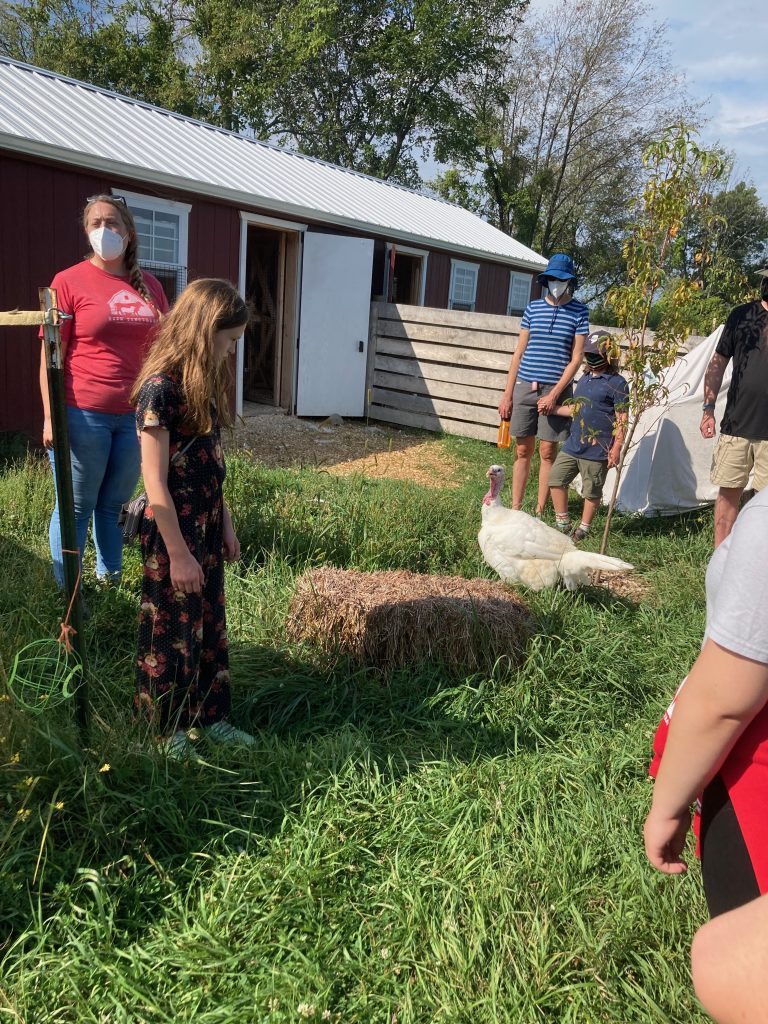
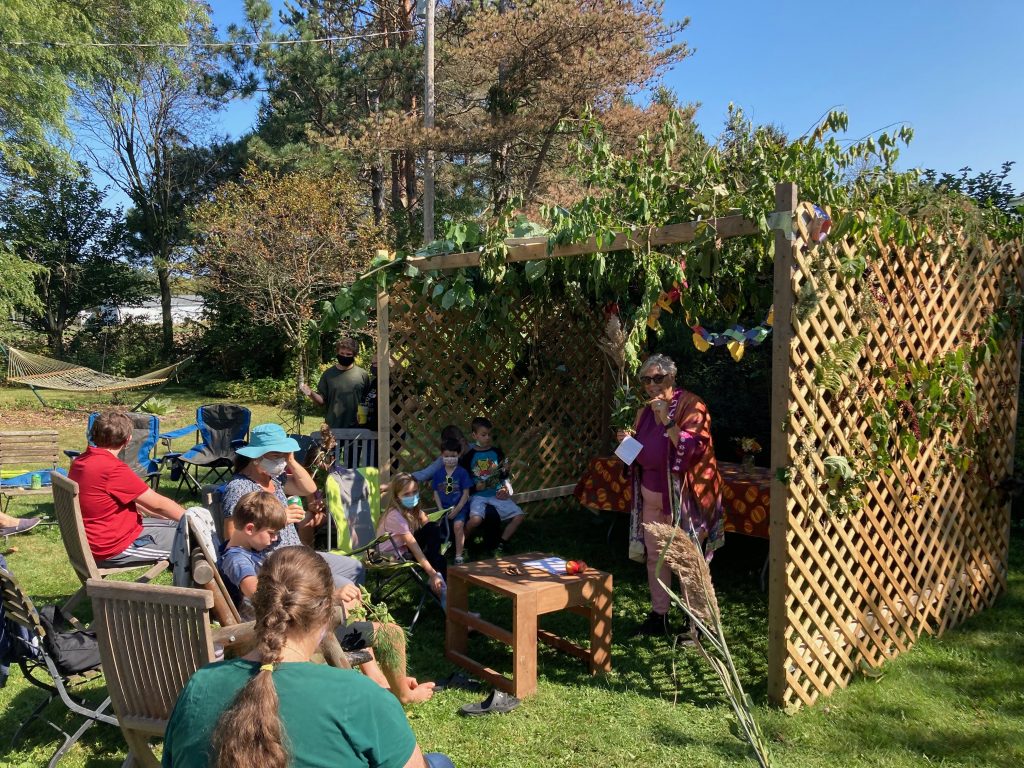
Beit Sefer wrapped up its 2021/2022 school year last weekend with a year end celebration and art show at the Farm on Jennings. The Beit Sefer program spent much of the 2021/2022 year outdoors, exploring Judaism’s relationship to nature. In addition to our traditional curriculum, the year focused on the changing of the seasons and what lessons the students can learn from nature. Some examples of this year’s lessons include blessings for harvest, Tikkun Olam and environmental stewardship, and the Jewish calendar’s relationship with agriculture. The impetus for the nature based curriculum was born out of COVID safety precautions, but served as a profound opportunity for families to explore Jewish learning in a new way.

It was a bittersweet celebration last weekend as our Beit Sefer director, Clare Kinberg, announced her retirement. Clare has brought so much to the Beit Sefer program, and she will be dearly missed. Thankfully, she remains a member of our congregation and community- so she will still be a presence in families’ lives in the future.

Please enjoy the photo collage below with some fun snapshots from the year. As you can see, it was a joyous year spent in community! If you would like to share any thoughts, memories, or gratitude for Clare, we will keep the comments open on this blog or you can email us at aarcgillian@gmail.com.

Filed Under: Community Learning Tagged With: Beit Sefer, Clare Kinberg, jewish learning, nature based learning

Planning for Shavuot

May 1, 2022 by Gillian Jackson

Learn about Shavuot AND Help Us Plan This Years Observation!

SURVEY LINK HERE!

History of Shavuot

Shavuot, or the ‘Feast of Weeks,’ is celebrated 50 days after Passover. The holiday coincides with both the giving of the Torah on Mt. Sinai and an ancient Jewish grain festival. In ancient Israel, Jews participated in three agricultural festivals per year where they would bring the fruits of their labor to the temple as offerings. The three holidays are Passover, Shavuot, and Sukkot. These agricultural based holidays allowed Ancient Jews the opportunity to gather in community to engage in ritual and celebration together. There is archeological evidence that Jews came from as far as the Mediterranean during the Greek era to reaffirm their faith and practice. When the Temple was destroyed in the first century CE, the harvest festivals transitioned from a central festival of offerings to a synagogue based practice. In diaspora, we have come to reconstruct and make relevant these holidays to provide meaning and connection in modern times. As an observance of the giving of the Torah, many Jews spend Shavuot engaged in the practice of learning.

Past AARC Observances of Shavuot

Shavuot 2021 we celebrated the end of Beit Sefer and Shavuot together by having blintzes at Aaron Jackson’s house! The congregation also attended a community wide lecture about Jewish approaches to Justice.

In 2020, we attended a nationwide (covid shutdown) Shavuot with Reconstructing Judaism.

2019 was our last in person Shavuot. We celebrated the holiday with Kehillat Israel and hosted lectures by scholars from both of our congregations. And of course ate cheesecake!

Shavuot This Year

Rabbi Ora has invited the congregation to submit their interest in a slate of potential programming choices. Please make sure that you take a few minutes to complete this survey! As always, let us know if you have any input, questions, or concerns!

FILL OUT THE SURVEY HERE!!!

Filed Under: Community Learning Tagged With: Shavuot

Nittle Nacht: A Jewish Christmas Eve Tradition

December 12, 2021 by Gillian Jackson 1 Comment

The Hav out for Chinese food in 2014

For many years, AARC members have joined Jews across America in the unofficial tradition of Chinese and a movie on Christmas Eve. This American cultural practice has roots that originate father than you might think in Eastern Europe and a tradition called Nittle Nacht.

According to Sefaria, Nittle Nacht has been observed on Christmas Eve since the 13th century. Nittle Nacht is commonly translated as ‘birth night’ in Yiddish, though some say the word ‘nittle’ refers to a Hebrew mention of Jesus as ‘the hanged one,’ or ‘nitleh.’

The practice has its origins in Eastern Europe in the late Middle Ages, when tensions between Christians and Jews ran high. On Christmas Eve when most Christians were headed to church, the visible reminder of the ‘otherness’ of the Jews who were not participating incited antisemitism. It was feared that Jews would be attacked when headed to study Torah on Christmas; therefore, rabbis banned Torah study on that day. There are other theories for the prohibition of Torah study on Nittle Nacht, such as the belief that studying Torah on this day would lend merit to Jesus. Whatever the origin of this holiday, for centuries Nittle Nacht observances usually involved Jews hunkering down and playing cards, chess, and dreidel as an alternative to study.

Over time, relations between Jews and Christians developed into a more peaceful coexistence, and the origins of Nittle Nacht became a distant yet formative memory. Still, traditions of spending time in community for Jews on Christmas Eve continued. In the early modern age in Germany, having a Christmas tree in the home was seen as a symbol of secular inclusion. Prominent Jews in Europe such as Theodor Herzl and Gershom Scholem were said to have Christmas trees in their homes. The origins of the modern ‘matzoh ball celebration,’ where Jews throw parties on Christmas Eve, was also born during this time.

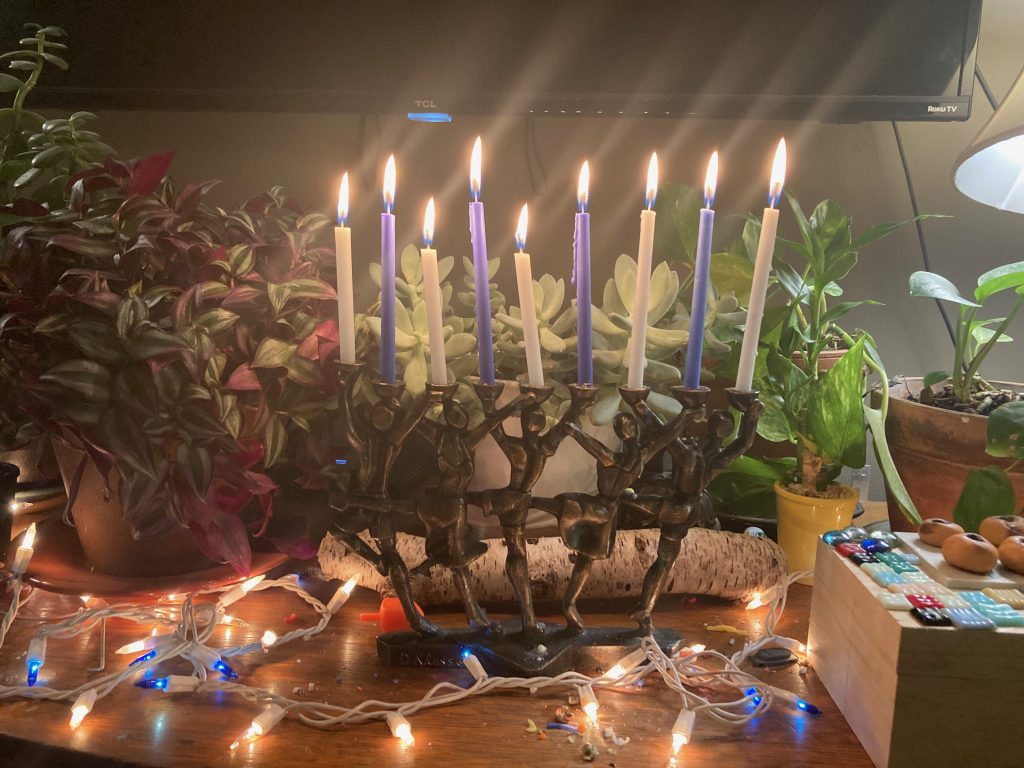
Once in America in the 20th century, Jewish observations of Christmas Eve traditions began to blend into the birth of modern Hanukkah observance as a gift-giving holiday. Modern American Jewish homes can be seen decorated with Hanukkah lights and winter-themed decor. There are aspects of the winter holidays that are shared, such as the celebration of light amongst the darkness of winter. It is an interesting history that has led us to this place. What Christmas Eve traditions does your family practice every year?

Filed Under: Community Learning Tagged With: holidays

December Adult Ed Series: Jewish End-Of-Life Perspectives

December 1, 2021 by Gillian Jackson

AARC and Rabbi Ora Nitkin-Kaner are pleased to announce December’s two-part adult education series focused on Jewish perspectives on end-of-life care. Both sessions will be held over Zoom.

Rabbi Ora Nitkin-Kaner

Curing, Caring, and End-Of-Life: The Jewish Perspective

Sunday December 12, 1-2:30 PM 

How does Judaism engage with the values of health, preserving life, minimizing pain, and a ‘good death’? When it comes to end-of-life, what values can guide us in making the hard decisions for our loved ones and ourselves? Join Rabbi Ora to explore the Jewish perspectives on these important issues.

This is Part 1 of a 2-part AARC Adult Ed series over Zoom. Register to attend and receive the Zoom link here.

Dr. Alan Molk

Saving Lives, Saving Dignity: An ER Doctor Shares His Insights On End-Of-Life Care

Sunday December 19, 1-2:30 PM

Join us in welcoming Dr. Alan Molk, an ER physician based in Phoenix, AZ. Naturally wired to “save lives no matter what,” Dr. Molk’s decades of experience in the ER, as well as his late mother’s journey with Alzheimer’s, convinced him that there are times when comfort care is more appropriate than aggressive care. Join us for a presentation by Dr. Molk based on his book, “Saving Lives, Saving Dignity: A Unique End-of-Life Perspective from Two Emergency Physicians,” followed by a discussion and opportunities for personal reflection.

This is Part 2 of a 2-part AARC Adult Ed series over Zoom. Register to attend and receive the Zoom link here.

We hope that you will join us for this important educational experience. Please email Gillian with any questions or concerns.

Filed Under: Community Learning, Upcoming Activities Tagged With: Rabbi Ora Nitkin-Kaner

Jewish Summer Learning Opportunities For The Whole Family

June 28, 2020 by Gillian Jackson

Rabbi Ora could not bring herself to leave town for her vacation without being sure that her congregation had ample resources at their fingertips for Jewish learning in her absence! She suggests that anyone interested in engaging with Jewish learning over the summer check out offerings from Hadar.org and Havaya@Home.

Hadar provides daily programming for the whole family all summer long. For kids, they offer a weekly Mishnah, a Parashah Club, and more! Adults will find a myriad of learning opportunities, including Talmud Study, a summer-long grief and mourning in a time of tragedy group, an adult Mishnah group, and more! Check out these offerings and the full schedule of events on Hadar’s website.

Camp Havaya has committed to providing fun camp activities for children who are unable to attend camp this summer. These include a weekly story time Mondays at noon and a Kabbalat Shabbat on July 3rd at 7pm. Take a look at Havaya’s website for more fun learning opportunities for your little ones.

We hope you can find some meaningful content to engage with over the summer. Do you have any interesting online learning resources to recommend? Please share them in the comments!

Filed Under: Community Learning Tagged With: hadar

  • « Go to Previous Page
  • Page 1
  • Page 2
  • Page 3
  • Page 4
  • Interim pages omitted …
  • Page 9
  • Go to Next Page »

Primary Sidebar

Search

Join Our Mailing List

Sign up for our twice a week newsletter to get details on upcoming events and catch up on our latest news.

This field is required.

Check your inbox or spam folder to confirm your subscription.

Upcoming Events

  • 6:30 pm – 8:00 pm, April 24, 2026 – Fourth Friday Kabbalat Shabbat
  • All day, April 26, 2026 – Beit Sefer
  • 12:00 pm – 3:00 pm, April 26, 2026 – “Lesson of the Homeland” and the Stories We Tell: A Conversation with Anat Zeltser
  • All day, May 3, 2026 – Beit Sefer
  • All day, May 9, 2026 – Wesley Jackson B'Nei Mitzvah

Latest News

  • RSVP to “Lesson of the Homeland” and the Stories We Tell: A Conversation with Anat Zeltser April 16, 2026
  • Climate Action Shabbat article in the April 2026 Washtenaw Jewish News April 3, 2026
  • Reimagining Torah Study: Moving from Zoom to In Person by Rabbi Gabrielle Pescador April 1, 2026
  • Creative Spirit at the AARC Beit Sefer March 27, 2026
  • When Is a Killer Not a Murderer? by Elizabeth Brindley March 19, 2026

Footer

Affiliated with

Copyright © 2026 Ann Arbor Reconstructionist Congregation